



Welcome to The Trendline, the FiftyPlusOne.news weekly polling roundup. Subscribe to get it delivered straight to your inbox and get bundled access to our polling website.
Hello poll lovers! Usually on Fridays, you all come here to read some deep dive into how voters think about an issue that matters to the American people, or a deeply researched look at a segment of the electorate and how they are thinking about politics. But frankly, folks, this week we are tired. We’ve spent all week conducting extensive investigations into misconduct and fraud by several pollsters, not to mention aggregating data from over 130 surveys. With all that going on, we simply have not had the time we need to provide you with the kind of Trendline you’ve come to expect from us. Rather than write something that we don’t feel proud of, we’ve decided not to write a full newsletter this week.
But we didn’t want to leave you hanging, so instead, we’re picking out the most interesting poll findings we’ve seen this week. It’s The Trendline: Oops, All Nuggets! We promise to come back next week with a detailed look at all the demographic groups we’ve been tracking this cycle and where they stand days before the midterms. In the meantime, enjoy your nuggets.
Polling nuggets
An AP-NORC poll released this week (Oct. 8 - 12, 2026) has some troubling news for those of us concerned about election integrity (hopefully all of us!). Just 39 percent of Americans said they have a great deal or quite a bit of confidence that votes in 2026 will be counted accurately, down from 47 percent ahead of the 2022 midterms. Among registered voters, the number who said the votes will be counted fairly is slightly higher at 45 percent, but still less than a majority. The decline in confidence this year is entirely driven by Democrats: 75 percent of registered Democrats said they had confidence in the vote count in 2022, down to 55 percent this year. Among Republicans, confidence has grown from 26 percent in 2022 to 38 percent now.
American views of China have rebounded from historic lows in 2024, according to newly released polling from Ipsos for the Chicago Council on Global Affairs (July 10 - 21, 2026). When asked to rate how favorably they felt about China on a scale from 0-100, Americans gave the country an average rating of 39, notably higher than the average rating of 26 just two years ago. Additionally, 57 percent of Americans now say that the U.S. should “undertake friendly cooperation and engagement with China” rather than “actively work to limit the growth of China’s power.” While that share is still lower than it’s been for much of the 21st century, it’s higher than in recent years; from 2020 to 2024, more Americans said the U.S. should work to limit China’s power, rather than cooperate and engage. The rise in favorable feelings toward China has also corresponded with a decline in those who say the U.S. should use troops to defend Taiwan if China invaded — just 38 percent say so now, down from a high of 52 percent in 2021.
In the wake of prominent sexual assault cases at fraternities at Cornell University and the University of Chicago in recent weeks, 55 percent of voters say that college fraternities and sororities have a negative impact on campus culture, according to new polling from Data for Progress (Oct. 9 - 13, 2026). Young people have a much more favorable view of Greek life than the overall population, with 47 percent of those under age 45 saying fraternities and sororities have a positive impact on campus culture, compared to 42 percent who say the opposite. A majority of voters don’t trust colleges, elected officials, or fraternities to appropriately respond to sexual assault claims, and 71 percent say that elected officials have done too little to prevent sexual assault.
Several Georgia politicians have had their names come up in 2028 speculation, but Georgia voters are less than enthusiastic about their local candidates running for president. Asked whether former Republican Rep. Marjorie Taylor Greene, GOP Gov. Brian Kemp, and Democratic Sens. Jon Ossoff and Raphael Warnock should run for president in 2028, Georgians said no to three of the four in a recent University of Georgia/Atlanta Journal-Constitution poll (Oct. 7 - 15, 2026). Georgia voters opposed Greene running for president by a whopping 66 percentage points, and opposed Ossoff and Warnock running by 6 and 17 points, respectively. But when it comes to Kemp, Georgia voters were very slightly in favor of his taking a whirl at the Oval Office, with 47.2 percent saying they would favor him running and 46.5 percent saying they would oppose it, a margin of just 0.7 percentage points in favor. When you zoom in on the partisan camps, though, things look a bit different: Georgia Democrats favor both Ossoff and Warnock running for president by 71 and 55 points, respectively, and Republicans favor Kemp running by 57 points. Perhaps because of her public break with the president, Greene is the only one underwater with her own party; just 18 percent of Georgia Republicans say they want her to run for president, while 69 percent disagree.
The death penalty has been in the news lately, with one inmate surviving an attempt to execute her by lethal injection, and the Pentagon announcing (and then canceling) plans to livestream the execution of Fort Hood shooter Nidal Hasan. In a new Ipsos/Reuters poll this week (Oct. 16 - 19, 2026), a majority of Americans, 55 percent, say they support the death penalty, while 31 percent oppose it and 12 percent are unsure. A plurality, 45 percent, say that lethal injection is the most appropriate method for executing a person, with a firing squad in second place at 19 percent. Still, there are some issues that Americans are concerned about when it comes to capital punishment. For example, 74 percent say they are concerned about the possibility of executing an innocent person wrongly convicted, and 59 percent are concerned with possible complications associated with different methods of execution. (Of course, this number may be inflated due to the recent news regarding an inmate surviving lethal injection.) But Americans are less worried about other issues: 53 percent say they are not concerned about racial disparities in administration of the death penalty, and 59 percent say they aren’t concerned about the cost to taxpayers.
President Donald Trump has repeatedly asked his supporters to pretend he’s on the ballot in this year’s midterm elections, in an effort to gin up support from his base. In a YouGov/The Economist poll (Oct. 19 - 20, 2026), that appears to be working — and backfiring. A majority, 55 percent, of registered voters said it feels to them like Trump is on the ballot, and that number was even higher among likely voters. But the voters that are most focused on Trump are not his base: 65 percent of voters who supported Harris in 2024 said it feels like Trump is on the ballot, while just 47 percent of 2024 Trump voters said the same. Among Democrats, 65 percent said it feels like Trump is on the ballot, while 28 percent said it doesn’t. For Republicans, the margin shrank to just 8 points: 48 percent said it feels like he’s on the ballot, and 40 percent said it doesn’t. As usual, independents are stuck in the middle, with 52 percent saying it feels like Trump is on the ballot, and 35 percent disagreeing.
Abdul El-Sayed, the Democratic candidate for U.S. Senate in Michigan, has faced renewed attacks on his religion and ethnicity in recent weeks from his political opponents, as Republicans attempt to draw connections between him and terrorist organizations, and refer to him by his middle name, Mohamed. These attacks have drawn attention to the additional scrutiny and hostility that Arab American and Muslim candidates face when running for office in the United States. In a new Washington Post-George Mason University poll (Aug. 20 - Sept. 7, 2026) that included over 350 respondents that identify as Arab Americans, 84 percent said they felt there was a lot or some prejudice and discrimination against Arabs in the U.S. today, and 28 percent said they had personally been a victim of anti-Arab rhetoric in the last year. But despite this, 67 percent still say they think of themselves as “a typical American.” That’s much higher than the 48 percent of Hispanic Americans who said the same in a Pew Research Center poll from 2025, or the 45 percent of Asian Americans who said so in a Pew poll in 2023. Overall, just 33 percent of Arab Americans said they thought of themselves as “very different from a typical American,” much lower than the more than half of Hispanic and Asian Americans who said so in the Pew surveys. Arab Americans are also much more likely than the general population to say that people like them have a good chance of improving their standard of living — 78 percent said so, compared to just 40 percent of the general population in an earlier 2026 Washington Post/Ipsos poll.
Forty-six percent of Americans in new YouGov polling (Oct. 20, 2026) say they wouldn’t want to ride in a flying car if given the opportunity. Setting aside how crazy that statistic is (who wouldn’t want to ride in a flying car???), a plurality (48 percent) of Americans don’t expect it to ever be common — just 36 percent of adults think flying cars will ever become widespread in the United States. Majorities of young people, men, and Hispanic Americans said they would ride in a flying car, while voters over 65 were the least likely to say so, with just 34 percent saying they would. And if such a thing were to ever exist, more people (40 percent) think it would have a negative effect on society than a positive one (13 percent). Party poopers.
Polling averages update
All numbers are as of 11:00 AM Eastern on Oct. 23, 2026.
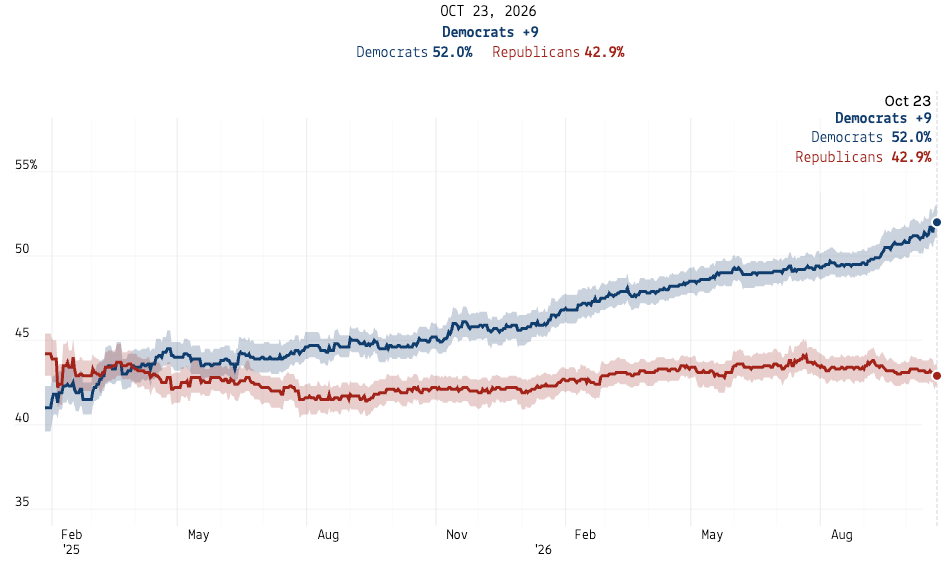
2026 U.S. House generic ballot
The Democratic margin in the 2026 U.S. House generic ballot ticked up a point this week, with Democrats ahead of Republicans by 9 percentage points. Currently, 52 percent of likely voters say they plan to vote for a Democrat in November, compared to 51.3 percent last week, while the percent that say they plan to vote for a Republican fell from 43.1 percent last week to 42.9 percent this week.
Trump’s job approval
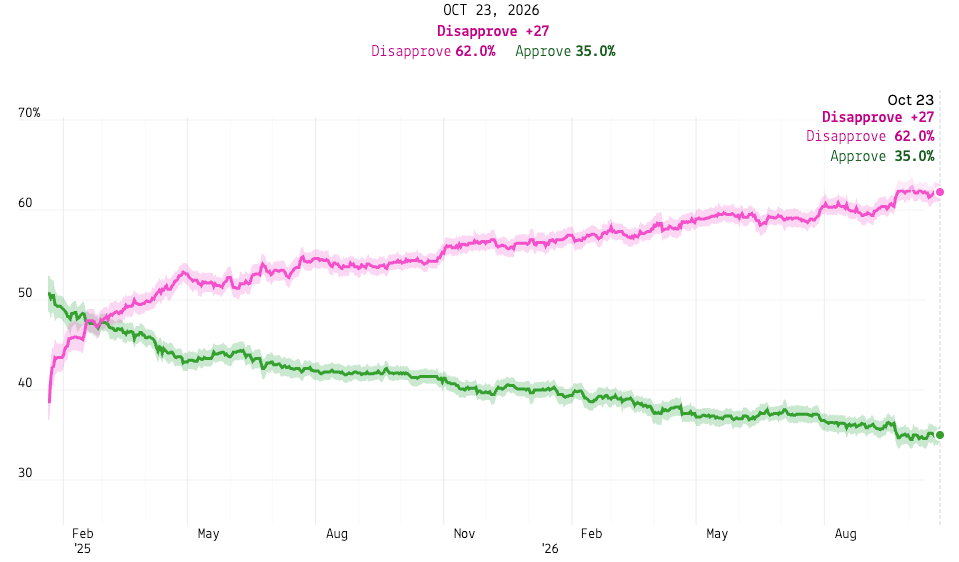
President Trump’s net approval rating among U.S. adults dropped a point this week to -27 percentage points. Overall, 62 percent of Americans disapprove of the president’s job performance, while 35 percent approve.
Paid subscribers to 50+1 get access to premium analysis, plus sortable tables and complete data access on our polling website. If you want to follow the 2026 cycle with the best data at your fingertips, become a paid subscriber.