



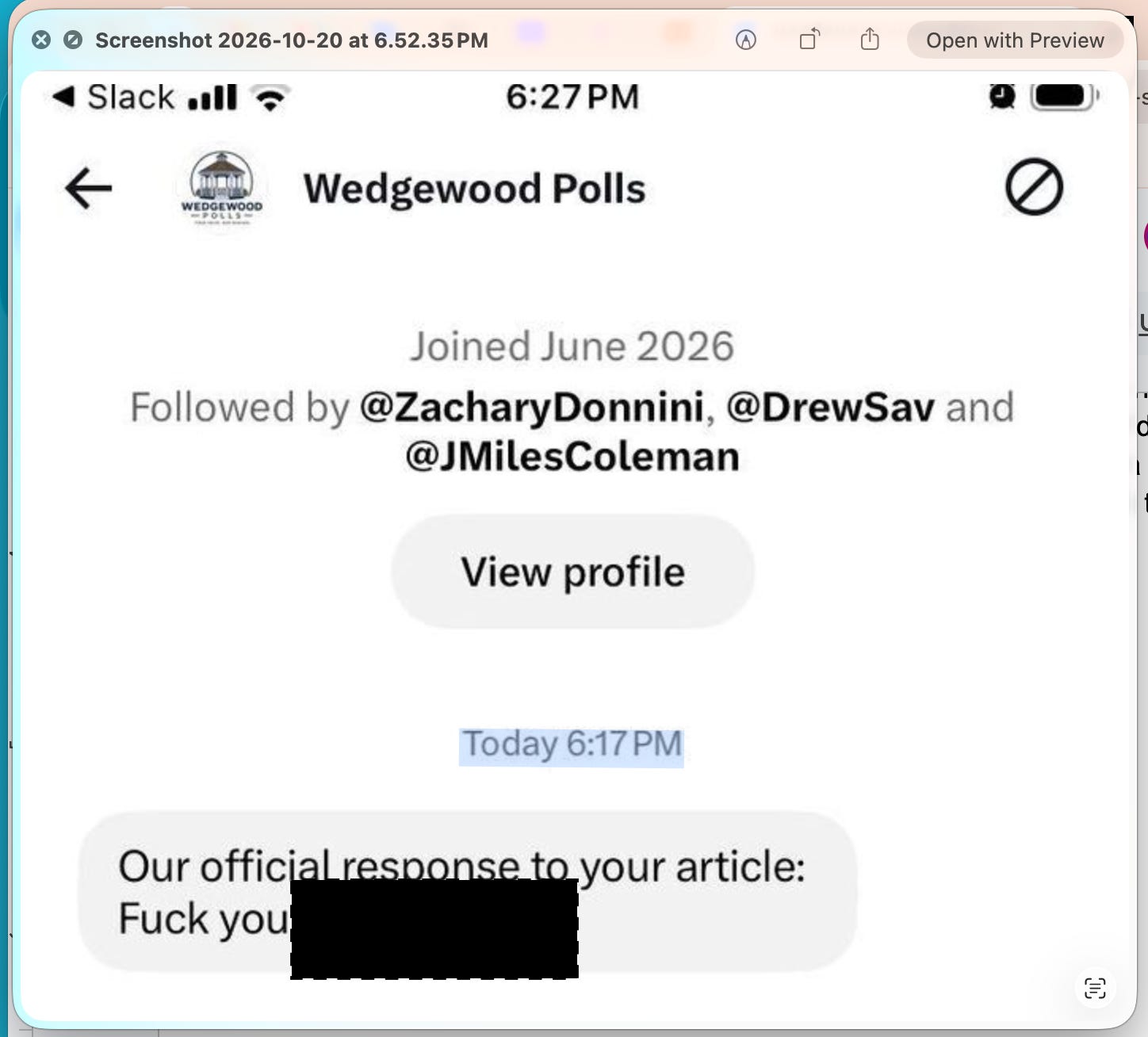
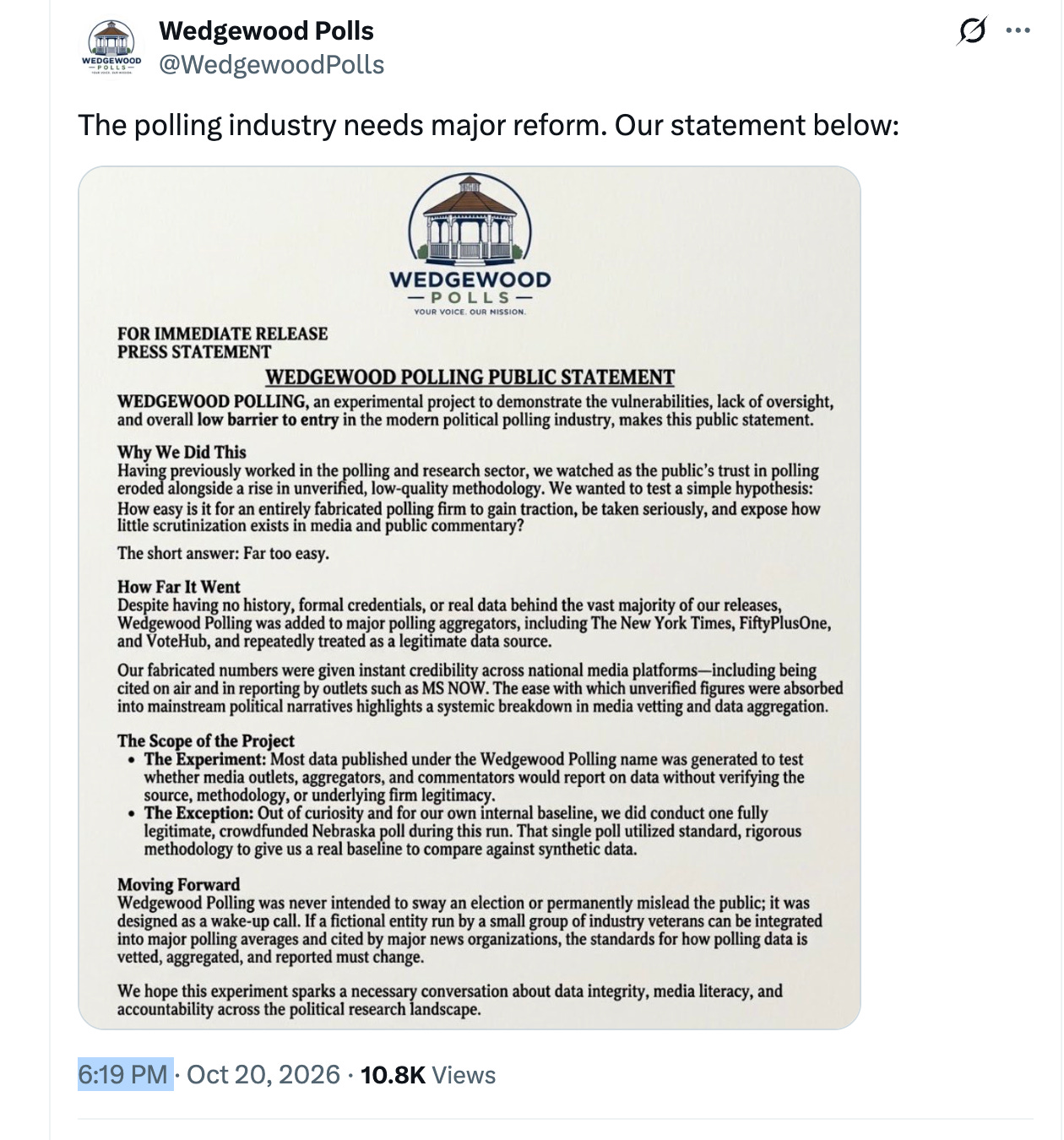
On Tuesday, Oct. 20, FiftyPlusOne reached out to Wedgewood Polls, a self-professed polling firm, with a request for comment on an investigation we had conducted into their alleged survey research. They did not respond to our request, but instead posted a public statement on social media admitting that they had been fabricating data. They also reached out directly in social media DMs minutes before publishing their memo with an official comment: “Fuck you,” plus the name of an individual not affiliated with FiftyPlusOne.
Their statement alleges that FiftyPlusOne, the New York Times, and other poll aggregators did not conduct appropriate vetting of their firm prior to aggregating their polls; this is false. We reached out to them to ask who they were and confirm the methodology statement on their website. We were given two names, Jack Sims and Andrew Prater. We were able to independently confirm that Sims had previous experience in the polling industry and reviewed their methodology statement in detail. It is not atypical for a pollster to leave an existing firm, form their own, and self-fund some surveys to build reputation; we had no reason at the time to believe this case was any different. Wedgewood operated as if it were a legitimate polling firm, including collecting money from donors to conduct crowd-funded polls, and sharing raw survey data (which we now have confirmed was fraudulent) with FiftyPlusOne on Oct. 19, 2026.
Below is the article that we intended to publish tomorrow, Oct. 21, 2026. We had given Wedgewood until midnight to respond to our questions. We have lightly edited the piece to acknowledge Wedgewood Polls’ admission of guilt.
Paid subscribers to 50+1 get access to premium analysis, plus sortable tables and complete data access on our polling website. If you want to follow the 2026 cycle with the best data at your fingertips, become a paid subscriber.
Original story
GONE are the days when all pollsters interviewed voters by phone or on their doorstep. Seeking to lower costs, many legitimate pollsters now interview respondents through online survey platforms that recruit real people — through web ads, rewards sites, and pop-ups inside mobile apps and games — to answer surveys. Many platforms maintain pools of respondents who take surveys on many topics in exchange for small rewards.
FiftyPlusOne recently used one of these platforms, Pollfish, to conduct a survey of the 2026 U.S. Senate race in Mississippi between incumbent Republican Sen. Cindy Hyde-Smith and Democratic challenger Scott Colom. We paid $900 for 600 interviews (an insanely cheap deal; this would cost at least 10 times as much if bought from other providers with whom we are familiar) completed over four days in October. Everything went as expected, and the platform was, in fact, remarkably easy to use. The data frankly does not look very high quality, but we don’t actually care about how accurate it will be at predicting the next election.
Yes, you read that right: We don’t care about the results of the poll we paid for at all! Rather, we conducted this survey entirely to gather evidence for an investigation into the authenticity of a new and prolific upstart polling firm, Wedgewood Polls.
You need to know about two important columns in the raw polling data Pollfish provided us. First, it contains a column labeled “ID” that serves as a unique identifier for every person who fills out polls on Pollfish; and second, a column named “transid”’ (the “transaction” identifier) that corresponds to the actual survey interview a person is completing. As far as we can tell, the transid is just the interview number relative to all other interviews this platform has ever conducted, numbering in the billions.
And here are two important facts about this data. First, in FiftyPlusOne’s data from this vendor, the ID variable for a person appears as a roughly even mix between a standard string of numbers (e.g., “1234567890”) and a string of numbers prefixed by a hyphen (e.g., “-1234567890”). Second, the transaction identifier correlates almost 1:1 with the time a person submitted their survey. We confirmed with Pollfish that this is the expected behavior of these columns, and verified that data from another pollster who has used the platform also produces patterns that match ours.
However, the respondent and transaction IDs recorded in survey data that Wedgewood provided to FiftyPlusOne do not match these expected patterns. Wedgewood told us it conducted a recent poll of the Mississippi Senate race using the same survey platform that we tested, Pollfish. However, in Wedgewood’s data, the respondent and transaction IDs do not behave the same way they do in FiftyPlusOne’s data, or in data from the third-party pollster we consulted. Additionally, they do not comport with the descriptions of these columns given to us by the survey platform.
These are just two of many factors that make FiftyPlusOne suspicious of the veracity of the polls being published by Wedgewood. We detailed these concerns to Wedgewood and, they publicly responded indicating that their polls were indeed fake. As a result, we will no longer be aggregating results from Wedgewood Polls or any other polling firm founded or run by Jack Sims or Andrew Prater, the individuals Wedgewood originally told us were behind the firm. Additionally, because the data was fabricated, we have removed their surveys from our database and polling averages. Below, we detail our investigation into this pollster in full.
Reasons we doubt the veracity of Wedgewood Polls
Last week, we received a credible tip from a trusted source that Wedgewood Polls might be faking data. We had received tips about Wedgewood in the past, but this particular tip had something crucial that other reports didn’t: evidence. So we asked Wedgewood to provide us with the raw data from their most recent survey, a Mississippi poll conducted Oct. 12 - 14, 2026, using the Pollfish panel provider. (While we now believe this survey to likely have been fabricated, for ease of reading we will still refer to it as a poll or survey in the following discussion.)
We were already wary of this survey. The poll was released just hours after a prominent race rater, Sabato’s Crystal Ball, had changed its rating of this race from Safe Republican to Likely Republican (somewhat of a surprise to elections watchers) and showed Hyde-Smith up only 4 points over Colom. That’s a notable coincidence.
When we got the raw data from Wedgewood, we found that it was surprisingly clean. For example, the raw, unweighted data was 67 percent white and 31 percent Black, fairly close to what might be a reasonable statewide estimate of around 60 percent white and 37 percent Black. The design effect for the poll, a measure of how much the pollster had to weight the data in order to get a representative sample, was 1.18, which is fairly low. For instance, the design effect for the 2024 Cooperative Election Study among validated voters was 2.4, and in our real Pollfish poll in Mississippi — weighted to the same benchmarks Wedgewood says they used — the design effect was 1.66.
It’s possible, however, to achieve lower design effects by using quotas or other techniques to construct a more representative sample at the time of recruitment. In a recent Strength in Numbers/Verasight poll, which did exactly that, the design effect was just 1.05.
We double-checked with Wedgewood that they didn’t use quotas to create their sample, which could explain the low design effect. A quota is a mechanism by which a pollster can constrain the sample, to ensure the panel provider returns a certain minimum number or percentage of respondents in each demographic group, and appears to be the only way Pollfish allows researchers to control the demographics of the sample during fielding. They said they didn’t, which made the low design effect especially unusual. But we were still left with a question: Was there anything that actually proved the data was fabricated?
That’s when we decided to try to replicate their survey, to the last detail. We programmed an identical survey in the Pollfish panel provider. Since Wedgewood did not use quotas, we didn’t either. We recreated their questions exactly, using the same question wording and responses, to the best of our ability. We purchased 600 panel respondents, at a cost of $900, and waited. In the meantime, we also obtained raw data generated by Pollfish from another pollster who ran a survey in December 2024. That pollster asked to be kept anonymous but regularly conducts public polls across the country. We’ll refer to them as Pollster A.
As the results came in, it became clear that the red flags we had seen in the Wedgewood data were definitely still waving. Our raw sample (which you can analyze for yourself here) was 48 percent white and 48 percent Black, enormously different from the Wedgewood poll. That, combined with the low design effect for the Wedgewood data and their lack of quotas, is suspect, but ultimately not hard proof of wrongdoing.
From FiftyPlusOne’s perspective, rather, the more damning evidence is the respondent IDs and transaction IDs mentioned in the introduction to this piece. Each Pollfish panelist has a unique ID number (standard practice for a large panel provider). Our raw data showed that about half of our respondents’ ID numbers (51.1 percent, to be exact) began with a dash, while zero respondent IDs in the Wedgewood data included a dash. In the data from Pollster A, 48.6 percent of respondent IDs began with a dash.
When we noticed this discrepancy, we asked Pollfish about the dash and what it meant. A customer service representative told us “it’s simply part of the formatting used.” Asked if it would be possible for a survey to have no respondent IDs with dashes, we were told “most likely not, as the IDs are typically generated in a standardized format that may include dashes.”
We also found it suspect that all of the respondent IDs provided in the Wedgewood data contain exactly 9 digits. In our data, 55 percent of respondent IDs contain 10 digits, not counting the dash, and only 41 percent contain nine (the remaining 4 percent are 8 digits are fewer). The data from Pollster A shows nearly the same mix, with 43 percent of IDs nine digits long. If roughly four in 10 real Pollfish IDs have nine digits, and they are pseudo-randomly selected for a survey, the probability that all 511 of Wedgewood’s would, by chance, be exactly nine digits is effectively zero (less than 10-170), even under generous assumptions. Combined with the absence of dashes, the respondent IDs in Wedgewood’s file do not look like any Pollfish data we have seen.
In addition, Pollfish provides another identifier for each respondent, the transaction id, referred to in the raw data as the “transid.” This identification number records that a particular respondent actually completed a particular poll. Two of the columns included in the Pollfish data are when each respondent started and finished the survey. And when we compare those columns to the transid, a clear pattern emerges.
In our data, the transid correlated nearly exactly to the time the respondent completed the survey (Spearman correlation coefficient of 1.0), indicating that these values are likely assigned sequentially to respondents as they complete surveys. In the data provided by Pollster A, we also saw a correlation between the transid and the time the respondent completed the survey (Spearman correlation coefficient of 0.94).
In Wedgewood’s case, however, the transid appears to be completely independent of the time the respondent completed the poll. While the FiftyPlusOne data and the data from Pollster A had correlation coefficients between the transid and the time of completion both over 0.9, the Wedgewood data had a Spearman correlation coefficient of -0.03, indicating essentially no correlation between the two values. This is illustrated in the graphic below.
We asked Pollfish about how the transid is generated. A customer service representative said that “the transID may appear to correlate with the order in which respondents complete the survey, but we can’t guarantee that it will always follow chronological order.” This may explain the slight variance in the data from Pollster A, but does not account for the total lack of correlation in the data from Wedgewood.
Moreover, we can do a little math on the transid values themselves to get a feel for when a poll was conducted. In the data from Pollster A, generated in December 2024, the transid values were around 2.703 billion. In the FiftyPlusOne data, generated in October 2026, the values were around 3.228 billion. This suggests that roughly 770,000 survey responses are generated on Pollfish every day. The transid values provided by Wedgewood were around 3.16 billion, which, based on this approximation, would place the survey sometime around July 2026. The FiftyPlusOne survey entered the field the day after the Wedgewood poll was completed, but the transid values are 67-68 million larger than those found in Wedgewood’s data. It is simply not plausible that a panel that appears to typically yield fewer than a million respondents per day suddenly completed over 60 million responses overnight.
All of these discrepancies together make us suspicious of Wedgewood’s data and require an explanation. On Monday, Oct. 19, we reached out to Wedgewood asking for more raw data from their other polls. We reached out again on Tuesday, Oct. 20 for comment about these discrepancies. In response to our request, Wedgewood issued a public statement admitting their data was fabricated.
It’s getting easier to conduct low-quality polls — or fake them altogether
When Wedgewood first began publishing polls in June, we reached out to the pollster, as is our practice, to ask about who they were and their background in polling. We were told that the organization was a bipartisan team, including Republican Jack Sims and Democrat Andrew Prater, and were provided information about their funding sources and methodology. Sims had previously worked for other pollsters that met our standards, which we independently confirmed, and the methodology statement on their website appeared to be industry standard.
This was sufficient information for us to aggregate the surveys at the time; as we have previously written, polling is fundamentally an industry built on trust. When we are provided information that is similar to information we have received in the past from real polling firms, it is impossible to know at the time that it is manufactured. A pollster leaving one firm to create their own is standard practice, so there was no reason for us to suspect that anything was amiss. In the past, we have trusted that pollsters are fielding real surveys, because we cannot independently verify every single poll that enters the field is real.
But the wrongdoing we have uncovered on the part of Wedgewood Polls is just the most recent in a series of cases of pollsters manipulating and fabricating data. Earlier this year, FiftyPlusOne found a small firm in Florida that admitted to manipulating respondent-level data so results matched the pollster’s independent assessment of the race. In another case, one individual told The Guardian this summer that he outright fabricated polling results in multiple races as part of a “social experiment” about how social media is quick to pick up any “polling” data, regardless of its legitimacy.
This may have been the case with Wedgewood, too.
One thing that is apparent after a review by FiftyPlusOne of all of these incidents is that wrongdoing appears to correlate with the use of AI tools to prepare result materials, such as toplines and crosstabs. This is evident, for example, from the shared default font across these firms to the general writing style and cadence of AI-generated content. We’ve archived examples of suspect materials from Wedgewood at this link. Unfortunately, we also know of very real pollsters that use similar tools to produce survey materials, so use of AI in and of itself is not sufficient evidence of wrongdoing.
It is clear, however, based on recent events, that AI-powered tools for generating content such as websites, PDFs, and spreadsheets have made it easier for those willing to act in bad faith to produce potentially bogus documentation of results that match the quality of those produced by legitimate research firms. As a result, going forward, we intend to apply more rigorous screening for new pollsters — including meeting them in real life or via a video call, and potentially reviewing firms’ microdata — to hopefully avoid problems like this in the future.
Footnotes
Wedgewood responded to our inquiry via Twitter/X direct message two minutes before publishing their official statement.
Original vetting email sent to Wedgewood Polls by FiftyPlusOne, along with their response:

I am really worried about the future of the polling industry tbh. Stuff like this makes people lose faith and trust in polls.