



Welcome to The Trendline, the FiftyPlusOne.news weekly polling roundup. Subscribe to get it delivered straight to your inbox and get bundled access to our polling website.
We’re just about 80 days from the 2026 midterm elections, and voters are starting to tune into the race a bit more. Much of the coverage surrounding the midterms so far has focused on each party’s primaries, but that leaves out a crucial demographic that is almost certain to decide ultimate control of Congress in November. With that in mind, this week’s Trendline will take a closer look at independent voters: where they stand ahead of November, and the issues they care most about.
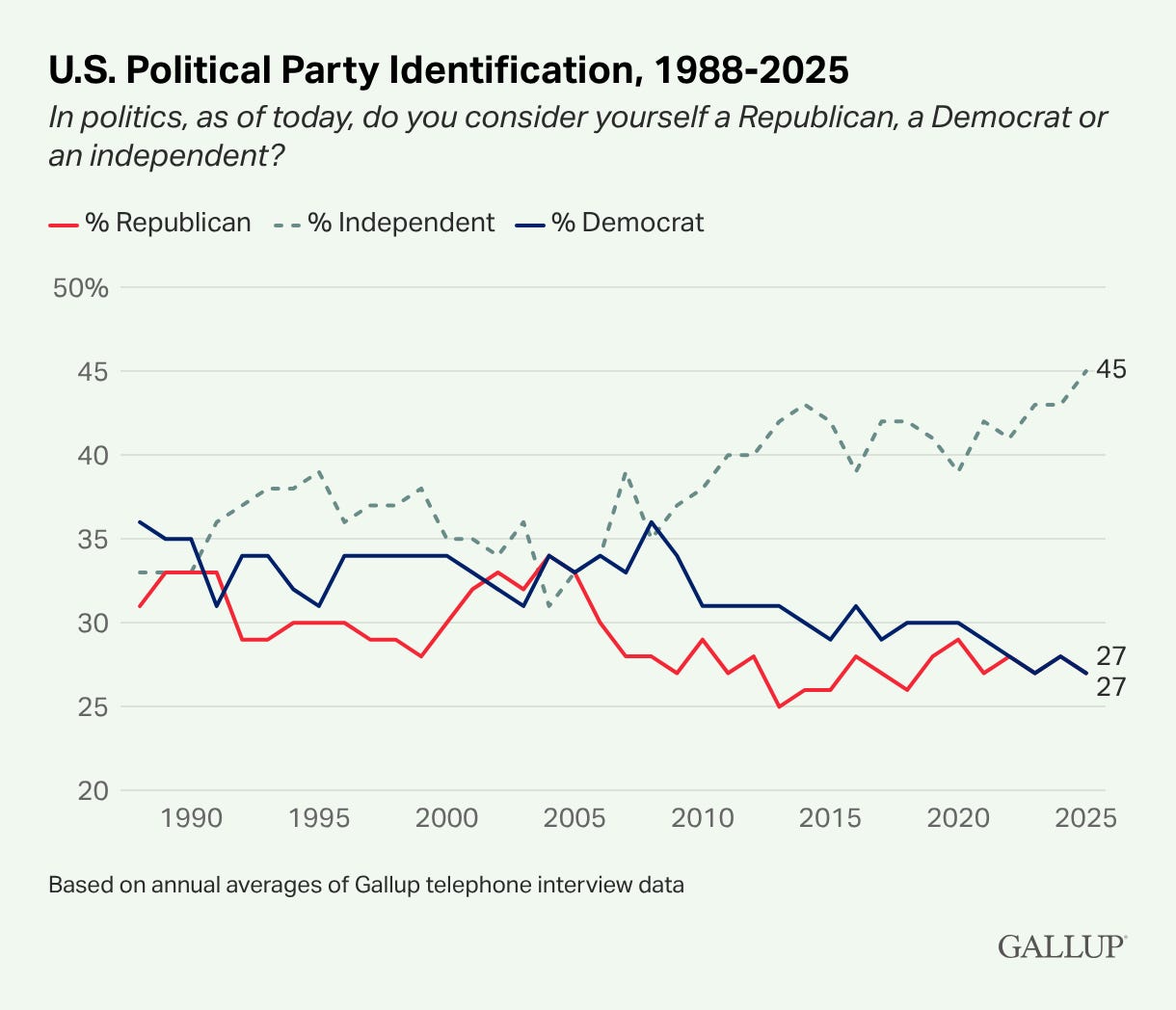
In recent years, the number of Americans who identify as political independents has been growing, according to Gallup’s tracker. Since 2008, the percentage of Americans who consider themselves independent has risen by 10 percent, with a record 45 percent identifying as an independent in 2025. This trend is especially pronounced with young voters; majorities of both Gen Z and Millennials say they are independents, while among Baby Boomers and the Silent Generation, it’s closer to a third.
It may come as no surprise that voters who identify as politically independent have a dour view of the two parties. According to a poll from the Marquette Law School (Jul. 22 - 29, 2026), just 24 percent of “pure” independents (those that say they do not lean toward either Republicans or Democrats) have a favorable view of the Democratic party, and 15 percent have a favorable view of the Republican party. They’re also not so hot on the president: the same poll showed President Donald Trump’s favorability underwater among pure independents by 57 percentage points.
This frustration with political parties manifests in other ways, too. In a CNN/SSRS poll (May 7 - 31, 2026), independents were more likely than partisans to say they didn’t follow politics at all — 14 percent said so, compared to 4 percent of Democrats and Republicans. On the other end of the spectrum, 42 percent of Democrats said they “frequently seek out the latest political news,” a sentiment shared by 39 percent of Republicans and just 25 percent of independents.
CNN/SSRS also found that independents are less likely to be registered to vote, with 67 percent saying they were registered while more than 80 percent of partisans were. And like Gallup, they found independents to be younger than partisans, with 63 percent of independents under the age of 50.
When it comes to how they’re feeling about America, the picture is just as bad as how they feel about the two parties. According to YouGov/The Economist tracking data, 68 percent of registered independent voters say the economy is getting worse, higher than at any time in the last five years since July 2022, and 11 points higher than among registered voters overall. Similarly, 74 percent say that the country is on the wrong track, compared to 64 percent of registered voters overall.
This higher level of dissatisfaction among independents isn’t new, but it wasn’t always like this. During Trump’s first term (and before), independent voters generally looked similar to the nation in terms of their views of the country. But after Biden’s inauguration in 2021, independent voters started to turn more pessimistic than the overall electorate, routinely dragging behind the country on whether things are going in the right direction. After Trump’s second inauguration, they briefly improved their outlook, before dropping below the nation overall once again.
Given this sour outlook, it may come as no surprise that independents are not particularly fond of the president’s handling of his job. Trump’s approval rating hasn’t been above 30 with independents since early March, shortly after the latest conflict in Iran began. (For details on how this average was calculated, please refer to the methodology statement in this article.)
That low rating places Trump’s net approval among independents in his second term roughly 15.5 percentage points lower than his net overall approval rating, which currently sits at -24 percentage points. On average, throughout his second term, his approval rating among independents has been 15 points lower than his topline approval rating, a seemingly new phenomenon in the current political environment.
For example, in Trump’s first term, YouGov/Economist tracking data showed that among registered voters, the absolute difference in Trump’s net approval rating among independents and his overall net approval averaged around two percentage points, and wasn’t consistently higher or lower (his read was better with independents in 100 out of 207 polls, worse in 80, and the same in 27). In August 2018, before his first midterms, Trump’s approval with registered independents was hovering in the mid-40s in YouGov’s data, and never fell below 35 percent in the entire term. In the latest YouGov/Economist poll (Aug. 7 - 10, 2026), Trump’s approval rating among registered independents is 25 percent.
All this dissatisfaction is showing in the generic ballot polling among independents as well. In the last year, the number of independents who say they plan to vote for Democrats has grown by almost five points, and they now prefer a Democratic candidate by just over 15 points. (For details on how this average was calculated, see the methodology statement in this article.)
This 15-point margin, if it holds, is significant. In the 2018 midterms during Trump’s first term, exit polls estimated that independents voted for Democrats by a 12-point margin, and in 2022, they favored Democrats by two points. But there’s still a significant proportion of undecided voters here; even now, less than 100 days before the election, 28 percent of independents remain undecided.
There’s also a chance that a lot of these independent voters don’t show up to the polls at all. In a Change Research poll (Jul. 13 - 17, 2026), when asked to rate how motivated they were to vote on a 10-point scale, just 58 percent of pure independents rated their motivation at eight or above, compared with 89 percent of Democrats and 82 percent of Republicans. Twelve percent of independent voters rated their motivation to vote in November as a 0 out of 10, while just 2 percent of Democrats and 3 percent of Republicans said the same.
Independent voters may be the key to the midterms, with Democrats and Republicans nearly maxed out on their own party bases already. If Republicans can shore up their numbers with independents, they may stand a chance of stemming the blue wave that Democrats are hoping for. But given their general dissatisfaction with the state of the country, it may be a tall order.
Other polling nuggets
NIL isn’t just taking over college sports anymore: In a poll from Ipsos/The Associated Press (Jul. 21 - 26, 2026), 44 percent of parents of school-aged children who participate in sports said that their child earning money for their name, image, and likeness in the future played a role in their decision to enroll them in sports, including 18 percent who said it played a major role. But NIL considerations still aren’t the main reasons parents are enrolling their kids in sports: Around two-thirds said that earning an athletic scholarship or improving their college acceptance odds played a role. Parents are also concerned about potential injuries in K-12 sports — 39 percent of parents said they would encourage their child to play a sport other than football due to concussion concerns, while 35 percent said they wouldn’t and 25 percent weren’t sure.
In a recent YouGov poll (Aug. 6 - 10, 2026), 59 percent of men said that it was important to them to be seen by others as manly or masculine, while 41 percent said it was not important. That number was slightly lower than the share of women who said it was important to them to be seen as feminine (63 percent). Women were also less concerned about being publicly shamed for their gender expression: 22 percent of men in the poll said they worried they would be judged or criticized for acting too feminine, while just 14 percent of women said they worried about being judged for acting too masculine.
While Trump has spent years almost entirely reshaping the Republican Party in his image, GOP voters aren’t necessarily identifying themselves as closely with the president. In the latest Cygnal poll (Aug. 6 - 7, 2026), 54 percent of Republicans said they considered themselves more of a “traditional conservative Republican,” while only 44 percent said they identified more as a “Trump Republican.” On the Democratic side, 61 percent said they were more of a “progressive Democrat,” while just a third considered themselves more of a “traditional Democrat.”
YouGov recently asked (Aug. 11, 2026) Americans how they pack their clothes in a suitcase. Most (58 percent) said they fold their clothes when packing, while 27 percent said they roll them. Clothes-packing experts (because apparently that’s a thing!) generally consider rolling your clothes to save more space than folding, though there are some trade-offs. But regardless of whether you fold or roll, at least you aren’t as chaotic as the 5 percent of Americans who say they just stuff their clothes into their suitcase, or the other 5 percent who say they don’t use a suitcase at all. Whatever gets you to the airport on time, I guess.
Polling averages update
All numbers are as of 1:00 PM Eastern on Aug. 14, 2026.
2026 U.S. House generic ballot
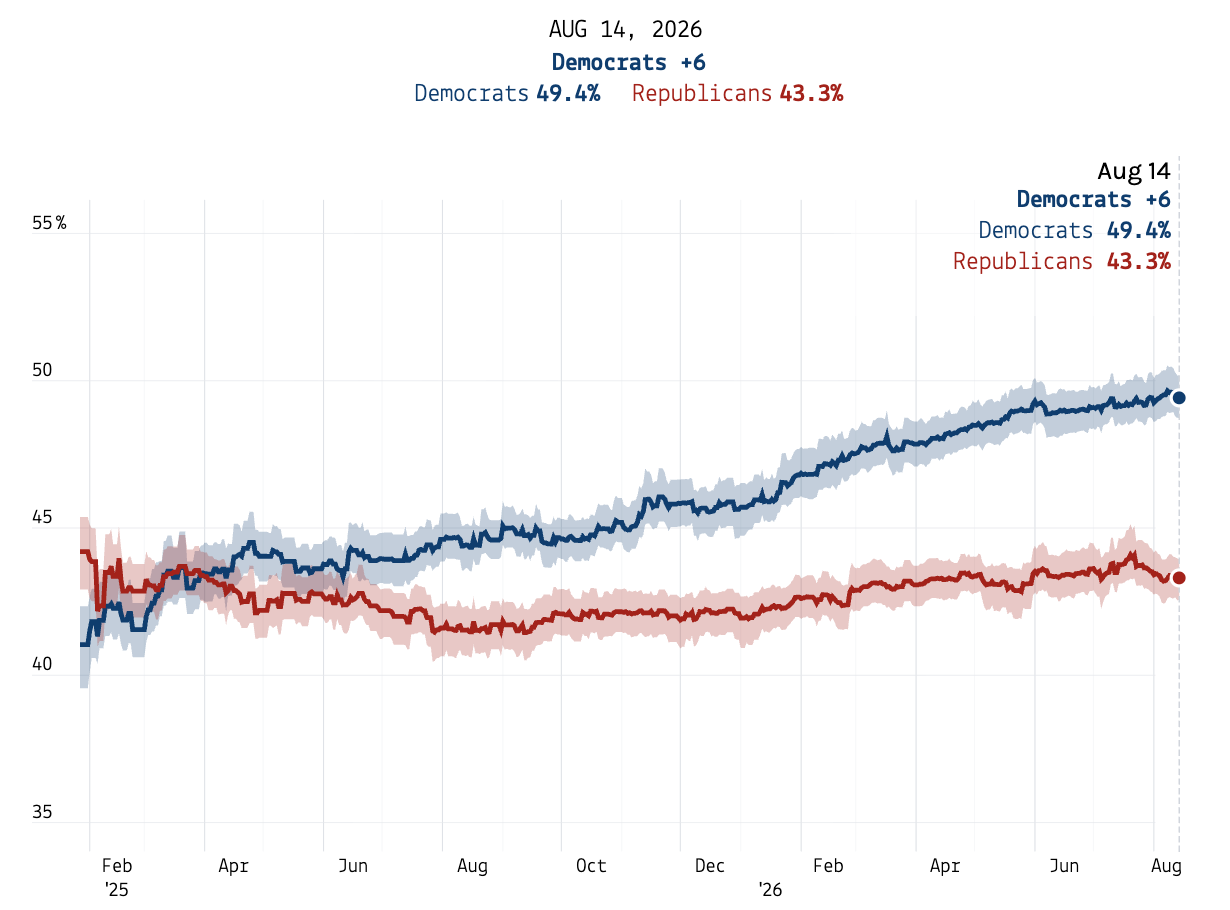
The Democratic margin in the 2026 U.S. House generic ballot rounded to 6 percentage points this week. Both Democrats and Republicans saw some improvement in their numbers, with Democrats increasing from 49 last week to 49.4 this week, and Republicans increasing from 42.5 to 43.3.
Trump’s job approval
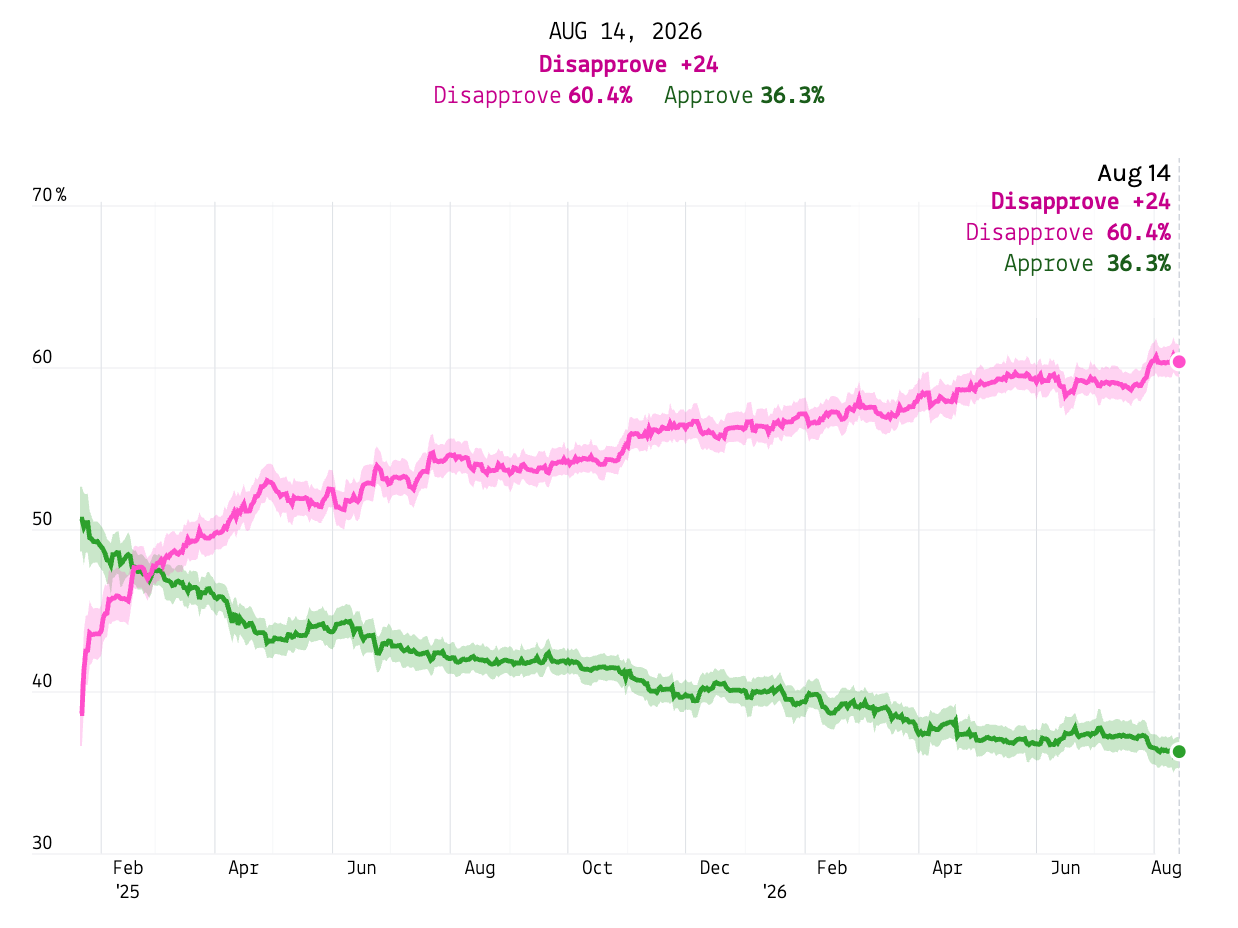
President Trump’s approval rating among U.S. adults fell about a percentage point on net this week from where it was last week. His approval number sank about half a point from 36.3 to 36.8, while his disapproval rating grew from 59.9 to 60.4. He also hit an all time low this week of 36.1 to 60.8 on August 11.
Paid subscribers to 50+1 get access to premium analysis, plus sortable tables and complete data access on our polling website. If you want to follow the 2026 cycle with the best data at your fingertips, become a paid subscriber.