



Welcome to The Trendline, the FiftyPlusOne.news weekly polling roundup. Subscribe to get it delivered straight to your inbox and get bundled access to our polling website.
A recent headline from The Hill caught my eye this week: “Almost 7 in 10 say Supreme Court should keep birthright citizenship in place: Survey.” The survey the article is referencing was released this week by Quinnipiac University, and showed 69 percent of respondents supporting birthright citizenship, while 27 percent were opposed.
I found this startling, because it doesn’t really jibe with the other polling we have on this issue. This turns out to be one of those types of questions where how a pollster writes the survey matters a lot to how people view the issue. So this week on The Trendline, we’re going deep on birthright citizenship, how pollsters ask about it, and what we can glean about Americans’ opinions on the issue.
To set the table, a bit of history. The first sentence of the 14th Amendment to the U.S. Constitution states “All persons born or naturalized in the United States, and subject to the jurisdiction thereof, are citizens of the United States and of the State wherein they reside.” In various court cases, this sentence has been clarified; in 1898, the Supreme Court ruled that the sentence applies to anybody born on U.S. soil, regardless of the immigration status of their parents. (There are some rare exceptions, such as for diplomats and foreign royalty.)
Despite various legal challenges, this 1898 precedent has stood ever since. But in January 2025, President Donald Trump signed an executive order seeking to limit birthright citizenship only to babies born to parents that have either citizenship or permanent legal status in the United States. This order was quickly challenged in court and is one of the final Supreme Court cases that is yet to be decided this term. (We expect a decision next week.)
As with any hot-button issue before the court, we’ve had plenty of polling on whether people agree with the Trump administration here or if they prefer to keep birthright citizenship in place. By and large the polling shows that people support birthright citizenship as currently understood, but the margins vary significantly by pollster. (Note: these are not all the polls we know of that ask about birthright citizenship but a sample to demonstrate the range).
Of course as with many policy issues, a lot of the differences come down to how pollsters word the question. The pollsters that found lower support generally presented the question in a framing that emphasized the legal status of the parents. For example, the YouGov poll, which had the lowest level of support for birthright citizenship at a margin of just 9 percentage points, specified in the question wording that the issue is about undocumented immigrants. They asked if respondents would support “limiting birthright citizenship by no longer giving U.S. citizenship to children born in the U.S. either to undocumented immigrants or to some temporary visitors.” The Data for Progress poll also mentioned the legal status of the parents in the question wording.
The Ipsos/Reuters poll, which also showed relatively low support, framed this question more neutrally: “Do you support or oppose ending birthright citizenship, which makes anyone born in the U.S. a citizen?” But a different type of polling issue was at play here, known as “priming.” Immediately before this question, the survey asked respondents if they “think it’s a good thing or bad thing that children born in the U.S. are U.S. citizens by birth, regardless of the legal status of their parents?” So even though the birthright citizenship question is framed neutrally, respondents were prepared by the pollster to be thinking about the legal status of the parents before the question was presented.
On the other hand, the Quinnipiac survey, which found the highest support for birthright citizenship with a margin of 42 percentage points, presented this question less as a matter of policy and more as a question of legal precedent. Rather than ask about birthright citizenship directly, the pollster asked the following: “The Supreme Court ruled in 1898 that under the U.S. Constitution anyone born in the United States is a U.S. citizen, regardless of their parents’ citizenship. Do you think the court should keep that ruling in place, or reverse it?” This is, in many ways, fundamentally different than asking if voters support birthright citizenship itself and perhaps contributed to the significant difference in the results.
I did find one survey that showed birthright citizenship underwater by 25 percentage points, conducted by McLaughlin & Associates in May. However, the question wording was so biased that I did not feel comfortable including it on this table. The question first told respondents that “the Fourteenth Amendment was written after the Civil War to make freed slaves citizens. Today it’s interpreted to mean any child born on U.S. soil is automatically a citizen — even if both parents entered illegally or came on a tourist visa.” It then asked if respondents agreed with restricting birthright citizenship to babies born to citizens or those with permanent legal status, asserting this is “what the amendment was actually meant to do.” By presenting this language, it’s essentially giving the answer to respondents rather than asking what they think about the issue.
As we saw with questions about who should be deported in the run-up to the 2024 presidential election, voters have complicated views about who should be granted citizenship when you ask more granular questions.
In the AP-NORC survey, asked generally if all children born in the U.S. should automatically be granted citizenship, 65 percent of respondents said yes. But in the same survey, almost half, 49 percent, said that children born to parents in the country illegally should not be automatically granted citizenship. These views mirror what we saw in advance of the 2024 election, when voters simultaneously said they supported deporting all immigrants in the U.S. illegally but opposed deporting undocumented immigrants who didn’t have a criminal record or separating noncitizen parents from citizen children.
All told Americans seem at least somewhat supportive of birthright citizenship, but they’re also a bit wary of providing citizenship to children of illegal immigrants. How pollsters ask these questions makes a big difference in how Americans answer them, so it can be difficult to get a solid read on what exactly Americans think about the issue.
Other polling nuggets
Americans’ faith in the success of the negotiations with Iran will lead to lasting peace. Last week, we noted an RMG research survey that showed 47 percent believe the war will end in the near future. This week, in an Ipsos/Reuters poll (June 18 - 22, 2026), just 18 percent said they thought the preliminary agreement was likely to lead to a lasting peace between the two nations, while 63 percent thought it was not likely. A majority — 52 percent — said that considering the costs and benefits, the Iran war was not worth it while 24 percent said it was.
Every year, the polling company Verasight conducts a survey with questions submitted by attendees at the annual conference for the American Association for Public Opinion Research. This year’s survey was released this week, and it’s full of interesting questions about all kinds of topics including race, AI, and polls themselves. In a question submitted by yours truly, Verasight asked respondents how many Americans they believe approve of the job Trump is doing as president. Our official job approval average for Trump currently shows 37.1 percent of Americans approve of the president; the lowest it has ever been was 36.4 percent in late May. Nevertheless, a majority (52 percent) said they believed less than 35 percent of Americans approve of the president, including 18 percent who said the number was less than 25 percent. Responses, of course, were highly partisan, with 50 percent of Republicans saying they thought over 45 percent of Americans approved of the president, while 73 percent of Democrats said his approval was 35 percent or less.
According to a new YouGov survey (June 18 - 22, 2026), Americans are pretty confident in our ability to do all kinds of things. Seventy percent thought they could pass the U.S. citizenship test, and majorities thought they could perform CPR or the Heimlich maneuver if needed. On the other hand, just four percent of Americans say they think they could beat a chess grandmaster in a single game of chess. Six percent believe that they could pilot a helicopter to a safe landing or hotwire a car in under a minute. Ten percent said they thought they could navigate to a destination using only the stars. And by a 12 percentage point margin, Americans think they could perform a random stranger’s job for a day, 38 percent to 26 percent (another 36 percent were unsure.)
Polling averages update
All numbers are as of 1:00 PM Eastern on June 26, 2026.
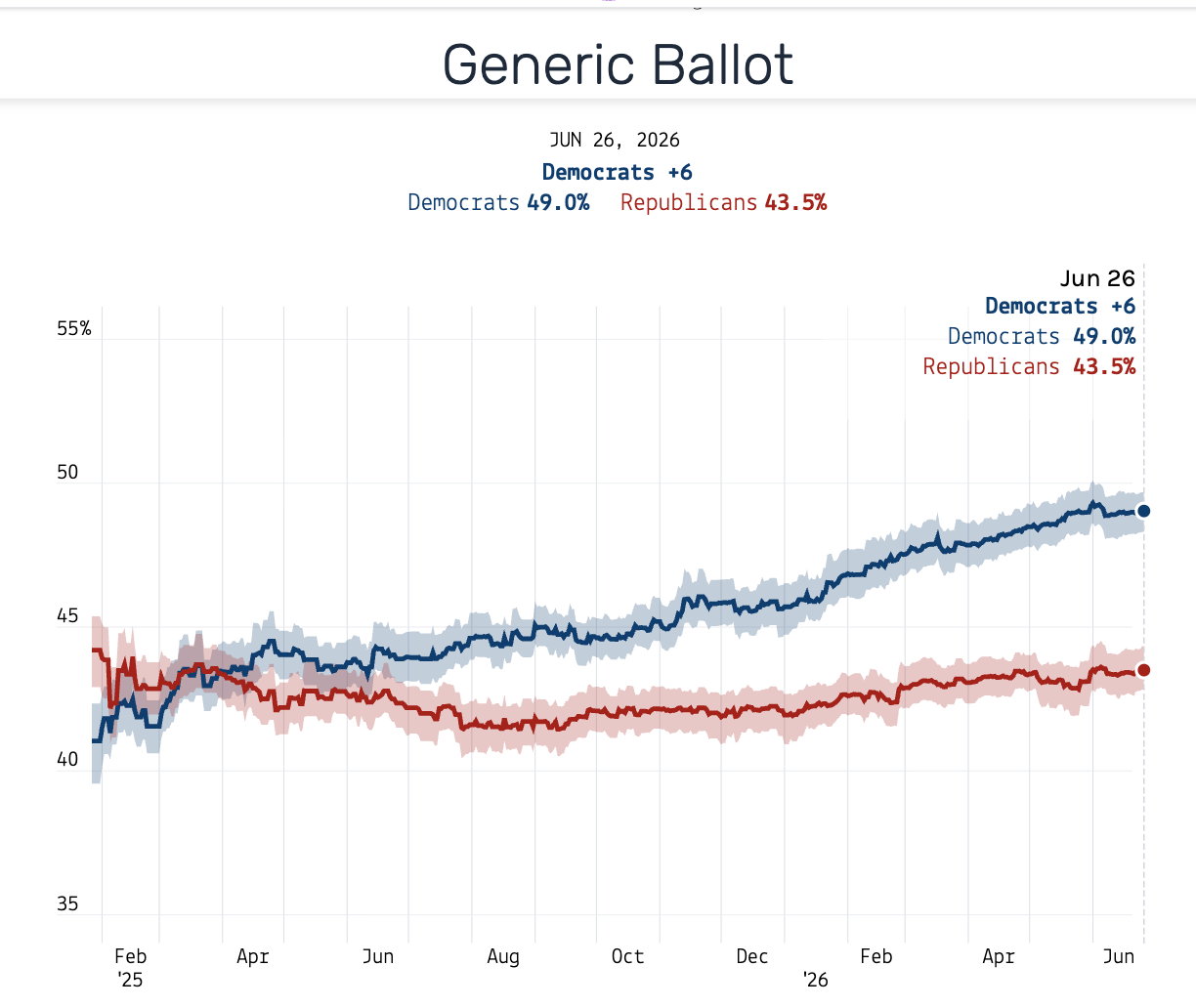
2026 U.S. House generic ballot
The Democratic margin in the 2026 U.S. House generic ballot remained stable this week, rounding to 6 points. And in case you missed it, we made a minor methodological change to how we calculate the average this week.
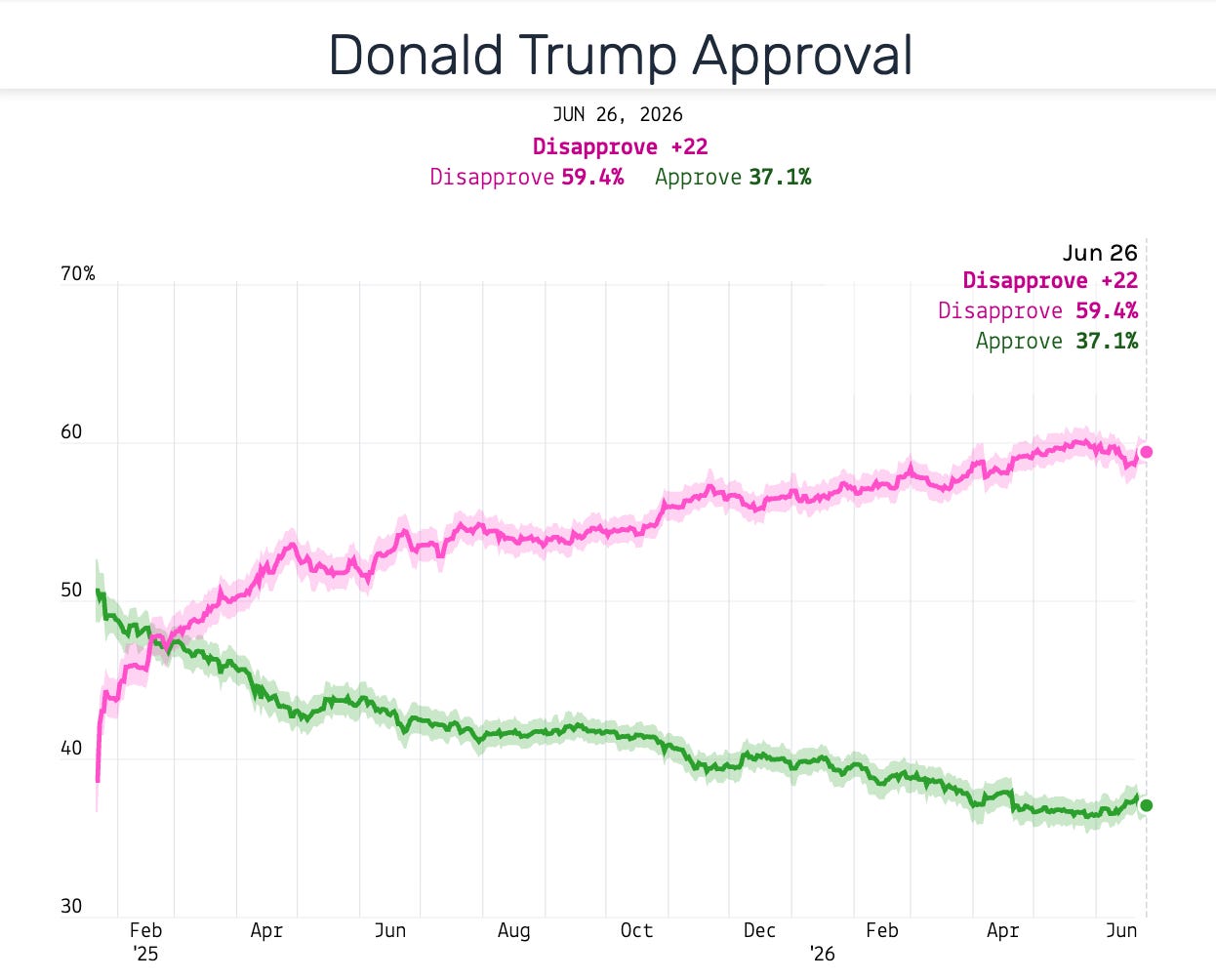
Trump’s job approval
President Trump’s approval rating among U.S. adults moved about 1 point on net this week, with his approval dropping 0.2 percent and disapproval rising 0.7 percent. An average of 37.1 percent of Americans approve of the president, while an average of 59.4 percent disapprove.
Paid subscribers to 50+1 get access to premium analysis, plus sortable tables and complete data access on our polling website. If you want to follow the 2026 cycle with the best data at your fingertips, become a paid subscriber.
That Ipso/Reuters result that says a majority of respondents said the war was worth it - that seems way out of line with any other recent result I've seen. What's up with that?
I'd like to see how many people think that citizens born in this country to non-citizen parents should lose their citizenship retroactively if they already have exercised any rights of citizenship (voting, obtaining a passport, etc.)