



Welcome to The Trendline, FiftyPlusOne’s weekly polling roundup. Subscribe to get it delivered straight to your inbox and get bundled access to our polling website.
On Monday, June 15, 2026, Iran and the United States announced their agreement to a Memorandum of Understanding in the ongoing conflict. This MOU outlines terms for a potential peace agreement and kicks off a new set of negotiations over the next 60 days to finalize that agreement. Republicans on Capitol Hill have had mixed reactions to the agreement, with some expressing concerns about key elements, such as allowing Iran access to $300 billion in reconstruction funds and the long-term fate of Iran’s military proxies.
Today on The Trendline, we’re taking a look at every poll we’ve seen about Iran since this MOU was signed. Admittedly, that’s not very many polls (just three), but it’s our first glimpse into how Americans feel about the MOU and a possible end to the conflict in Iran.
The first survey comes from RMG Research/Napolitan News Service. It began fielding the same day as the announcement was made (June 15), and was in the field for 2 days. In this poll, we see voters expressing optimism about some elements of the deal. Fifty-eight percent said that the agreement to end the war will be good for the United States, while 20 percent said it would be bad for the U.S. and 21 percent were not sure. Even more voters were optimistic about the deal’s impact on the economy; 67 percent said the agreement would be good for the economy, while just 18 percent said it would be bad and 16 percent were unsure.
However, voters were mixed on whether this deal is actually likely to work. After being told that “the U.S. and Iran have announced an agreement to end the war, though some details will be worked out over the next 60 days,” voters were asked how likely it is that the war will “end in the near future.” Just 13 percent said it was very likely to end in the near future, and 34 percent said somewhat likely. Thirty-two percent said it’s not very likely to end, and 9 percent said it’s not at all likely.
All told, that’s 47 percent who think the war is at least somewhat likely to end soon, and 41 percent who think it’s not. So even though voters think the deal will benefit the U.S., both overall and economically, they’re not quite sure things are going to work out during the negotiation period.
The next survey, from Quantus Insights, was in the field the two days following the announcement of the agreement. In this poll voters were told that “the U.S. and Iran recently announced a preliminary agreement to stop hostilities, reopen shipping through the Strait of Hormuz, and begin 60 days of talks on Iran’s nuclear program and sanctions.” They were then asked if they approve or disapprove of the agreement. Approval was overwhelmingly positive — 56 percent said they approved while just 13 percent said they disapproved. Another 16 percent responded that they “neither approve nor disapprove,” and 15 percent were unsure.
Approval of the deal in the Quantus Insights poll is surprisingly bipartisan. While just 10 percent of Democrats in the survey said they approved of how Trump is handling his job as president, 48 percent said they approved of the Iran MOU while 16 percent disapproved. Among Republicans, 66 percent approved of the MOU, and 55 percent of independents approved.
It’s worth noting, however, that the language of the question may have slightly improved approval ratings for the agreement. The question emphasizes specifically two immediate outcomes: “stopping hostilities” and “reopening shipping through the Strait of Hormuz,” without acknowledging some of the elements in the agreement that have caused concerns, like the reconstruction fund. Admittedly, those more controversial elements are yet to be fully negotiated. While the two items mentioned in the question are expected to occur during the 60-day negotiation period, it may have made the situation sound a bit rosier to poll respondents.
And on the nuclear negotiations, there’s a warning sign in this poll. Voters were told “as part of any deal, the U.S. may push Iran to give up, remove, or destroy its stockpile of highly enriched uranium.” They were then asked whether they would approve of the U.S. “making this a condition of the agreement.” Sixty-three percent said they strongly approved of Iran getting rid of its nuclear material being a condition of the agreement, and another 11 percent said they somewhat approved.
This could be a sticking point in any ultimate negotiations. Last July the U.S. bombed Iran’s nuclear sites, burying the enriched uranium deep underground. According to experts, removal of the nuclear material would be extremely difficult. The MOU itself doesn’t necessarily call for removal of the material but states that it should be disposed of with a “minimum methodology to be down-blending on site.” But even that would first require a risky, complicated extraction process. So if 74 percent of the public thinks this should be a condition of the final agreement, they may find themselves disappointed.
The third and final poll we’ve seen since the MOU was announced was conducted by YouGov on June 18. This poll asked Americans whether, if the final deal that was outlined in the MOU is ultimately signed, the U.S. or Iran will be better off than they were before the start of the conflict. In both questions, a slight plurality of Americans agree that both countries will be better off than they were at the start of the conflict, with 31 percent saying so about America and 36 percent saying so about Iran.
However, it’s clear that Americans think this is a bit better for Iran than for the U.S. Five percentage points more said that Iran will be better off if the deal is signed than said the same about the U.S. And by nine points, more said America will be worse off than said so about Iran.
As with many things about American life, there’s a significant difference by partisanship here. Just 12 percent of Democrats said America would be better off, while 45 percent said it would be worse off. Independents also slightly lean toward negativity about the deal: 24 percent said it would make the U.S. better off, while 31 percent said worse off. However among Republicans there’s much more optimism, with 58 percent saying the deal would make the country better off and just 6 percent saying it’d be worse off.
To sum up where we’re at: Americans are optimistic about some of the terms of the deal and approve of it being signed. They see positive outcomes for the economy in the future as a result of the deal. But they strongly agree that we should require Iran to remove or destroy its nuclear material (which could be impossible),think this is better for Iran than for the U.S. (by a slim margin), and aren’t fully sold on whether or not this deal is even going to work. Of course, we’ll keep an eye on the polls in the coming weeks and bring you more Iran polling as the situation develops.
Other polling nuggets
According to the latest YouGov/The Economist poll (June 13 - 15, 2026), a majority of Americans support a constitutional amendment to get rid of the Electoral College. Fifty-six percent said they would support an amendment to choose the president by popular vote, while 23 percent were opposed. Even more popular was a potential constitutional amendment to require a balanced federal budget, which Americans favored 72 percent to 7 percent. Some potential amendments didn’t get Americans’ approval, though, such as repealing the Second Amendment (Americans were opposed 55 to 21), allowing presidents to seek more than two terms (Americans were opposed 70 to 16), and eliminating birthright citizenship (Americans were opposed 53 to 29).
High gas prices continue to cause difficulties for Americans. According to an NPR/PBS News/Marist University poll (June 8 - 11, 2026), 78 percent of Americans said gas prices were putting a strain on their household budgets, with 34 percent saying they’re a major strain and 44 percent a minor strain. The problem appears to be particularly acute for Latinos. While 30 percent of white Americans and 36 percent of Black Americans said gas prices were a major strain, among Latinos that number jumps to a majority of respondents (52 percent). Another 32 percent of Latinos said that gas prices were a minor strain.
Americans have a complicated view of our shared identity, according to a new NBC News/More Perfect poll conducted by Hart Research Associates/Public Opinion Strategies. The poll found a majority (54 percent) of Americans said that “most Americans share the same core values but disagree about policies and issues,” compared to 44 percent who said that “most Americans have fundamentally different core values.” At the same time, though, just 18 percent said there is more that unites Republicans and Democrats while 80 percent said there is more that divides them. But the division may be perceived to be more at the elite level than anything else: 82 percent agreed that “most ordinary Americans, regardless of political party, have more in common with each other than with people in our country who hold a lot of power.”
Have you heard The Secret? Apparently, Americans have. A majority of Americans, 53 percent, said they believed that “thinking positively about desired outcomes can directly turn those desires into reality in the physical world” in a YouGov poll (June 12, 2026). Thirty percent said they didn’t believe it. In the same survey, 44 percent said they believe in ghosts, while 42 percent said they didn’t. And 29 percent said they believed that some people can put curses on others, while 57 percent said they didn’t.
Polling averages update
All numbers are as of 1:00 PM Eastern on June 19, 2026.
2026 U.S. House generic ballot
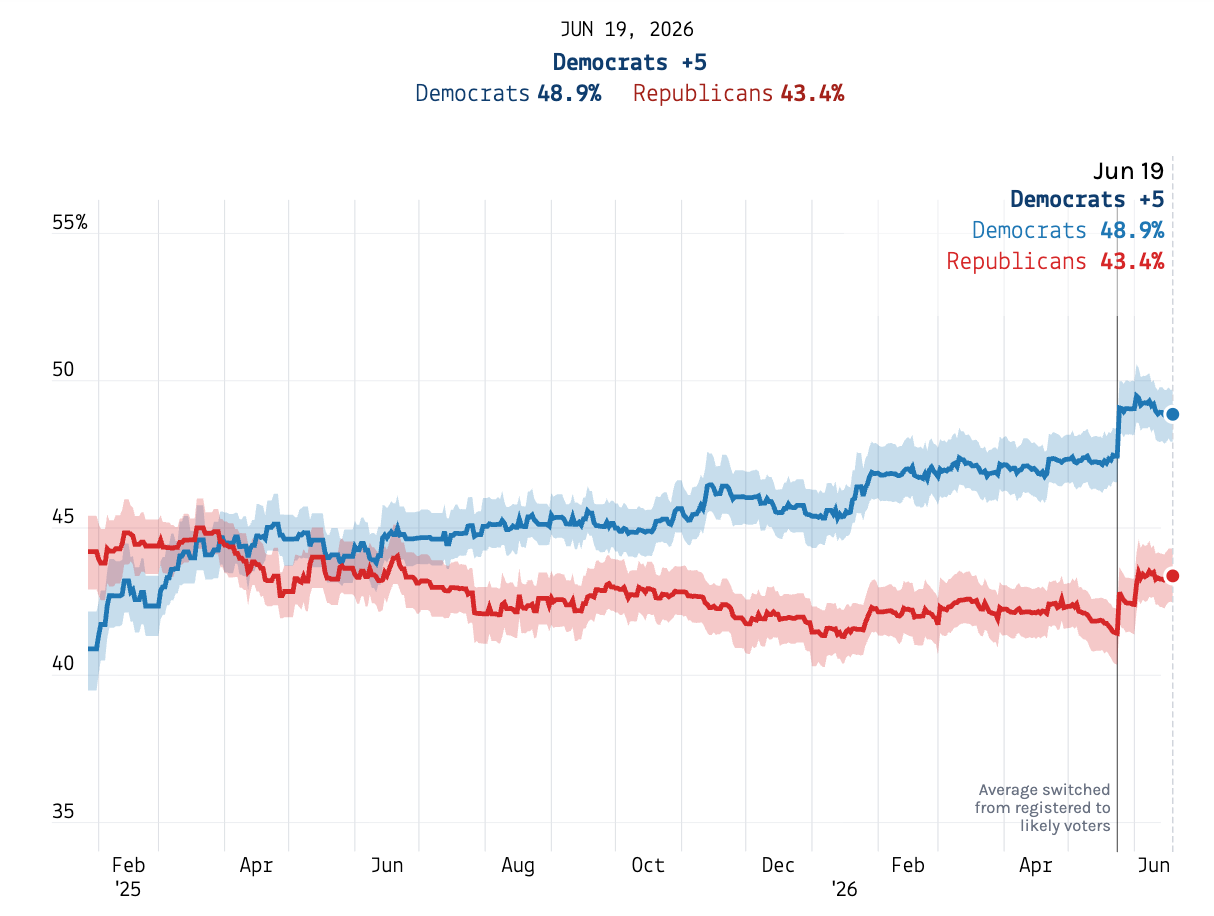
The Democratic margin in the 2026 U.S. House generic ballot rounded to 5 points this week, down from its high of 7 points in late May/early June. About 49 percent of likely voters plan to vote for a Democrat, while 43 percent plan to vote for a Republican.
Trump’s job approval
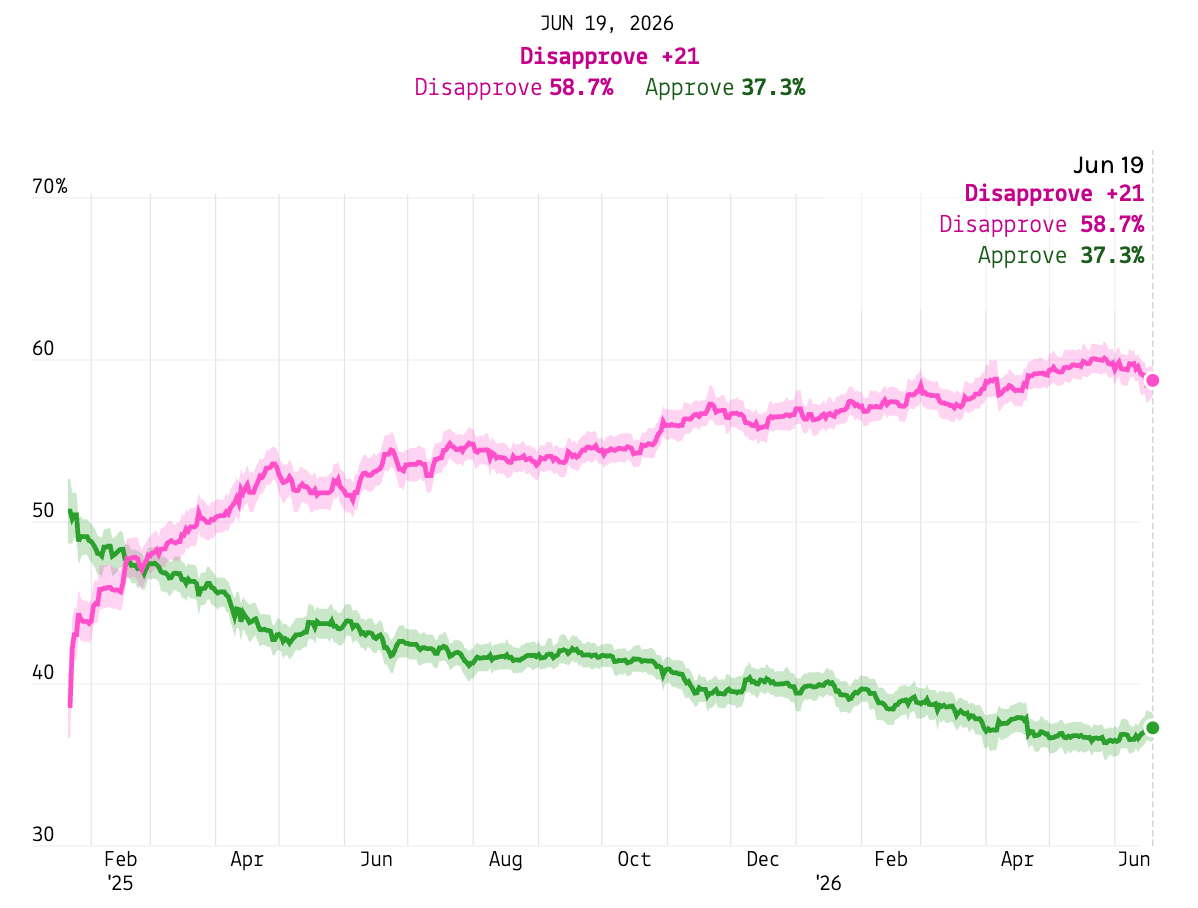
President Trump’s approval rating among U.S. adults has recovered from its lows, improving by about 2 points on net since last week. An average of 37.3 percent of Americans approve of the president, up from 36.6 last week, while disapproval has fallen from 59.6 percent to 58.7 percent.
Paid subscribers to 50+1 get access to premium analysis, plus sortable tables and complete data access on our polling website. If you want to follow the 2026 cycle with the best data at your fingertips, become a paid subscriber.