

Welcome to The Trendline, FiftyPlusOne’s weekly polling roundup. Subscribe to get it delivered straight to your inbox and get bundled access to our polling website.
In the State of the Union address on Tuesday, President Donald Trump made exactly one reference to polls. When discussing the SAVE America Act currently before Congress, Trump said the following:
I’m asking you to approve the SAVE America Act, to stop illegal aliens and others who are unpermitted persons from voting in our sacred American elections, the cheating is rampant in our elections. It’s rampant. It’s very simple. All voters must show voter ID. All voters must show proof of citizenship in order to vote. And no more crooked mail-in ballots except for illness, disability, military or travel. None. And this should be an easy one and, by the way, is polling at 89%, including Democrats, 89%.
So, is it polling at 89 percent? This week on The Trendline, we check in on how Americans are thinking about voting, democracy, and what parts of the proposed legislation they do and don’t support.
Voters are split on how our democratic experiment is going. In a Bowling Green State University/YouGov poll (Feb. 13 - 16, 2026), voters were asked “thinking about the future, how confident are you in American democracy?” Fifty-one percent said they were “very” or “somewhat confident,” while 50 percent said they were “not very confident” or “not confident at all” (rounding causes the numbers to exceed 100 percent). However, on this point, Democrats were more likely to express concern than other political groups: 36 percent of Democrats said they were very or somewhat confident, compared to 40 percent of independents and 71 percent of Republicans.
When it comes to the immediate future, though, voters seem to be feeling a bit better. In an Echelon Insights survey (Feb. 19 - 23, 2026), 63 percent of voters said they were very or somewhat confident that “the 2026 midterm election will be free and fair,” a position shared by majorities across the political spectrum: 69 percent of Republicans, 62 percent of independents, and 56 percent of Democrats agreed. However, in the same poll, partisans don’t really trust each other when it comes to elections. 66 percent of Republican voters said they thought that “Democrats are attempting to steal the 2026 midterm election,” while 77 percent of Democratic voters said the same of Republicans.
And while Trump cites concern about noncitizens casting votes in federal elections, that concern isn’t universal. A study from the Center for Transparent and Trusted Elections (Dec. 19, 2025 - Jan. 12, 2026) found that while trust that votes will be counted accurately has fallen, particularly among Democrats, the sources of that mistrust vary widely. Among Republicans, 51 percent said they had some or a lot of distrust about “people who are not U.S. citizens” casting ballots in elections, but only 11 percent of Democrats did. For Democrats, the greatest source of mistrust wasn’t about ineligible voters casting ballots or improper vote counting, but gerrymandering. Fifty-one percent of Democrats said that they had some or a lot of mistrust due to district lines not being “drawn in a way that fairly reflects what voters want.”
Now, on to proposed reforms. While the president mentioned a number of different reforms in his address, the SAVE America Act does not include all of those items. The key provision of the SAVE Act is to require states to “obtain documentary proof of U.S. citizenship and identity – in person – when registering an individual to vote in a Federal election.” In a Yahoo/YouGov poll (Feb. 9 - 12, 2026), Americans did support the requirement, but not as strongly as the president suggested. Sixty-two percent of respondents said they favor “requiring proof of citizenship – usually in the form of a passport or birth certificate – in order to register to vote,” while 23 percent said they would oppose the requirement. In the Echelon Insights poll, 67 percent of likely voters said that “requiring proof of citizenship to vote” would make the 2026 midterm election more fair, while 24 percent thought it would make it less fair.
And while Trump claimed bipartisan support for the proposal, according to the Yahoo/YouGov poll, that’s just not true. Democrats opposed the policy by 6 percentage points, 45-39, while Republicans supported it by 85 percentage points, 89-4. Independents also expressed support, but far less strongly; they favored the measure by 37 percentage points, 60-23.
Trump also mentioned other voting-related policies, such as limiting vote-by-mail. On this point, Americans don’t seem to agree with the president. In the Yahoo/YouGov poll, 46 percent of respondents opposed making it harder to vote by mail, while 38 percent were in favor. And even fewer supported making it harder to vote early in person: just 21 percent favor the policy, while 57 percent were opposed. In the Echelon Insights survey, 69 percent of likely voters said that “promoting early voting and secure mail-in ballots” would make the midterms more fair, while 20 percent said it would make them less fair – the opposite of what Trump is suggesting.
The most popular voting-related policy Trump mentioned was requiring voters to present identification in order to vote. In the Echelon Insights poll, this policy was the most favorable of all the policies they tested, with 76 percent of likely voters saying requiring ID to vote would make the 2026 midterms more fair, and just 17 percent saying it would make them less fair.
Finally, while it didn’t make it into Trump’s speech on Tuesday, there’s been ongoing chatter, including from the president, about whether the federal government should take over election administration, either nationally or in certain states. Voters oppose this policy strongly: in an ABC News/Washington Post/Ipsos poll (Feb. 12 - 17, 2026), registered voters opposed the policy more than 2-to-1, with 56 percent opposed and 25 percent in favor. Among both Democrats and independents, support was in the single digits, at 4 and 6 percent, respectively. Among Republicans, however, 46 percent supported the idea, with 24 percent opposed. This may be related to question wording, though, as the poll explicitly mentioned that Trump proposed the plan. With Trump’s name included in the question wording, Republicans may be more likely to indicate support than they would without that prompt.
Subscribe to FiftyPlusOne to unlock the full polling experience on our website and get premium analysis that goes beyond the toplines. FPO subscribers get new analysis weekly and help keep the infrastructure for our website running.
Other polling nuggets
According to a new poll conducted by CNN/SSRS after Trump’s State of the Union address this week, just over half (54%) of people who watched the president speak said he was focusing on the right issues. That would be good news for the president, who, polls have shown, voters think is not prioritizing the issues that matter most to them, were it not for the fact that CNN also found this group of speech-watchers leaned politically to the right by 13 percentage points. (The sample size of Democrats in the survey was so small that the pollster was unable to report crosstab findings among them.) Among that already-friendly crowd, nearly half (45%) said Trump focused too little on the economy and cost of living, and just 31% expressed a lot of confidence in him to make living costs more affordable.
CNN’s survey also found that speech-watchers were about evenly split on whether the president’s handling of tariffs was appropriate or an overstep of his powers. State of the Union addresses almost always get watched disproportionately by Americans who already approve of the president — in CNN’s polling dating back to the Clinton era, audience reactions have always been positive — but even grading on that curve, Trump’s 64% positive rating was lower than for the address he gave Congress last year, or Biden’s in his last year in office.A new survey from the Pew Research Center (Jan. 20 - 26, 2026) finds a 50-point partisan gap in who thinks their side is winning in politics — one of the widest Pew has recorded in a decade of asking the question. Six in 10 Republicans and Republican-leaning independents now say their side is winning more often than losing, while just 10% of Democrats say their side is winning — the lowest mark for either party since Pew first asked in 2016. Notably, even during Joe Biden’s presidency, Democrats were more likely to say their side usually loses in politics than to say they were winning.
A new ABC News/Washington Post/Ipsos poll (Feb. 12 - 17, 2026) finds that while about nine in 10 voters who strongly disapprove of Trump say they’d vote for the Democratic candidate in the midterms, among those who only somewhat disapprove of Trump, 46% say they’d actually vote for the Republican candidate, compared to just 32% who’d go Democratic. This is a notable finding, as it suggests 2026 and 2028 could come down to whether Democrats can convert soft Trump disapprovers into actual Democratic voters. Disapproval of the president is a necessary, not sufficient, condition for the other party to win. However, just 10 percent of voters in the survey said they disapprove somewhat of Trump’s handling of his job (48 percent disapprove strongly). That’s a small sample size, so there’s a fairly large margin of error on this result.
How do Americans feel about war with Iran? The latest Economist/YouGov poll (Feb. 20 - 23, 2026) finds that about half (49%) of Americans oppose the U.S. using military force to attack Iran, while just 27% support it. A majority of Republicans (58%) back such an attack, but majorities of Democrats (76%) and independents (54%) are against it, and even the 58% support among the GOP is lower than at the start of past U.S. military interventions. And yet, 58% of Americans think the U.S. military is likely to take action against Iran in the next month. These numbers suggest any military action would carry significant political risk for the administration heading into the midterms.
Finally, from Echelon Insights’ February poll: voters apparently think vaping is bad but marijuana is good. The survey found that voters hold strongly negative views of e-cigarettes and vaping while being broadly supportive of marijuana legalization. Support for marijuana legalization now routinely clears 60% in national polls (Pew recently pegged it at 87% when you include medical-only supporters), while public attitudes toward vaping have soured amid youth health concerns.
Polling averages update
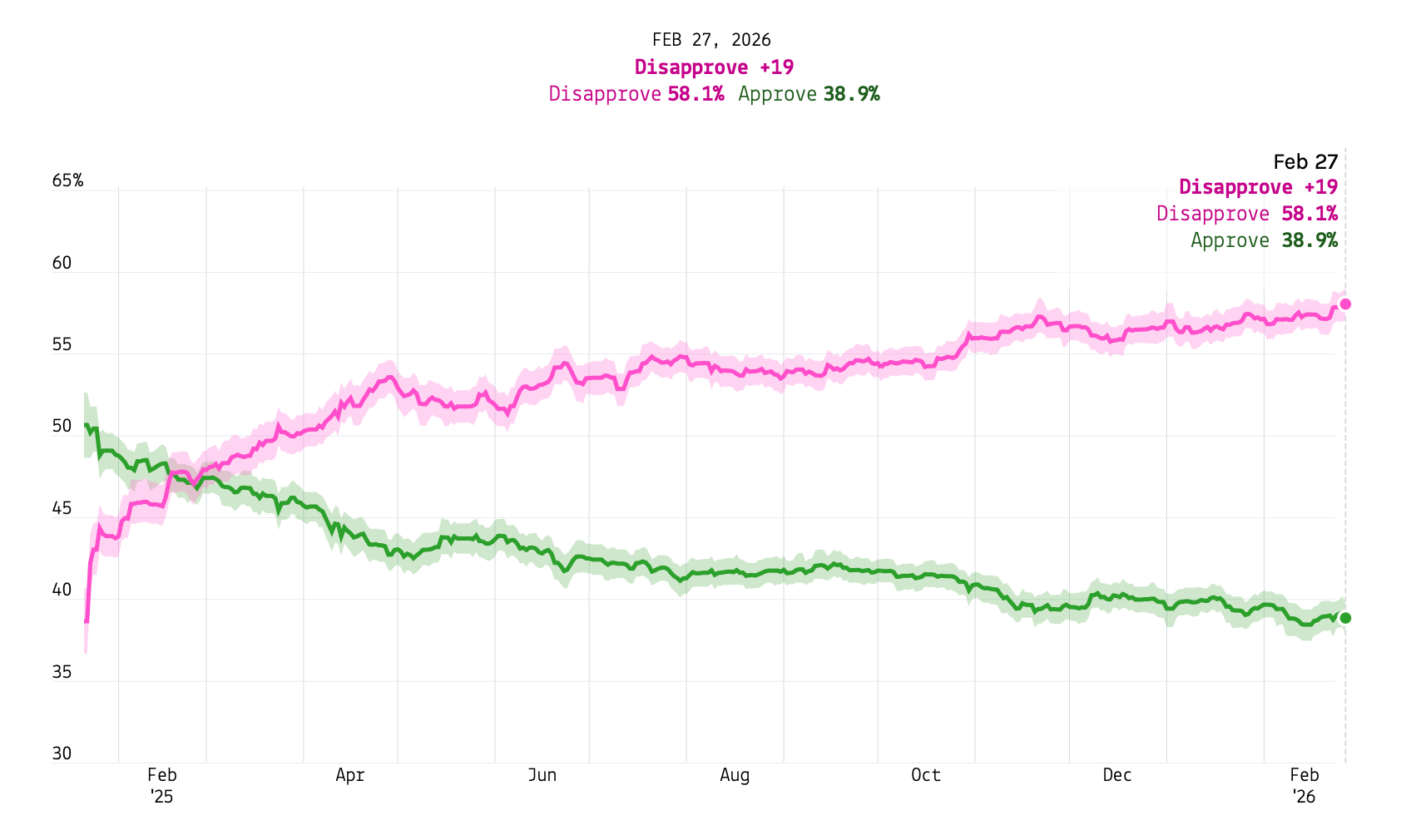
Texas Republican U.S. Senate primary
New polls released this week have pushed Texas Attorney General Ken Paxton up to a 5.3-point lead over incumbent U.S. Senator John Cornyn in the GOP primary for the Lone Star state’s Senate seat. Wesley Hunt trails both candidates, at 19% of the vote. Polls can be wildly off in primary contests, so it’s not impossible that Paxton could win 50% of the vote on Mar. 3 and avoid a primary — but it remains unlikely.
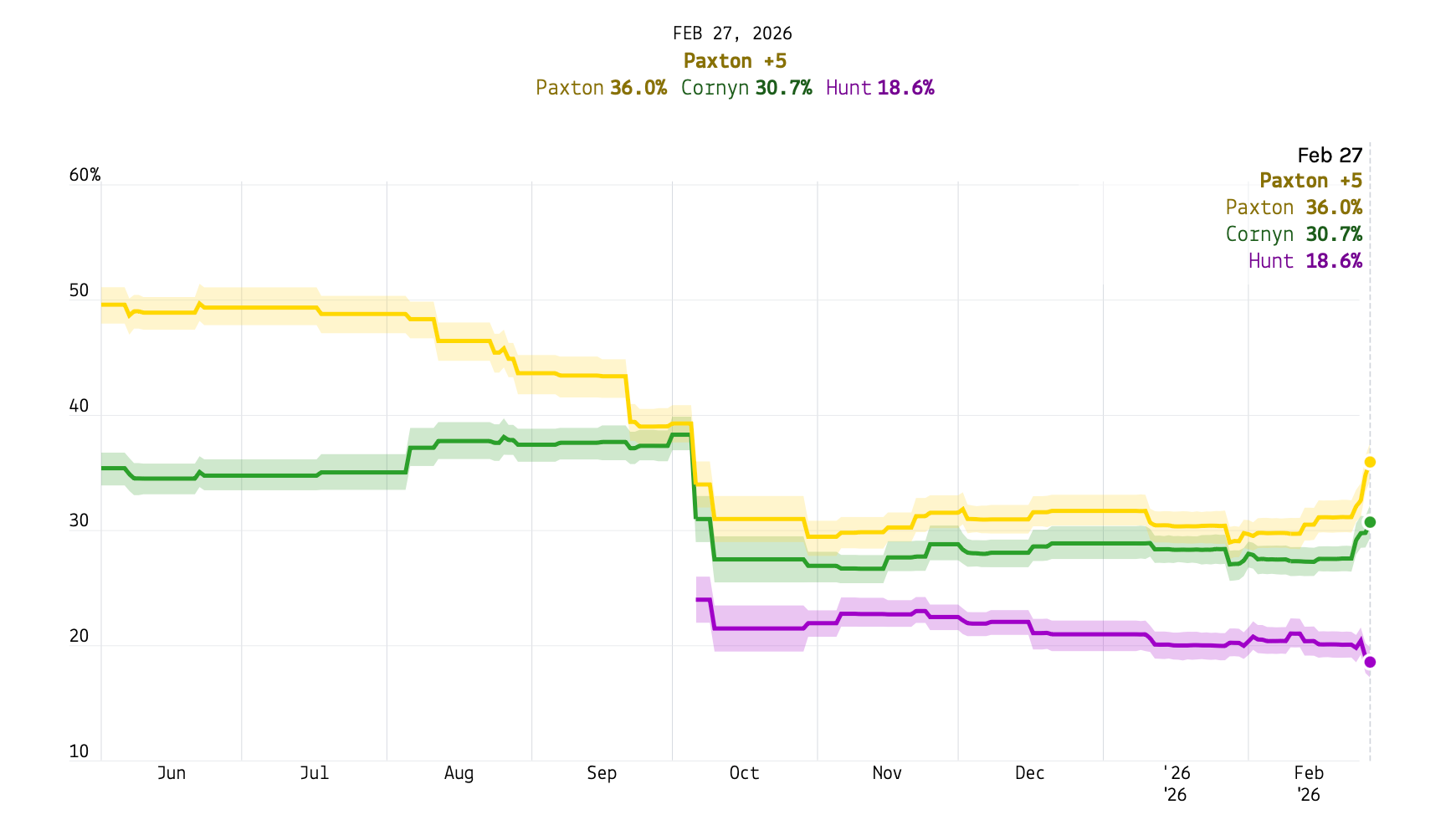
Texas Democratic U.S. Senate primary
On the Democratic side of the race, Texas state House Rep. James Talarico has recently pulled into a small lead against U.S. Congresswoman Jasmine Crockett, with 46.6% of the vote in our polling average vs Crockett’s 43.1%. That lead is within the margin of error and either candidate could win. We calculated that historical statewide primary polls picked the wrong winner in competitive races about 20% of the time.
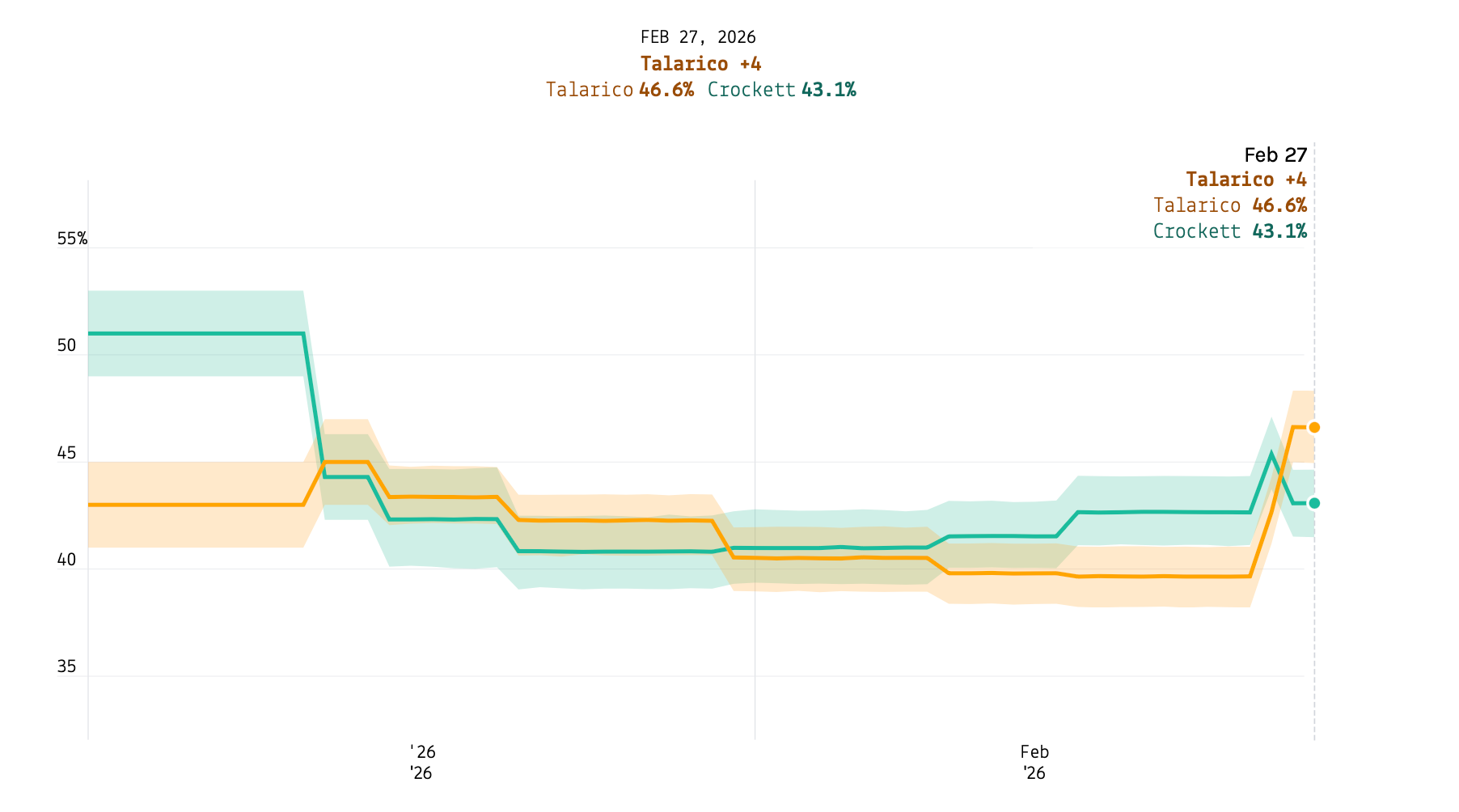
2026 U.S. House generic ballot
Democrats have held their lead on the 2026 U.S. House generic ballot steady over the last week, at about 47% of the vote versus 42% for the Republicans.
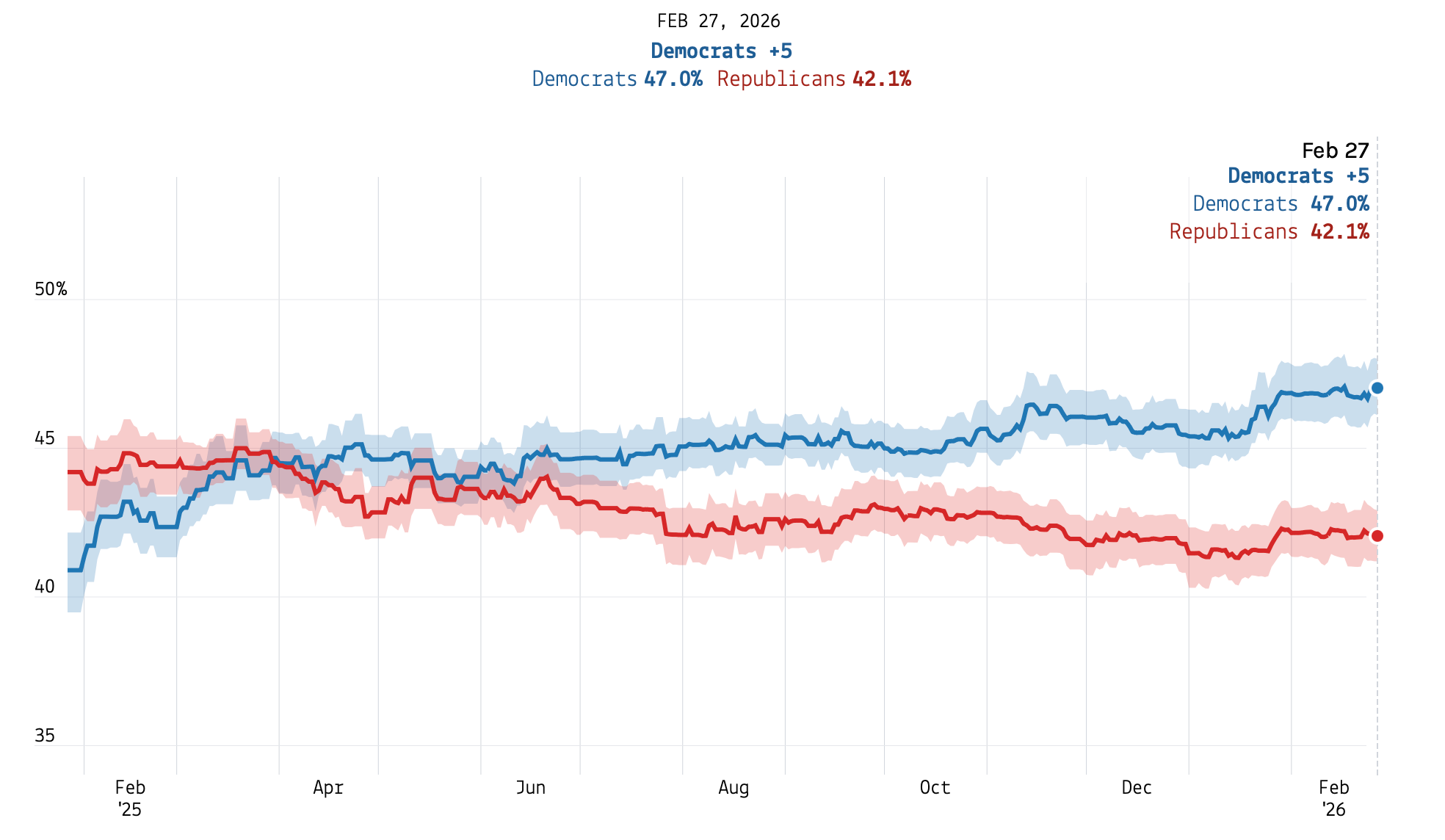
Trump’s job approval
Donald Trump’s job disapproval hit a new high of 58.1% this week, while 38.9% disapprove of him. As of 12:00 PM on Feb. 27.