



Welcome to The Trendline, FiftyPlusOne’s weekly polling roundup. Subscribe to get it delivered straight to your inbox and get bundled access to our polling website.
Primary season is officially heated up, so this week, FiftyPlusOne rolled out new polling averages for several competitive primaries taking place across the country this spring and summer. Here is where a selection of four high-profile contests stand as of April 10, 2026.
California Governor (nonpartisan primary)
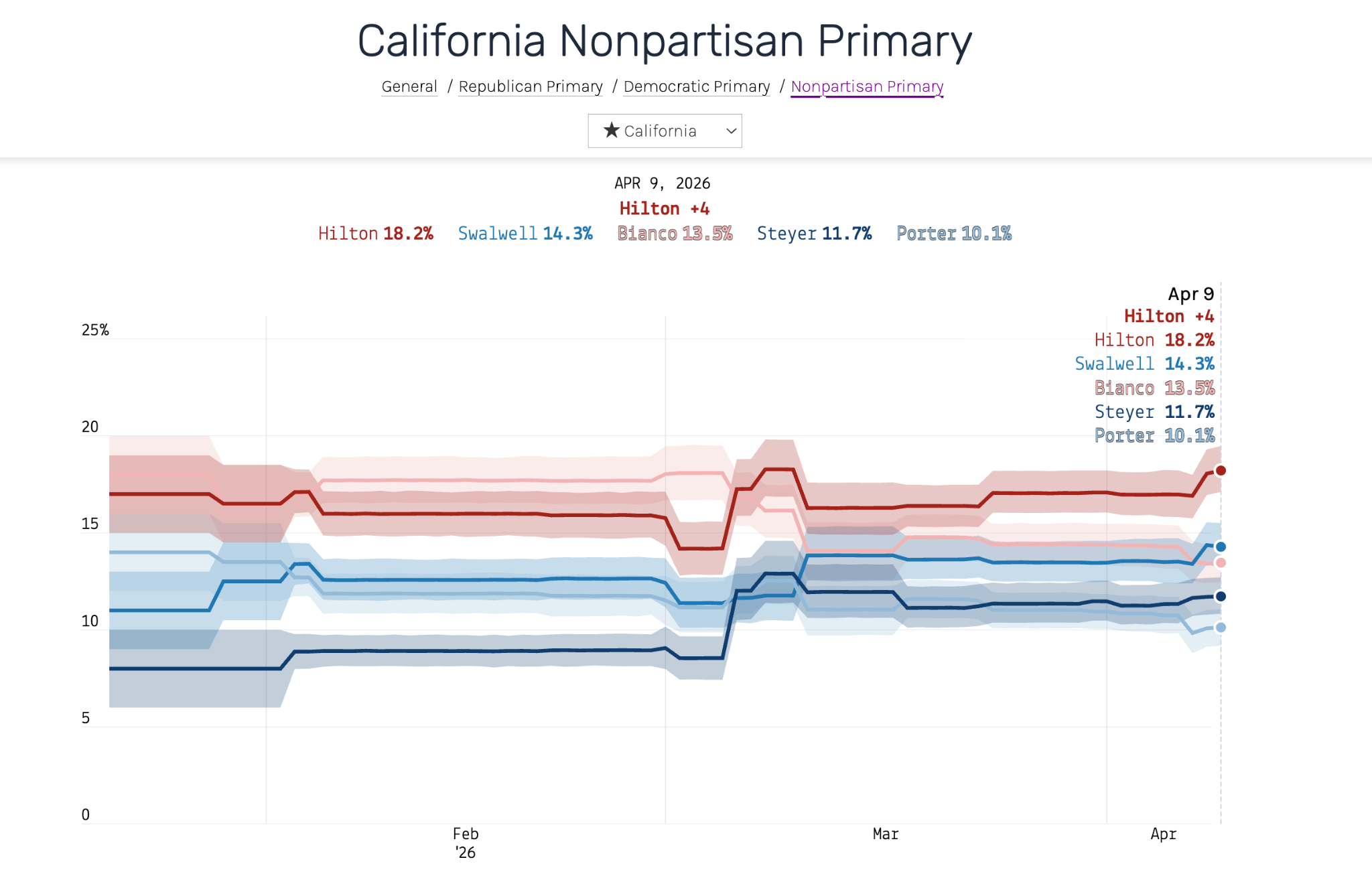
California’s open gubernatorial race — governor Gavin Newsom is term-limited and can’t run again — is shaping up to be a wide-open contest. Because California uses a nonpartisan blanket primary, the top two finishers advance to November regardless of party, making the math particularly complicated in a crowded field. Given close polling today, it is possible that either Democrats or Republicans get “shut out” — meaning a candidate from that party doesn’t make it to the November general.
As of today, Republican political commentator Steve Hilton leads the pack with 18.2 percent of the vote, followed by Democratic Representative Eric Swalwell at 14.3 percent, Republican Sheriff Chad Bianco at 13.5 percent, Democratic businessman Tom Steyer at 11.7 percent, and former Representative Katie Porter at 10.1 percent. Hilton “leads” by just 4 points over the field — much smaller than the uncertainty we have given the time remaining until the election and imprecision of primary polling.
However, Hilton was recently endorsed by President Donald Trump, so it’s possible that he may consolidate more California Republican voters as time goes on. With five candidates bunched within 8 points of each other, predicting who finishes in the top two is genuinely difficult. Moreover, California certified over 60 candidates for the primary ballot, so there’s still time for someone else to rise to prominence.
Texas Republican Senate Runoff
In the Senate primary runoff between Attorney General Ken Paxton and incumbent Senator John Cornyn, Paxton has opened up a meaningful lead: our average has him at 47.7 percent to Cornyn’s 40.6 percent, a margin of +7. Notably, Paxton started the runoff period polling above 50 percent and has since settled back somewhat, while Cornyn has held relatively steady.
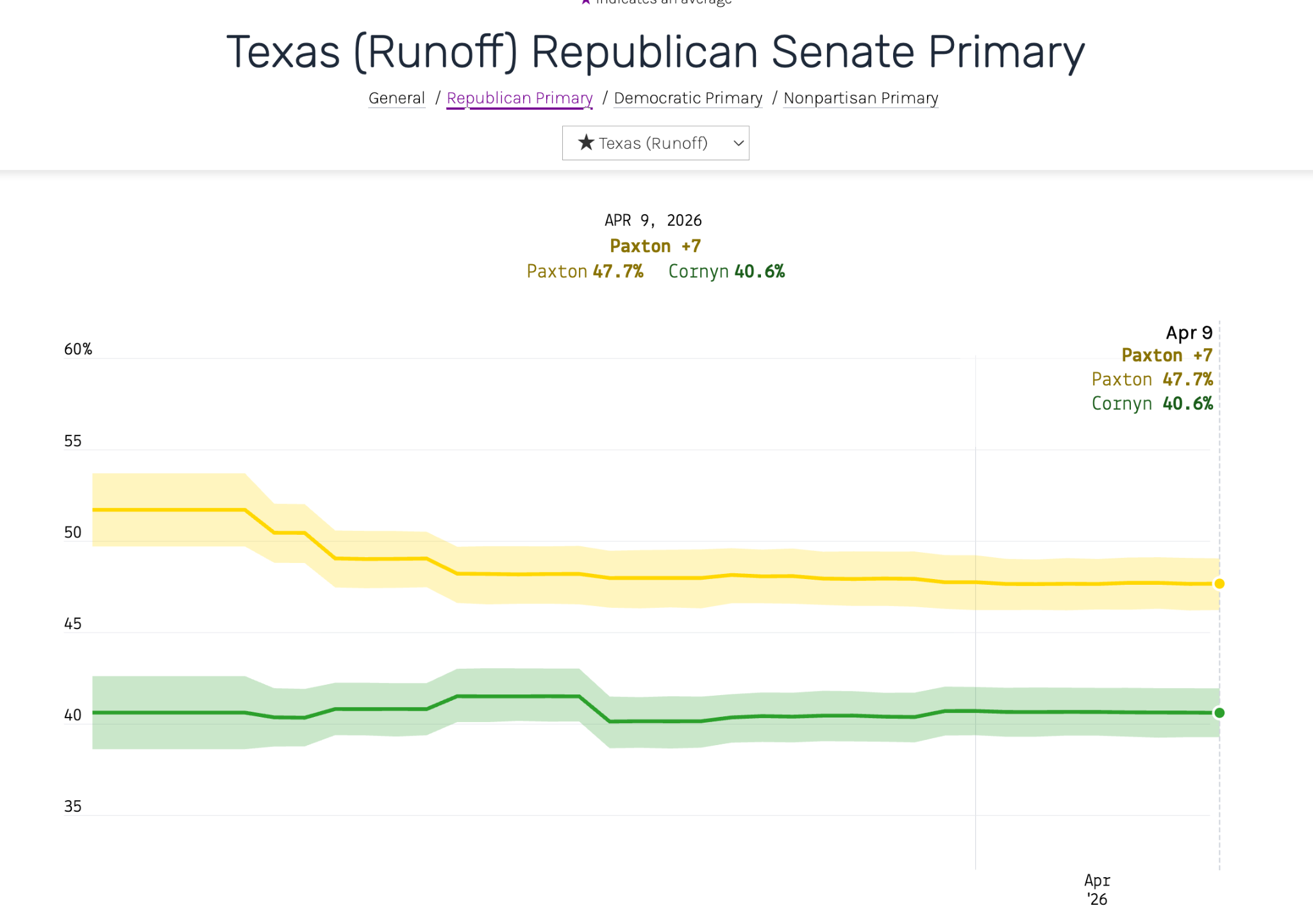
The polls in the first round of this primary underestimated Cornyn by about 7 points, so there is room for him to beat the polls — and Paxton. Polls of the first round also showed Paxton winning more votes from third place and now-eliminated candidate Wesley Hunt, so he should have the better shot to win. But there’s a long way to go until the election in May!
Louisiana Republican Senate Primary
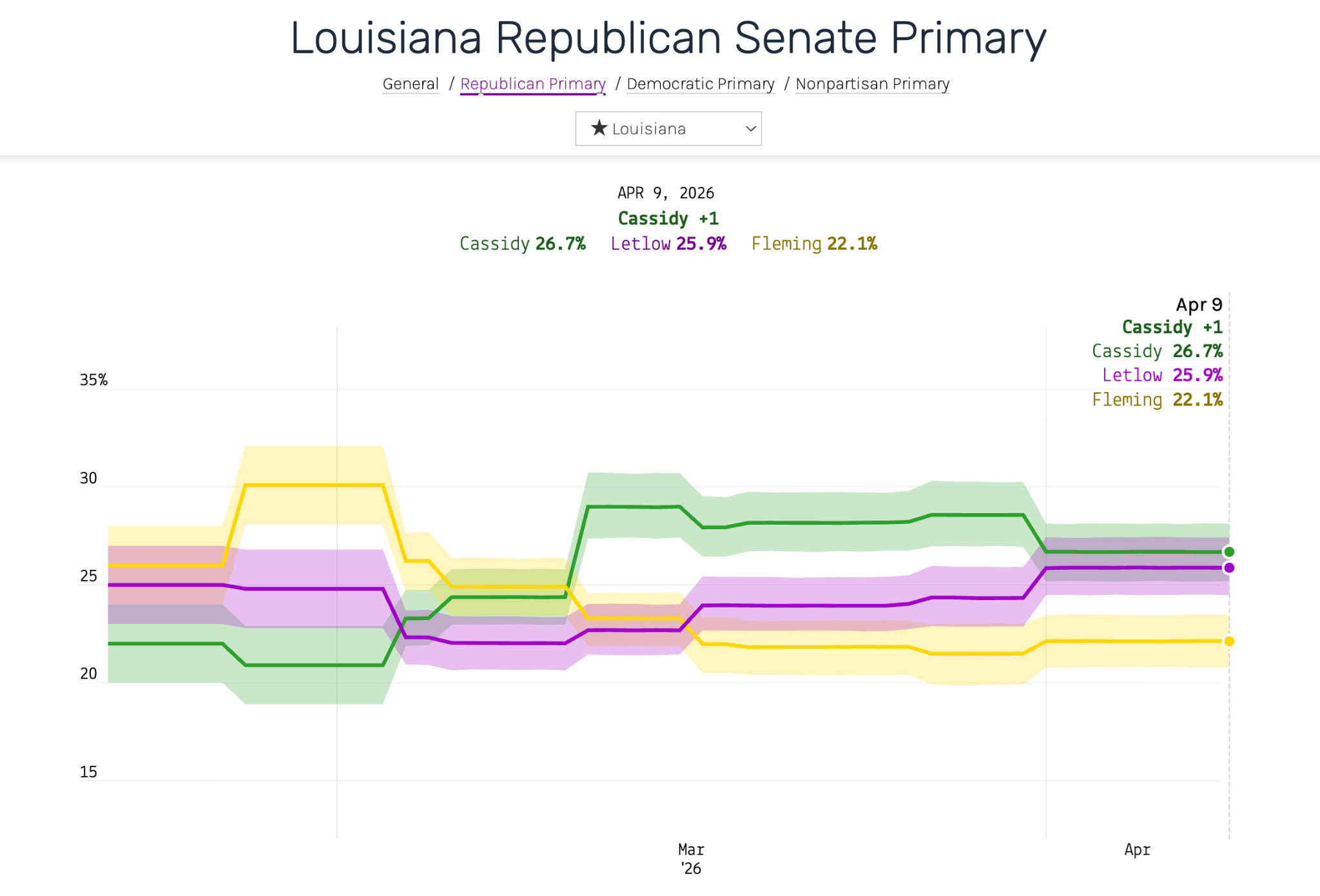
Incumbent Senator Bill Cassidy is running for a third term in Louisiana, but his vote to convict Donald Trump in his second impeachment trial has made him a prime target for the president. Trump and Governor Jeff Landry both endorsed Representative Julia Letlow, who entered the race in January. Louisiana State Treasurer John Fleming, a former congressman and Trump administration official, is also a major contender.
Our average has the primary on May 16 as a genuine three-way race: Cassidy leads narrowly at 26.7 percent, with Letlow just behind at 25.9 percent and Fleming at 22.1 percent — a margin of just 1 point between first and second. The primary is set for May 16, with a runoff on June 27 if no candidate clears a majority. Given the current numbers, a runoff looks likely.
South Carolina Republican Governor Primary
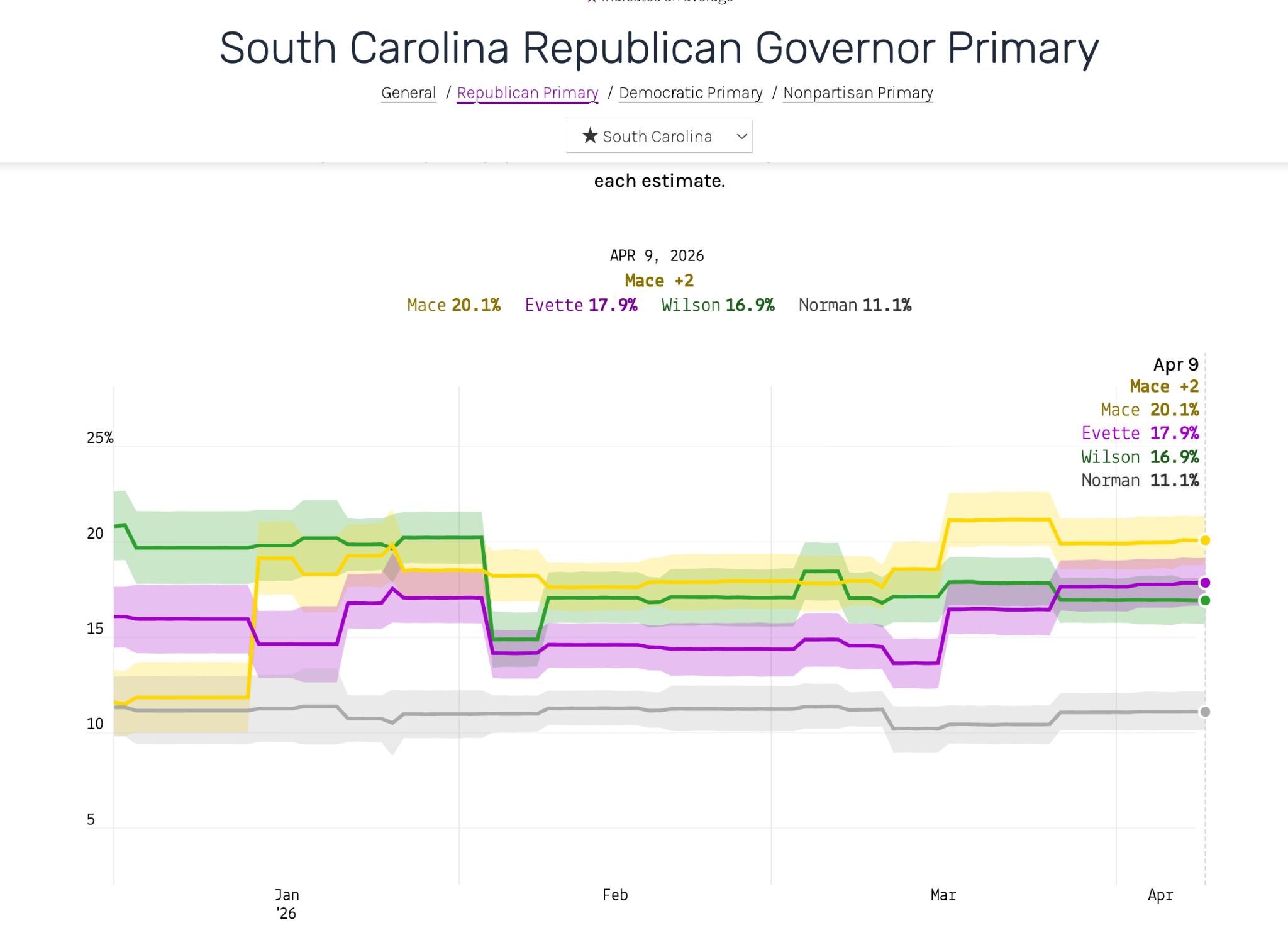
With incumbent Governor Henry McMaster term-limited and ineligible to seek re-election, the race to succeed him has drawn a crowded Republican field. The top four contenders are Lieutenant Governor Pamela Evette, Attorney General Alan Wilson, and Representatives Nancy Mace and Ralph Norman, and the race has become, in the words of one person close to the Mace campaign, “first a race for an endorsement, and second, a race for governor” — Trump has yet to weigh in.
Our average as of April 9 has Mace leading narrowly at 20.1 percent, followed by Evette at 17.9 percent, Wilson at 16.9 percent, and Norman at 11.1 percent — a margin of just 2 points between first and second. The race has been volatile since we began tracking it, with the lead changing hands multiple times. The primary is set for June 9, with a runoff on June 23 if no candidate clears a majority.
A note on methodology: you can read about how we build our averages at fiftyplusone.news/methodology. As we’ve noted before, primary polling is noisy, and our averages should not be treated as definitive (or more definitive than the polling in a race warrants). All four averages will be updated as new polls are released.
Other polling nuggets
Generally speaking, Americans support the U.S. agreeing to a ceasefire in Iran if the nation reopens the Strait of Hormuz. In a YouGov poll conducted the day after the ceasefire was reached (Apr. 8, 2026), 66 percent approved of such a plan, while just 10 percent disapproved. However, one day later, Americans expressed some skepticism: When asked who the ceasefire actually benefits, 29 percent said the ceasefire benefits Iran more than the U.S., while 14 percent said it benefits the U.S. more. Another 27 percent said it benefits both equally, and the rest were not sure.
A growing number of voters are skeptical about government spending. In a Fox News poll conducted by Beacon Research and Shaw & Co. Research (Mar. 20 - 23, 2026), 75 percent of responds said almost all or a great deal of federal government spending is wasteful and inefficient, up from 57 percent at this time last year. And a record 70 percent of respondents told the pollster that their own taxes are too high, the largest percentage to say so since the survey began asking the question in 2004.
While Artemis II makes her way back to Earth, Americans feel positively about the space program and NASA. In an Ipsos poll (Apr. 3 - 5,2026), 80 percent of respondents said they had a favorable opinion of NASA. In addition, 76 percent said the U.S. space programs makes them feel proud. As to long term goals, 59 percent said they thought it was strategically important for the U.S. to establish a long-term presence on the moon, while 37 percent said it was not that important to U.S. interests. (Newt Gingrich must be so excited.)
According to a Pew Research survey (Mar. 23 - 29, 2026), Republican support for NATO continues to decline. Asked how much the U.S. benefits from NATO membership, just 38 percent of Republicans said the U.S. benefits a great deal or a fair amount, down from 55 percent in 2021 and the high 40s in 2025. Independents saw a similar decline: 59 percent said the U.S. benefits a great deal or fair amount from NATO membership, down from 71 percent in 2021 and the mid-60s in 2025. Democrats, however, are holding strong: between 81 and 85 percent of Democrats said that NATO membership benefits the U.S. in every survey Pew has conducted between 2021 and today.
Polling averages update
All numbers are as of 9:00 AM Eastern on April 10, 2026.
2026 U.S. House generic ballot
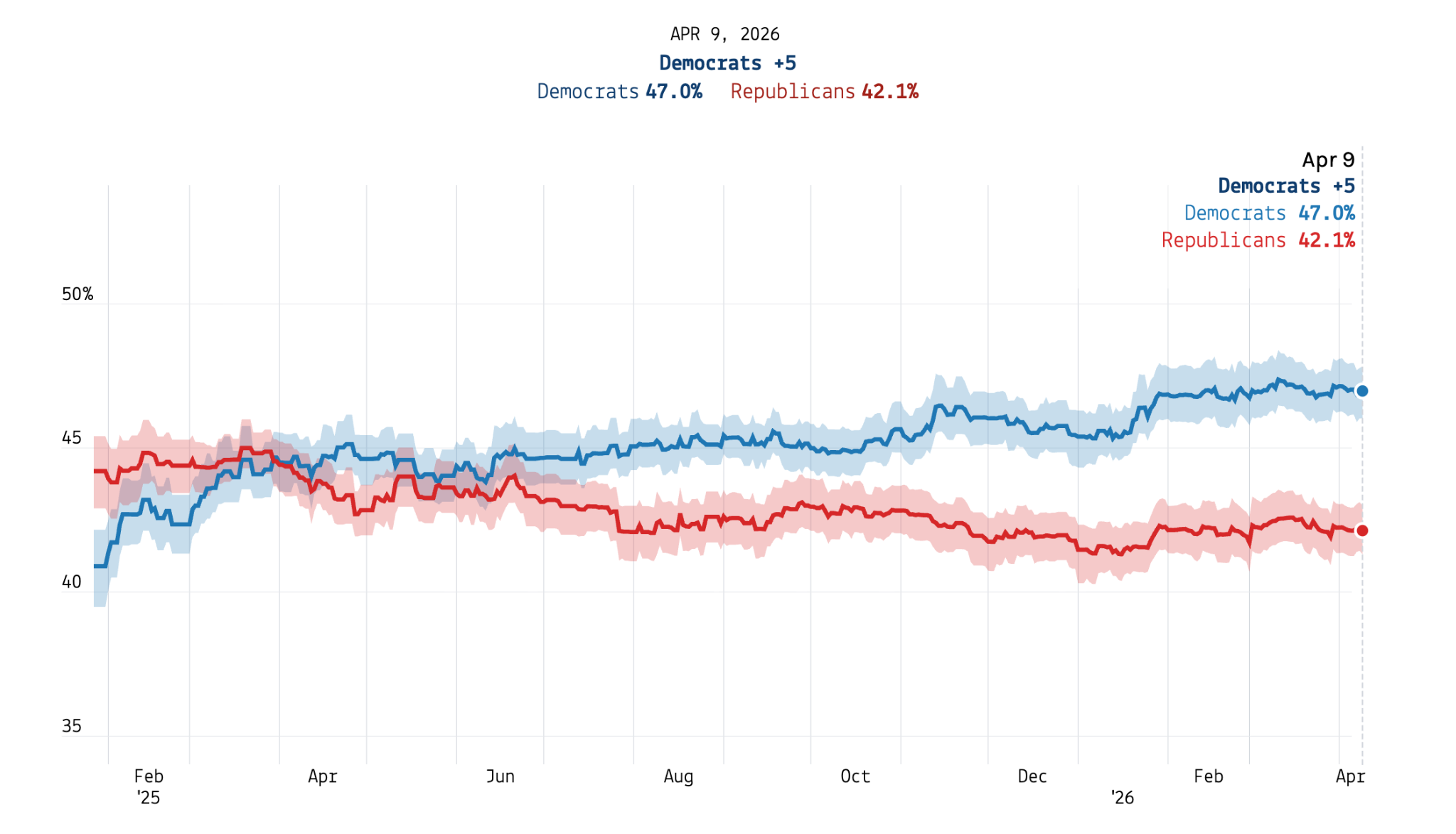
Democrats have held their lead on the 2026 U.S. House generic ballot at +5 (after rounding) over the last week, with no significant change in our aggregate. Today 47 percent of registered voters saying they’ll cast their ballot for Democrats this fall, versus 42 percent for the Republicans. Around 11 percent of registered voters are undecided.
Trump’s job approval
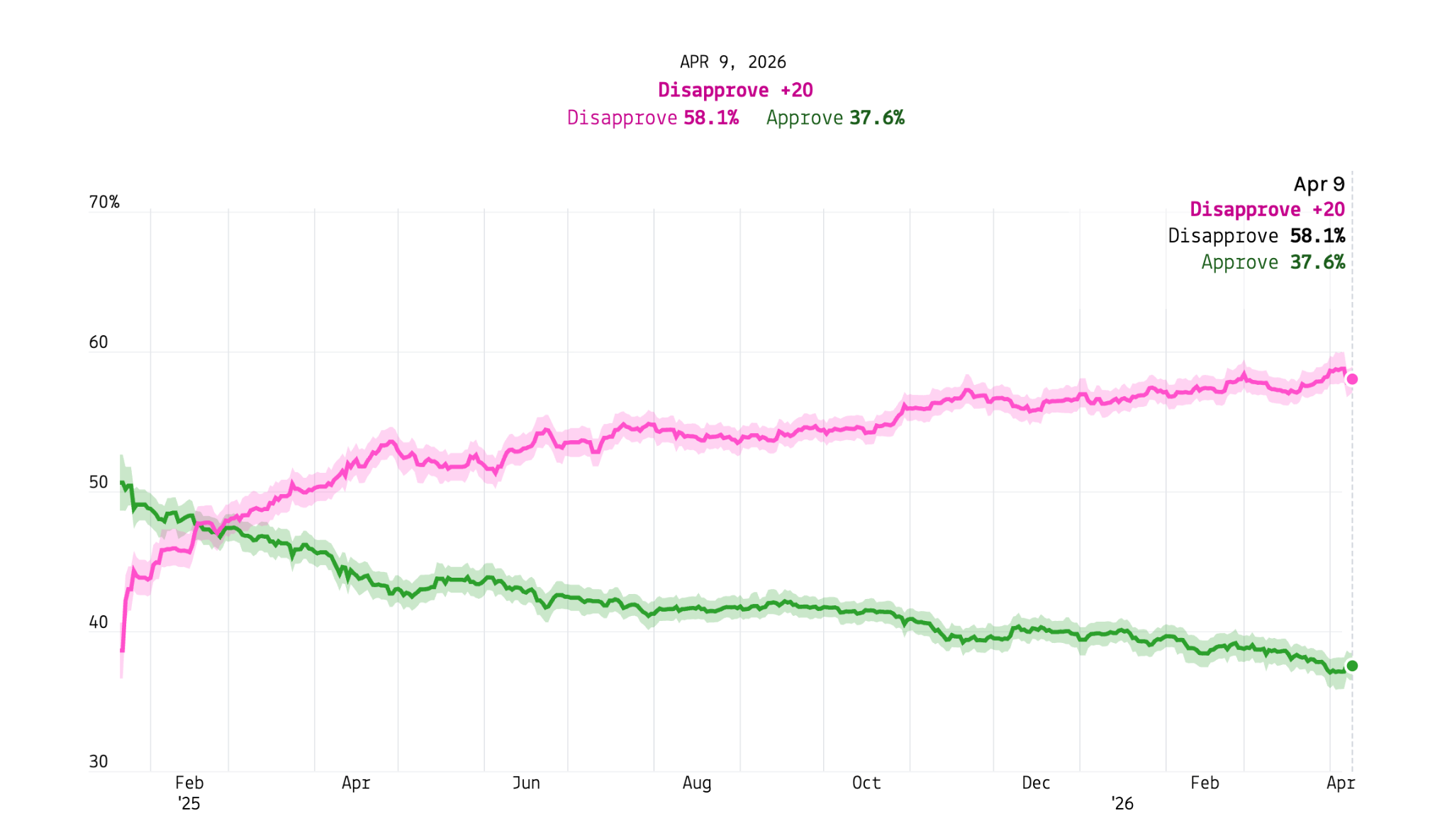
President Trump’s approval rating rose within the margin of error to 37.6 percent this week, while the percent of Americans who disapprove of the job he is doing fell slightly to 58.1. His -20 to -21 rating is a historical low for this point in a president’s term.
Paid subscribers to 50+1 get access to premium analysis, plus sortable tables and complete data access on our polling website. If you want to follow the 2026 cycle with the best data at your fingertips, become a paid subscriber.