



50+1 is a small start-up covering U.S. elections and public opinion through polling averages, forecasts, and original commentary. Subscribe today to get every post sent straight to your inbox — and consider going paid to unlock our full data tools.
Throughout the early spring this year, there was a persistent worry among Democrats that they could get “locked out” of the California gubernatorial election. California is one of only three states that run all-party primaries, in which candidates of all parties run on the same primary ballot, and some number of the top candidates move on to a runoff election in November (the other two are Alaska and Washington). In California, only two candidates make it through to the general election, and until the end of March, the two leading candidates in polling were Republicans Steve Hilton and Chad Bianco.
But things have changed since March. We’ve seen President Donald Trump endorse one of the top two Republicans, more than one Democratic drop out, and significant changes in the polls. As of early May, it now looks like the Democrats could actually lock the Republicans out of the November runoff, rather than the other way around.
Before we get into that, let’s take a look at what the problem was for Democrats in the first place. When the race got underway, too many Democratic candidates in the race were splitting up the Democratic vote, with no one candidate able to gain an advantage. Indeed, there will be 24 Democrats on the primary ballot in June, but just 12 Republicans (and an additional 25 candidates with either no party preference or another party affiliation).
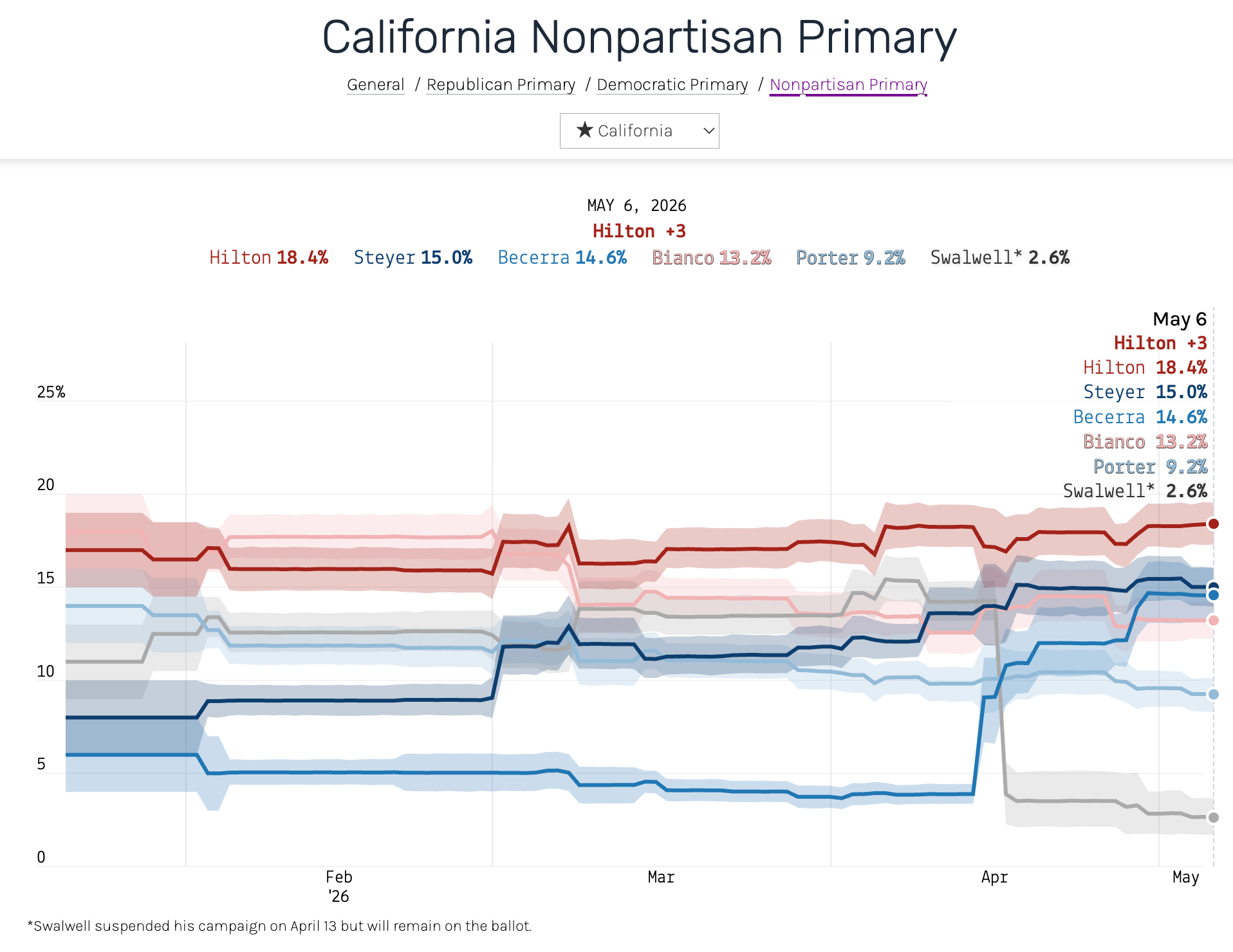
Of those candidates, pollsters identified roughly eight Democrats that they generally include in their polls as plausible candidates, but just two Republicans. Through the end of March, both of those Republicans were polling in double digits, while three Democrats were, and the other five Democrats were consistently peeling off low single-digits.
But as April got underway, things began to shift. On Monday, April 6, Trump endorsed Hilton. Some Democrats speculated that this would lead to a consolidation in the Republican vote in the race, and while Hilton has gained a few points in the polls since then, Bianco hasn’t really budged. On April 4, our polling average showed Hilton with 16.8 percent and Bianco with 13.6 percent; As of 6:00 PM Eastern on May 6, 2026,, those candidates are polling at 18.4 percent and 13.2 percent, respectively.
Then, amid a flurry of scandal, top-polling Democrat Eric Swalwell dropped out of the race on April 13. At the time, he had been the highest polling Democrat, at 14.3 percent, trailed closely by Tom Steyer at 14 percent. His exit seems to have redounded primarily to the benefit of Xavier Becerra, who shot up from 3.9 percent on April 13 to 14.6 percent today. Steyer, who had already been steadily climbing in the polls since early March, has also picked up a point, and now sits at 15 percent.
Hilton continues to lead the top two Democrats by 3-4 points, with Bianco trailing them by 1-2 points.
Alright, so if Hilton is still leading, you might ask me: why would you think the Democrats could lock the Republicans out? Wouldn’t you expect the polling leader to win?
Well, yes and no. As we’ve written in the past, primary polling is notoriously hard, so there’s reason to exercise caution, especially when the polling lead is only a couple of points. But there are two reasons to think that the top two Democratic candidates could continue to rise between now and the June primary, surpassing Hilton and locking the GOP out of the runoff in November.
Reason #1: More Democrats are still on the fence.
Generally speaking, it’s fair to assume that statewide, California is split roughly 60-40, with about 60 percent of votes going to Democrats and 40 percent to Republicans in recent elections. So if we expect that 60 percent of the votes in the primary will go to Democrats and 40 percent to Republicans, we can get a back-of-the-envelope calculation for how many voters from each party still haven’t made up their minds. On average, in polls conducted since Swalwell’s exit, 49 percent of the vote is going to Democrats, and 32 percent to Republicans.1 In our 60-40 universe, that means there’s still 11 percent of the electorate we would expect to choose a Democrat, and 8 percent we would expect to choose a Republican.
Of course, that three point difference between Democrats on the fence and Republicans on the fence doesn’t seem like very much. But again, the polling leader in this race is only leading by three percentage points to begin with, so we’re dealing with pretty thin margins already.
More importantly, the voters who show up for the primary election in June may be more Democratic than the usual 60-40 split among the general electorate.
In the redistricting referendum in California last December, the Democratic-aligned “Yes” side won 64-36. In other primaries that have been held so far in 2026, Democrats have turned out in much larger numbers than we’ve seen in previous primaries. For example, in the Ohio primary in 2022, Republicans were ahead of Democrats more than two-to-one in turnout in the Senate race, with over 1 million GOP voters and just over 500,000 Democrats. But in the primary in Ohio this week, Republicans appear to have barely led Democrats in turnout: just over 800,000 Republicans voted, and just under 800,000 Democrats did (note: these results are not yet final).
So let’s revisit the on-the-fence numbers with this in mind. If Democrats have a slightly higher than usual turnout advantage in June, say, 63-37 rather than 60-40, then an average of 14 percent of voters that currently have not chosen a candidate would likely choose a Democrat, while just 5 percent would be expected to choose a Republican. If Becerra and Steyer each get 5 percent of those Democratic fence-sitters (and the remaining 4 percent split between the other Democrats), while Hilton and Bianco split their 5 percent equally, that’s enough to push the topline into a 3-way tie. Any additional turnout advantage makes it even likelier for the two top Democrats to push ahead of Hilton.
Reason #2: Voters like voting for winners.
As we’ve seen Steyer and Becerra rise in the wake of Swalwell’s departure, we’ve seen another phenomenon begin to emerge in the polls: Democrat Katie Porter’s slow decline.
While Porter hasn’t collapsed, her vote share has been steadily ticking down in the polling average since late April. On April 13, Porter’s average was 9.8 percent; after Swalwell’s exit she ticked up a bit to 10.4 throughout mid-April, and has slowly been dropping ever since. Her current polling average is 9.2 percent, about half a point lower than where she was when Swalwell dropped out.
Now, this decline isn’t all that significant. One could argue that it’s all margin of error stuff, and I’m sensitive to that argument. But the fact that it’s been consistent in one direction for several weeks doesn’t bode well for her candidacy. And it could be the beginning of what we commonly see in these sorts of multi-candidate races: voters consolidating toward the end of the race around candidates they view as having the potential to win.
While not a primary, one very clear example of this phenomenon can be seen in the Oregon gubernatorial race in 2022. That race featured three candidates: Democrat Tina Kotek, Republican Christine Drazan, and independent former Democrat Betsy Johnson. In the early stages of the race, particularly in September 2022, there was significant fretting among Democrats that Johnson’s presence in the race could cost them the seat in November; Johnson was consistently polling in the high teens and low twenties throughout September. As a former Democrat, much of that vote share was pulling from Kotek, and Drazan held a polling lead throughout that period.
But then, October hit. Voters started to get serious about choosing their candidates. And almost immediately, Johnson’s poll numbers began to crash. By November, she was polling in the single digits, and Kotek had taken the lead over Drazan in the average. Ultimately, Johnson earned 8.6 percent of the vote in the election, less than half of where she’d been polling in September.
Well, the time has come in California. We’re about one month out from the primary, and voters are starting to get serious about choosing their candidates. This could mean that as the last month goes on, voters who have been telling pollsters they plan to vote for lower-polling Democratic candidates like Porter or Democrat Matt Mahan may go the way of Betsy Johnson voters in Oregon, and shift their support to one of the top two polling candidates. On average, 20 percent of voters say they plan to vote for a Democrat other than Becerra or Steyer; if half of these switch to one of the two Democratic leaders, that’s another 10 percent of the votes to split between the two.
Ultimately, nobody knows what will happen in California in June. With 61 candidates on the ballot and five candidates polling at 9 percent or above, there’s a lot of fluidity still in this race. But there’s an outside chance that the combination of turnout advantages and consolidation could push Hilton off the November ballot. At this point, Republicans getting locked out seems more likely than Democrats missing the November ballot.
Paid subscribers to 50+1 get access to premium analysis, plus sortable tables and complete data access on our polling website. If you want to follow the 2026 cycle with the best data at your fingertips, become a paid subscriber.
Footnotes
This average excludes polls conducted for the Super PAC California is Not for Sale, which explicitly opposes Tom Steyer, as well as polls conducted on behalf of a candidate in the race
This is very astute analysis. And I agree that a 60-40 split is probably optimistic for Republicans. A little while back, I looked at every partisan statewide election during a midterm since the start of the top-two era—23 races in total. Republicans hit 40% just six times. The average was 38%. https://bsky.app/profile/the-downballot.com/post/3mg745spjz22y