



Welcome to The Trendline, the FiftyPlusOne.news weekly polling roundup. Subscribe to get it delivered straight to your inbox and get bundled access to our polling website.
In May, the average price of gas nationwide hit $4.48. That coincided with the highest inflation rate in three years, driven primarily by a protracted war with Iran that has disrupted supply-chain routes and sent prices soaring. Since 2022, Americans have consistently ranked inflation as the among the most important issues facing the country, and they haven’t been afraid to make their concerns known at the ballot box; in the 2024 election, high inflation and the state of the economy were some of the top reasons voters elected Donald Trump.
Affordability concerns have continued to dominate the electoral conversation this cycle, with House Democrats making it their signature campaign issue, and some congressional Republicans are worried their party isn’t doing enough to address rising costs. Those are good instincts: According to polls from YouGov/The Economist, Americans are rating inflation/prices as even more important now than in 2024, and by a significant margin. In October 2024, 24 percent of Americans said inflation was the most important issue facing the country. Those numbers have grown steadily over the past year, reaching 30 percent in May and jumping to 36 percent in the most recent poll released this week.
These rising concerns aren’t just happening in the abstract — polling has also shown that Americans have changed their spending habits in response to persistent inflation. Over half of respondents in a recent poll from Ipsos (Jun. 2 - 3, 2026) said they had cut back on non-essential spending after seeing an increase in gas prices and the cost of living, while over a third said they had postponed larger expenses and bought less-expensive brands.
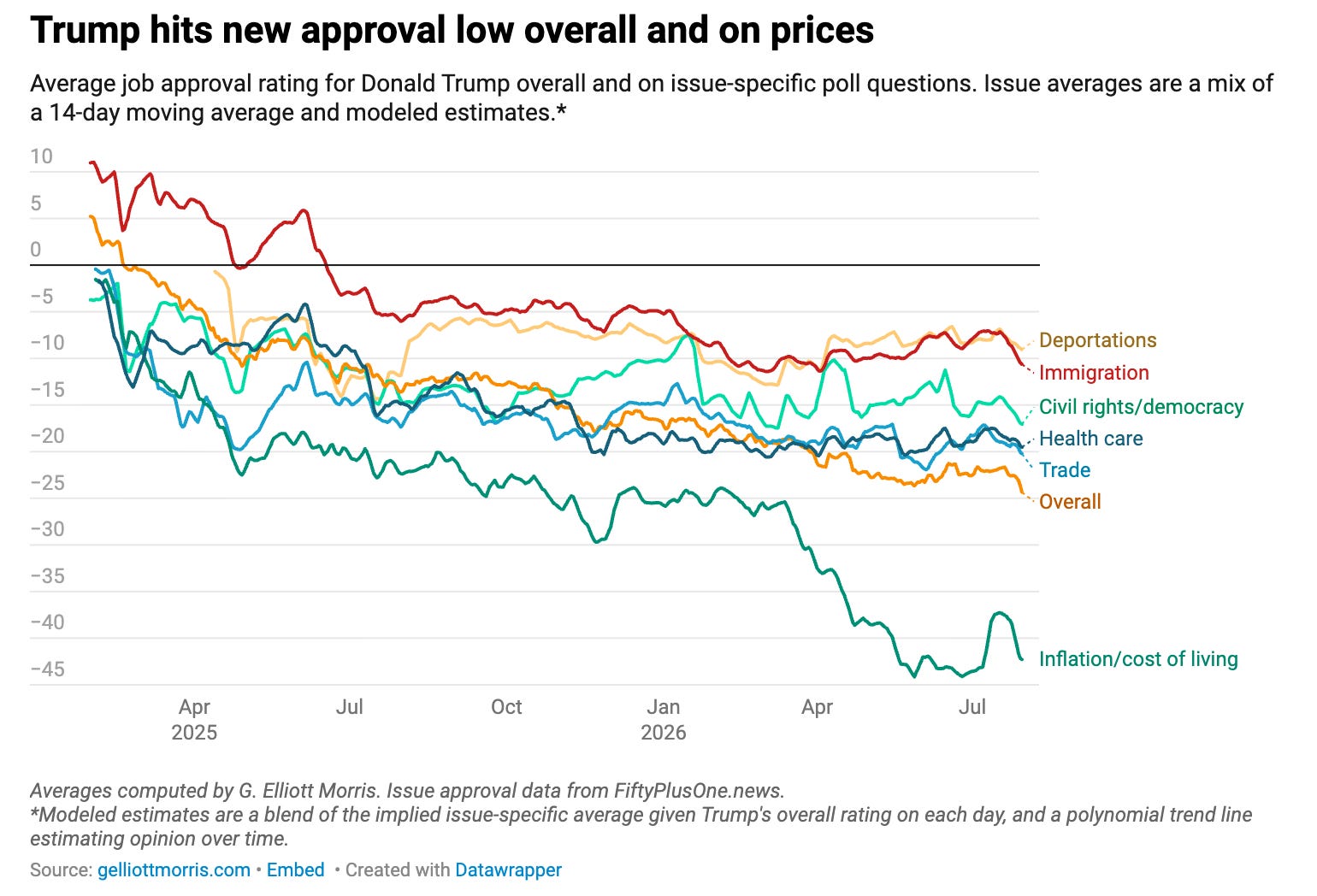
Congress’s apparent inaction on these issues this year has only bred further discontent among the public. The recent rise in inflation following the war with Iran has corresponded with a dramatic decline in the public’s approval of Trump’s handling of the economy. Trump’s net approval on inflation and the cost of living is now underperforming his overall net approval rating by almost 20 percentage points, and has dropped more than 40 points since the start of his term, according to an average of polls compiled by FiftyPlusOne.news and computed by our very own G. Elliott Morris. That makes it his lowest-rated issue being tracked, and a liability not just for him but Republicans as a whole this November.
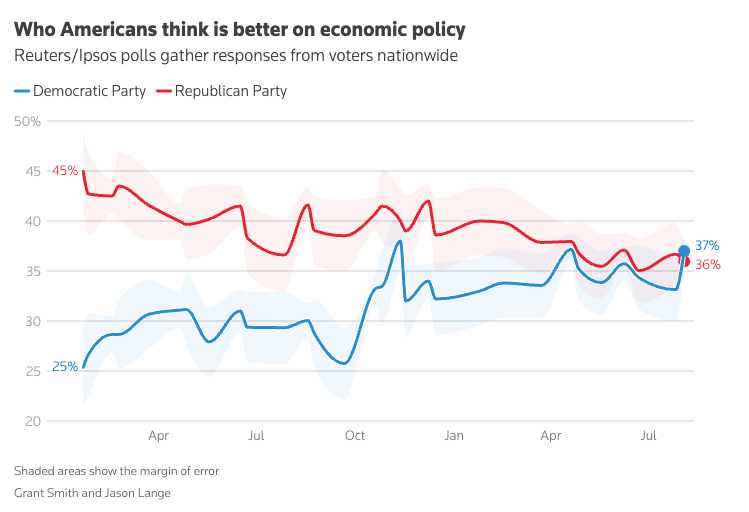
The public’s deep disapproval of Trump’s handling of inflation has led to an interesting development: For the first time in a decade, more Americans trust Democrats on economic issues than Republicans, according to polling from Ipsos/Reuters. In their most recent poll (Jul. 29 - Aug. 3, 2026), 37 percent of Americans trusted Democrats more on the economy, while 36 percent preferred Republicans. Since Trump took office, the net share of Americans who trust Democrats more than Republicans on the issue has risen by over 20 points. That’s a dramatic reversal for the GOP.
What does this all mean for November? Candidates of both parties are already hammering affordability messaging, trying to position themselves as fighters for voters’ pocketbooks. But Republicans have a much harder task ahead of them. Democrats in 2024 tried desperately to disentangle themselves from former President Joe Biden’s abysmal economic ratings and the sky-high inflation that had plagued much of his term, but they were ultimately dragged down with the ship, losing the Senate and the presidency. Republicans will be hard-pressed to distance themselves from Trump’s tanking approval on inflation and the cost of living, and voters’ increasing distrust of their ability to handle the economy.
The GOP can take some comfort in the fact that most Americans aren’t single-issue voters. Other issues, like health care, social security, and democracy, also rank highly in polls and will factor into voters’ choices. And of course, not everyone who disapproves of Trump’s handling of inflation will turn out and vote blue in November. While Democrats have seen gains in the generic ballot since the beginning of the year, it hasn’t been to the same magnitude as the plummet in Trump’s approval rating. However, as we’ve noted before, the generic ballot tends to start drifting toward the out-of-power party in the last few months of the campaign season, so there’s still time for Democrats to pick up support ahead of November.
Other polling nuggets
As ICE has fallen from the headlines, the public’s views of the Trump administration’s immigration enforcement activities have softened somewhat — though they are still not particularly positive. In an AP-NORC poll (Jul. 23 - 27, 2026), 55 percent of respondents said that the administration has gone too far in “sending federal immigration agents into U.S. cities,” down from 62 percent in February. Similarly, the share who said the administration has gone too far in “restricting legal immigration” fell from 54 to 51 percent between the two surveys, and the percentage who said Trump had gone too far in “deporting immigrants living in the U.S. illegally” fell from 52 to 47 percent.
Sixteen percent of Americans have experienced homelessness, according to a new YouGov poll (Jul. 28 - 30, 2026). Sixty-one percent said that homelessness in the U.S. is a very serious problem, and another 29 percent said it’s a somewhat serious problem. As for what to do about it? Most think the federal government should step in. Seventy-seven percent said that the federal government should do more to address homelessness, and 70 percent said that state and local governments should do more. Just 11 percent said that the issue is beyond the government’s control, while 75 percent said that the government can do a lot to address homelessness.
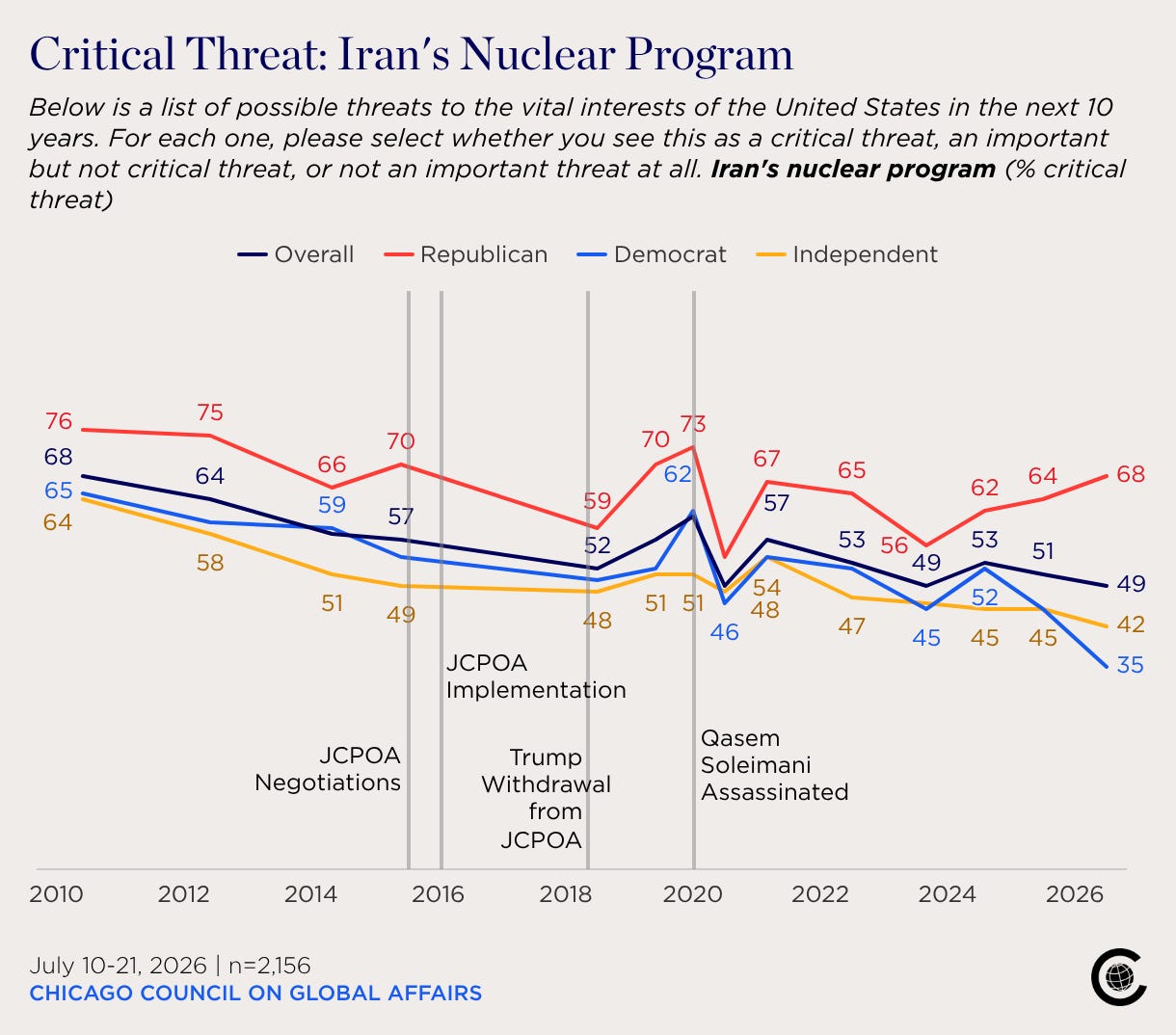
Sixty-eight percent of Americans say the war in Iran has not been worth the costs, according to new polling from Ipsos/The Chicago Council on Global Affairs (Jul. 10 - 21, 2026). This includes 91 percent of Democrats and 76 percent of independents. Republicans, on the other hand, disagree: 63 percent told the pollsters that the war was worth the costs, while just 36 percent said it was not. Overall, the percentage of Americans who think that Iran’s nuclear program is a critical threat has been falling, now standing at 49 percent. But the percentage of Republicans who think Iran’s nuclear program is a critical threat has steadily grown since 2023, from 56 to 68 percent.
Americans aren’t going to the movies all that much anymore: 43 percent told YouGov (Aug. 6, 2026) that they haven’t been to a theater in over a year. Even so, a majority (51 percent) said that seeing a movie in the theater is a better experience than watching it at home. And younger folks were just as likely as their older counterparts to say the theater experience is better than watching at home, with 51 percent of those aged 18 to 29 saying movies are better in theaters, compared to 48 percent of those over the age of 65.
Polling averages update
All numbers are as of 1:00 PM Eastern on Aug. 6, 2026.
2026 U.S. House generic ballot
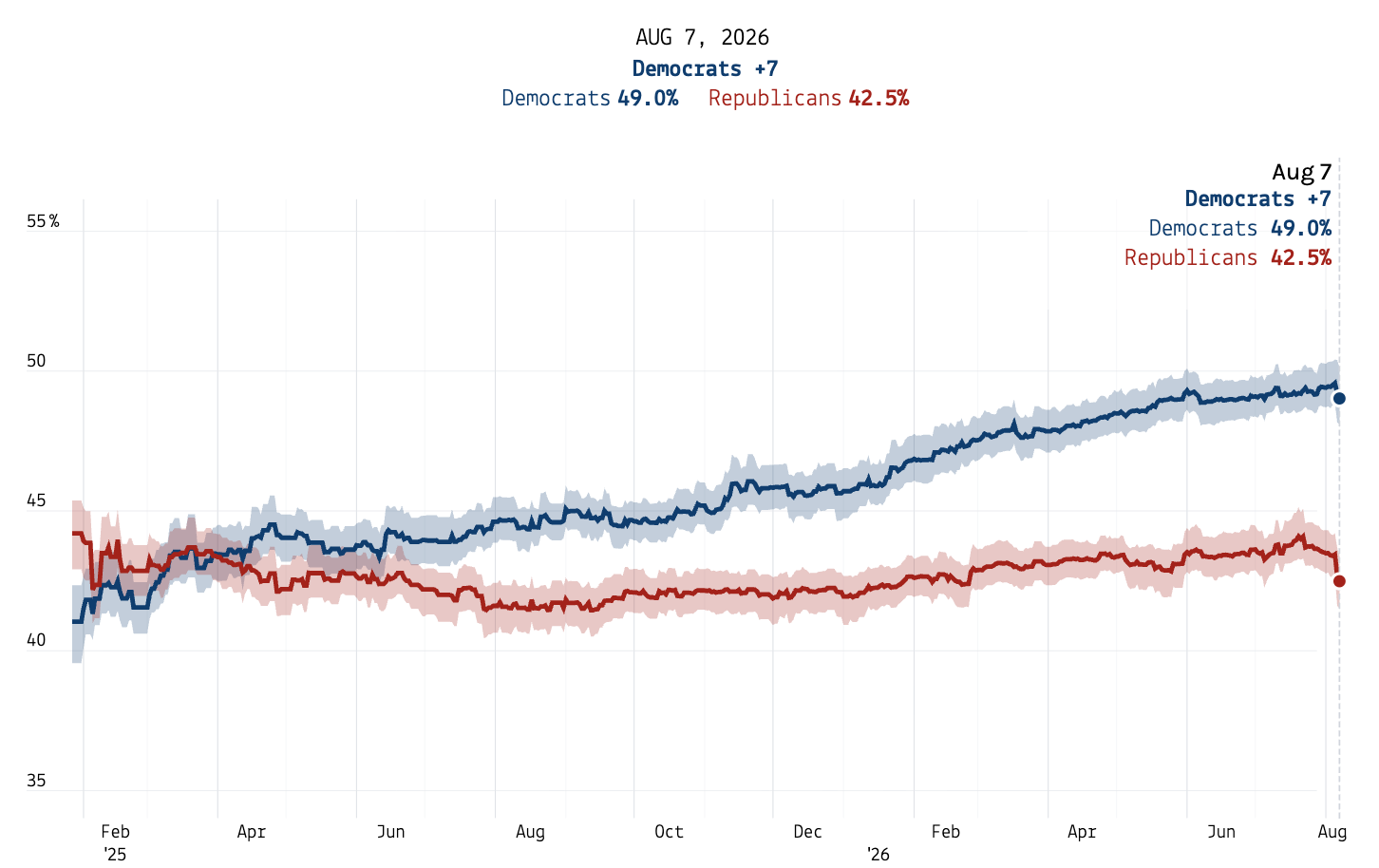
The Democratic margin in the 2026 U.S. House generic ballot grew this week, rounding to 7 points. The average number of likely voters saying they plan to vote for a Republican fell from 43.5 percent on July 31 to 42.5 percent today, a full point, while the number who say they plan to vote for a Democrat fell less than half a percent, from 49.4 to 49.0.
Trump’s job approval
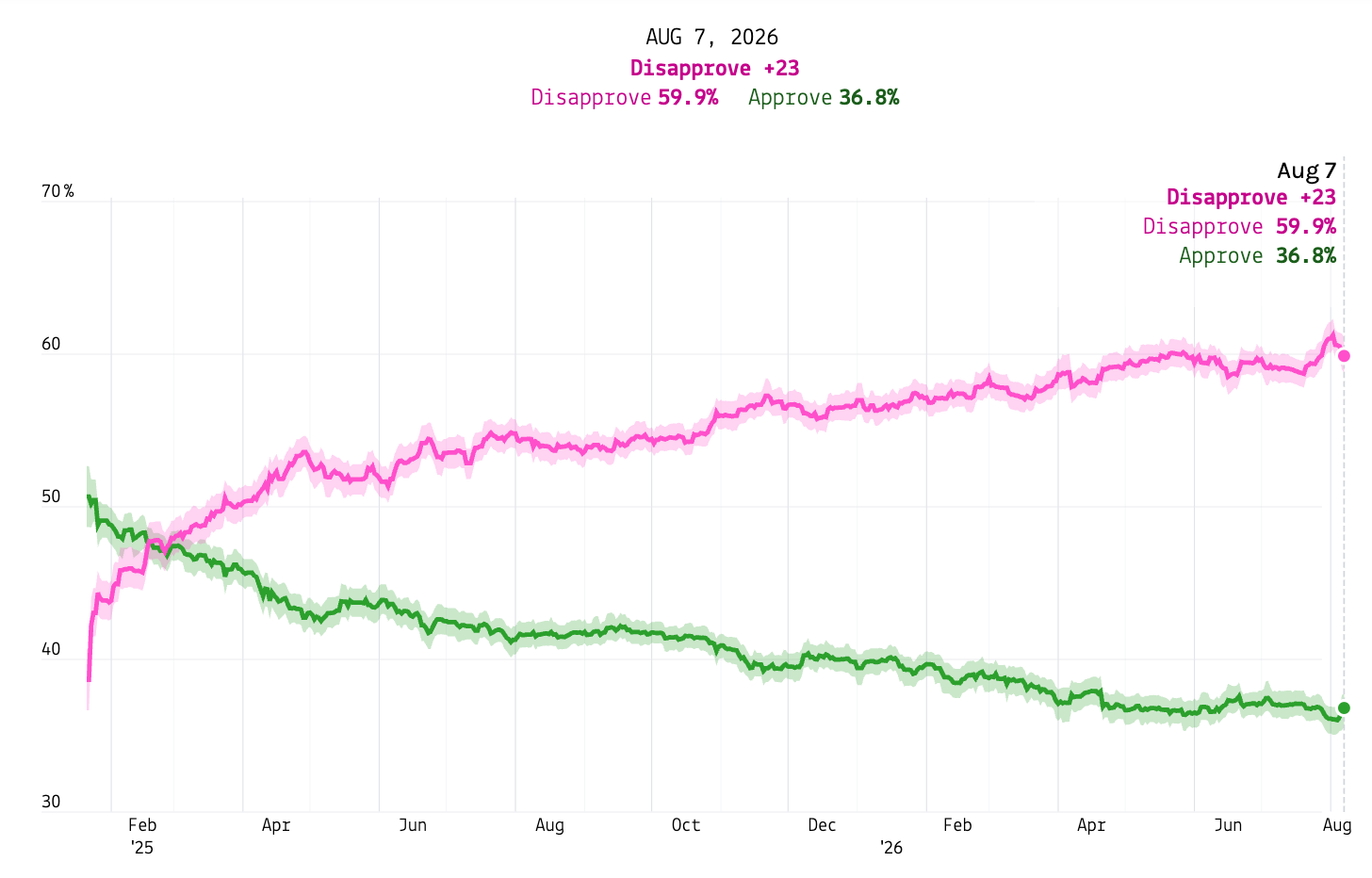
President Trump’s approval rating among U.S. adults has recovered somewhat from his all time low last week. On July 31, he was under water by 25 percentage points, with 36.1 percent approval and 61 percent disapproval. Today, his approval sits at 36.8 percent, with disapproval at 59.9 percent.
Paid subscribers to 50+1 get access to premium analysis, plus sortable tables and complete data access on our polling website. If you want to follow the 2026 cycle with the best data at your fingertips, become a paid subscriber.