

Welcome to The Trendline, the FiftyPlusOne.news weekly polling roundup. Subscribe to get it delivered straight to your inbox and get bundled access to our polling website.
Most of the latest coverage surrounding polling has focused on the battle for control of Congress, or President Trump’s historically low approval numbers. But there’s far more on the ballot this November than just federal races, including controversial ballot measures surrounding the electoral process, taxes, and transgender rights. These measures can have far-reaching impacts, even for residents of other states. We don’t have public polling for every measure that will be on voters’ ballots, but we have seen a good amount for some of the most potentially consequential measures of the year. For this week’s Trendline, we’ll be breaking down the latest polling on ballot measures to see which ones stand a chance at passing and how they might impact Americans across the country.
Elections
Multiple states are voting on measures affecting elections and voting in their states, some with the potential to dramatically alter how their residents pick their elected representatives.
In Missouri, Proposition A gives voters the choice of whether or not to keep a newly passed Republican gerrymander that would almost certainly help the GOP pick up a seat in Congress. (That map was paused by the state Supreme Court last month to let voters weigh in first.) We’ve only seen one recent public poll for the measure, and Missourians appear to be pretty evenly split; in a Saint Louis University/YouGov poll (Aug. 13 - 24, 2026), 35 percent of likely voters said they would vote to keep the new gerrymander, while 32 percent would reject it, and 33 percent weren’t sure.
Another voting-related ballot measure in Missouri would make it harder for the state legislature to weaken or change the initiative and referendum process, after state lawmakers nullified paid sick leave protections voters had passed via initiative. Voters seemed more friendly to this measure, with 48 percent supporting it in the SLU/YouGov poll and 21 percent opposing. Another 32 percent said they weren’t sure.
Maryland also has a redistricting-related measure on the ballot this year; Question 3 would clarify that state constitutional redistricting requirements apply only to state legislative districts and not congressional ones. Democrats in the state legislature put this measure to voters in the hopes of passing a new gerrymander of their own next year. The two public polls we have on the measure paint a starkly different picture — a Hart Research poll (Sept. 8 - 10, 2026) sponsored by Fight Back MD (which supports the measure) found the measure up slightly, with 40 percent of respondents in favor, 35 percent opposed, and 25 percent unsure. But a Lincoln Park Strategies/Ragnar Research Partners poll (Sept. 10 - 13, 2026) for Protect Maryland Votes (which opposes the measure) showed the question underwater by double digits, with just 28 percent of Marylanders supporting the measure, 41 percent opposed, and 31 percent unsure.
In California, voters will decide whether to amend the state’s recall election process to leave offices vacant until a special election can be held to replace a recalled politician, rather than the current system of electing a replacement at the time of the recall. A PPIC poll from last month (Sept. 4 - 10, 2026) showed voters quite opposed to this change, with just 35 percent supporting the measure and 59 percent opposed. Only 5 percent said they weren’t sure.
And in Massachusetts, Bay Staters will vote on whether to overhaul their primary process and create a single primary system where the top two candidates regardless of party move on to the general election, the same system used in California and Washington. Three recent polls of the question show it passing with varying degrees of strength — a University of Massachusetts Amherst/YouGov poll (Aug. 5 - 12, 2026) had the measure ahead by 19 points, with 51 percent supporting and 32 opposed to the overhaul. Two September polls also showed the measure ahead, but by a smaller margin. A MassInc/CommonWealth Beacon poll (Sept. 14 - 22, 2026) showed 43 percent of respondents in favor of the measure and 36 percent opposed. And in a University of New Hampshire poll (Sept. 17 - 21, 2026), 41 percent of respondents were supportive, while 39 percent were opposed.
Alaska will also hold (another) vote on whether to repeal the state’s top-four ranked-choice primary system and return to a traditional party primary system. We’ve only seen one public poll on the topic so far: a Fabrizio Ward/Impact Research poll for AARP (Sept. 8 - 11, 2026) showed voters closely split just like they were in 2024, with 44 percent in favor of repealing ranked-choice voting and 47 percent opposed.
Taxes
Lots of states will also have voters weigh on tax proposals, some of which have caused quite a stir — California’s Proposition 40 chief among them. Also referred to as the “billionaire tax,” the measure would levy a one-time 5 percent tax on individuals with over $1 billion in assets to help fund state programs, including health care and food assistance. The measure has drawn fierce opposition from prominent figures like Gov. Gavin Newsom, as well as from the state’s wealthiest residents, who managed to get opposing measures on the same ballot. Propositions 41 and 42 would nullify Proposition 40 if either one of them gets a higher share of the vote than 40.
These propositions are by far the ballot measures for which we’ve seen the most public polling this cycle. In an average of polls conducted in August and September, just over 48 percent of respondents said they support Proposition 40, while an average of 41 percent were opposed. Propositions 41 and 42 received a bit less support on average from Californians, but it’ll still be a nail-biter; Proposition 42 in particular is right on the heels of Proposition 40.
In Washington, voters will be asked whether to repeal a millionaire’s tax that the state legislature passed earlier this year, the first income tax ever to be levied in the state. According to the one public poll we’ve seen from DHM Research (Sept. 14 - 21, 2026), voters seem to be pretty opposed to the repeal. When shown the official ballot language for the measure, just 35 percent of respondents said they supported the initiative, while 57 percent were opposed.
Other states will vote on whether to decrease taxes. Floridians will decide on Amendment 3, which would greatly expand the homestead tax exemption, limit yearly tax increases, and restrict local spending using these funds. An average of three recent polls (from Sachs Media, St. Pete Polls/Florida Politics, and Stetson University) shows 54 percent in favor of the measure and 30 percent opposed, which isn’t quite enough to get the measure over the finish line: Florida requires 60 percent support for constitutional amendments to pass. And North Carolinians will vote on whether to decrease the maximum allowable state income tax to 3.5 percent, down from the current 7 percent cap (though no residents are currently taxed at that level). Recent polls from Elon University/YouGov (Aug. 21 - 31, 2026) and Harper Polling/Carolina Journal (Sept. 13 - 15, 2026) both show the measure with over 60 percent support.
Transgender Issues
Voters in Arizona, Colorado, Missouri, Nebraska, and Washington will be asked to weigh in on policies affecting transgender Americans this November. So far, there have only been two publicly released polls across these initiatives.
In Arizona, Proposition 318 would ban schools and sports groups from letting individuals use restrooms, locker rooms, or showers that are not designated for the sex they were assigned at birth. It would also remove a provision from state law allowing female students to participate in sports designated for males. A Stealth Analytics poll (Aug. 11 - 13, 2026) showed the measure with 52 percent support, with just 16 percent opposing and 32 percent unsure.
Missourians will vote on Amendment 3, which would do a couple of different things. It would repeal the voter-approved amendment establishing a constitutional right to reproductive freedom, and would prohibit abortions except in specific instances of rape, incest, or medical emergency. It would also ban all gender transition surgeries and medication for minors. The Saint Louis University/YouGov poll showed the amendment in a tight battle, with 43 percent of respondents supporting and 44 percent opposing the measure. Thirteen percent weren’t sure.
Many more measures will be on voters’ ballots across the country this November, but we’ve only seen public polls for a select few. Massachusetts residents will be asked (among other things) if they want to make recreational marijuana use illegal again (they’re opposed on average by a 34-point margin), and whether they want to relax some zoning laws to allow for more single-family housing construction (they support on average by a 37-point margin). Michiganders will decide whether to call a state constitutional convention — a Glengariff poll for WDIV and the Detroit News (Aug. 31 - Sept. 3, 2026) showed the measure up by 16 points. And Vermonters will vote on whether to prohibit the denial of rights based on traits like race, national origin, religion, sexual orientation, and gender identity; almost 70 percent of respondents in a recent University of New Hampshire poll (Sept. 17 - 21, 2026) were in favor.
Other polling nuggets
A polling experiment from Echelon Insights (Sept. 17 - 21, 2026) tested how voters responded to different language around data centers. Half of respondents were asked if they supported a data center in their community, and the other half were asked if they supported a “server farm.” With the data center language, voters were opposed by a margin of 40 percentage points, 65 to 25. But with the server farm language, opposition shrank to a margin of 22 percentage points, 50 to 28. Also notable: When using the server farm language, the number of respondents who said they were undecided was 22 percent, twice as many as said the same about data centers, so some of this decrease in margin may be due to voters having less strongly held opinions about server farms than data centers.
According to The Argument/Verasight (Sept. 16 - 21, 2026), the only war Americans believe was worth fighting in the last century was World War II. Asked whether it was right or wrong for the U.S. to engage in a variety of conflicts, a majority said wars in Iran, Iraq, and Vietnam were wrong, and a near-majority (47 percent) said the same about Afghanistan. Thirty-seven percent said U.S. involvement in Afghanistan was right, the most of any non-World War II conflict. When it comes to World War II, however, voters take a decidedly different position: 74 percent said it was right to engage in that conflict, while just 12 percent disagreed.
Americans’ trust in the Supreme Court has reached a historic low, according to polling data from Gallup dating back to the 1970s. In the latest survey (Sept. 1 - 17, 2026), just 46 percent of Americans said they have a great deal or fair amount of trust in the Supreme Court, the lowest reading on record, and 61 percent disapprove of the job the Court is doing, tying the record high disapproval rating first recorded in July of this year. The drop is driven mostly by Democrats, whose approval of the Court has been falling since 2021, and now stands at just 12 percent. But independents have also hit a record low in their approval of the Court, at 31 percent, and Republicans’ ratings of the Court have also seen a dip from a high of 79 percent in September 2025 to 65 percent in the most recent poll.
It’s October, and Spooky Season has officially begun. According to YouGov (Sept. 25 - 28, 2026), half of Americans (49 percent) believe that some people have paranormal abilities, and 58 percent believe that people have experienced paranormal encounters that are unable to be explained scientifically. Around a fifth of Americans (19 percent) say they have seen a spirit or ghost, and seven percent report having seen a demon. More than half (52 percent) say that homeowners should be required by law to disclose whether or not they believe their house is haunted before selling it.
Polling averages update
All numbers are as of 12:00 PM Eastern on Oct. 2, 2026.
2026 U.S. House generic ballot
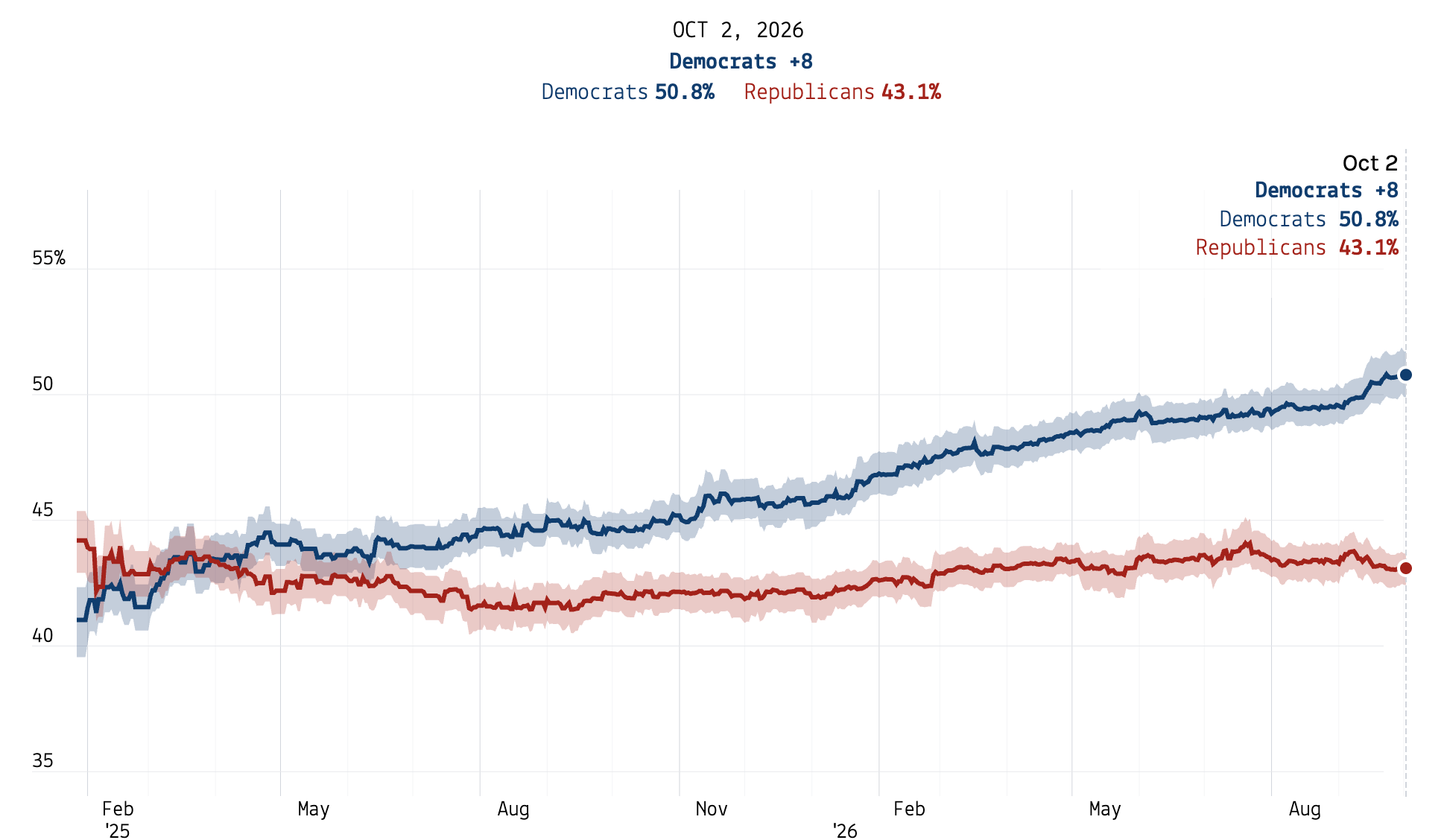
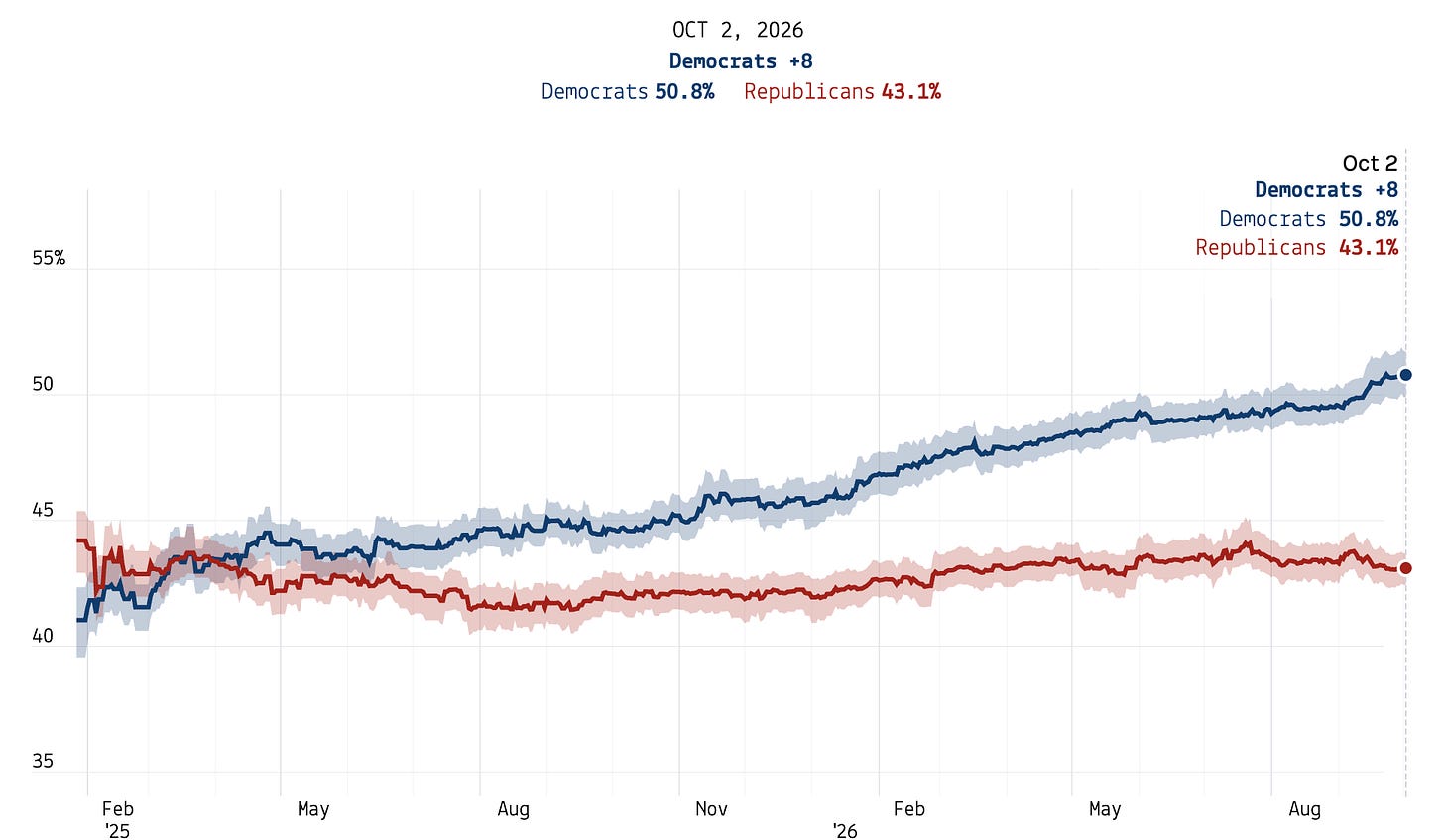
The Democratic margin in the 2026 U.S. House generic ballot remained steady this week, with Democrats still ahead of Republicans by 8 percentage points. Currently, 50.8 percent of likely voters indicate that they plan to vote for a Democrat in November, while 43.1 percent plan to vote for a Republican.
Trump’s job approval
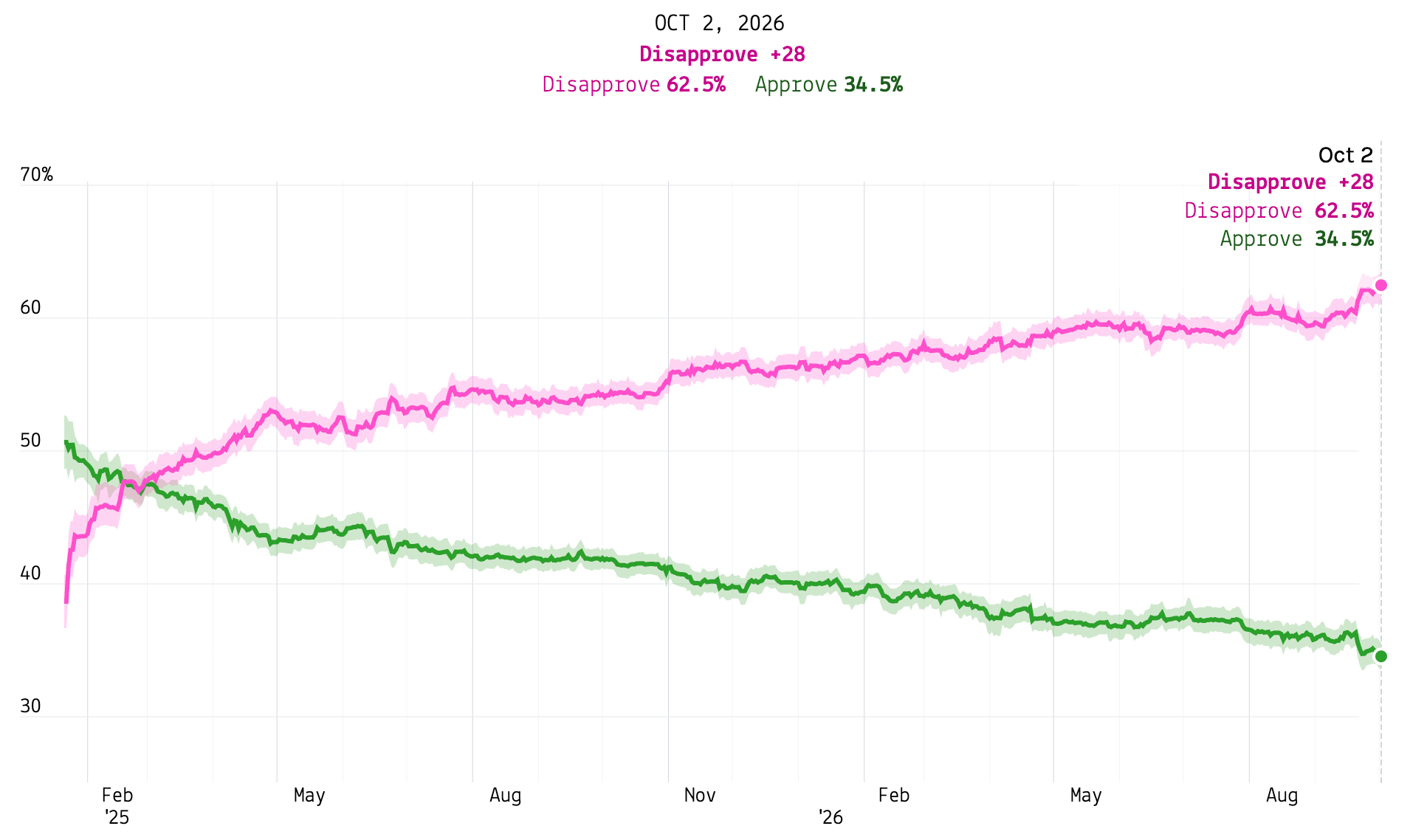
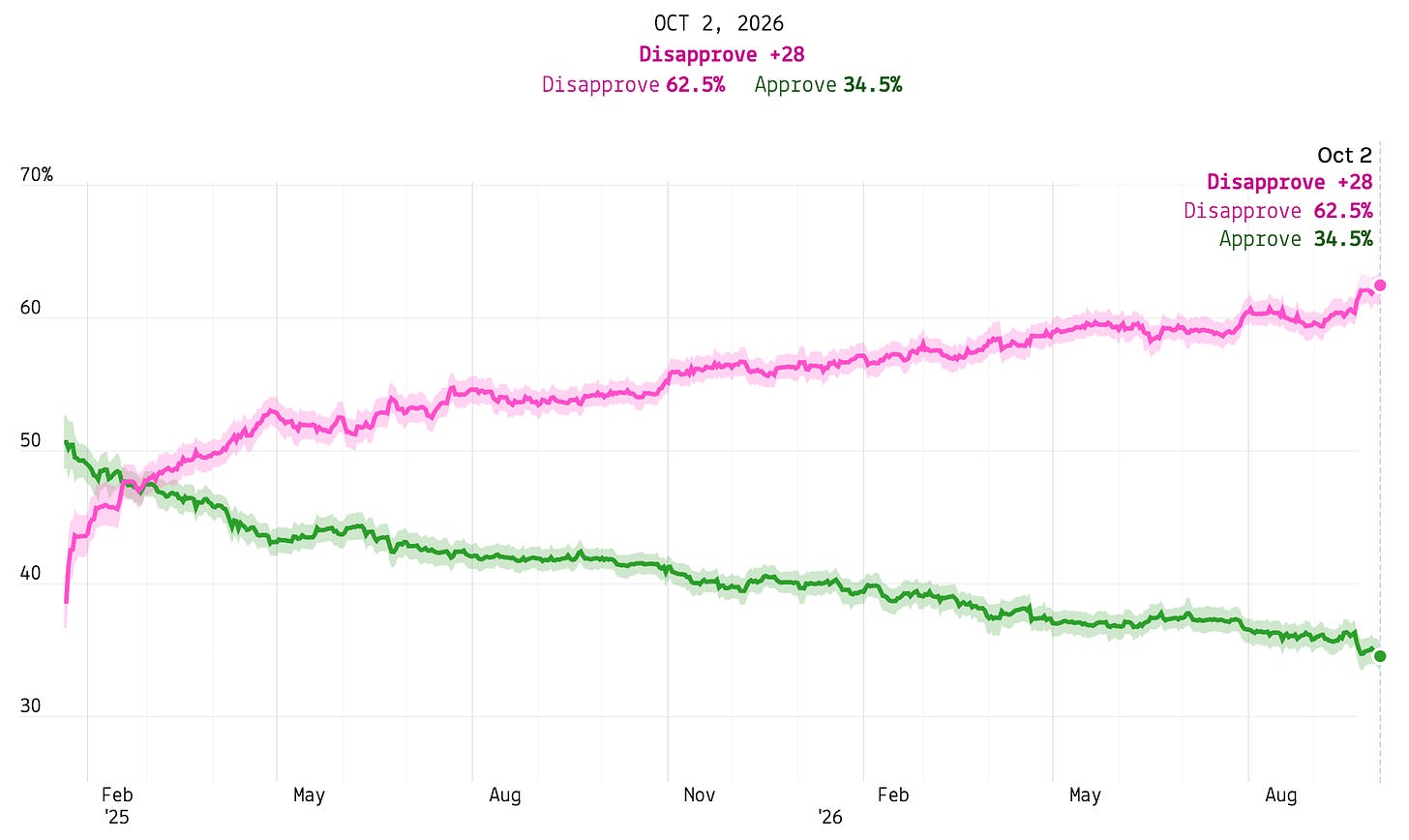
President Trump’s net approval rating among U.S. adults dropped a point this week, for a new low of -28 percentage points. Overall, 62.5 percent of Americans disapprove of the president’s job performance, while just 34.5 percent approve, his lowest ever rating.
Paid subscribers to 50+1 get access to premium analysis, plus sortable tables and complete data access on our polling website. If you want to follow the 2026 cycle with the best data at your fingertips, become a paid subscriber.