



Welcome to The Trendline, FiftyPlusOne’s weekly polling roundup. Subscribe to get it delivered straight to your inbox and get bundled access to our polling website.
It’s time for one of the most anticipated sporting events globally — the 2026 World Cup! For the first time, the tournament is being hosted by multiple nations, including the United States, alongside Mexico and Canada. Have Americans noticed? Do they care? This week on The Trendline, we dig in to see how Americans feel about the World Cup, soccer, and the U.S.’s role in this year’s contest.
According to an Ipsos poll (May 29 - 31, 2026), most Americans have at least heard about the World Cup. Fourteen percent say they have heard a lot about the tournament, and another 50 percent have heard a little. But in the same survey, just knowing the event is coming doesn’t translate to enthusiasm: just 7 percent say they are very or extremely excited about the World Cup, while 18 percent say they are somewhat excited and 73 percent say they are not too or not at all excited.
Among fans of professional soccer, though, there’s quite a bit more enthusiasm. According to a YouGov/CBS News poll (Jun. 2 - 4, 2026), only 17 percent of Americans overall say that they are excited about the World Cup, but among fans of professional soccer, that number jumps to 52 percent. Another 24 percent of soccer fans say they are “pleased, but not excited.” However, soccer fandom in the survey is a fairly limited population in the U.S.: just 11 percent of respondents say they are “big fans” of professional soccer, 17 percent say they are “casual fans,” and the vast majority, 71 percent, say they are not fans.
And despite the American men’s team’s spotty record in previous World Cups (of the 22 tournaments that have been held so far, the U.S. last made the top 3 teams in the very first tournament in 1930, and failed to qualify or withdrew in half of the contests), Americans have at least some confidence in their team this year. In the Ipsos poll, 47 percent said they didn’t have high expectations for the U.S. in this year’s World Cup, but 49 percent disagreed. And 26 percent said they would be disappointed if the U.S. doesn’t win the tournament (in their predictions for the tournament, not a single writer for ESPN placed the U.S. in the top four).
Politics, however, has intervened in the World Cup, as it often does in American life. Amid increased immigration scrutiny across the country, reports have swirled about fans and players potentially being turned away at airports; at least one referee from Somalia was denied entry to the U.S. for the tournament. Americans don’t feel great about immigration enforcement at the games either (which the Trump administration has downplayed): in a Washington Post/University of Maryland poll (May 14 - 18, 2026), 65 percent of respondents said they opposed ICE agents being present at matches, while just 35 percent supported the enforcement.
And despite some initial questions, the Iranian men’s team is allowed to participate in the contest, a move generally supported by Americans. In the Washington Post/University of Maryland poll, 75 percent said that the Iranian team should be allowed to play. Sixty-nine percent also said that players from Iran that wanted to stay in the U.S. due to fear of persecution back home should be allowed to remain here.
As to attending the games, some upcoming matches still aren’t sold out, so there’s still some opportunity for fans to catch a match in person. However, the price might be a barrier. The cheapest seats for the U.S. home opener against Paraguay today, for example, are over $1,000. Fifty-nine percent of respondents in the Ipsos poll said it is “too expensive for the average American to attend a game,” and just 2 percent said it was affordable for average Americans (the rest were unsure). In a YouGov poll (May 21 - 24, 2026), just 1 percent of respondents said they would be willing to pay over $1,000 to watch a game that includes the U.S. team; 66 percent said they wouldn’t buy a ticket at any price.
But it’s not only World Cup games that Americans aren’t interested in attending. Asked in the YouGov survey about their previous soccer interest, nearly half (49 percent) said they had never attended a soccer match of any kind, not even a youth game. Just 17 percent said they had previously attended a professional soccer match, and 8 percent said they had been to a previous World Cup game.
However, it’s not all bad news for soccer fans. Interest in the World Cup has been steadily growing, according to YouGov. Ten percent of respondents indicated that they watched matches in 2010, 13 percent in 2014, 17 percent in 2018, and 21 percent in 2022. We’ll find out soon if 2026 continues the trend of Americans learning to love the sport that the rest of the world has long embraced.
Other polling nuggets
While the political universe may be all abuzz about the Maine Senate race, most Americans are not paying attention. In a Reuters/Ipsos poll (Jun. 3 - 8, 2026) taken the week before his primary, 63 percent of Americans say that they have heard nothing at all about Democratic Senate nominee Graham Platner, while 14 percent say they have heard a lot about him and 22 percent say they have heard a little. More Americans have heard about Ken Paxton, the Republican candidate for Senate in Texas, than Platner: 19 percent have heard a lot about Paxton, 27 percent have heard a little, and 52 percent have heard nothing at all.
Americans are split about congressional redistricting, according to a new Emerson College poll (Jun. 7 - 8, 2026). Thirty-eight percent told the pollster that mid-decade redistricting is generally a good thing for the country, while 46 percent said it’s generally a bad thing. Support is strongly driven by Republicans, 56 percent of whom said that mid-decade redistricting is a good thing, while 29 percent of Democrats and 30 percent of independents agreed. Majorities (51 percent of both) of Democrats and independents said mid-decade redistricting is generally a bad thing for the country.
In a new annual poll from the Harvard T.H. Chan School of Public Health and the de Beaumont Foundation (Mar. 19 - Apr. 1, 2026), trust in the nation’s public health sector has dramatically fallen in the last year. Just half of Americans say they trust health recommendations from the CDC; 77 percent trusted the agency in the 2025 survey. The change is being driven mostly by Democrats and independents — trust in the CDC among Democrats fell 58 percentage points since last year’s wave, and among independents it fell 30 percentage points. Trust among Republicans was more or less the same in the two surveys. In addition to lower confidence in the CDC, trust in state and local health departments has also fallen since last year, with 66 percent now trusting their state health department and 70 percent their local health department.
Belief in aliens is growing, according to a new YouGov/CBS News poll (Jun. 2 - 4, 2026). Sixty-three percent of Americans said they believe there is intelligent life on other planets, up from 48 percent in the 1990s and 56 percent in 2017. And 21 percent believe we have already made contact with intelligent life from other planets, while 33 percent say we will never make contact with intelligent aliens. When it comes to our government’s handling of UFOs, Americans are deeply skeptical. A large majority — 84 percent — say the government knows more about the issue than it’s telling the public.
Polling averages update
All numbers are as of 11:00 AM Eastern on June 12, 2026.
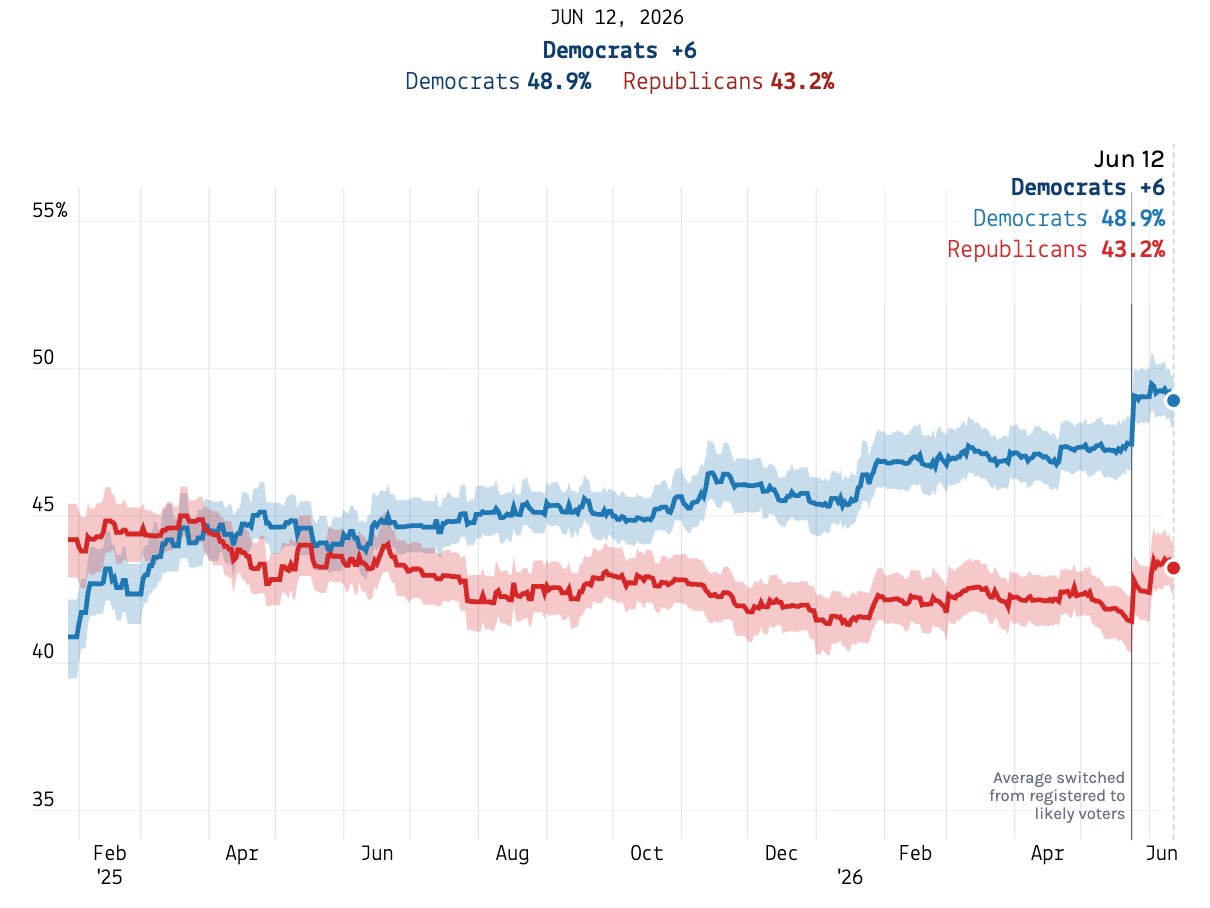
2026 U.S. House generic ballot
The Democratic margin in the 2026 U.S. House generic ballot rounded to 6 points this week, staying more or less steady from last week. About 49 percent of likely voters plan to vote for a Democrat, while 43 percent plan to vote for a Republican.
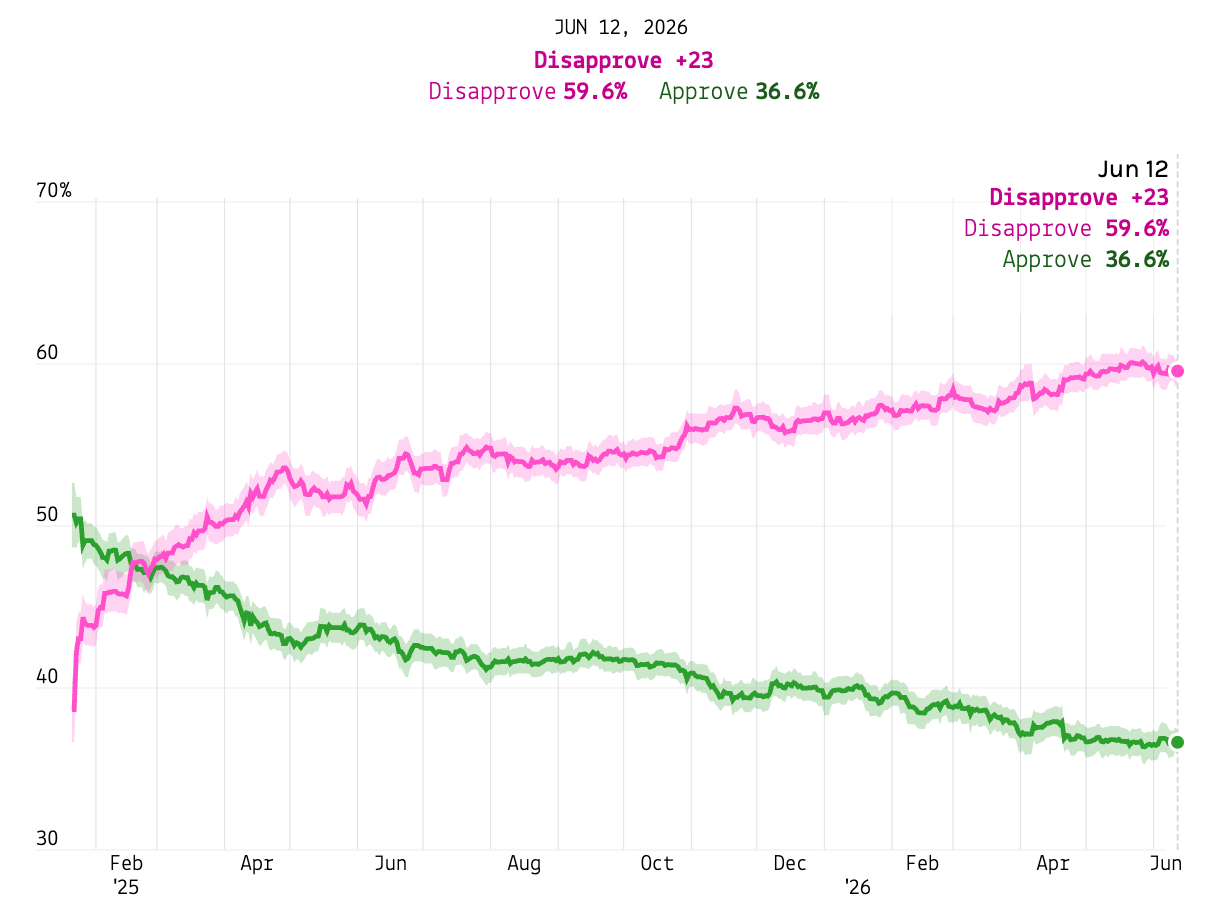
Trump’s job approval
President Trump’s approval rating among U.S. adults has fallen a tad since last week. An average of 36.6 percent approve of the president, down from 36.9 last week, while his disapproval has risen from 59.4 to 59.6.
—
Paid subscribers to 50+1 get access to premium analysis, plus sortable tables and complete data access on our polling website. If you want to follow the 2026 cycle with the best data at your fingertips, become a paid subscriber.