



Welcome to The Trendline, FiftyPlusOne’s weekly polling roundup. Subscribe to get it delivered straight to your inbox and get bundled access to our polling website.
In the last few weeks, dozens of pollsters have asked Americans their opinions about U.S. military intervention in Iran. Many articles have been written summarizing these polls, so we won’t go into detail rehashing all the results here. The topline takeaway is, generally, Americans disapprove of the United States’ attacks on Iran starting Feb. 28, 2026, with approval roughly in the high 30s/low 40s, while disapproval sits roughly in the high 40s/low 50s.
Instead, this week on The Trendline, we’re taking a slightly different approach. We’re focusing on polling among Republicans, conducted both before and after the strikes, to better understand how the different factions in the Republican party view not just the Iran conflict in particular, but America’s use of military force and foreign policy more broadly. Most of this polling is based on crosstabs from nationwide surveys, as narrow polling among Republicans on niche issues like this is hard to come by, but it still paints a picture of a party that, while they may be on the same sides of most issues, are still divided in many ways.
First, consider Gallup’s latest World Affairs survey (Feb. 2 - 16, 2026) on the priorities of Americans when it comes to foreign policy.
Compared to Americans overall, Republicans are less likely to prioritize altruistic foreign policy goals that explicitly help other countries, such as “defending our allies’ security” and “promoting and defending human rights in other countries.” On the other hand, Republicans are more likely than Americans overall to prioritize foreign policy goals that would explicitly benefit the U.S. or its safety, such as “securing adequate supplies of energy for the U.S.” and “preventing future acts of international terrorism.”
In addition, according to Ipsos/Chicago Council on Global Affairs surveys conducted over the last 15 years, Republicans have always been far more concerned about Iran’s nuclear program than other political groups.
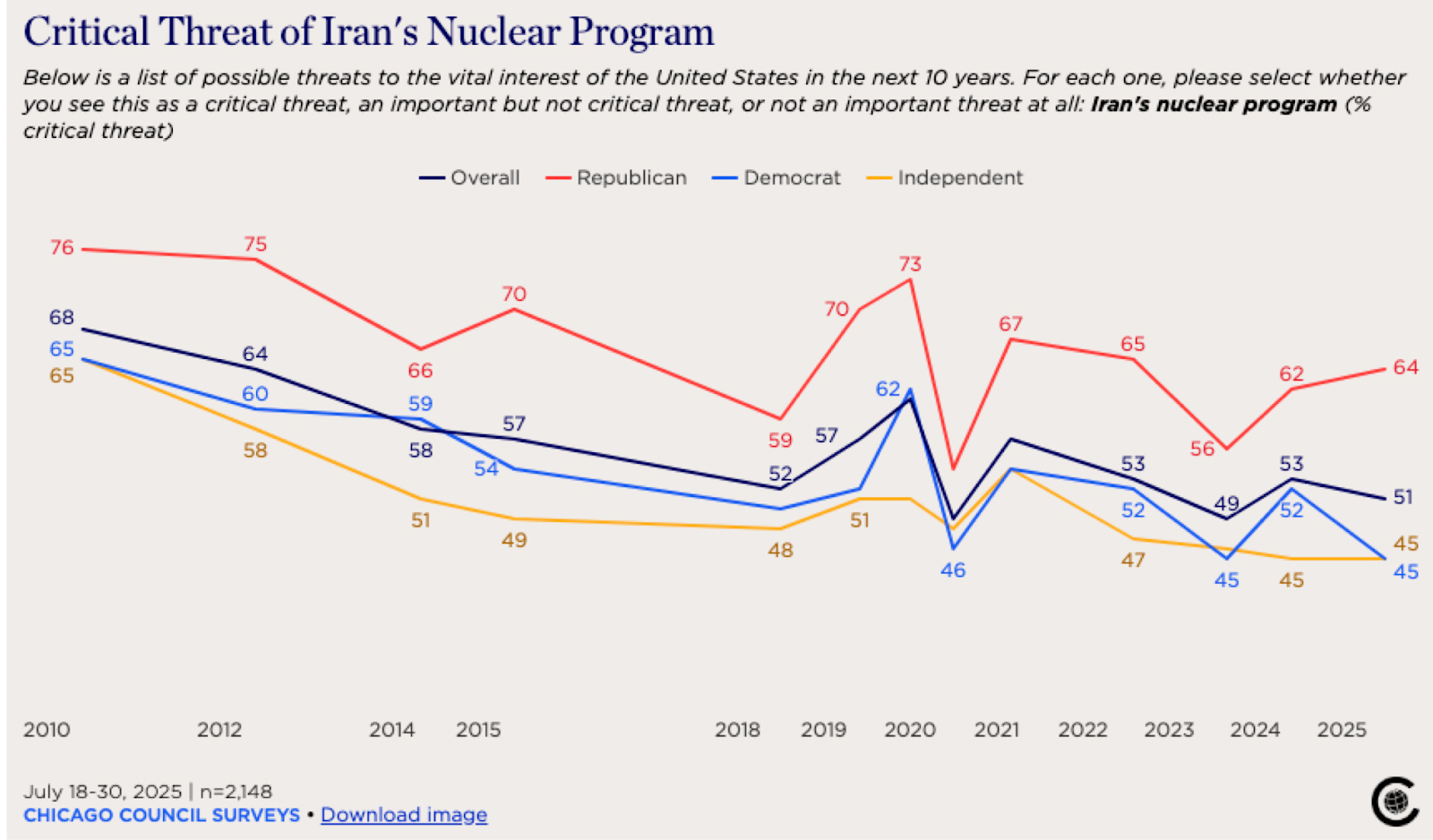
In the most recent Ipsos/Chicago Council survey that asked this question (July 2025), the gap between Republicans’ view of the nuclear program as a “critical threat” and the overall public’s view was the widest the poll has ever measured, at 14 points. And in their latest survey (Feb. 27 - Mar. 1, 2026), conducted just after the latest U.S. campaign began, this issue topped the list of concerns among Republicans, with 88 percent saying they were “very or somewhat concerned” about “the possibility of Iran developing nuclear weapons” (75 percent of the public overall agreed).
Given the high level of concern about Iran’s nuclear program among Republicans, and the general instinct to support actions taken by a president of one’s own party, it may be unsurprising that Republicans are much more supportive of the military action in Iran than other political groups. Indeed, even before the strikes were launched, a YouGov/CBS News poll (Feb. 25 - 27, 2026) found that 84 percent of Republicans said they would favor “the United States taking military action against Iran to try to prevent them from producing nuclear weapons,” while 16 percent opposed. By contrast, among Americans overall, 51 percent said they favored the action and 49 percent were opposed.
But the high support among Republicans may also reflect a tendency for voters to follow the lead of their elected and opinion leaders. After the strikes began, YouGov and CBS News reached back out to the same poll respondents to see how their minds had changed. In a less specific question, respondents were asked if they approved or disapproved of “the U.S. taking military action against Iran.” The public overall had shifted ten points away from supporting the action, with 44 percent approving and 56 percent disapproving. But among Republicans, support for military action had actually increased one point, to 85 percent, with opposition at 15 percent. The write-up of the article mentioned that the “MAGA base”1, in particular, was supportive of the action, but did not provide specific details of how MAGA Republicans and non-MAGA Republicans responded.
Other surveys, however, did provide this breakdown. In a CNN/SSRS survey conducted just after the strikes (Feb. 28 - Mar. 1, 2026), 77 percent of Republicans said they approved of “the U.S. decision to take military action in Iran,” while 23 percent disapproved. But the article noted the following:
MAGA Republicans are 30 points more likely than non-MAGA Republicans to say they strongly approve of the decision to take military action, 34 points likelier to say it will reduce the threat Iran poses to the US and nearly 50 points more likely to say they have a great deal of trust in Trump to make the right decisions about US use of force in Iran.
Now, this may seem counterintuitive to people that equate the MAGA movement with the America First movement, but these two ideas are not quite ideologically aligned. While elites in the party do seem to marry these ideas, a survey from Navigator Research conducted just after the strikes on Iran last summer (June 26 - 30, 2025) shows that is less true among the public at large. The pollsters asked all respondents which of the following two statements they agree with more:
It’s better for the U.S. when we’re more active and involved in world affairs
It’s better for the U.S. when we’re less active and involved in world affairs
Respondents that chose the first statement were labeled “interventionist,” and those that chose the second statement were labeled “isolationist.” Among other differences, interventionist Republicans were slightly more likely to identify as MAGA (71 percent) than isolationist Republicans (64 percent). (Interventionist Republicans were also generally much older and more politically engaged than isolationist Republicans.) Among Republicans overall, 50 percent were classified as interventionist, more than among Democrats (48 percent).
Non-MAGA Republicans were also generally far less supportive of Trump than MAGA Republicans. For example, MAGA Republicans were 27 points more likely to say they approved of Trump’s handling of foreign policy than non-MAGA Republicans. On whether Trump made the right decision to “bomb Iran, targeting their nuclear program,” MAGA Republicans were 20 points more likely to say it was the right decision than non-MAGA Republicans. Asked whether the U.S. should continue to use its military in the conflict, 53 percent of Republicans said yes; among MAGA Republicans that number rises to 61 percent. On the other hand, a plurality (46 percent) of non-MAGA Republicans said the U.S. should stop.
And in another Navigator survey, this one conducted just before the most recent military actions in Iran (Feb. 19 - 22, 2026), MAGA Republicans were much more likely to support wars, including regime change wars, than any other political group.
This tendency of MAGA Republicans to prefer interventionist policies is not new or unique to the Iran conflict. In a survey from Angus Reid (Jan. 16 - 20, 2026), respondents were asked whether various actions taken in the first year of the Trump administration made them more pleased or upset. While MAGA Republicans were more pleased than non-MAGA Republicans on every issue tested, the largest gaps were among issues related to unilateral or potentially undemocratic actions by the Trump administration and foreign policy.
In a survey from the same pollster conducted after the strikes (Mar. 2 - 4, 2026), MAGA Republicans were significantly more aggressive than non-MAGA Republicans on the operation. MAGA Republicans, for example, said they would support a U.S. decision to send ground troops to Iran by 49 points, 66 to 17, while non-MAGA Republicans said they would support such a decision by only 2 points, 40 to 38. Asked if the military action in Iran would make the U.S. more or less safe, 76 percent of MAGA Republicans said it would make the country safer, and just 5 percent said it would make the country less safe; among non-MAGA Republicans, just 41 percent thought the conflict would make the country safer, while 21 percent said it would make the country less safe. And MAGA Republicans generally thought the operation would be quicker: 59 percent said they believed the conflict would last up to six months, while just 39 percent of non-MAGA Republicans believed the same.
These polls paint a clear picture: while Republicans are broadly more supportive of military action in Iran than the public at large, the MAGA wing of the party is driving much of that support. MAGA Republicans are more hawkish, more trusting of Trump’s leadership on foreign policy, and more optimistic about the conflict’s outcomes than their non-MAGA counterparts. Far from being the isolationist “America First” bloc they’re often portrayed as, MAGA Republicans consistently emerge in polling as the most interventionist faction in American politics today.
Other polling nuggets
A new poll from the Vanderbilt Project on Unity and American Democracy (Feb. 20 - 23, 2026) finds broad, bipartisan pessimism about the state of the country. Two-thirds of Americans say the country is on the wrong track, and 73% believe the Founding Fathers would not be proud of the country today. The economic mood is particularly sour: 77% disagree with a question asking if their cost of living has decreased, and 63% rate the current economy as fairly or very bad. The pessimism is especially acute among young people, with just 12%of 18- to 29-year-olds saying they are “extremely proud” to be American, compared to 41% among those 65 and older.
With the 2026 Winter Olympics just concluded, a new YouGov survey (Feb. 27 - Mar. 2, 2026) finds that Americans broadly like their national sports teams. The U.S. women’s ice hockey team tops the list, with 56% of adults saying they view the team favorably, followed closely by the men’s ice hockey team (54%), the men’s basketball team (53%), women’s basketball (50%), men’s soccer (50%), and the women’s soccer team (48%). Notably, these teams are popular across party lines — the U.S. men’s hockey team, for example, is viewed favorably by 68% of Republicans and 53% of Democrats — making Olympic sports one of the few things Americans can still agree on.
Interest in weight-loss drugs continues to grow. According to a new Leger survey (Feb. 6 - 9, 2026), 11% of U.S. adults report currently taking a prescription GLP-1 medication like Ozempic or Wegovy, and another 12% of non-users say they’re interested in taking one. Weight loss is the top motivator, cited by 71% of those considering the drugs. Users also report notable lifestyle changes: fewer cravings, smaller restaurant portions, and shifts in spending away from indulgent categories and toward fitness and personal care.
Trump’s brief improvement among Hispanic voters appears to be fading. According to a new PRRI survey (Feb. 10 - 18, 2026), just 24% of Hispanic Americans now hold a favorable view of the president, down from a high of 39% in September 2024. The decline has been especially sharp among Hispanic Protestants, who dropped from 48% favorability in September 2025 to 37% in February 2026. Overall, just 36% of Americans view Trump favorably, down from 41% in September 2025.
Support for abolishing Immigration and Customs Enforcement has hit a(nother) new high. According to the latest Economist/YouGov poll (Feb. 27 - Mar. 2, 2026), half of Americans (50%) now support abolishing ICE — the first time the figure has reached the majority threshold in YouGov’s polling. At the same time, opposition has fallen to an all-time low of 39%. For the first time, a majority of independents (52%) back abolishing the agency, and even among Republicans, support has reached a new high of 23%. The shift has coincided with declining trust in ICE overall: 44% of Americans now say they have no confidence in the agency at all, up from 38% in October, and a majority (58%) say ICE uses excessive force.
Polling averages update
All numbers are as of 11:00 AM Eastern on March 6, 2026.
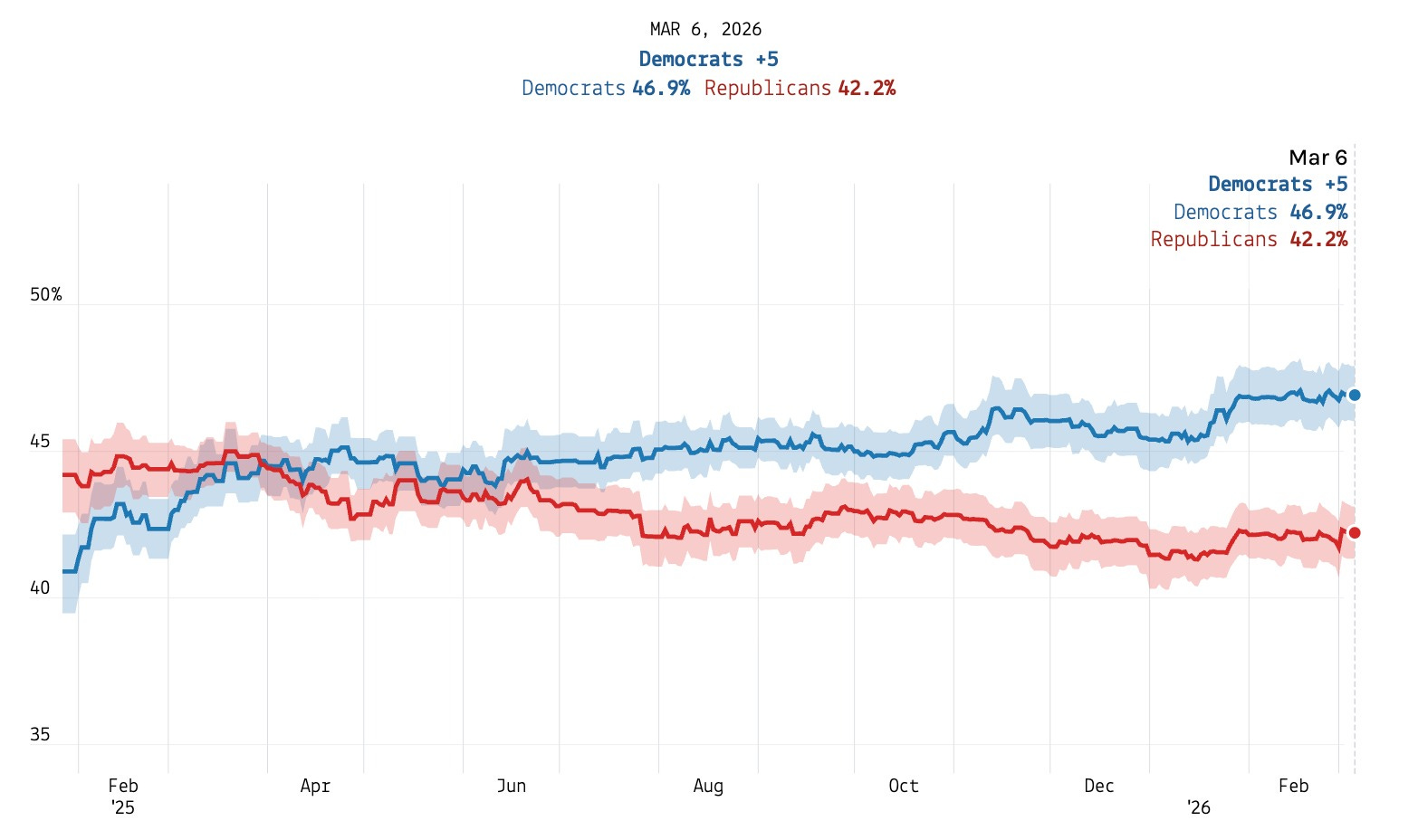
2026 U.S. House generic ballot
Democrats have held their lead on the 2026 U.S. House generic ballot steady over the last week, at about 47% of the vote versus 42% for the Republicans.
Trump’s job approval
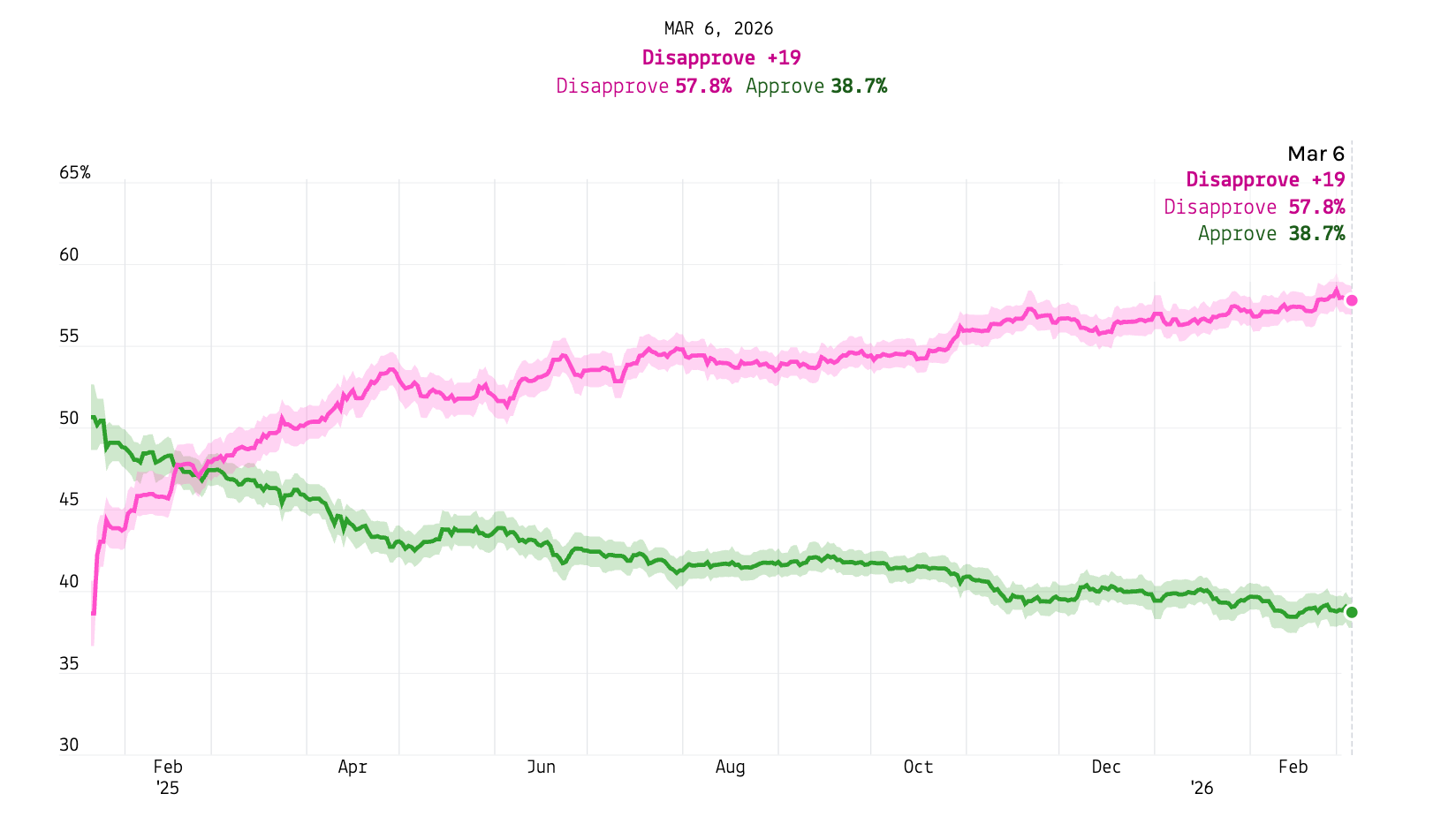
After briefly hitting a new net low of -20 in 50+1’s aggregate, Donald Trump’s approval rating reverted back to previous levels somewhat and ends the week at 39% approve and 58% disapprove, among all U.S. adults.
Paid subscribers to 50+1 get access to premium analysis, plus sortable tables and complete data access on our polling website. If you want to follow the 2026 cycle with the best data at your fingertips, become a paid subscriber.
Footnotes
In all surveys discussed in this article, whether a respondent is classified as “MAGA” is based on their self-identification.