



Welcome to The Trendline, the FiftyPlusOne.news weekly polling roundup. Subscribe to get it delivered straight to your inbox and get bundled access to our polling website.
Earlier this year, Americans’ perception of corruption in the U.S. government hit the highest level that Gallup has ever recorded, going back at least 20 years. In the latest survey (May 1 - June 10, 2026), 89 percent of Americans said that corruption was “widespread throughout the government in this country.” That’s 30 points higher than the share who said the same back in 2006, when Gallup first began asking the question, and a dramatic departure from Trump’s first term, when Americans didn’t rate corruption as any more widespread than they had in the past.
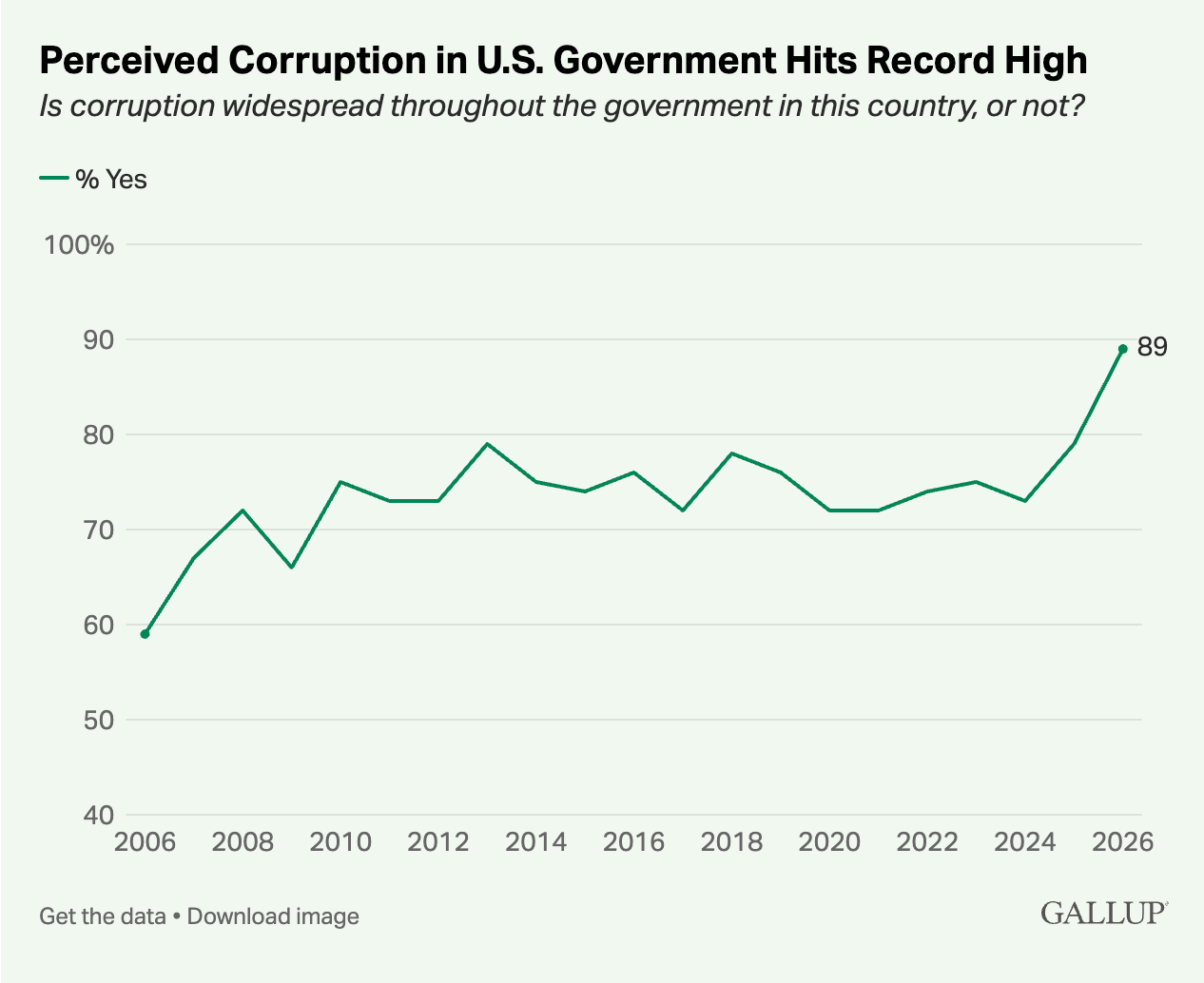
But the most striking finding from this report isn’t that sky-high number — it’s that since 2023, only four countries of the 132 Gallup surveyed have had a perceived corruption rate higher than the United States: Ghana, Nigeria, Lebanon, and Peru. Among wealthier economies, the U.S. had by far the highest perceived corruption in Gallup’s polling, outpacing the median OECD country by 20 points last year. According to most Americans, our government seems to be in a corrupt league of its own.
But by most expert measures, the U.S. is not actually one of the most corrupt countries in the world, or even close to it. Transparency International publishes an index of global corruption each year based on economic and civic data from across the globe; in 2025, out of 182 countries, the U.S. ranked as the 29th least corrupt.
So if it’s true that the U.S. actually ranks in the top fifth of least corrupt countries in the world, why do Americans seem to have a worse view of their government than almost any other nation? A lot of it may boil down to how people define ‘corruption.’
In a recent Navigator Research survey (Aug. 21 - 24, 2026), a slight majority (51 percent) of registered voters said the most harmful kind of corruption in the U.S. was perpetrated by “wealthy special interests and big corporations,” rather than by politicians who accept bribes or “[use] inside information for personal profit” (43 percent). And when respondents were asked who they thought was most involved in corruption, three of the top five answers included billionaires, wealthy campaign donors, and special-interest groups, while the other two referred to Republican politicians.
This seems to indicate that when many Americans talk about corruption, they’re referring in large part to the political influence of billionaires and special interests rather than shifty criminal activity from politicians themselves (although plenty of Americans think that’s a problem too). This is borne out in Gallup’s polling as well — Americans’ perceptions of corruption within U.S. businesses also hit an all-time high this year at 71 percent.
So while the U.S. might perform fairly well on some of the more traditional measures of corruption that are included in Transparency International’s index, those metrics might not be capturing the perceived influence of monied interests that many Americans are most worried about.
But let’s not get too far ahead of ourselves. It’s not just the wealthy special interests that are catching flak; politicians and political parties are getting their fair share of blame too. Topping the above chart by a healthy margin was President Donald Trump and his family, with 48 percent saying they’re involved in corruption, closely followed by Republicans in Congress at 37 percent (Democrats in Congress rounded out the top six at 28 percent). And because Trump and Republicans are in charge of the government right now, that may contribute to an increase in how Americans see corruption.
When Americans were asked in a YouGov poll this summer (June 29 - July 1, 2026) how serious of a problem they thought corruption was among a long list of professions, members of Congress and U.S. presidents topped the list. (The professions seen as least corrupt were professional athletes, doctors, and professors.) YouGov also asked respondents how many politicians in the U.S. they thought were corrupt; 66 percent said at least half of them, while 26 percent said just “some,” and literally 0 percent said that none were corrupt. Those are pretty clear signs that individual politicians are still broadly seen as corrupt, even if Americans’ idea of corruption is slightly more focused on the influence of outside interests.
Refreshingly, all of this is something that Republicans and Democrats agree on. It’s true that the recent spike in Gallup’s numbers was driven almost entirely by Democrats, but that’s mostly because Republicans already saw the government as corrupt at the start of Trump’s presidency — perceptions of corruption in the government grew from 57 to 91 percent among Democrats between 2024 and 2026, a 34-point increase, while Republicans moved from 87 to 83 percent, only a 4-point change.
It’s also true that the GOP is consistently seen as more corrupt than the Democratic Party across recent surveys, particularly President Trump, who voters view as distinctly corrupt. But it’s actually Republicans who are more worried about the issue: In the Navigator poll, Republican voters are slightly more likely than Democrats to list corruption as a top-five issue. And while GOP politicians might be seen as a bit more corrupt overall, voters are telling pollsters they’re tired of corruption from both parties — when Navigator asked about a long list of corruption scandals, a quarter of voters consistently said that each happens equally often in either party.
Supermajorities of both parties also have a firm belief that corruption is a fixable issue, and that perpetrators should face punishment. In a recent Ipsos/Reuters poll (Aug. 14 - 17, 2026), 75 percent of Republicans and 83 percent of Democrats thought corruption in politics could be “eliminated with strong regulation and enforcement,” while only around 20 percent in either party said corruption was “just part of how politics gets done and it can’t really be eliminated.”
When the University of Massachusetts Amherst/YouGov asked respondents in an August survey (Aug. 21 - 26, 2026) what the most appropriate consequence for offenders of various corrupt actions would be, over 80 percent of respondents (and similar shares of Democrats and Republicans) said that criminal or ethics investigations should be opened. Less than 15 percent of adults said that we should just let the voters decide.
Every country is going to experience some amount of corruption — politicians are people, after all, and some people will always break the rules. Corruption isn’t a new part of American life, even though more voters are worried about it now than in the last 20 years, and it probably isn’t quite as bad as many are perceiving it to be. But unlike most political issues, Americans from both parties actually agree on both the diagnosis and the cure, and there has been some recent movement in Congress to help address some of the problems, such as advancing a ban on congressional stock trading and introducing several bills limiting congressmembers from prediction market trading. Ultimately, though, unless significant changes are made to curtail the influence of big business on politics, it seems unlikely that Americans’ views of corruption will change anytime soon.
Other polling nuggets
Half of Americans say that student loan debt isn’t worth the risk, according to a new poll from Noble Predictive Insights/The Center Square (Aug. 12 - 16, 2026). Fifty percent said that taking on student loans is “too risky because many graduates struggle to find jobs that justify the cost,” while 35 percent said they thought a college degree was worth the risk. Even among those with a bachelor’s degree, more said the loans were too risky than not, with 46 percent saying that student debt was too hazardous and 43 percent saying the degree was worth the risk.
By a whopping 51-point margin, Americans disapprove of renaming Lake Ontario to Lake America, according to this week’s YouGov/The Economist survey (Aug. 28 - 31, 2026). Disapproval stretched across the political spectrum, but was decidedly less pronounced among Republicans; Democrats disapproved by 80 percentage points, independents by 69 points, and Republicans by just 4 points.
Americans would rather pay more for gas than continue sending troops to Iran, according to a new survey from J.L. Partners/The Daily Mail (Aug. 28 - 31, 2026). Asked to choose between paying $5 for gas or sending more troops, 46 percent preferred higher gas prices, compared with 22 percent who preferred sending more troops. Democrats were especially likely to prefer higher gas prices than more deployments, with 55 percent saying they’d rather pay more at the pump, and 15 percent saying they’d rather send more troops. Republicans were split, with 38 percent saying they prefer higher gas prices and 39 percent preferring deployments.
What do you do when you’ve forgotten the name of an acquaintance? According to a recent YouGov poll (Sept. 2, 2026), Americans aren’t likely to fess up. Just 24 percent say they would tell the person they’ve forgotten their name, while 46 percent would avoid using the name and hope to remember, and another 15 percent would try to get the person or someone else in the conversation to say their name. Older respondents are more likely to admit they’ve forgotten than younger ones, with 29 percent of those aged 65 and up saying they’d admit it, compared with 21 percent of those under 30. (We’re Cooper and Mary, in case you needed that.)
Polling averages update
All numbers are as of 10:30 AM Eastern on Sep. 4, 2026.
2026 U.S. House generic ballot
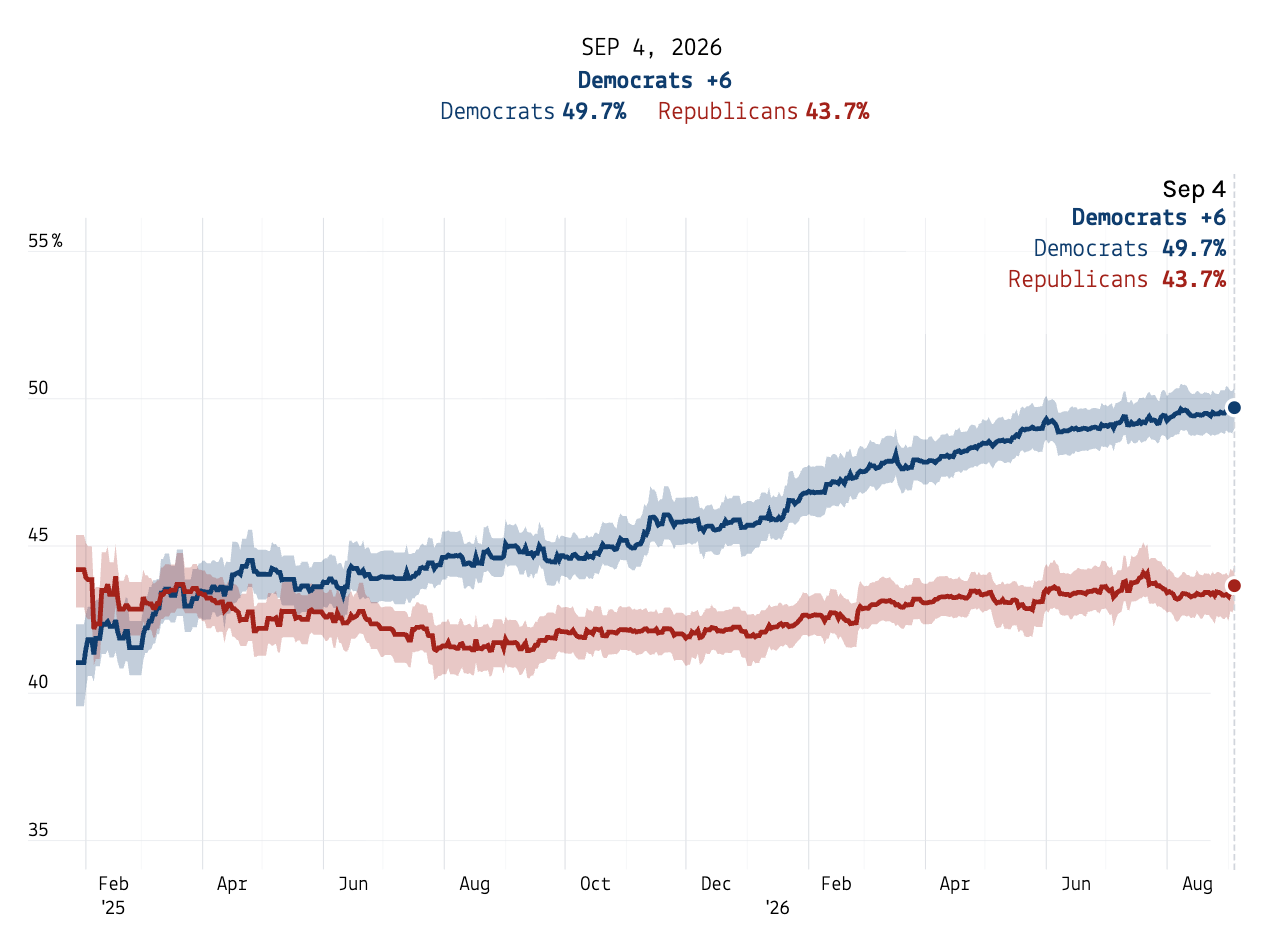
The Democratic margin in the 2026 U.S. House generic ballot remained stable this week, with Democrats ahead of Republicans by 6 percentage points. Currently, 49.7 percent of likely voters indicate that they plan to vote for a Democrat in November, while 43.7 percent plan to vote for a Republican.
Trump’s job approval
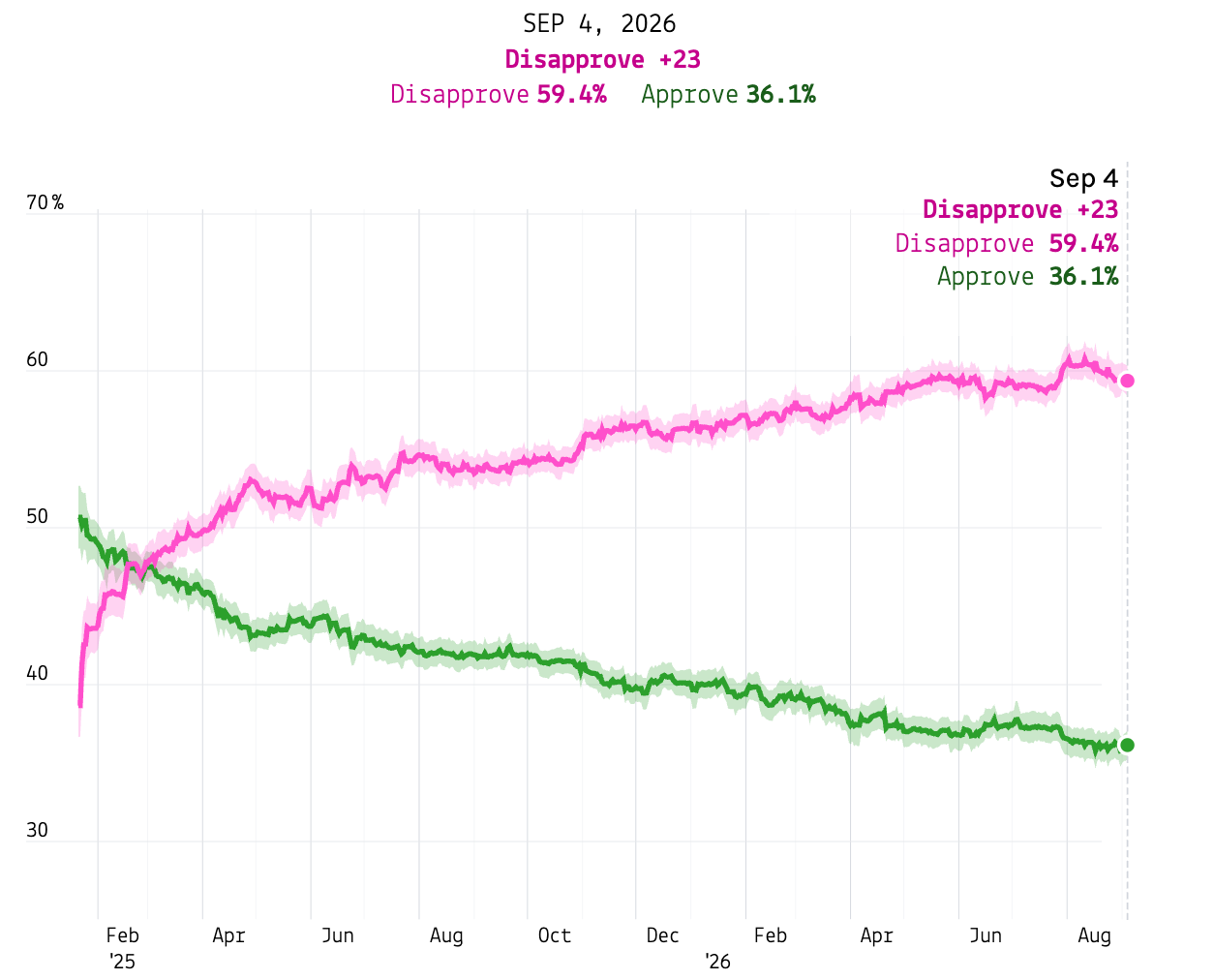
President Trump’s approval rating among U.S. adults stayed fairly steady this week, with 36.1 percent of Americans approving of his job performance, the same as last week. His disapproval rating fell slightly from 59.6 percent last week to 59.4 percent this week.
Paid subscribers to 50+1 get access to premium analysis, plus sortable tables and complete data access on our polling website. If you want to follow the 2026 cycle with the best data at your fingertips, become a paid subscriber.