



Welcome to The Trendline, FiftyPlusOne’s weekly polling roundup. Subscribe to get it delivered straight to your inbox and get bundled access to our polling website.
In the polling analysis industry, we rightfully spend a lot of time focused on the president’s approval rating as a proxy for general voter sentiment. And there’s good reasons for that: there’s a strong correlation between, for example, presidential approval and midterm elections (among other things). But today, we’re going to look at some of the other types of questions pollsters ask about the president, to try to get a better understanding of how voters view him overall, and whether those views have evolved.
In a survey released this week, YouGov/The Economist (Apr. 10 - 13, 2026) asked respondents whether various words did or did not apply to the president. A selection of these words includes honest, effective, and strong; as well as corrupt, cruel, and dangerous. The word most commonly selected by respondents as applying to President Donald Trump was “dangerous,” which 52 percent of respondents said described Trump, while 16 percent said it did not.
YouGov has asked this before, so we can get a sense of how sentiment may have changed in recent months because of high-profile events (the U.S. capture of Nicolás Maduro in Venezuela is arguably the starting point for the current foreign policy turmoil, for example). We looked at a YouGov/The Economist poll conducted December 12-15, 2025, before recent foreign entanglements, and there appears to have been significant movement on these traits. For example, in December, the word most commonly selected as describing Donald Trump was not “dangerous,” it was “bold” (this had fallen to third place by the April survey). And Trump has also fallen on other positive traits as well. In fact, on every characteristic tested, Trump has shifted between December and April, generally in the wrong direction.
And perhaps worryingly for the president, while his approval rating overall hasn’t dropped much with Republicans, you do see drops in these characteristics. For example, in December, just 8 percent of Republicans said they thought the word “dangerous” applied to the president. By April, that had doubled to 16 percent. The percentage of Republicans who said they thought the president was “intelligent” dropped from 74 to 67 percent between the two surveys. And the percent of Republicans who said that “effective” describes Trump fell from 80 percent in December to 68 percent in the April poll.
This kind of change is meaningful, because the president’s job approval in our current era of high polarization has become less a signal of presidential performance and more a signal of partisan identity. Most Republicans are not willing to tell a pollster they disapprove of the president unless he does something truly beyond the pale, but they can express their concerns in other ways.
Views of Trump outside of his approval rating appear fairly sour in other polls as well. In an RMG Research/Napolitan News survey (Apr. 13 - 14, 2026), 51 percent of registered voters said that Trump should resign as president, while 42 percent said he should not – more than thought former President Joe Biden should resign in the wake of his disastrous debate performance in 2024. In a Data for Progress poll (Apr. 9 - 14, 2026), 50 percent of respondents said Trump should be removed from office due to his April 7th social media post that stated, in part, “a whole civilization will die tonight, never to be brought back again.”
Indeed, it may be the case that the social media posts are driving some of this dimming sentiment. In a series of overnight surveys conducted by YouGov asking about some of Trump’s more inflammatory posts, Trump’s statements are deep underwater. For example, Trump’s post last Sunday attacking the Pope saw an approval rating of 18 percent, with disapproval at 56 percent. The aforementioned statement about annihilating a whole civilization had approval at 23, with 64 percent disapproval. (The pollster has also tested several other social media posts in the last few weeks.)
Generally, Americans seem confused about what Trump is trying to do with his social media. In a CBS News/YouGov poll conducted last week (Apr. 8 - 10, 2026), asked whether Trump’s social media posts are meant to be what he “intends to do at the time” or “negotiating strategies,” 33 percent of Americans said the posts reflected what Trump intends to do, 24 percent said they were negotiating strategies, and 43 percent said they were both.
YouGov/Economist also routinely asks respondents whether they actually like the president. This “likability” score tends to be a bit lower than the president’s overall approval rating, for two reasons: first, it’s perfectly reasonable to support the policies and official actions of a particular politician, while disliking them personally; and second, because the pollster offers a response option of “neither like nor dislike.” Since the pollster began asking the question, the lowest number of Americans that have ever said they like the president personally is 26 percent, which has been achieved only three times: in the wake of January 6, 2021, in January of 2024, and in March of this year. Trump’s lowest net likability (the difference between the number of respondents who say they like and dislike him) reached the second-lowest level in the history of the series in March.
Even as people’s views of the president’s characteristics have dimmed, though, on other aspects of Trump’s temperament and personality, very little has changed. For example, the April YouGov/Economist survey asked about Trump’s cognitive health and age. Forty-eight percent of respondents said that Trump is suffering modest or significant cognitive decline, while 32 percent said he is not suffering any cognitive decline. This is almost exactly the same as numbers the pollster has previously published; in a YouGov poll conducted last September (Sept. 2 - 4, 2025), 48 percent of respondents said that Trump is suffering significant or modest cognitive decline, and 33 percent said he is not suffering any cognitive decline. In the September survey, respondents said by a margin of 10 points that Trump is too old to be president; in April, they said he was too old by a margin of 8 points.
All in all, it seems that views of Trump as a person and his personality traits have suffered as a result of his most recent actions as president. While his approval ratings and opinions about his age are roughly stable, he is eroding significantly elsewhere, where partisans feel more free to express their disapproval.
Other polling nuggets
A new Ipsos America 250 survey (Feb. 25 – Mar. 4, 2026) finds Americans still hold tight to foundational ideals even as confidence in the country’s trajectory erodes: 83 percent say believing in freedom, justice, and equality is important to being American, and 88 percent agree there’s an urgent need for greater unity. But 52 percent say the country’s best days are behind us (versus 44 percent who say ahead), and 77 percent say they have serious doubts about the country’s future. Perhaps most strikingly, while 71 percent say it’s important for the U.S. to provide Americans the opportunity to live prosperous and happy lives, just 19 percent say the country is doing that well — a 52-point gap.
A new Quinnipiac University poll (Apr. 9 – 13, 2026) finds voters expect the war in Iran to drag on, but partisans disagree sharply on how long. Overall, 68 percent of registered voters say the war will last months (36 percent), about a year (13 percent), or longer (19 percent); just 4 percent think days and 20 percent weeks. Republicans are substantially more optimistic, with 38 percent saying days or weeks versus only 12 percent of Democrats, while 45 percent of Democrats expect the war to last a year or longer compared to just 16 percent of Republicans.
Americans continue to be skeptical about artificial intelligence, according to a YouGov poll conducted this week (Apr. 17, 2026) among 10,658 U.S. adults. Forty-five percent said the effects of AI on society will be somewhat or very negative, while just 32 percent said somewhat or very positive and 15 percent said neither. Trust numbers tell a similar story: 7 percent said they trust AI to provide accurate information a great deal and 34 percent a fair amount, while a combined 50 percent said they trust it not much or not at all.
A new memo from Third Way and UnidosUS (Impact Research/BSP Research, March 10 - 20, 2026, 1,000 likely voters with an oversample of 850 Hispanic voters) finds President Trump deeply underwater, with favorability at 44 percent favorable to 55 percent unfavorable overall and 34 to 66 percent among Latino voters. On his signature issue, voters overall say Trump and Republicans have “gone too far” on immigration enforcement by 55 to 43 percent; among Latinos, that jumps to 70 to 29 percent. And 59 percent of voters — including 81 percent of Latinos — say ICE needs significant reforms before receiving any additional funding, with 27 percent of voters overall (and 41 percent of Latinos) saying the agency should be abolished altogether.
A new Pew Research Center analysis (published Apr. 15, 2026, based on the Spring 2025 Global Attitudes Survey of 25 countries) finds Americans stand out among residents of wealthy democracies for their dissatisfaction with their political system. Despite the U.S. having the highest GDP per capita of any country surveyed, 77 percent of Americans say the country’s political system needs major changes or complete reform — comparable to Brazil (87 percent), South Korea (86 percent), and Greece (83 percent), and well above Sweden (29 percent), the Netherlands (31 percent), and Canada (47 percent). The U.S. is also the only country surveyed where more adults rate the morality and ethics of their fellow citizens as bad than good, and just 26 percent of Americans say children today will be better off financially than their parents.
Polling averages update
All numbers are as of 11:00 AM Eastern on April 17, 2026.
2026 U.S. House generic ballot
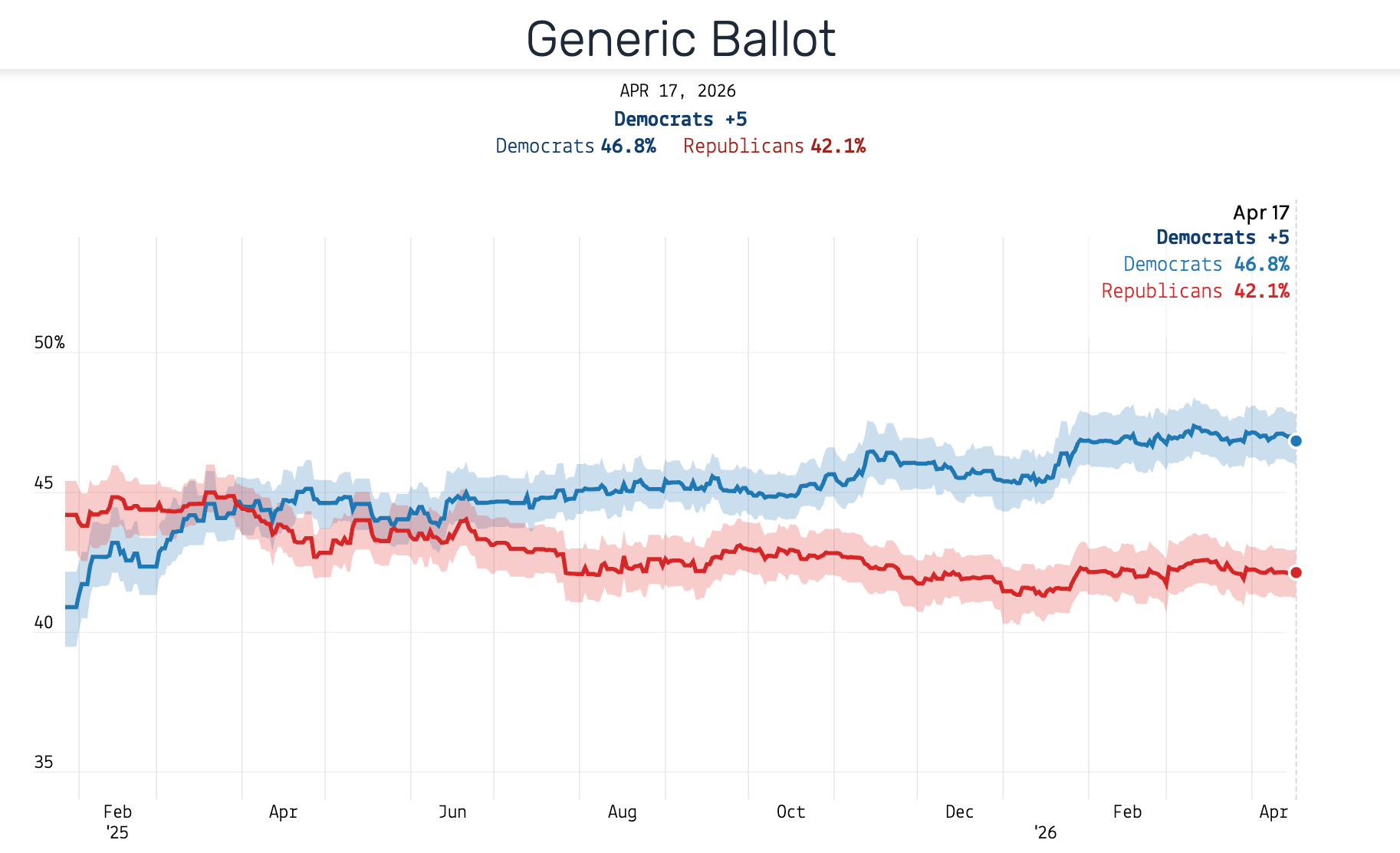
Democrats have held their lead on the 2026 U.S. House generic ballot at +5 (after rounding) over the last week, with 47 percent of registered voters saying they’ll cast their ballot for Democrats this fall versus 42 percent for the Republicans.
Trump’s job approval
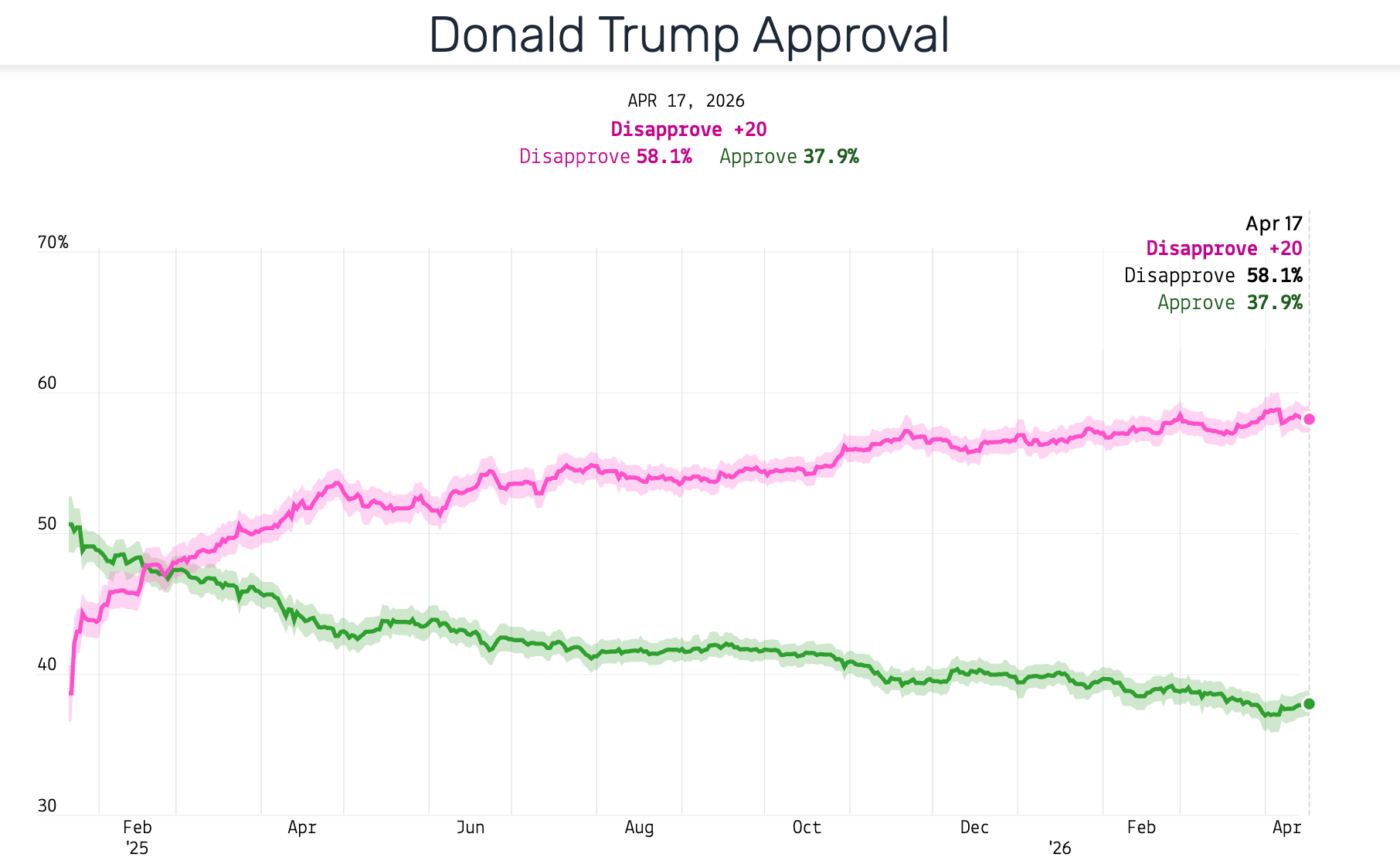
President Trump’s approval rating rose within the margin of error to 37.9 percent this week, while the percent of Americans who disapprove of the job he is doing also was flat at 58.1 percent. His -20 rating among all adults continues to be a historical low for this point in a president’s term, except for Richard Nixon’s rating during watergate.
Paid subscribers to 50+1 get access to premium analysis, plus sortable tables and complete data access on our polling website. If you want to follow the 2026 cycle with the best data at your fingertips, become a paid subscriber.