



Welcome to The Trendline, FiftyPlusOne’s weekly polling roundup. Subscribe to get it delivered straight to your inbox and get bundled access to our polling website.
On Thursday, April 2, 2026, President Donald Trump fired Attorney General Pam Bondi, a move that had been rumored to be in the works for some time. Bondi joins former Secretary of Homeland Security Kristi Noem as the second cabinet-level official to lose their job in Trump’s second term, within the space of less than a month. So this week on The Trendline, we’re taking a look back on how Americans have viewed Bondi, her handling of her job, and the Department of Justice under her leadership.
At the time of her appointment, the public seemed more or less okay with the choice. In a YouGov/The Economist survey taken just as Trump was being inaugurated (Jan. 19 - 21, 2025), 40 percent of respondents said they approved of her nomination, while 32 percent disapproved. Of the 9 cabinet-level appointees asked about in the survey, this net approval of 8 points was the second strongest, beaten only by approval of Marco Rubio as nominee for Secretary of State (48 percent approved, 32 percent disapproved).
This initial support came in the context of a wave of media, in which Bondi promised ahead of her confirmation vote that she would not “politicize” the Justice Department, and that justice would be “administered evenhandedly” through the country. Compared to some of Trump’s other picks, such as Secretary of Defense Pete Hegseth or Secretary of Homeland Security Robert F. Kennedy Jr., Bondi was seen as a more conventional choice: a state attorney general being elevated to the federal level.
Bondi was confirmed on Feb. 2, 2025, and quickly stumbled into her first mistakes. On Feb. 21, 2025, she told Fox News host John Roberts that the Epstein “client list” was “sitting on my desk right now to review,” causing months of speculation about what she might mean. Later that month, she released the “Epstein Files Part 1,” largely consisting of material that had previously been made public. By July, the Justice Department had denied Bondi’s claims, releasing a memo saying that there was no evidence Epstein was murdered, or that a “client list” existed.
Bondi did not fare well in the polling after this memo was published. In an AtlasIntel survey at the time (Jul. 13 - 18, 2025), 74 percent of voters said they believed that an authentic client list existed based on Bondy’s February statements, and 54 percent said that the DOJ was engaged in “a cover-up of Trump’s previous relationship with Jeffrey Epstein.” Asked if Bondi should remain Attorney General “after the DOJ’s July 2025 memo contradicted her earlier statements about a Jeffrey Epstein ‘client list’,” 28 percent said they thought she should remain, while 51 percent said she should resign.
And while the scandal of the Epstein investigation has swirled in the background throughout Trump’s second term, it’s hardly the only issue Bondi has had to contend with. Facing pressure from Trump, the Justice Department began several prosecutions and investigations into Trump’s perceived enemies, such as James Comey in September 2025 and Leticia James in October 2025. (Both cases were later dismissed in court.)
These moves also didn’t sit particularly well with the public. In a Marquette Law School poll (Nov. 5 - 12, 2025), 55 percent of respondents said that the Justice Department had “filed unjustified cases against Donald Trump’s political opponents,” while 45 percent said the cases were justified. In the same poll, 58 percent said that cases filed against Trump in 2022-2024 were justified, while 42 percent thought they were unjustified, indicating that the public wasn’t just concerned about cases against political figures, but the Trump Justice Department in particular. And in a survey from YouGov/The Economist (Sept. 26 - 29, 2025), 55 percent of respondents said they thought Trump was “directing the Justice Department to go after his political enemies,” while just 25 percent said they thought he wasn’t.
This sentiment has persisted over time: in a YouGov/The Economist poll taken this month (Mar. 13 - 16, 2026), the same question was asked. In that poll, 56 percent of respondents said they thought Trump was using the Justice Department to go after enemies, while 23 percent disagreed. And the Epstein controversy has continued to swirl, as more files have been released and, controversially, some have not. Voters continue to be skeptical of the administration on the issue. In a University of Massachusetts/YouGov survey taken last week (Mar. 20 - 25, 2026), 59 percent of respondents agreed that the Trump administration is “hiding important information about the Epstein case,” while 18 percent disagreed and 24 percent said they “neither agree nor disagree.”
Throughout each of these scandals, Bondi’s unpopularity has continued to grow. While favorability or approval for cabinet level officials is not asked in every survey, we compiled all the instances where YouGov/The Economist asked respondents about Bondi’s favorability.
While her favorable rating has barely changed over time (it has been between 22 and 27 in every instance), her unfavorable rating has slowing grown, from 24 percent in late January to 48 percent in the most recent survey, conducted March 6 - 9, 2026. And in that survey, Americans also said that they supported Bondi’s firing more than any other Cabinet secretary, both in raw numbers and on net.
In all, Bondi served through a tumultuous time in the DOJ. Americans’ initial support and optimism of her nomination as a potentially more conventional Cabinet member was challenged almost immediately by her handling of the Epstein investigation, and her continued perceived missteps only served to increase her unpopularity. Now, we wait to see who Trump will nominate to try to pick up the pieces.
Other polling nuggets
If you think modern smartphones have gotten too big, you are not alone. According to a new Ipsos survey (Mar. 24 - 25, 2026), eight in ten adults say they prefer a smartphone they can operate with one hand, and the same share say it’s essential that their phone fit into a standard pocket without sticking out or feeling bulky. A majority (51 percent) say modern smartphones have become too wide to grip securely and comfortably, and nearly half (49 percent) wish there were more smaller options on the market. Fewer than half (48 percent) say they’d be willing to accept a bigger, heavier device in exchange for more screen space — suggesting that for most people, the tradeoff just isn’t worth it.
If you could go to the moon — and were guaranteed a safe return — would you? According to a new YouGov survey (Apr. 1, 2026), a slim plurality of Americans say yes: 44 percent said they’d want to make the trip, while 40 percent said they would not (15 percent weren’t sure). Younger Americans were more likely to say they would take the trip, with 53 percent of those under 31 saying they’d go to the moon compared to just 31 percent among seniors. Women also took the less risky approach, saying 50 to 33 percent they would not take the trip, compared to 56 percent of men who said they would.
A new Washington Post/George Mason University poll of Virginia’s redistricting referendum finds a tight race ahead of the April 21 election. In a poll that has Trump’s approval rating at 40% among registered voters, the referendum is ahead by just 6 points, 53 to 47 percent. The narrow margin may come down to turnout: 85 percent of Republican and Republican-leaning independents said they are certain to vote or already have, compared to 77 percent of Democrats. Early voting data has reinforced those concerns, with ballots in Republican-leaning districts outpacing those in Democratic-leaning ones.
Polling averages update
All numbers are as of 11:00 AM Eastern on April 3, 2026.
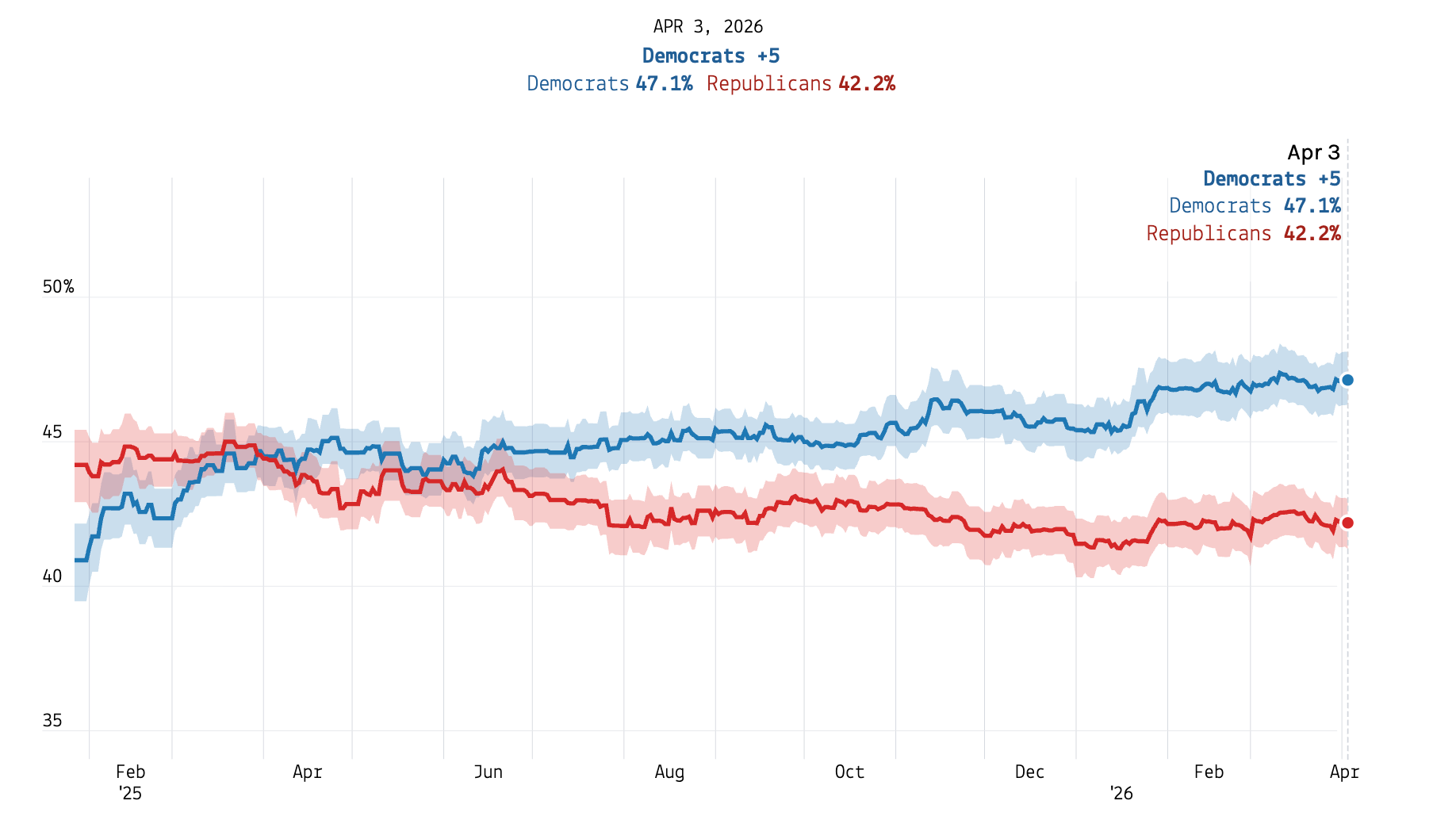
2026 U.S. House generic ballot
Democrats have held their lead on the 2026 U.S. House generic ballot at +5 (after rounding) over the last week, with 47 percent of registered voters saying they’ll cast their ballot for Democrats this fall versus 42 percent for the Republicans.
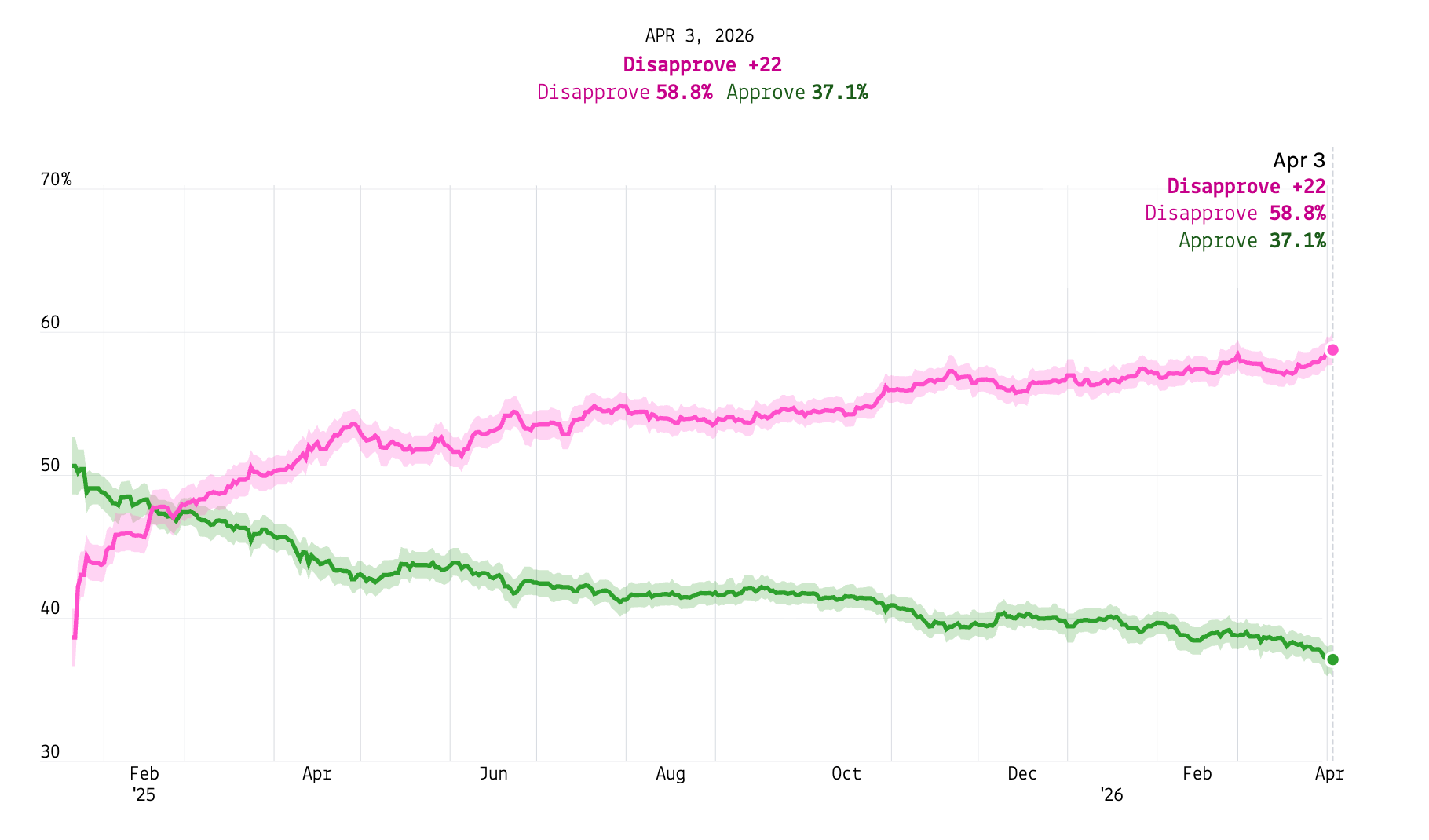
Trump’s job approval
Another week, another new low in President Trump’s approval rating. He fell to 37.1 percent approval as of Friday morning, a new low for his second term and rivaling his lowest point ever after the Jan. 6 riot at the U.S. capitol. The percent of Americans who disapprove of the job he is doing also rose from 57.8 to 58.8 percent. The net rating of -21.7 is also a new low.
Paid subscribers to 50+1 get access to premium analysis, plus sortable tables and complete data access on our polling website. If you want to follow the 2026 cycle with the best data at your fingertips, become a paid subscriber.