



Welcome to The Trendline, the FiftyPlusOne.news weekly polling roundup. Subscribe to get it delivered straight to your inbox and get bundled access to our polling website.
It’s summertime, which means the Supreme Court is in the news again.
The court’s overall approval rating has been abysmal for years now, and according to the latest YouGov/Economist poll conducted earlier this week (Jul. 3 - 6, 2026), most of the justices’ personal favorability ratings are in the gutter as well. Only the three liberal justices have positive net favorability ratings, while the six conservative members are underwater to varying degrees.
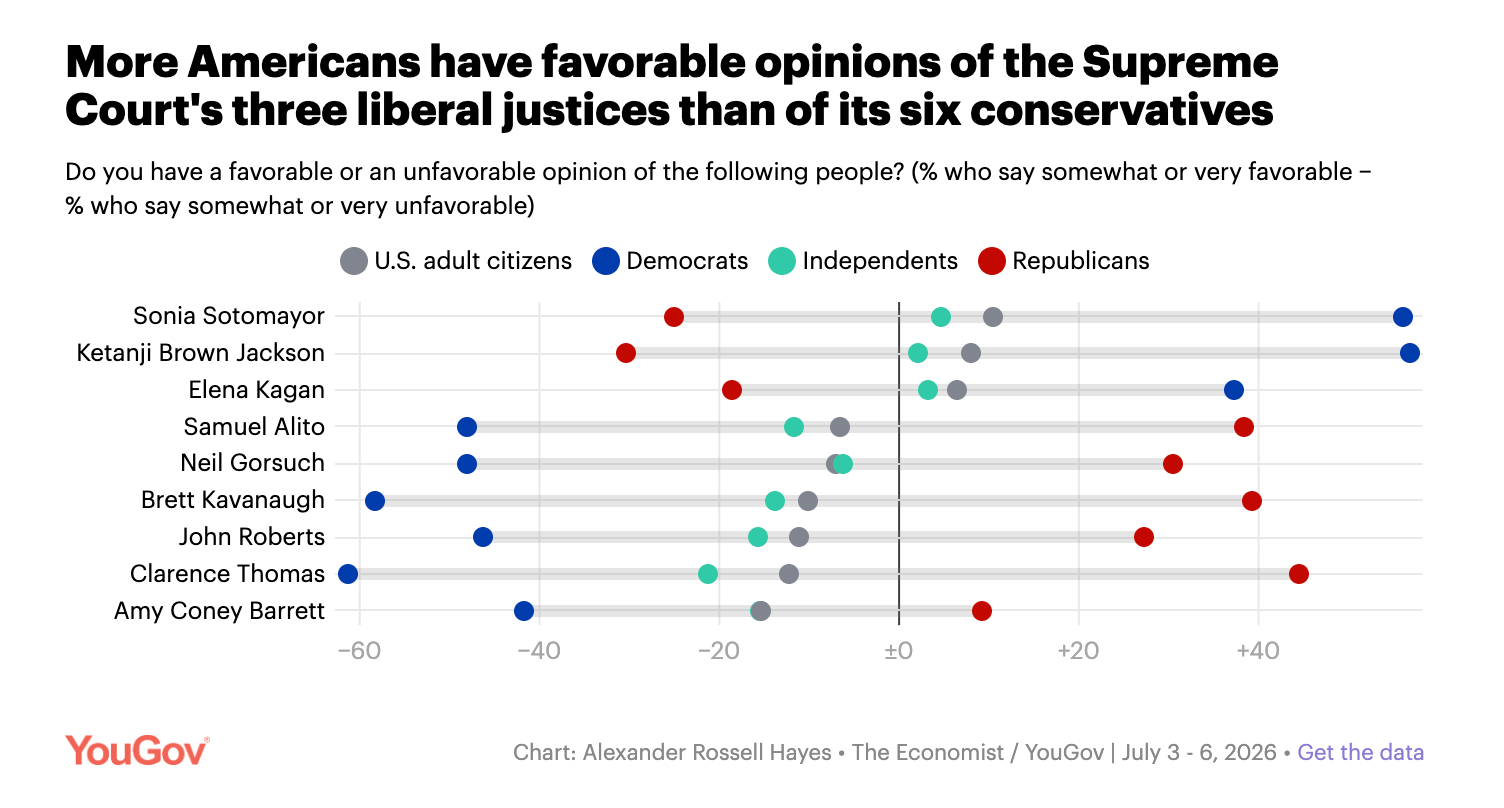
Part of this gap is partisan: In every case, Democratic respondents in the poll were more likely to express an opinion about the justices than Republican respondents. But among independents, the least likely group to express an opinion, we see the same pattern: Every Democratic-appointed justice has a net-positive favorability rating, and every Republican-appointed justice has a net-negative rating.
The decisions they authored this year probably won’t do much to help their numbers. The court closed its term last week with highly consequential rulings on birthright citizenship, transgender athletes, and campaign finance law, and it might come as little surprise that many of the most controversial decisions this year were unpopular with the public.
According to SCOTUSPoll, an annual survey conducted by researchers at the University of Texas and Harvard University, a majority of the public agreed with the court’s decision in only six of 14 major cases decided this term. On average across the cases that SCOTUSPoll tracked, less than half (48 percent) of the public agreed with the Supreme Court’s eventual ruling.
It’s certainly not all bad news for the court; some of the biggest decisions of the term, including those surrounding birthright citizenship and President Trump’s authority to impose tariffs on other countries, were also the ones most supported by the public.1 But many others, including decisions surrounding campaign finance law and a pair of 2nd Amendment challenges to gun regulations, were deeply unpopular.
Opinion on a lot of these cases isn’t particularly strong, with over half falling between 40 and 60 percent support, so we should probably approach them with a healthy amount of caution. Polling about Supreme Court cases can be especially susceptible to question wording bias, since most Americans are often unfamiliar with the details of each case and don’t have strong opinions yet. Because of that lack of familiarity, public opinion is often quite malleable, particularly during the buzzy period just after a ruling is handed down.
The SCOTUSPoll survey was conducted in the spring, before most of the major cases of the term were decided. That means that public sentiment could have shifted, perhaps dramatically, in the months since, as voters were exposed to a barrage of news coverage and reactions from politicians in the wake of each decision. When support or opposition for a ruling is hovering in the 40s or 50s, there’s a good chance that either the question wording or the news coverage surrounding a decision could significantly impact public opinion. It’s probably a good idea not to draw too many sweeping conclusions from the results for those “squishy” cases where voter sentiment isn’t as clear-cut.
But beyond the specific cases of this term, the public also seems uneasy with the amount of deference the Supreme Court has shown to Trump and conservative causes. In the YouGov/Economist poll, 45 percent of respondents said the court’s recent decisions had given the president too much power, versus 9 percent who said they’d given him too little power, and 29 percent who felt they had given him “about the right amount of power.”
In another YouGov poll from May, 61 percent of adults said that the justices “often let their own personal or political views influence their decisions,” and in a separate question just 25 percent said that the court was impartial in its decisions, compared to 49 percent who said they tended to favor one group or another.
The Court’s term is done, so we probably won’t be hearing much about them for at least a few months. But there are rumors swirling about potential retirements, so there may be more to come soon. I certainly wouldn’t want these numbers hanging over my head as I start my summer vacation.
Other polling nuggets
On Wednesday, Maine Democratic Senate candidate Graham Platner dropped out after new allegations of sexual assault surfaced. The focus now shifts to deciding who will replace Platner on the ballot, which is ultimately up to the state Democratic party. A number of candidates have thrown their hats into the ring, including former state Senate President Troy Jackson, Secretary of State Shenna Bellows, and epidemiologist Nirav Shah, all of whom ran unsuccessfully last month in the Democratic primary for governor.
The limited public polling we have so far shows Jackson may be best positioned to defeat Republican Sen. Susan Collins in November, but it’s a bit too early to know anything for sure. The day before Platner dropped out, PPP conducted a flash poll for his campaign, testing various hypothetical head-to-head matchups against Collins to see if the oyster farmer was still viable — and if not, who might be. The results showed Jackson performing the best of the group, and he was the only candidate tested who polled ahead of Collins (by five points, 49 percent to 44 percent). Bellows and Shah were tied with Collins, while Platner, Gov. Janet Mills, and former U.S. Senate candidate Jordan Wood were all trailing the GOP senator. A Wedgewood Polls survey conducted right before news of the latest allegations became public also showed Jackson ahead by 5 points, 48-43 percent.
But a Z to A Research poll released yesterday and conducted for 314 Action, a super PAC supporting Shah, showed a more mixed bag. Of the three candidates tested, Jackson actually performed the worst, trailing Collins by two points, while Bellows was tied and Shah was up a point. Ultimately, though, all three of the matchups were well within the margin of error and should be considered a statistical tie.On the heels of a controversial red card given to U.S. striker Folarin Balogun during a World Cup match against Bosnia-Herzegovina (and its subsequent last-minute reversal), the U.S.’s round-of-16 match against Belgium became the most-watched soccer game in American history. Earlier this week, HarrisX/2Way asked Americans what they thought about the red card debacle, and among the half of respondents who had an opinion, the results were resounding. Thirty percent of Americans said Balogun did not deserve the red card, while just 16 percent said he did (54 percent said they weren’t sure). Thirty-two percent said FIFA was right to reverse the decision, while 19 percent said the red card should have stood. But following reports that Trump personally lobbied FIFA President Gianni Infantino to suspend the red card, most Americans seemed to think he crossed a line. Forty-seven percent said that Trump’s actions weren’t appropriate, while 24 percent said they were and 28 percent weren’t sure. All the drama surrounding the red card and reversal didn’t end up mattering much in the end, though: Belgium handily dismantled the U.S. team 4-1.
Support for Israel continues to slide among Democrats and the public as a whole, according to an AP-NORC poll conducted last month. According to the poll, the share of respondents who said the U.S. “wasn’t supportive enough” of Israel fell from 25 percent in 2024 to 18 percent in June. At the same time, the share of adults who said the U.S. was “too supportive” of Israel in its conflict with Palestinians inched up to 40 percent from 37 percent in January 2024. Among Democrats, though, the increase was more pronounced, going from 45 percent in 2024 to 58 percent in June.
Polling averages update
All numbers are as of 11:00 AM Eastern on July 10, 2026.
2026 U.S. House generic ballot
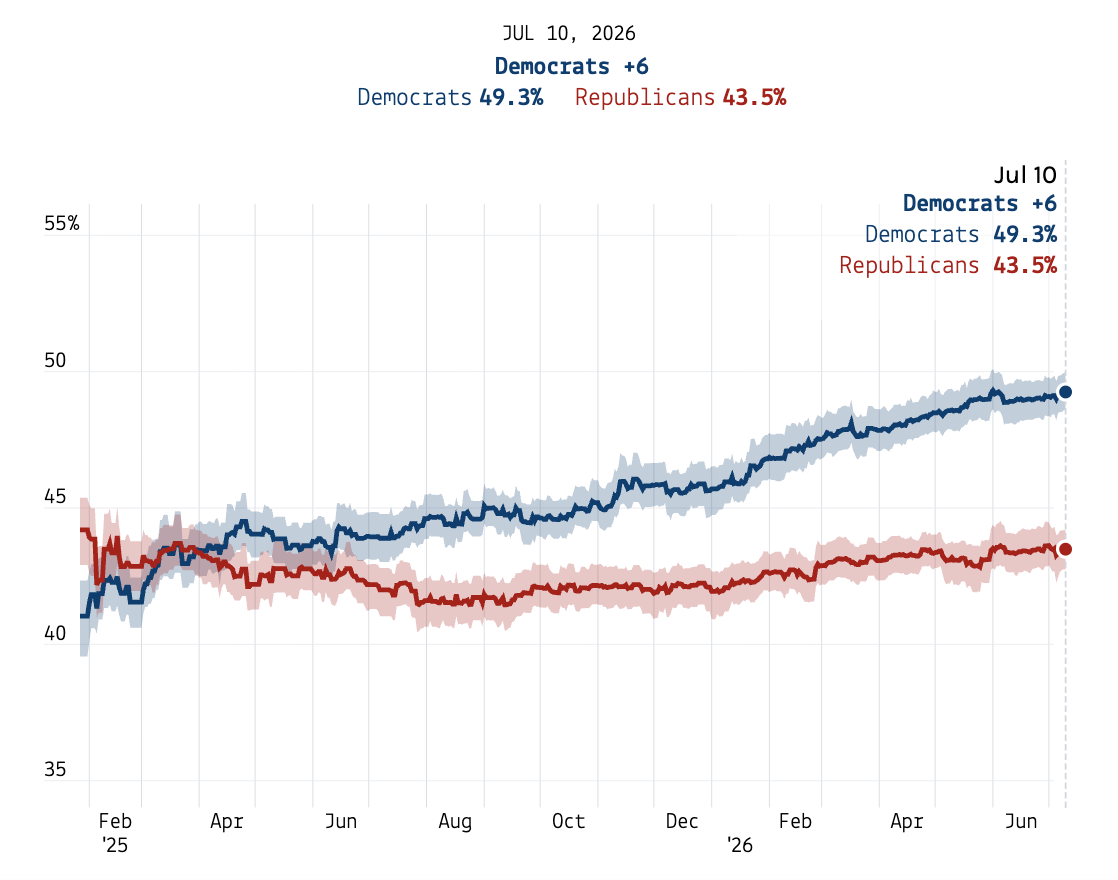
The Democratic margin in the 2026 U.S. House generic ballot remained stable this week, rounding to 6 points. Currently, about 49.3 percent of likely voters say they plan to vote for a Democrat in November, while 43.5 percent say they plan to vote for a Republican.
Trump’s job approval
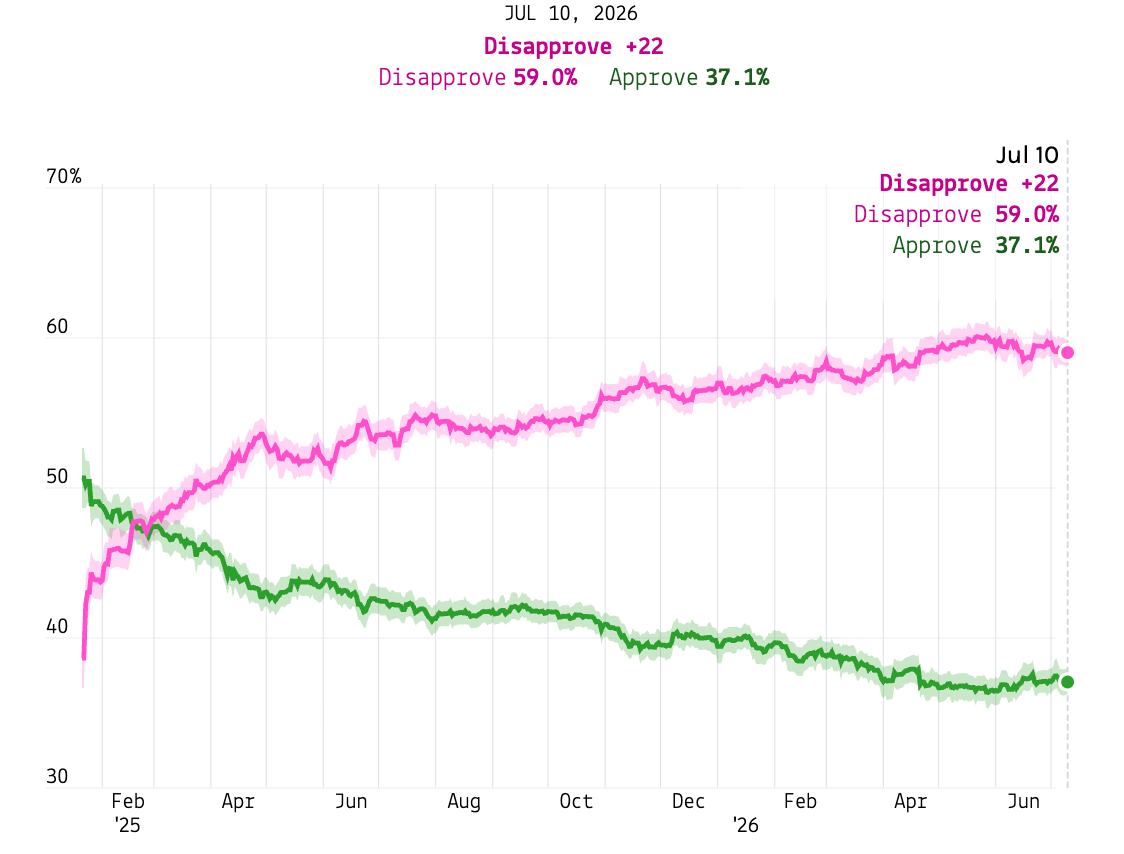
President Trump’s approval rating among U.S. adults barely budged this week, with his approval staying the same and disapproval dropping 0.4 percent. An average of 37.1 percent of Americans approve of the president, while an average of 59 percent disapprove.
Paid subscribers to 50+1 get access to premium analysis, plus sortable tables and complete data access on our polling website. If you want to follow the 2026 cycle with the best data at your fingertips, become a paid subscriber.
Though, as Mary Radcliffe explained in a previous edition of The Trendline, polling on birthright citizenship can be somewhat hard to interpret.