



Welcome to The Trendline, FiftyPlusOne’s weekly polling roundup. Subscribe to get it delivered straight to your inbox and get bundled access to our polling website.
On Thursday, April 30, Maine Governor Janet Mills ended her bid for the Democratic nomination for U.S. Senate, leaving Graham Platner — a 41-year-old oyster farmer, Marine Corps veteran, and progressive newcomer — as the all-but-certain Democratic nominee against Republican Senator Susan Collins this fall. Mills, who is 78, had entered the race in October with the backing of Senate Minority Leader Chuck Schumer, a head start in name recognition, and a pitch built around her record as a two-term governor in a swing state.
By April, multiple polls had Mills trailing badly. A late-March Emerson College survey put Platner up 55 to 28 percent. A University of New Hampshire poll in February had him up 64 to 26. Her late-stage attack ads, focused on Platner’s old social media posts, didn’t move the polls. Given these numbers, as well as a significant fundraising deficit, her exit wasn’t really a surprise.
Despite his baggage (Platner recently had a tattoo common among Neo-Nazis covered up, and made misogynistic and racist remarks in old social media posts), plenty of factors boosted Platner. He is an effective fundraiser, credibly makes an anti-establishment case that is popular among both the progressive left and MAGA right, and scored big early endorsements from high-profile U.S. Senators including Vermont’s Bernie Sanders. But one other factor may have been the most important: Platner is young, while Mills is old. The race became, as Platner framed it, a contest between old and new ideas. And when it comes to age, Americans overwhelmingly favor the new.
In a new Marist University/NPR/PBS News poll conducted late April, 8 in 10 Americans said they support both maximum age limits and term limits for members of Congress. The agreement crosses party lines, with 78 percent of Democrats backing both ideas, and between 80 and 90 percent of Republicans favoring age caps and term limits. Older voters were also about as likely to favor age caps as younger ones.
This survey echoed findings from a Reuters/Ipsos poll conducted earlier this year. In that survey, 89 percent of U.S. adults agreed that members of Congress should have term limits, and 85 percent said they should face a mandatory retirement age. Seventy-nine percent agreed with the broader statement that elected officials in Washington are too old to represent most Americans, including 76 percent of Republicans and 86 percent of Democrats.
But in that poll, Americans favored age limits not just for members of Congress, but every federal office. Seventy-one percent of adults favored an age limit for president, including 81 percent of Democrats and 64 percent of Republicans. Support for age limits for House and Senate members is roughly the same. And regarding the Supreme Court — from which justices retire on average well into their 80s — 68 percent of Americans favor age limits.
When it comes to winning elections, the sweet spot may be younger than you think. A YouGov poll (March 27 - 30, 2026) found a plurality of adults say the age at which Congresspeople “are generally best able to fulfill the duties of serving” is between 40 and 49. Zero percent of respondents said the ideal age for a member of Congress is above 70, and 80 percent said 75 years is “too old” to run.
YouGov also asked which prominent figures in government respondents thought were too old to do the job. Joe Biden topped the list at 82 percent, but a majority said the same thing about Donald Trump (57 percent) and Bernie Sanders (also 57 percent).
Mills’ effective defeat in the Maine Democratic primary for Senate shows how toxic age has become in modern politics. Given the choice between a younger and older candidate, YouGov’s poll found, 46 percent of Americans chose young and only 11 percent chose old. Platner now heads to a general election against incumbent Republican Senator Susan Collins, who at 73 is seeking a sixth term in Washington. She will have to head off the same attacks that sank the current governor.
Other polling nuggets
Last week, King Charles III made a state visit to the United States, an occasion met with much pomp and circumstance (and media coverage). Americans, however, don’t seem much to care: In an Ipsos poll (May 1 - 3, 2026), just 25 percent said they had been following the story very or somewhat closely. For comparison, 74 percent said they were following stories about gas prices and the cost of living, and 46 percent said they were following stories about redistricting. And when it comes to the U.S.-British relationship, Americans appear to be moving away from the United Kingdom. In May 2024, 48 percent told Ipsos that they agreed there is a “special relationship” between the two nations. That number is down to 34 percent in the most recent survey — and the number who disagree has risen from 5 to 13 percent (the rest either neither agree nor disagree or are unsure).
Americans are split on the recent Supreme Court ruling that changed its interpretation of Section II of the Voting Rights Act, according to a survey by YouGov Blue/The Downballot (Apr. 30 - May 4, 2026). Given a description of the case and outcome, 34 percent said they generally agreed with the ruling, 46 percent said they generally disagreed, 12 percent said they neither agreed nor disagreed, and another 7 percent said they weren’t sure. Asked whether the Voting Rights Act was still needed to protect against racial discrimination in elections, a majority (55 percent) said yes, 31 percent said no, and 14 percent were undecided.
Voters are not happy with Trump’s foreign policy decisions, according to a recent Marist University/NPR/PBS News poll (Apr. 27 - 30, 2026). Sixty-two percent of registered voters told the pollster that Trump’s decisions as president had weakened the United States’ role on the world stage, while 38 percent said his decisions had strengthened it. Among Democrats, 94 percent said his decisions had weakened the U.S.’ standing; 67 percent of independents and 22 percent of Republicans agreed.
Forty percent of Americans say the biggest sin of their countrymen is greed, according to new YouGov polling (May 7, 2026). Asked which of the Seven Deadly Sins (a Catholic concept dating back to the 4th century) Americans commit the most, 40 percent said greed, far more than the next highest responses of gluttony (11 percent), lust (9 percent), and pride and envy (tied at 8 percent). When it comes to their own sins, though, Americans are far less likely to confess: just 5 percent said the sin they commit the most is greed, behind pride and lust (tied at 12 percent) and envy and sloth (tied at 10 percent).
Polling averages update
All numbers are as of 10:00 AM Eastern on May 8, 2026.
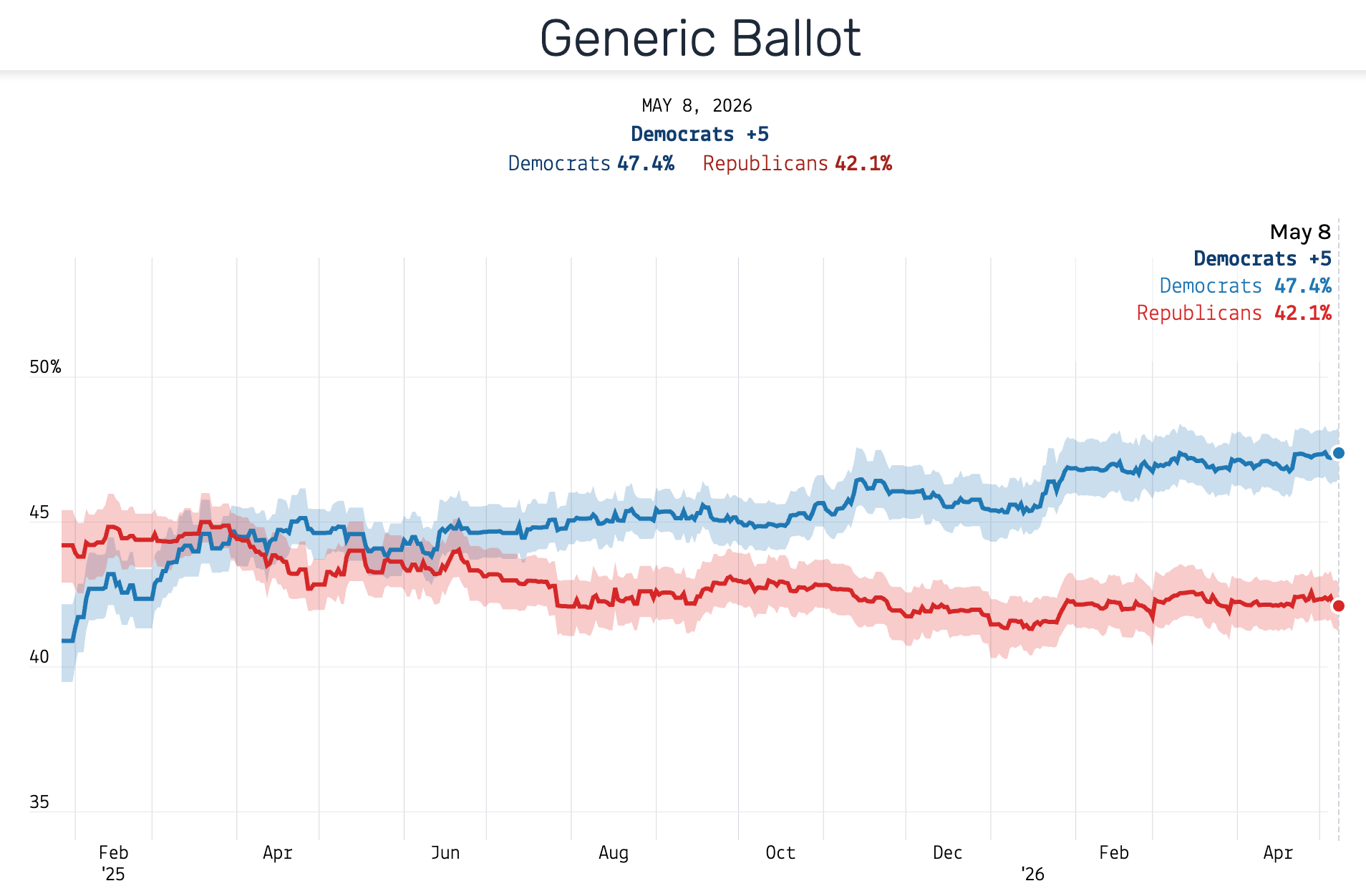
2026 U.S. House generic ballot
Democrats have held their lead on the 2026 U.S. House generic ballot at +5 (after rounding) over the last week, with 47.4 percent of registered voters saying they’ll cast their ballot for Democrats this fall versus 42.1 percent for the Republicans.
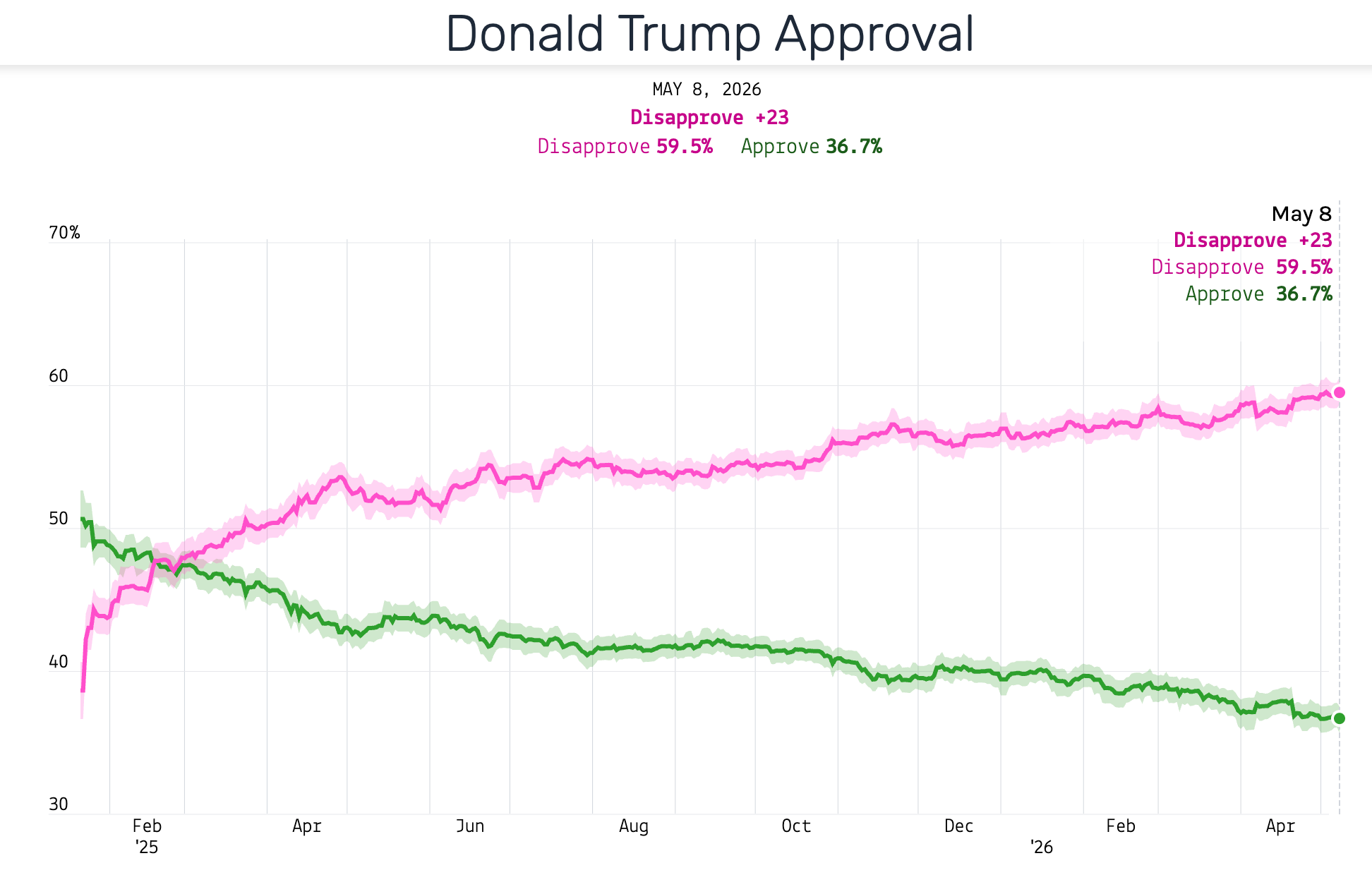
Trump’s job approval
President Trump’s approval rating among U.S. adults held steady at an all time low of 36.7 percent this week, while the percent of Americans who disapprove of the job he is doing rose within the margin of error to 59.5 percent.
Paid subscribers to 50+1 get access to premium analysis, plus sortable tables and complete data access on our polling website. If you want to follow the 2026 cycle with the best data at your fingertips, become a paid subscriber.