



Welcome to The Trendline, the FiftyPlusOne.news weekly polling roundup. Subscribe to get it delivered straight to your inbox and get bundled access to our polling website.
There’s been a lot of talk in recent weeks about the Democratic Socialists of America, as DSA candidates across the country have been running (and winning) in primary races in deep blue districts and cities. So today we’re taking a look at the official DSA platform to find out how the American people feel about some marquee DSA policies. For each policy we’ll examine the DSA platform language and take a look at polling about those issues. Of course, we don’t have time to look at every policy on the website, so we’ve chosen a handful that seem to be getting the most attention.
Healthcare
The official DSA platform language on healthcare is as follows.
Guarantee universal healthcare at no cost to individuals, including complete access to reproductive and gender-affirming care. Expand healthcare access and quality by investing in new public hospitals and clinics. Make all medical education and training public and free.
The first bit here on guaranteeing universal healthcare is commonly referred to as “Medicare for all.” Generally speaking, the idea of the government providing healthcare to every citizen is above water with the American people. For example, in a recent survey by Tavern Research for Zeteo and the Searchlight Institute (Jun. 24 - 26, 2026), 52 percent of likely voters said they would support “the U.S. automatically enrolling every American in a comprehensive government-administered health insurance plan,” while just 19 percent opposed the idea.
However, when you give people more information, support often drops. For example, when the pollsters added information to the question indicating that such a program would be “funded through significantly increased federal taxes,” support fell to 40 percent, and opposition rose to 29 percent. And asked whether they would switch from their current private health insurance plans to a federal program with similar monthly payments, only 30 percent of respondents said they would switch while 70 percent preferred to remain with their current provider.
As for access to reproductive healthcare and gender affirming care provided by the government, it doesn’t seem that the DSA has the public on their side. In a 2024 study by the University of Maryland Program for Public Consultation (Jun. 18 - Jul. 3, 2024), voters were asked to rank how acceptable certain policies are on a scale of 0 (totally unacceptable) to 10 (totally acceptable). Limiting federal funding for abortion was rated as unacceptable (0-4) by less than half — 45 percent — of respondents nationally. Twenty percent rated it as a 5 out of 10 — which the pollster referred to as “tolerable” — and 35 percent rated the policy as acceptable (6-10). Regarding gender affirming care, a 2025 poll from the Pew Research Center (Feb. 10 - 17, 2025) showed only 22 percent of Americans support requiring health insurance to cover gender transition-related medical care, so it seems unlikely that a majority would support the government funding it.
Green New Deal
The official DSA platform language on the Green New Deal is as follows.
Workers must lead our democratic transition to a green future. Pass a federal jobs guarantee. Implement massive investment in sustainable, publicly owned energy and transit infrastructure. Phase out the use of fossil fuels. Reclaim and repair our earth’s resources for all.
Voters have indicated support for a federal jobs guarantee for years. In 2024, Jacobin found that, on average, support for such a program was almost 60 percent. More recently, polling from The Argument/Verasight (May 29 - Jun. 3, 2026) found that 71 percent of voters supported a program “where the federal government would guarantee a job to any adult citizen,” with pollster Lakshya Jain writing that this was “among the most popular proposals I’ve ever tested in any poll.”
Americans also support increased funding for transportation infrastructure, according to a June poll by Morning Consult/The Associated General Contractors of America (Jun. 1 - 7, 2026). In that poll, 47 percent said that they thought federal highway, bridge, and transit funding should be increased, 32 percent said it should be kept the same, and only 7 percent said it should be reduced. When it came specifically to transit, 70 percent said they supported more funding for public transit systems, with just 18 percent opposed.
However, on phasing out fossil fuels, the DSA seems to be going in the opposite direction as the American people. According to a March survey from the Pew Research Center (Mar. 16 - 22, 2026), the percentage of Americans who say that expanding fossil fuels should be a higher priority than expanding wind and solar energy has grown from 20 percent to 42 percent in the last 6 years, while those saying renewables should be a higher priority has shrunk from 79 percent to 57 percent. And slightly more Americans — 38 percent — say the federal government should encourage oil and gas drilling than say it should discourage it — 28 percent.
On the other hand, the Pew survey also finds that Americans strongly support the government encouraging production of wind and solar power, with 65 percent saying so, while just 9 percent say the government should discourage production of renewable energy. So while the DSA may not have the public in hand on phasing out fossil fuels, an increased focus on developing renewable energy could be more popular.
Israel/Palestine
The official DSA language related to Israel and Palestine is as follows.
Recognize the rights of the Palestinian people, including the right of return, the right to resist military occupation, and the right to self determination in a free Palestine with Jerusalem as its capital. End all military and economic aid to Israel. Prosecute U.S. and Israeli leaders responsible for the genocide in Gaza.
American opinion on the Israeli-Palestinian conflict has shifted dramatically, according to decades of polling from Gallup. In the most recent survey (Feb. 2 - 16, 2026) Americans say their sympathies lie more with the Palestinians than the Israelis — the first time this has been the case in Gallup polling going back to 2001. Both independents and Democrats are more sympathetic to Palestinians than Israelis, while Republicans are significantly more sympathetic to Israelis than Palestinians. Favorable views of Israel have fallen to their lowest level since 1989.
Throughout the poll series, Americans have supported an independent Palestinian state. Support has reached a recent high of 57 percent with just 28 percent opposed, higher than at any time since 2003. However, the survey does not specify that such a state would have Jerusalem as its capital, as called for in the DSA platform. While I was unable to find polling with that specific provision, it’s likely that — as we see with Medicare for all — support would decline when specifics were detailed in poll questions.
As to ending military and economic aid to Israel, the DSA seems to have the public closer to their side. In a July poll from Emerson College (Jul. 19 - 20, 2026), 61 percent of likely voters said that the federal government spends too much on aid to Israel. However, completely ending aid may be less popular than simply reducing it. A July survey from Ipsos/The Washington Post (Jul. 8 - 13, 2026) showed that only 29 percent of Americans supported fully ending military support to Israel. Another 26 percent said it should be reduced. So while Americans agree with the DSA that our federal budget spends too much on Israel, it’s not clear that they’d be on board with a complete termination of funding.
Criminal Justice Reform
The official DSA language related to criminal justice and policing is as follows.
Demilitarize police departments, disempower police unions, and redirect funding to public services as steps towards fully abolishing the police and prison system which protects the rich and jails the poor. Treat drug addiction and mental illness as health issues, not crimes. End qualified immunity and empower civilian oversight bodies with real authority over the police.
When it comes to abolishing the police and prison system, the DSA is decidedly on the wrong side of public opinion. A July poll by Change Research (Jul. 13 - 17, 2026) asked about some DSA-related policies, including this. Asked if they supported “ending prisons and policing as they currently exist, including cutting police budgets toward zero and releasing people from prison,” just 13 percent of voters said they supported the policy, while 80 percent were opposed. In a simpler question from an RMG Research/Napolitian News Service poll (Jul. 13 - 14, 2026), 68 percent of voters said they would be less likely to vote for a candidate who supported “defunding the police,” while 15 percent said they would be more likely.
Nevertheless, there are some elements of the DSA platform that are popular with voters. In a 2025 poll from YouGov (Oct. 28 - Nov. 3, 2025), voters favored ending qualified immunity by 23 percentage points, 54 to 31. And policies related to police oversight had enormous support, including making it easier for the federal government to charge officers for using excessive force (supported by 69 percent) and creating a federal registry for complaints against officers (supported by 72 percent).
The YouGov survey also showed mixed opinions on redirecting funding to public services. Asked whether they would support “budgeting less money for your local police department and more for social services (for instance, funding social workers and mental health professionals),” 46 percent of respondents said they were in favor, while 38 percent were opposed and 16 percent were unsure. But as with the more recent surveys, opinion was clear on defunding the police: the policy was underwater by 40 percentage points.
There are, of course, many other policies in the DSA platform that have varying levels of support among the public. For example, their call to invest in new, publicly-owned housing is generally popular, while their call for reparations to Black Americans is not. Many of their policies related to electoral reform would find favor with the American people, such as ending Citizens United and getting money out of politics. Others might not, like ranked choice voting. Still others might be more mixed, such as making Washington, D.C. a state.
Opinions on the DSA platform reflect the complexity of how Americans view policy. The details underlying each proposal span the gamut of popularity, with some aspects overwhelmingly favored among the electorate and others deeply underwater. How these candidates ultimately fare in future elections may hinge on which policies they emphasize, and whether they are able to jettison the least popular ideas in order to win over voters.
Other polling nuggets
A poll from Politico/Public First (Jul. 13 - 15, 2026) found that voters across the political spectrum overestimate how much gas prices have increased since Trump took office. While gas prices have, on average, increased just $0.67 since Trump’s inauguration, according to Politico, 23 percent of respondents say gas has risen in their area by $3 or more. Another 17 percent said prices have risen by between 2 and 3 dollars, and 25 percent said they’ve risen by between 1 and 2 dollars. Of course, respondents may be having a difficult time with the timeline here. Gas prices fell in the first year of Trump’s administration before rocketing up due to the conflict in Iran, so respondents may be comparing current prices to the more recent lows rather than the beginning of Trump’s term.
Opposition to AI data centers continues to grow, according to the latest Emerson College poll (Jul. 19 - 20, 2026). A significant majority, 63 percent, of likely voters said they would oppose data centers “being built in or near your community,” up from 42 percent in December 2025. Just 27 percent said they would support the centers, down from 33 percent in December. Opposition is strongest among Democrats, with 77 percent opposed, compared to 66 percent of independents and 47 percent of Republicans.
Nearly one in three Americans are sharing their bed with at least one furry friend according to a YouGov poll (Jul. 24, 2026). Thirty-one percent said they sleep with at least one pet, including 10 percent who said they sleep with 2 or more. And unlike the divisive issues of our time, sleeping with a pet is bipartisan: 32 percent of Democrats, 30 percent of independents, and 30 percent of Republicans are all sharing their beds with at least one furbaby. Sweet dreams, folks.
Polling averages update
All numbers are as of 1:00 PM Eastern on July 24, 2026.
2026 U.S. House generic ballot
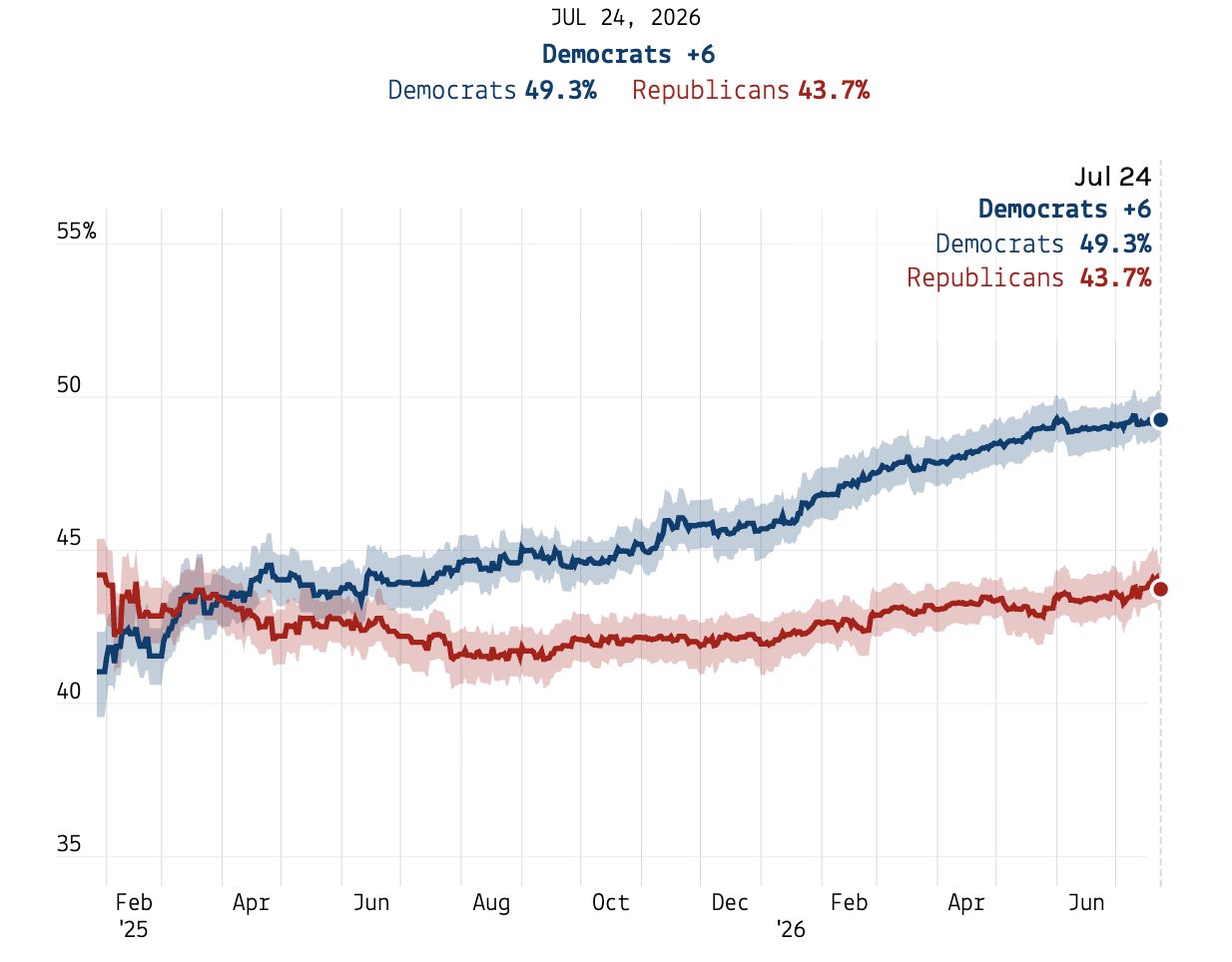
The Democratic margin in the 2026 U.S. House generic ballot rounded to 6 points this week, up from 5 points last week. Currently, 49.3 percent of likely voters intend to vote for a Democrat in November, compared to 43.7 percent who plan to vote for a Republican.
Trump’s job approval
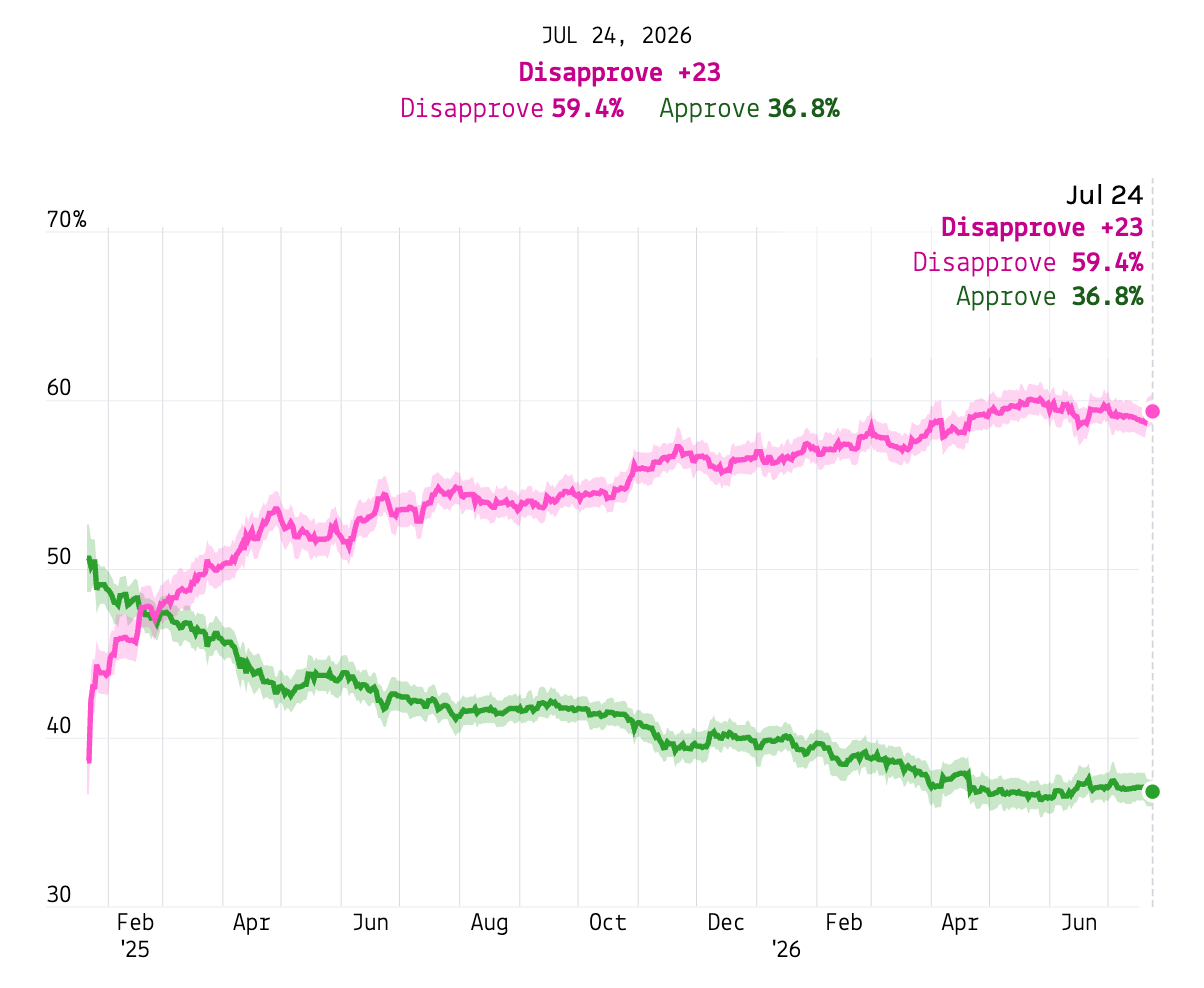
President Trump’s approval rating among adults decreased this week, from 37.1 percent approval to 36.8 percent. At the same time, disapproval rose from 58.9 to 59.4 percent.
Paid subscribers to 50+1 get access to premium analysis, plus sortable tables and complete data access on our polling website. If you want to follow the 2026 cycle with the best data at your fingertips, become a paid subscriber.