



Welcome to The Trendline, the FiftyPlusOne.news weekly polling roundup. Subscribe to get it delivered straight to your inbox and get bundled access to our polling website.
This week marked the official start of the Supreme Court’s new term, though the justices have been ruling on emergency appeals all summer long. In July, I wrote about how most of the court’s notable rulings from last term were unpopular with Americans, and how every member of the court’s conservative majority has a negative favorability rating. That’s all still true, and the high court’s ratings haven’t gotten any better as it heads into another packed term.
In FiftyPlusOne’s average of polls, the share of Americans who disapprove of the job the Supreme Court is doing is higher than anytime going back to at least 2020, when Amy Coney Barrett joined the court. The court’s net approval rating is -14 percentage points, rivaling the lowest net rating since we began tracking SCOTUS approval polls.
And in Gallup’s latest polling (Sept. 1 - 17, 2026), trust in the judicial branch of the federal government hit its lowest level on record, with just 46 percent of Americans saying they had a great deal or a fair amount of trust in the courts. Amidst this cloud of dissatisfaction with the federal judicial system, the Supreme Court will hear multiple high-profile cases over the next months, ranging from LGBTQ rights to gun control to immigration and voting restrictions. In today’s Trendline, we’ll take a look at how Americans feel about the issues coming before the court, and where the justices may already align with public opinion.
One of the cases before the court this term surrounds President Donald Trump’s decision early last year to ban transgender Americans from serving in the military on the grounds that they do not have the “high mental and physical” abilities required to serve. We haven’t seen many recent polls on the subject, but multiple surveys in 2025 suggested that Americans were opposed to this ban and supported allowing transgender people to serve in the military.
A majority (53 percent) of Americans in an Ipsos/Washington Post poll (Feb. 13 - 18, 2025) opposed the ban, while 42 percent said they supported the restrictions. Gallup (Jan. 21 - 27, 2026) found similar levels of support, with 58 percent of adults saying transgender people should be allowed to serve in the military, while 38 percent supported a ban. That level of support was down from years prior, though, when two-thirds or more of Americans favored allowing transgender servicemembers in Gallup’s polling.
Many Americans may not have super strong feelings on the subject, though; when an AP-NORC poll (May 1 - 5, 2025) gave respondents an option to say they “neither favored nor opposed” a ban, 36 percent chose it. That compares to the 37 percent who supported allowing transgender servicemembers and 26 percent who were opposed.
Another high-profile case the Supreme Court will hear this term is whether or not to allow laws that ban assault weapons, like AR-15s. This case isn’t deciding whether to ban assault weapons nationwide, but rather whether state or local bans on these kinds of weapons violate the Second Amendment. YouGov polling earlier this year (Apr. 28 - 30, 2026) found that 63 percent of Americans support banning assault-style weapons, while just 25 percent oppose a ban and 12 percent weren’t sure. In general, Americans favor stricter gun control measures — 68 percent of likely voters in a Tavern Research/Searchlight Institute poll (June 24 - 26, 2026) said that it should be harder to buy a gun in the U.S., while just 20 percent said it should be easier.
The Supreme Court will also hear challenges to some of Trump’s immigration policies, including mandatory detention for immigrants living in the U.S. and his administration’s decision to deport immigrants to countries other than their home ones. In a University of Massachusetts/YouGov poll (Mar. 20 - 25, 2026), 63 percent of adults opposed deporting immigrants to countries that they aren’t from, while just 13 percent supported such a policy (24 percent said they were neither supportive nor opposed). But a recent Public First/Politico poll (Sept. 13 - 15, 2026) showed more support for the policy, though a large share weren’t sure — 38 percent of respondents were in favor of the policy, while just 21 percent opposed it. But 27 percent said they neither supported nor opposed the measure, and another 13 percent said they didn’t know, meaning many Americans may not feel very informed on the subject.
Question wording may have played a role here, too — the University of Massachusetts poll phrased the policy as “deporting undocumented immigrants to a country they are not from.” But the Public First/Politico poll worded it a bit differently, instead describing it as “sending people with rejected asylum claims to other countries while they wait to be returned.” The University of Massachusetts wording (including the emphasis) might have nudged respondents away from the policy, while the comparatively milder wording of the Politico poll could have had the opposite effect.
Voting laws will also come before the court this term, including one from Arizona that requires proof of citizenship when registering to vote and another that mandates regular voter roll purges of residents who can’t confirm their citizenship. These laws seem to have broad support from the public, at least in the abstract. A YouGov/The Economist poll (Mar. 13 - 16, 2026) earlier this year showed 59 percent of Americans supportive of policies that require proof of citizenship when registering to vote, with only 29 percent opposed. And in a separate Public First/Politico poll (Apr. 11 - 14, 2026), 52 percent said they supported requiring proof of citizenship to vote, with only 18 percent opposed. Respondents in the Politico poll were supportive of voter roll purges too, with 47 percent in favor and 22 percent opposed. A large chunk of respondents weren’t sure though, with 19 percent saying they neither supported or opposed the purges, and another 13 percent saying they weren’t sure.
A couple of other notable cases are on the docket this term as well, including one that will determine whether states can require public schools to display the Ten Commandments. Fifty percent of Americans supported such a requirement in a Pew Research poll (Apr. 6 - 12, 2026), while 48 percent were opposed. And kicking off the term earlier this week was a case that will decide whether municipalities can sue oil and gas companies for damages linked to climate change. A poll last year from Data for Progress (Mar. 28 - 30, 2025) showed 65 percent of likely voters opposed granting legal immunity to oil and gas companies for climate change-related lawsuits, though the poll was conducted for the climate advocacy group Fossil Free Media.
The Supreme Court will hear many cases this term outside of the ones mentioned here, and they’re certain to receive more emergency appeals even beyond the cases already scheduled for full argument. Approval of the current iteration of the court may already be pretty entrenched (and negative). But in at least some of these high-profile cases, public opinion seems aligned with the conservative position. That could leave some valuable, albeit rare, opportunities for the justices to issue a popular ruling.
Other polling nuggets
The Protect College Sports Act passed the Senate last week, though it may face a tougher hurdle in the House. While just 17 percent of Americans have heard of the act, according to Ipsos (Oct. 2 - 4, 2026), when they’re told about the provisions, they are in favor. Sixty percent support a cap on how much universities are allowed to pay athletes, and 55 percent support limiting an athlete’s eligibility to five years. When it comes to limiting college athletes to one transfer, a plurality (43 percent) of Americans are in favor of the provision, though even more (45 percent) are unsure. College sports fans, on the other hand, are strongly in favor of the rule, with 61 percent supporting it and just 10 percent opposed.
According to the latest KFF poll (Sept. 16 - 21, 2026), 85 percent of Americans say that our healthcare system needs at least major changes, including 36 percent who say it needs to be completely overhauled. Two-thirds supported Medicare-for-all, up from 53 percent in October 2020. Part of that support may be some confusion about what a Medicare-for-all policy might look like: 65 percent believed that if such a plan were implemented, they would be able to keep their current health insurance. And when given some of the downsides, support slid: 64 percent opposed Medicare-for-all if it would require most Americans to pay more in taxes, and 76 percent opposed it if it would lead to delays in people getting treatment. On the other hand, support increased when respondents were given potential positives: 75 percent supported Medicare-for-all if it would eliminate health insurance premiums and reduce out-of-pocket costs, and 76 percent supported it if it would guarantee health insurance as a right for all Americans.
Trump made news this week when he published Sen. Tom Cotton’s personal cell phone number during a dispute about eliminating Daylight Saving Time. According to YouGov (Oct. 2 - 5, 2026), 63 percent of Americans side with the president, supporting eliminating the clock changes, while just 15 percent are opposed. However, more Americans would prefer preserving permanent Daylight Saving Time (42 percent) rather than permanent Standard Time (28 percent). And while some have proposed that individual states make decisions about whether or not to change the clock, that doesn’t have much public support: Just 23 percent say states should make the decision, while 43 percent say it should be up to the federal government (another 9 percent say states should be able to choose between a more limited set of options).
Polling averages update
All numbers are as of 12:00 PM Eastern on Oct. 9, 2026.
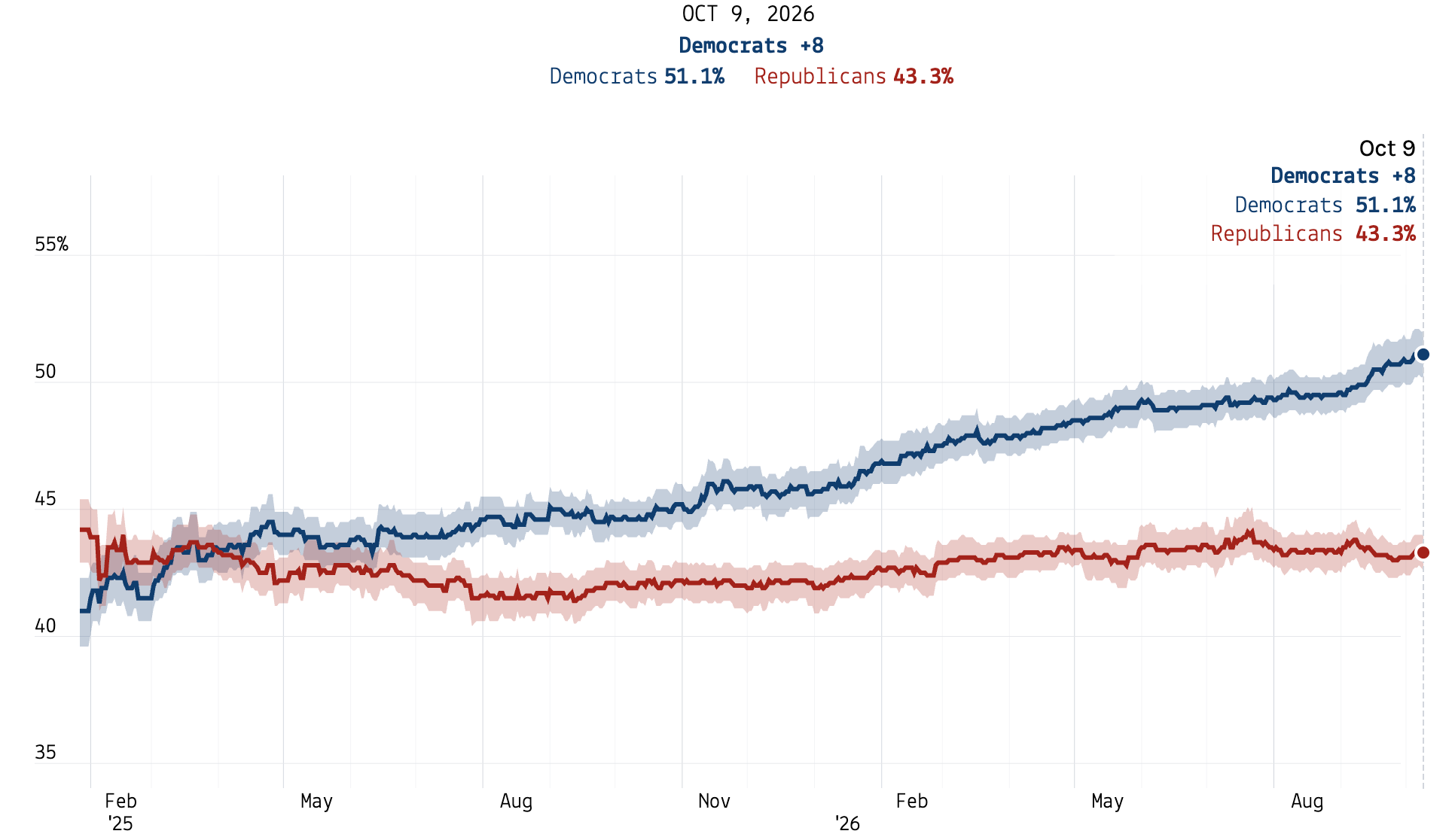
2026 U.S. House generic ballot
The Democratic margin in the 2026 U.S. House generic ballot remained steady this week, with Democrats still ahead of Republicans by 8 percentage points. Currently, 51.1 percent of likely voters indicate that they plan to vote for a Democrat in November, while 43.3 percent plan to vote for a Republican.
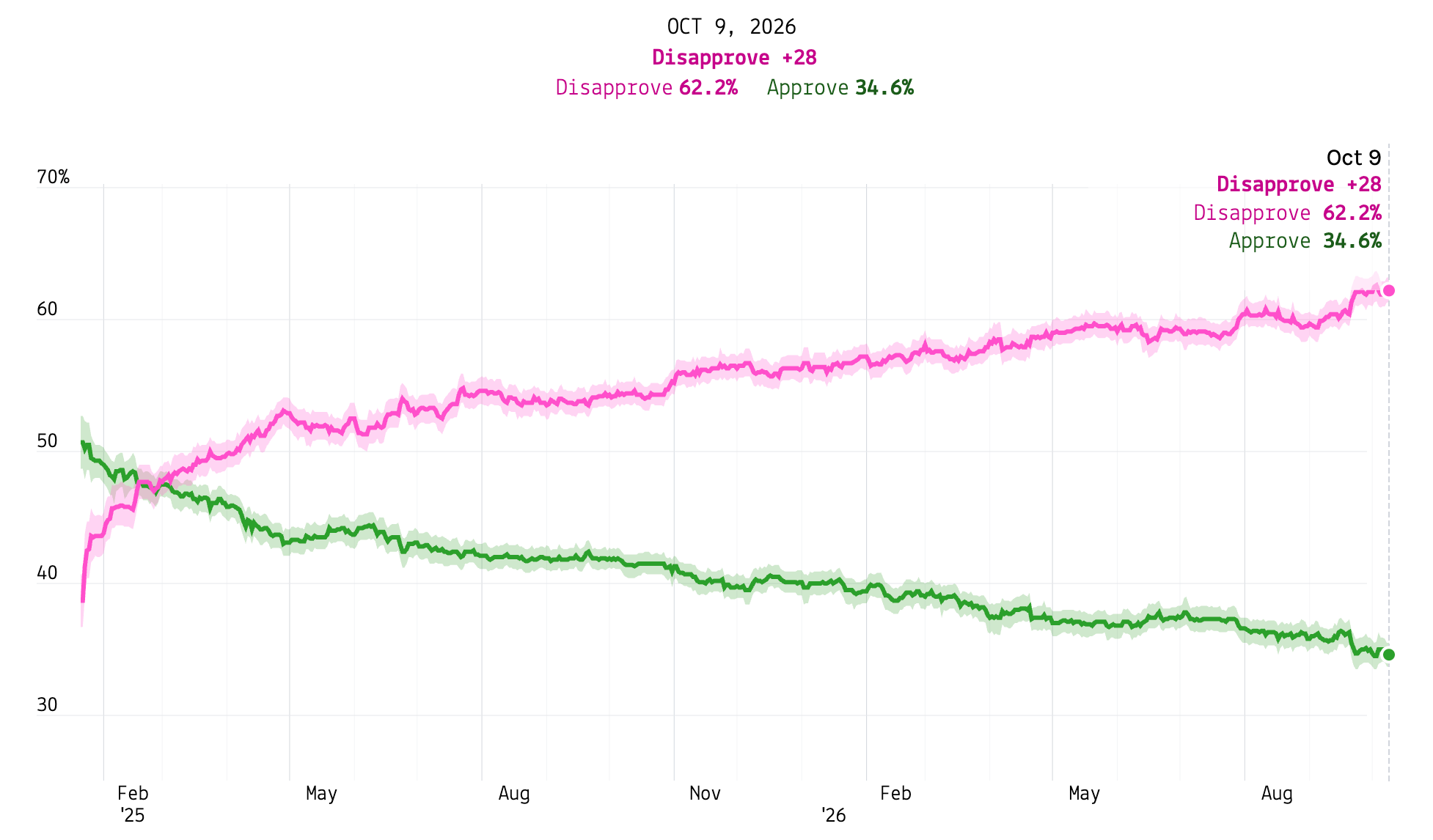
Trump’s job approval
President Trump’s net approval rating among U.S. adults remained steady this week, at -28 percentage points. Overall, 62.2 percent of Americans disapprove of the president’s job performance, while 34.6 percent approve.
Paid subscribers to 50+1 get access to premium analysis, plus sortable tables and complete data access on our polling website. If you want to follow the 2026 cycle with the best data at your fingertips, become a paid subscriber.