



Welcome to The Trendline, FiftyPlusOne’s weekly polling roundup. Subscribe to get it delivered straight to your inbox and get bundled access to our polling website.
On February 14, 2026, the U.S. Senate failed to reach an agreement on funding for the Department of Homeland Security, the federal department that houses agencies such as Immigration and Customs Enforcement, the Coast Guard, and the Transportation Security Administration. This triggered a partial government shutdown affecting only the DHS. Democrats insisted that funding not be provided to ICE until changes are made to the way they enforce immigration laws, and Republicans insisted that the entire department be funded together. (Early Friday morning, March 27, Republicans in the Senate gave in and voted in favor of the Democratic plan to fund all offices in DHS except for ICE. The bill now heads to the House of Representatives.)
In the early days of the shutdown, barely anyone noticed (or cared). In an RMG Research/Napolitan News Service poll (Feb. 23 - 24, 2026) conducted 10 days after the shutdown began, just 57 percent of registered voters knew that there was a partial government shutdown ongoing. And only 4 percent of respondents said that the shutdown had “a lot” of impact on their daily life.
For comparison, that is far less than people knew about the shutdown last fall. In a poll taken at a similar point in the life of the fall shutdown (Oct. 13 - 14, 2025), 74 percent knew there was a government shutdown. During the fall shutdown, voter awareness grew over time: In the RMG Research/Napolitan News Service polling, by early November last year, 85 percent of voters knew there was a shutdown.
But this time around, it’s not clear that voters have tuned in in the same way. In a YouGov/CBS News poll taken last week (Mar. 17 - 20, 2026), just 55 percent said they were following news about the shutdown very or somewhat closely. And a third of respondents said they weren’t sure of the Democrats’ or Republicans’ positions on the issue (in reality, this is probably an underestimate, since some respondents might reflexively defend their “side” rather than admit they don’t know what’s going on).
Even so, in the early days of the current shutdown, it looked like the Democrats had a decent level of support for their position. In a Navigator Research poll (Feb. 19 - 23, 2026), 58 percent of voters said they agreed more that congress should “withhold funding from ICE until it changes its approach, even if that means shutting down the Department of Homeland Security,” while 34 percent agreed that they should “continue to fund ICE in its current form to reopen the Department of Homeland Security.”
However, as TSA agents have gone weeks without a paycheck, Americans are starting to see chaos at the nation’s largest airports. Hundreds of TSA agents have quit, and some airports have reported call-out rates among agents of up to 40 percent. And while Americans may not be paying close attention to the shutdown, they certainly noticed the consequences: in a YouGov poll this week (Mar. 25, 2026), 65 percent of Americans said that security wait times at airports were longer than average or among the longest they’ve ever been. Just 10 percent said they were average or shorter than usual. When asked how much the shutdown had increased wait times, 57 percent said “a great deal,” and another 16 percent said “a moderate amount.”
This increased attention on airports and TSA may have weakened Democrats’ hand on the issue. While the February polling from Navigator Research showed Democrats’ position ahead by 24 points, in a mid-March survey (Mar. 12 - 16, 2026), that support had cooled. Using slightly different question wording than the February survey, the March poll found that 49 percent of registered voters preferred Congress to “withhold all funding from the Department of Homeland Security, including funding for the TSA (Transportation Security Administration), until ICE changes its approach,” while 36 percent preferred Congress to fully fund the department, a margin of just 13 points.
As the chaos increased, several approaches to resolve the situation were proposed. Elon Musk offered to pay TSA agents temporarily. Senators offered a compromise deal that would fund parts of DHS, including TSA, but would not include funding for ICE and some other immigration-related departments. Earlier this week, President Donald Trump rejected both of these proposals, instead sending ICE agents to support the TSA in some airports. According to a Verasight/Strength in Numbers poll (Mar. 24 - 25, 2026), both these moves were underwater: Americans disapproved of deploying ICE to airports by 13 percentage points, and disapproved of Trump rejecting the Senate compromise by 31 percentage points.
Finally, in the wee small hours of Friday morning, the Senate went ahead and passed their compromise funding deal, despite the president saying he didn’t support it. And Trump, perhaps realizing how much stress this was causing to American travelers (63 percent of Americans told YouGov that disruptions and delays at airports are very or somewhat stressful), also found a workaround: on Thursday evening, he declared a national emergency, opening a pathway for him to spend funds on pay for TSA agents without having to wait for Congress to allocate them.
It’s yet to be seen whether these moves will help alleviate the travel stress plaguing Americans. We don’t know how quickly DHS will be able to issue backpay for agents, and with hundreds having already quit their jobs, there may still be disruption at some airports. However, it’s quite possible that if the issues with the TSA are more or less resolved via Trump’s emergency declaration, this shutdown will fade back into the background again. That could lead it to drag on even longer if Trump vetoes the legislative solution Senators have crafted, or the House fails to pass it. The shutdown last fall was 43 days, the longest in American history; today is day 41 of the DHS shutdown, so we could be poised to make history again.
Other polling nuggets
Americans’ top foreign policy priority related to the war in Iran is keeping gas prices low, a new poll from the Associated Press and NORC finds (Mar. 19 - 23, 2026). The survey asked U.S. adults how important it was for the U.S. to pursue four goals in foreign policy: preventing gas prices from rising, preventing Iran from obtaining a nuclear weapon, preventing Iran from threatening Israel, and replacing Iran’s government with one that is “friendlier to U.S. interests.” In total, 67 percent of adults said it was extremely or very important to keep gas prices low, whereas 65 percent said the U.S. needed to keep Iran from getting a nuclear weapon and 39 percent said it was important to protect Israel. Regime change was the least popular goal; just 33 percent of Americans said it was extremely or very important to replace Iran’s government with a more friendly alternative.
A new Fox News poll (Mar. 20 - 23, 2026) finds half of voters say they are falling behind in daily economic life, and 7-in-10 say neither party has a plan to bring prices down The 46 percent who say they are personally falling behind financially is near the survey’s all-time record — and 61 percent say they wouldn’t be able to pay their bills if they missed more than two paychecks. That’s up from 54 percent in 2023.
For the first time in Gallup’s post-pandemic tracking, U.S. workers are more likely to say they are personally struggling in their lives (49 percent) versus thriving (46 percent). Just 28 percent of workers say now is a good time to find a quality job in the U.S., down from 70 percent in the middle of 2022. Job satisfaction has dropped across the board, but especially for federal workers: their happiness is down 12 points, double the decline among other workers.
Americans think artificial intelligence would probably beat them at picking stocks, but are far less confident in AI’s ability to forecast elections. In a YouGov poll (Mar. 25, 2026), 17 percent said they’d beat a chatbot in the stock market, while 29 percent thought the robots would win out. But when it comes to elections, 19 percent thought AI would do better, while 21 percent thought they would beat the chatbots.
Polling averages update
All numbers are as of 11:00 AM Eastern on March 27, 2026.
2026 U.S. House generic ballot
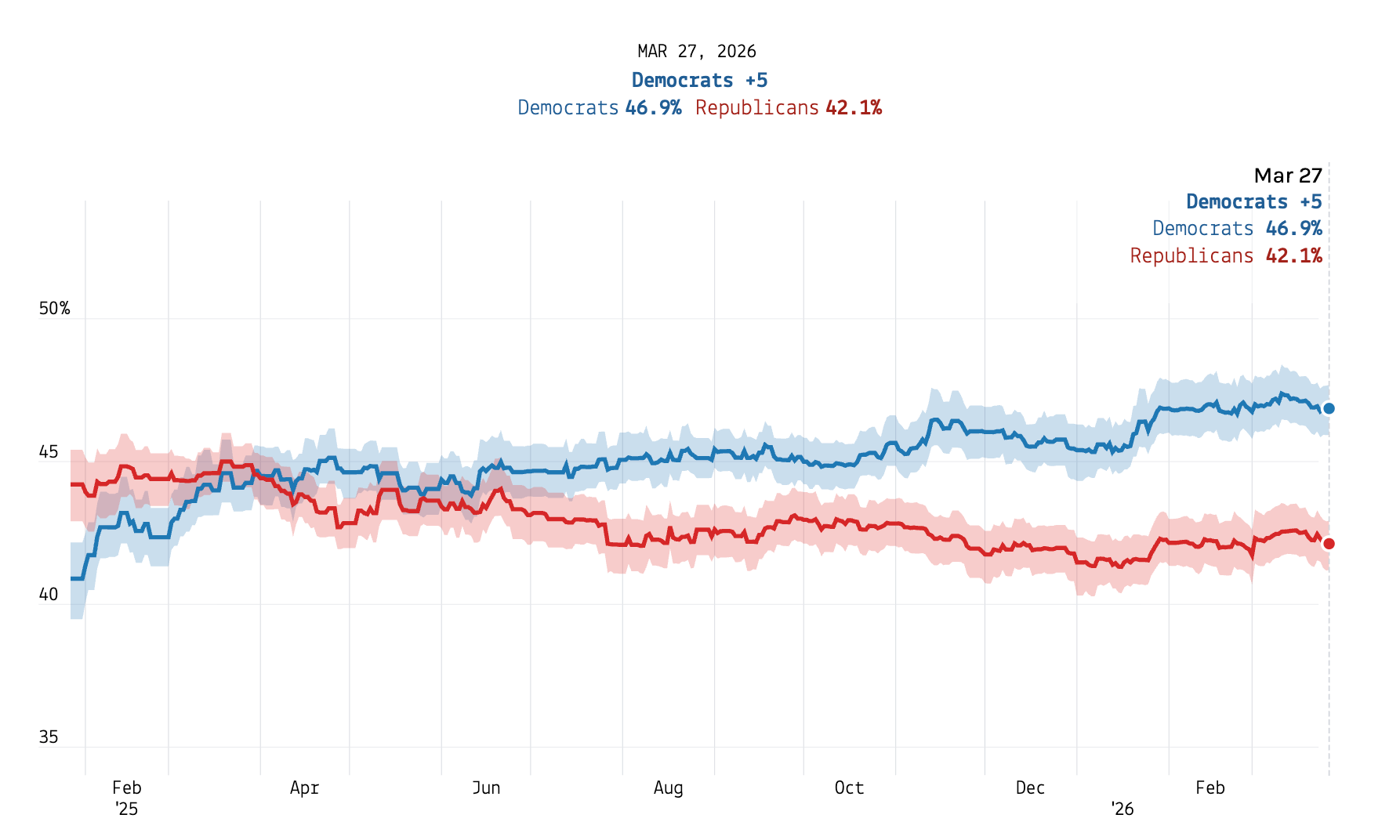
Democrats have held their lead on the 2026 U.S. House generic ballot at +5 (after rounding) over the last week, with 47 percent of registered voters saying they’ll cast their ballot for Democrats this fall versus 42 percent for the Republicans.
Trump’s job approval
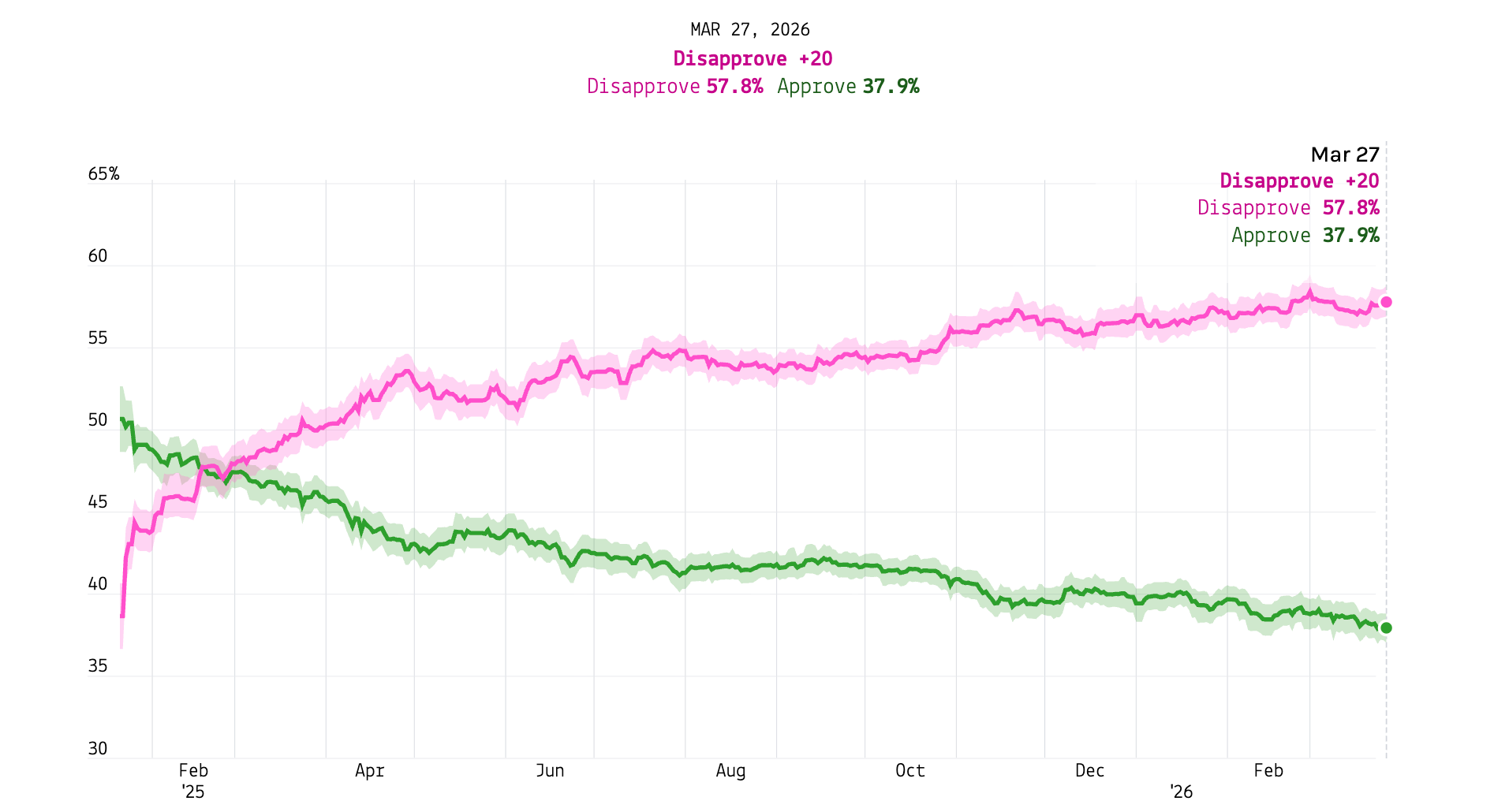
Another week, another new low in President Trump’s approval rating. POTUS sagged to 37.9 percent this week, the first time in his second term that his approval percentage started with the number 37. His disapproval rating also rose slightly from 57.2 to 57.8 percent. The net rating of -19.9 is also a new low.
Paid subscribers to 50+1 get access to premium analysis, plus sortable tables and complete data access on our polling website. If you want to follow the 2026 cycle with the best data at your fingertips, become a paid subscriber.