



Welcome to The Trendline, FiftyPlusOne’s weekly polling roundup. Subscribe to get it delivered straight to your inbox and get bundled access to our polling website.
In recent weeks, there have been a spate of new concerns about prediction markets, online betting sites where everyday Americans can gamble on pretty much anything. Concerns have been raised about insiders leveraging private information to make money on topics as diverse as the television show Survivor, the outcome of this year’s Academy Awards, and even possibly government officials betting on the war in Iran.
Amid the handwringing about whether the casino-ification of American life might be bad for society, Arizona Attorney General Kris Mayes brought criminal charges against Kalshi, one of the major players in the business, and Democratic politicians introduced legislation to ban bets on government actions, including war, and prevent insiders from trading on events where they either know or control the outcome.
So, what do Americans think about these markets? Who’s using them, and what are they using them for? This week on The Trendline, we take a look at what Americans have told pollsters about these new, often risky, financial markets.
Prediction market uptake approaching sports betting sites among young men
According to a poll conducted by Ipsos on behalf of the American Institute for Boys and Men (Feb. 27 - Mar. 1, 2026), most Americans aren’t all that familiar with prediction markets. Just 21 percent said they were very or somewhat familiar with the platforms, another 36 percent said they had heard of them, and 42 percent said they had not heard about them. When it comes to actually using these platforms, just three percent of respondents said they had used Kalshi, one more regulated online option, in the last six months, and 1 percent said they had used Polymarket, another prediction site that lets users wager with cryptocurrency pseudo-anonymously. To put that in context, according to the survey, 6 percent of respondents said they had used DraftKings in the past 6 months.
However, the Ipsos/AIBM poll also included an oversample of Americans under the age of 35. And among younger users, particularly young men, things look a bit different. Among men aged 18-24, 29 percent said they were familiar with prediction markets, and that jumps to 42 percent among men aged 25-34. Another third of young men said they had heard about these markets. And while just 3 percent of the population overall said they had used Kalshi in the past six months, that number more than doubles among young men: 7 percent of men aged 18-24 said they had used the platform, and 8 percent of men aged 25-34 said the same. Asked about a variety of betting-related apps, young men were much more likely than the population overall to say they had used them.
In another survey conducted by Echelon Insights for Paradigm (Feb. 13 - 18, 2026), 17 percent of voters said they had ever placed a bet on a prediction market. As with the Ipsos/AIBM poll, they find that these bettors tend to be younger, with 38 percent of those aged 18-34 saying they had placed a bet, compared to just 3 percent of those aged 65 and up. Moreover, both surveys show that nonwhite Americans are more likely to use prediction markets. For example, in the Echelon Insights/Paradigm poll, 13 percent of white Americans said they had placed a bet, while 25 percent of nonwhite Americans said the same.
As to what users are betting on, the dominant category is sports. Forty-eight percent of those who told Ipsos/AIBM they had used a prediction market in the last six months said they purchase sports contracts. (The sample size of respondents who told Ipsos/AIBM they used prediction markets in the last six months is 96, so treat this paragraph and the following chart with caution.) Following sports, 38 percent said they used the markets for politics contracts, and 36 percent said they used them for contracts related to financial markets.
The fact that sports contracts are so popular on these platforms has caused some consternation with the states. While the Commodity Futures Trading Commission (CFTC) currently holds authority over prediction markets, maintaining that they sell a narrow financial instrument called an “event” or “futures contract”, the authority to legalize and regulate sports betting resides with the states. Lawmakers in several states have argued that sports contracts on prediction markets amount to an illegal sports book, and a number of states are considering legislation to limit prediction markets’ ability to offer these and other controversial contracts. Others may follow in Arizona’s footsteps and bring lawsuits against the platforms.
Americans say prediction markets are effectively gambling sites
And frankly, it appears that Americans might agree with the states more than the feds in this case. In the Ipsos/AIBM poll, asked if various risky financial moves were more like gambling or investing, a majority (61 percent) of Americans said that event contracts on prediction markets were closer to gambling, while just 8 percent said they were closer to investing and another 18 percent said they were a mix of both. This is closer to what Americans said about more traditional gambling, like slot machines, than other new financial products, like cryptocurrency, and quite different from how respondents saw more traditional risky financial behavior, like retail investors buying individual stocks.
When it comes to legality of these markets, voters are also more skeptical about prediction markets than other forms of gambling. In the Echelon Insights/Paradigm poll, a majority of voters said that the lottery (61 percent) and casinos (57 percent) generally should be legal. And forty-five percent said that sports betting generally should be legal. But for prediction markets, just 35 percent said they should generally be legal.
As to how to regulate these markets, in the Ipsos/AIBM survey, 66 percent of Americans said that “no regulation at all” for prediction markets would be a bad idea, while just six percent said it would be a good idea. Majorities said they would support regulating them “like online/sports gambling (e.g., age 21+, state-level rules)” and “like financial investing/trading (e.g., age 18+, federal-level rules),” so either approach might satisfy the public’s desire to rein in these markets.
Voters are especially skeptical of some of the more controversial markets that have popped up in recent weeks, such as those about the outbreak of war or other classified military operations. In a Data for Progress poll (Mar. 13 - 15, 2026), 59 percent of likely voters said wagers “on potential government actions, ranging from what politicians will say in speeches to whether the U.S. will carry out a military strike” should not be allowed, compared to 28 percent who said they should. And when asked about a variety of contentious contract types, voters were overwhelmingly concerned about people using markets to gamble on political outcomes.
As prediction markets continue to expand into more and more domains of American life, we can expect that lawmakers will start trying to regulate (and tax) these industries. And so far, it looks like Americans will be on their side.
Other polling nuggets
The war in Iran is apparently contributing to rising economic pessimism. A new Economist/YouGov poll (Mar. 13–16, 2026) finds 59 percent of Americans say the economy is getting worse — the highest share to say so since October 2022, and up 6 points from the prior week, one of the largest one-week jumps recorded since 2017. The rise is driven mostly by Independents (up 10 points, to 66 percent) and Republicans (up 6 points, to 24 percent). The poll also finds a strong correlation with gas prices: among Americans who say gas prices are up a lot, 76 percent say the economy is getting worse — compared to only 39 percent among those who say gas prices are up a little.
Trust in federal public health institutions has declined sharply since Trump took office, and the shift is being driven primarily by Democrats, according to the latest Axios/Ipsos American Health Index (Mar. 6–9, 2026). 58 percent of Americans now trust the CDC, up slightly from 54 percent in October, but down from 66 percent in December 2024, with the FDA falling similarly to 53 percent, down from 60 percent in December 2024. On vaccines specifically, 73 percent agree that parents should follow the CDC’s recommended child immunization schedules, down from 81 percent in March, with the share who “strongly agree” falling from 51 percent to 36 percent. Democrats are still twice as likely as Republicans to strongly agree (59 percent vs. 28 percent).
A new NBC News poll (Feb. 27–Mar. 2, 2026) finds Americans’ views of Israel have almost entirely inverted over the past decade. When asked whether their sympathies lie more with Israelis or Palestinians, 40 percent of registered voters side with Israelis and 39 percent with Palestinians — compared to a 45–13 percent split in favor of Israel in 2013. The shift has been especially dramatic among Democrats: the share viewing Israel positively has fallen from 34 percent in 2023 to 13 percent in 2026, while negative views have spiked from 35 percent to 57 percent. Republicans have moved only slightly, with two-thirds still siding with Israelis. The shift is now actively shaping 2026 Democratic primaries, with candidates navigating pressure from both pro-Israel donors and anti-AIPAC activists.
Finland has once again topped the World Happiness Report — its ninth consecutive year at No. 1 — while the United States has continued to slide, according to a new Gallup report (published Mar. 18, 2026). The U.S. has declined from 17th to 23rd, a shift driven largely by lower life evaluations among young adults. The Nordic nations continue to dominate the top of the rankings, though Costa Rica entered the top five for the first time — the highest ranking ever for a Latin American country. In the U.S., Canada, Australia, and New Zealand, youth happiness has fallen by an average of 0.86 points on the 0-to-10 scale, bucking a global trend in which young people in most regions are happier today than 20 years ago.
Polling averages update
All numbers are as of 11:00 AM Eastern on March 20, 2026.
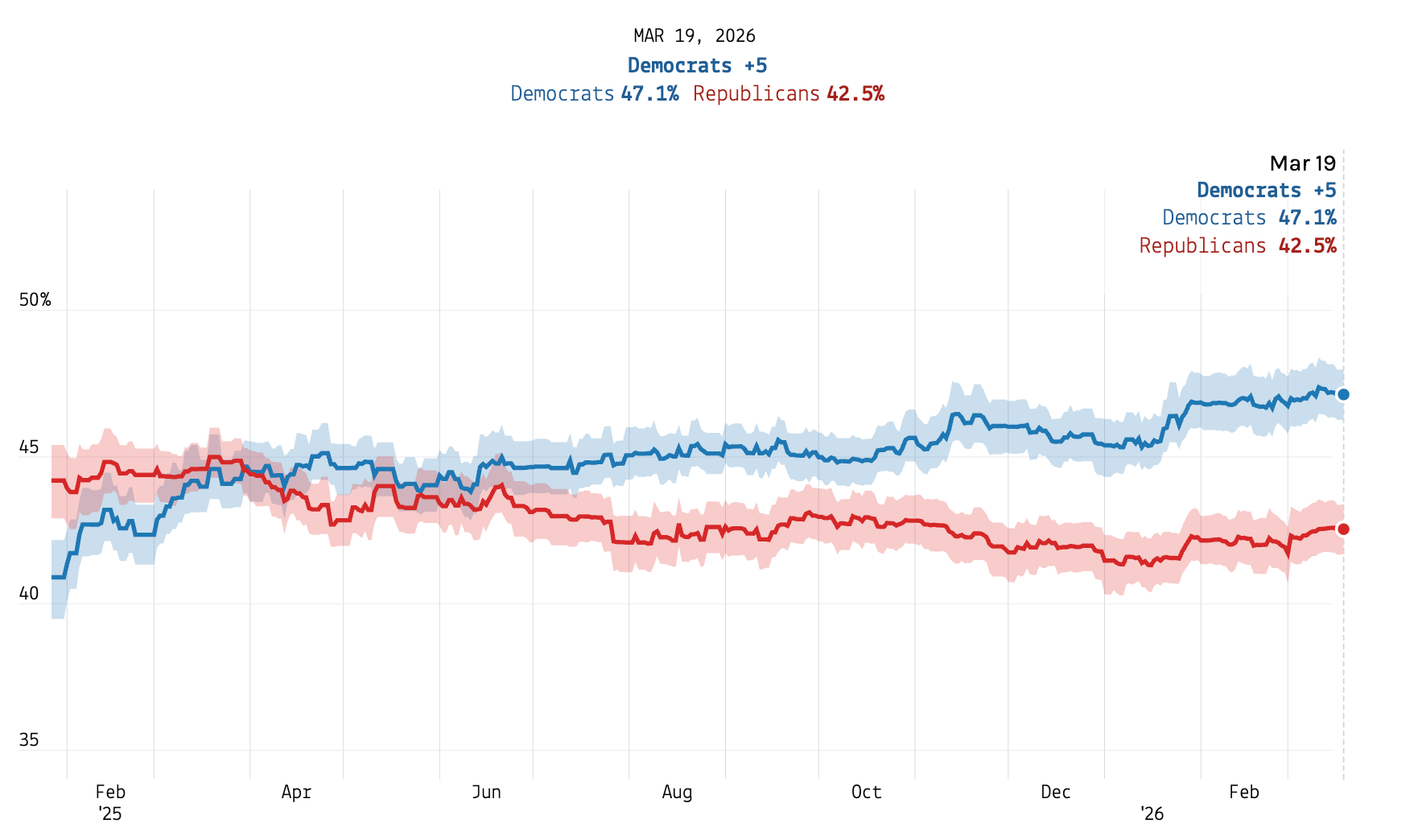
2026 U.S. House generic ballot
Democrats have held their lead on the 2026 U.S. House generic ballot at +4.5 over the last week, rounding to 47 percent of the vote for Democrats versus 42 percent for the Republicans.
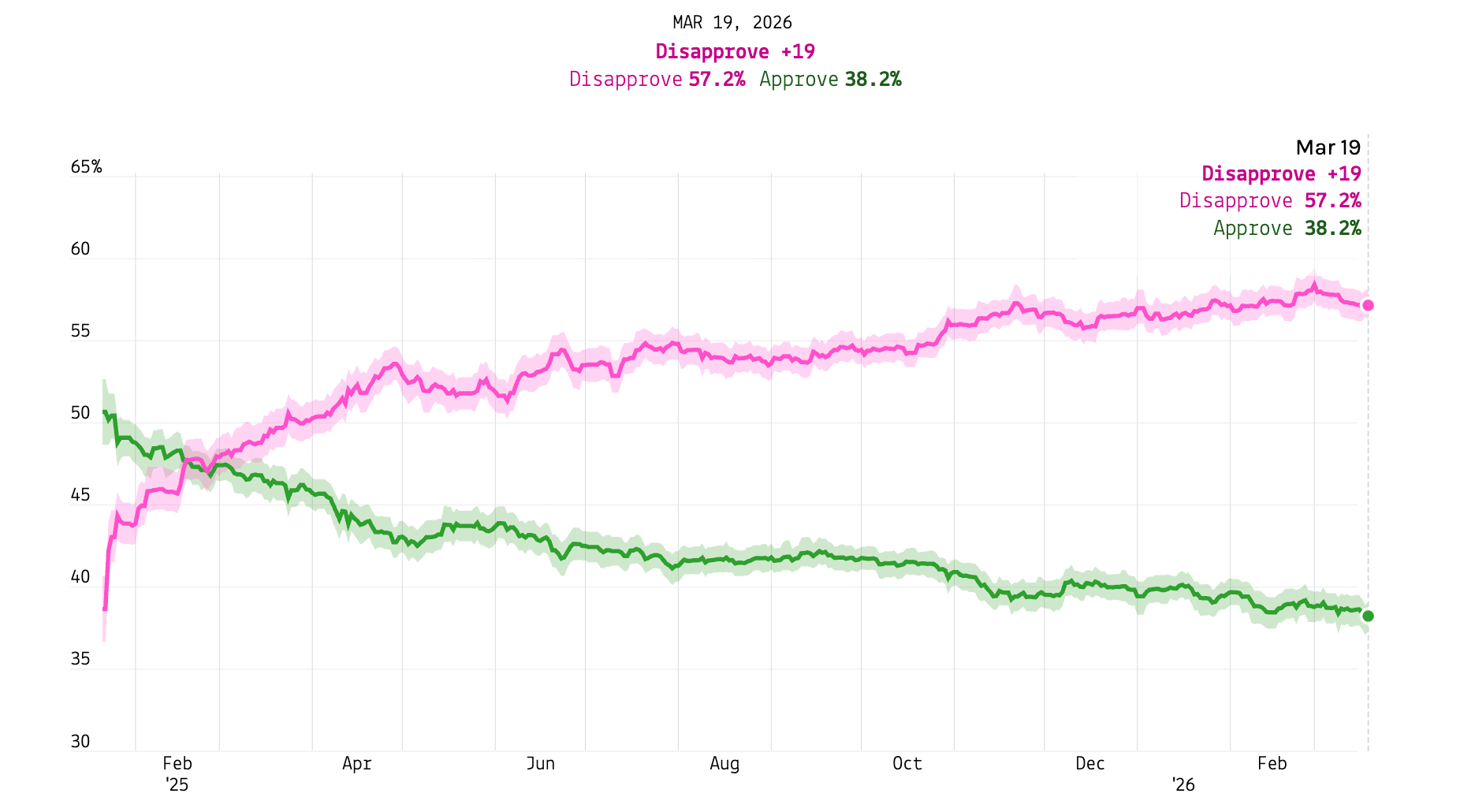
Trump’s job approval
President Trump’s approval rating hit a new low of 38.2 percent this week. His disapproval rating also held steady from 57.3 percent to 57.2 percent.
Paid subscribers to 50+1 get access to premium analysis, plus sortable tables and complete data access on our polling website. If you want to follow the 2026 cycle with the best data at your fingertips, become a paid subscriber.