



Welcome to The Trendline, the FiftyPlusOne.news weekly polling roundup. Subscribe to get it delivered straight to your inbox and get bundled access to our polling website.
Earlier this cycle, at the urging of President Donald Trump, the Republican-controlled legislatures in Texas and Florida took the rare step of redrawing their congressional maps in the middle of the decade. Both states have some of the highest Hispanic populations in the country, and the GOP carefully redrew congressional districts hoping that the deep in-roads Republicans made with Hispanic voters in 2024 would stick around. But those plans already seem to have gone awry.
In heavily-Hispanic southern Texas, one solidly Democratic district (TX-35) was completely transformed to one that voted for Trump by 10 points in 2024, and two Democratic-held seats that already leaned Republican (TX-28 and TX-34) were pushed a few points further to the right. All three were initially seen to be relatively easy pick-ups for the GOP come November, while a fourth district in the area, TX-15, was already held by a Republican and not expected to be very competitive regardless of redistricting.
But 46 days before the election, Democrats are favored in TX-28 and TX-34, while TX-35 is a toss-up, according to FiftyPlusOne’s 2026 House forecast. And in TX-15, Democratic challenger Bobby Pulido has led all three public polls of the race this year (though two were sponsored by Democratic-leaning organizations); our forecast still rates the seat as leaning Republican.
In Florida, Republicans seem to be having a similar issue. Rep. María Elvira Salazar, who represents a newly tweaked district that voted for Trump by 15 points in 2024, is running like she’s behind; this week she released an ad chastising Trump for his immigration policies after a Democratic-funded poll released yesterday showed Salazar up by just 1 point. And in FL-22, a seat with just over 30 percent Hispanic voters that the GOP redrew as a prime pickup opportunity, Democrat Pia Dandiya is actually a slight favorite to win in our forecast, though it’s close enough that we still rate the race as a toss-up.
Taken together, the fact that Democrats are even competitive in so many right-leaning heavily Hispanic districts has many in the party jumping for joy. All of these districts voted for Trump by at least 10 points, and many party activists and insiders are claiming that the gains Republicans made among Hispanic voters in 2024 have all but been erased.
In today’s Trendline, we’re taking a closer look at how Hispanic voters are thinking about politics and the coming midterms. What issues are motivating Hispanic voters this year, and do we see the same leftward lurch among Hispanics across the country, or is this just an isolated trend limited to a handful of competitive seats in two states?
Despite the good signs for Democrats in Texas and Florida, national polling data among Hispanics is a bit more cautious. While Republicans have certainly lost support among the demographic compared to 2024, it’s not a complete reversion to the mean. According to an average of crosstabs from national generic ballot polls, Democratic support among Hispanic voters still isn’t even close to the level it was in 2016 and 2018, when net Democratic advantage in House races was over 35 points, according to exit polls. Instead, their current lead looks more like 2020, when net Democratic support among Hispanics fell from its 2018 high to +27 points.
But even Democrats’ current 25-point advantage is a vast improvement from their 2024 performance, when the party won Hispanics by only 9 points. And it’s a slight improvement from the last midterm in 2022, when the party held a 21-point advantage.
That growing advantage has come mostly from a decline in support for Republicans, rather than a swell of support for Democrats. Compared to the 2024 election, Democratic support among Hispanics has grown by just 3 points, while support for the GOP has dropped by 13 points. Republican support among Hispanics is now at its lowest level since 2018. (Given that current polling has over 10 percent of Hispanic voters undecided in November’s election, there’s still room for the margin to change as we get closer to November.)
Much of the drop in support for the GOP may be due to dissatisfaction with Trump. According to a poll from BSP Research/UnidosUS this spring (Apr. 27 - May 14, 2026), a quarter of Hispanic Trump voters in 2024 say that if they had the opportunity to do it over, they would not vote for the president. That’s higher than the 18 percent of Trump voters overall who regretted their vote in a recent poll from Navigator Research (Aug. 21 - 24, 2026).
Indeed, since Trump took office in January 2025, the net Democratic advantage with Hispanics and Latinos in the generic ballot has grown by around 14 points, outpacing movement among the general population by about 3.5 points.
The laziest explanation for this dissatisfaction is that Hispanic voters are unhappy with Trump’s heavy-handed immigration policies. That’s certainly true for many: Just 26 percent of Hispanic voters approve of the way Trump has handled immigration, compared to 43 percent of all likely voters in the latest New York Times/Siena University poll (Sept. 8 - 13, 2026). But polls of Hispanic voters have shown pretty clearly that, like most Americans, they’re actually prioritizing economic issues much more.
In the BSP Research/UnidosUS poll from May, Hispanic voters listed the cost of living/inflation, the economy/jobs, health care, and housing all as more important issues than immigration reform. Cost of living concerns, in particular, were far and away the most pressing for respondents: 60 percent said it was one of their top-three issues, compared to just 21 percent who said the same of immigration reform. And in a Wick poll also conducted this spring (May 21 - 25, 2026), 73 percent of Hispanic voters said they were more concerned about high prices and the cost of living than they were about immigration enforcement.
Those concerns are almost identical to 2024. Right before the election that year, BSP Research’s final tracking poll for EntraVision and AltaMed also showed cost of living concerns topping the list of most-important issues among Hispanic voters, with immigration issues not even cracking the top five.
So rather than a direct response to Trump’s immigration enforcement tactics (which are definitely still unpopular!), most Hispanics seem to be turning on Republicans out of a deep unhappiness with the state of the economy. Just 21 percent of Hispanic voters in this year’s BSP Research poll, for instance, said they expected Trump’s economic policies to make them better off next year, while 52 percent expected the policies to make them worse off. That’s a drop from the 46 percent of Hispanic voters who said they trusted Trump more to handle economic issues in 2024 exit polling. The fact that Democrats haven’t gained all that much ground with Hispanics compared to the significant GOP declines this year might suggest that the backlash that manifested in 2024 is simply aimed at whichever party is currently in charge, a typical thermostatic swing.
But even if immigration does become a deciding factor for a critical mass of Hispanic voters, it’s still not clear that Democrats would gain much more support than they already have. In this year’s BSP poll, 51 percent of Hispanic respondents said Democrats would do a better job handling immigration reform, while just 25 percent chose Republicans (19 percent said it made no difference). That’s almost exactly the same as the numbers on inflation and the cost of living, which 51 percent of Hispanics trusted Democrats more to handle, with 23 percent choosing Republicans instead. And when asked specifically about border security, the GOP was much closer: 34 percent said Republicans would handle the issue better, compared to 40 percent for Democrats (and another 19 percent who said it made no difference).
We’ve seen significant movement toward Democrats in the overall generic ballot over the last week or two, and it’s certainly possible that Hispanic and Latino voters move even further to the left between now and Election Day. Given small sample sizes in crosstabs, it’s impossible to say how the current 10 percent of undecided voters will lean; if they mirror trends among decided voters, Democrats would expand their advantage among Hispanics from 25 percentage points to 28. And if they swing further left than current trends, the GOP might have literally drawn their own demise, especially in Texas and Florida.
Other polling nuggets
A majority of voters, 53 percent, say that the Trump administration’s immigration enforcement has gone too far, according to a new Beacon Research/Shaw & Company Research/Fox News poll (Sept. 11 - 14, 2026). Eighty-seven percent of Democrats, 60 percent of independents, and 17 percent of Republicans agreed that the administration’s immigration enforcement had gone too far. Voters were split as to why they thought so, however: 45 percent of those who said the enforcement had gone too far said it was because it was using too much force, while 49 percent said that it was targeting the wrong people and 6 percent said both.
Democrats hold an 8-point lead on the generic ballot in a new YouGov/CBS News poll (Sept. 8 - 11, 2026), but voters aren’t totally sold on the party. Asked if they would be financially better off or worse off if Democrats win control of Congress in November, voters were evenly split, with 36 percent saying they would be better off and an identical 36 percent saying they would be worse off (27 percent said it wouldn’t make a difference). Still, Democrats have the upper hand on Republicans: Asked the same question about Republicans winning control, voters said they would be financially worse off by an 18-point margin, 46 to 28, and by a 9-point margin, voters said their personal financial situation made them more likely to vote for Democrats than Republicans.
Amid a wave of new measles cases and deaths, many Americans remain skeptical of vaccine safety. In an Ipsos/Reuters poll (Sept. 11 - 14, 2026), 13 percent of Americans said they thought vaccines were not safe for adults or children, roughly unchanged from the 15 percent who said the same back in February. Just 73 percent said parents have a duty to vaccinate their children against measles, and 32 percent said that public schools should not be allowed to refuse enrollment to unvaccinated children. Americans are also skeptical of the Trump administration’s ability to handle the current measles outbreak: Just 26 percent said the current administration is handling the outbreak responsibly, while 41 percent disagreed (the rest were unsure or did not respond to the question). Asked whether the administration would stop the outbreak and prevent measles from becoming a common illness again, just 27 percent agreed that they would, while 42 percent thought they would not be able to stop the outbreak.
While medical treatments continue to extend human lifespans, it appears there’s at least some limit to how far folks want to take it. A plurality, 43 percent, said they would not choose to live to 150 if it were possible, while 31 percent said they would, according to a new YouGov/Economist survey (Sept. 11 - 14, 2026). Older voters were the least likely to want to live longer: 50 percent of those aged 65 and up said they would not choose to live to 150, while 23 percent said they would. The youngest voters were most likely to want to live on, with 39 percent saying they would choose to live to 150 and 43 percent saying they would not. Apparently there really is such a thing as too many birthdays for some people.
Polling averages update
All numbers are as of 12:00 PM Eastern on Sept. 18, 2026.
2026 U.S. House generic ballot
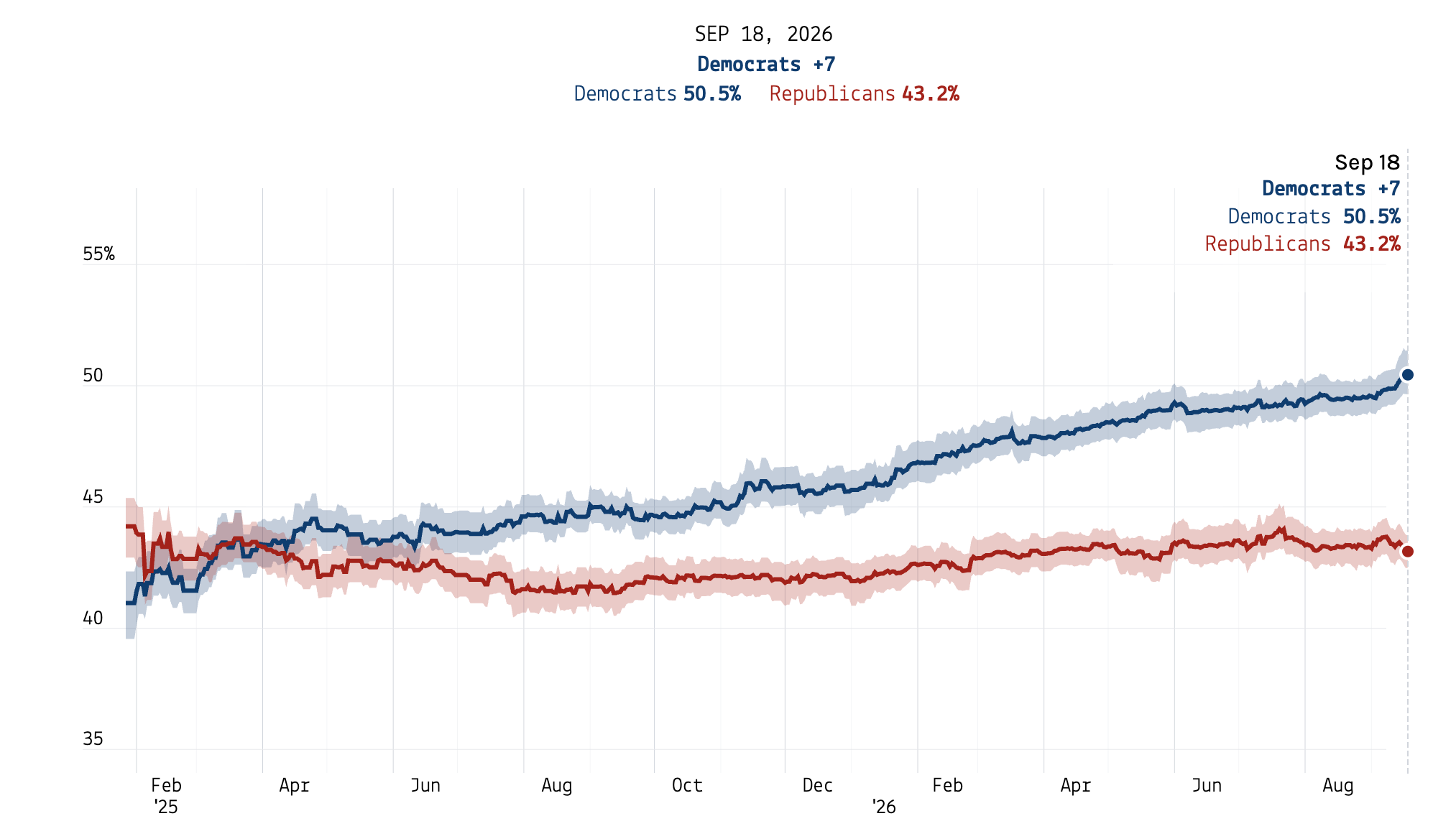
The Democratic margin in the 2026 U.S. House generic ballot ticked up a point this week, with Democrats now ahead of Republicans by 7 percentage points. Currently, 50.5 percent of likely voters indicate that they plan to vote for a Democrat in November, while 43.2 percent plan to vote for a Republican.
Trump’s job approval
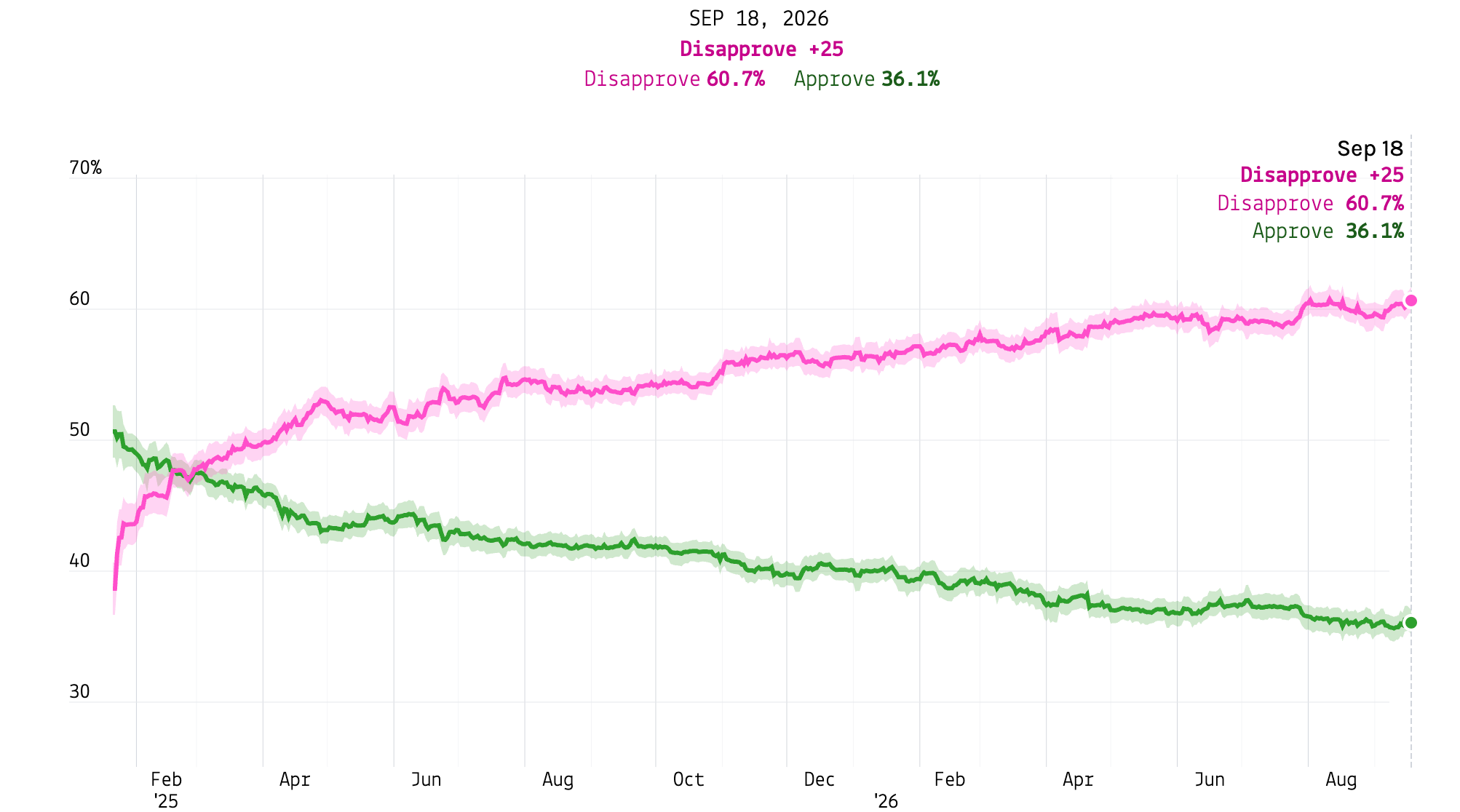
President Trump’s net approval rating among U.S. adults remained stable this week. Overall, 60.7 percent of Americans disapprove of the president’s job performance, while just 36.1 percent approve, for a net approval rating of -25 percentage points.
Paid subscribers to 50+1 get access to premium analysis, plus sortable tables and complete data access on our polling website. If you want to follow the 2026 cycle with the best data at your fingertips, become a paid subscriber.