



Welcome to The Trendline, the FiftyPlusOne.news weekly polling roundup. Subscribe to get it delivered straight to your inbox and get bundled access to our polling website.
On Wednesday, the House of Representatives voted to table articles of impeachment against Defense Secretary Pete Hegseth, effectively killing the effort to impeach him during these last few weeks of the current Congress.
Hegseth isn’t out of the woods yet, though. Democrats have hinted they may revive an impeachment effort once they take control of Congress in January. Hegseth (and the Trump administration as a whole) will certainly face a slew of investigations and inquiries from congressional Democrats, who are champing at the bit to use their new investigative powers — but whether those investigations will actually result in more articles of impeachment is less clear.
Public opinion is broadly in favor of impeaching Hegseth, although support varies considerably based on question wording. In a YouGov/The Economist poll from last week (Nov. 4 - 6, 2026) that simply asked “Do you think Congress should impeach Pete Hegseth?” 42 percent of respondents said yes, while 35 percent said no and 23 percent were unsure. But support for impeachment appeared to be higher in surveys that directly tied the effort to Hegseth’s handling of the war with Iran.
In a separate YouGov/The Economist poll from September (Sept. 18 - 21, 2026) that asked “Would you support or oppose impeaching Defense Secretary Pete Hegseth (also referred to as Secretary of War) for starting a war with Iran without authorization by Congress?” net support for impeachment was more than twice as high, with 51 percent of respondents in favor, 34 percent opposed, and 15 percent unsure. And in a Data for Progress poll (Sept. 18 - 20, 2026) that asked whether Hegseth should be impeached “for his handling of the Iran War,” 47 percent were in support, while 38 percent were opposed and 15 percent didn’t know.
That increased support for impeachment comes as the war with Iran remains deeply unpopular. In an Ipsos/Reuters poll from this week (Nov. 6 - 9, 2026), Americans disapproved of U.S. military strikes against Iran, 62 percent to 33 percent, including 63 percent of independents and 27 percent of Republicans who disapproved of the war. Fifty-four percent said that considering the costs and benefits to the U.S., it wasn’t worth taking military action against Iran, while just 23 percent said it was worth it. Overall, 71 percent said they supported Congress passing legislation to end the conflict, including majorities of Democrats, Republicans, and independents.
It’s perhaps not surprising then that mentioning Hegseth’s handling of such an unpopular war would increase support for his impeachment. But Hegseth has been unpopular from the beginning of his tenure, even before the conflict with Iran began. A YouGov/Yahoo News poll conducted shortly after Hegseth’s nomination was announced (Nov. 14 - 18, 2024) showed his personal favorability numbers low — just 30 percent of respondents rated him favorably, tied for the second lowest favorability rating among the nominees that had been announced up to that point. Twenty-five percent of respondents in the poll viewed him unfavorably, with a large plurality saying they didn’t have an opinion yet.
Hegseth’s personal favorable numbers are mostly unchanged today — 33 percent of Americans in a recent Impact Research/National Research/Wall Street Journal poll (Sept. 16 - 21, 2026) said they had a favorable opinion of him. But what has changed is the share who say they have an unfavorable view of Hegseth or aren’t sure; 45 percent of Americans didn’t have an opinion about him in the Yahoo News poll from when he was first nominated, but that number is now down to about 20 percent depending on the survey (it was 17 percent in the Wall Street Journal poll). And 50 percent of respondents in the WSJ poll said they now have an unfavorable opinion of Hegseth, double the share that said the same in the Yahoo News poll from 2024.
Paid subscribers to 50+1 get access to premium analysis, plus sortable tables and complete data access on our polling website. If you want to follow the 2028 cycle with the best data at your fingertips, become a paid subscriber.
Beyond personal favorability, Hegseth has also received low marks for his overall job performance. In a YouGov poll this summer (July 8 - 10, 2026), Hegseth was in a three-way tie for the lowest net approval rating among President Donald Trump’s cabinet members, alongside Attorney General Todd Blanche and Education Secretary Linda McMahon. Voters disapproved of his job performance by 16 points on net. And in a separate, more recent survey from YouGov (Oct. 2 - 5, 2026), when asked which senior official should leave the Trump administration next, a plurality (20 percent) of Americans said it should be Hegseth, nearly double the share for the next highest choice (Secretary of Health and Human Services Robert F. Kennedy Jr., at 11 percent).
While Hegseth’s deep unpopularity with the public has led Americans to generally support his removal, he’s not the only figure facing threats of impeachment from the incoming Congress. While his likelihood of removal is much slimmer than Hegseth’s, Trump also faces the prospect of intense investigations and potential impeachment from congressional Democrats next year, and support for that effort could be just as high as for giving the Defense Secretary the boot. In the latest Verasight/Strength in Numbers poll (Oct. 13 - 19, 2026), 50 percent of Americans supported impeaching Trump, while 38 percent were opposed and 13 percent weren’t sure.
Despite this, holding the Trump administration to account ranks quite low on the list of issues Americans want the next Congress to tackle. In the Ipsos/Reuters poll from this week, investigating the Trump administration (not necessarily impeachment, though the two are related) was second lowest on the list of priorities Americans wanted the new Congress to focus on. Among the various issues asked, investigations of the Trump administration was the only issue where more respondents said they didn’t want Congress to focus on it than did.
So while it’s possible (or even likely) that the new Democratic-controlled Congress could take up Hegseth’s impeachment again next year, Americans aren’t signaling that it’s more important to them than the cost of living issues that catapulted the party to the best midterm showing in over 50 years. That may be the one bright spot for Hegseth in what is otherwise a pretty dismal report card.
Other polling nuggets
About 6 percent of voters in the 2026 midterms voted for Trump in 2024 and a Democrat in 2026, according to post-election polling by Navigator Research (Oct. 28 - Nov. 8, 2026). These Trump defectors were especially focused on inflation and costs: Asked to select their top four issues, 33 percent of all voters chose inflation as among their key priorities, compared with 48 percent of Trump defectors, and 37 percent of Trump defectors cited cuts to healthcare and food assistance, compared to 25 percent among all voters. In previous polling, Navigator found about a quarter of Trump 2024 voters regretted their vote, but in the latest poll conducted only among those who actually did vote, 16 percent of Trump voters said they regretted their vote, suggesting that a sizable percentage of Trump regretters chose not to vote in the midterm election.
As newly elected Democratic state governments take their seats in the coming months, there has been renewed interest in the National Popular Vote Interstate Compact, a mechanism that would bypass the Electoral College and allow for the president to be chosen by popular vote. According to a new YouGov/The Economist poll (Nov. 9 - 11, 2026), 69 percent of Americans report knowing at least something about the Electoral College, including 78 percent of registered voters. Given a brief description of the Electoral College and direct election, a slight majority, 51 percent, of registered voters say they prefer direct election based on the popular vote over the current system, though a significant percentage (21 percent) say they are unsure. Support for direct election is strongest among Democrats (68 percent), while Republicans continue to favor the Electoral College by 13 percentage points, 46 to 33.
It’s time to take your yard signs down, folks. In a YouGov poll this week (Nov. 7, 2026), a majority of Americans, 58 percent, say political yard signs should come down within a week of the election (and another 6 percent say political yard signs are never acceptable in the first place). On this point, we finally have bipartisan agreement: Majorities of Democrats, independents, and Republicans all say that signs should come down within a week. But younger Americans give a bit more leeway, with 24 percent of Americans under the age of 30 saying signs can stay up as long as someone wants, while just 11 percent of those 65 and older agree.
Polling averages update
All numbers are as of 11:00 AM Eastern on Nov. 13, 2026.
Trump’s job approval
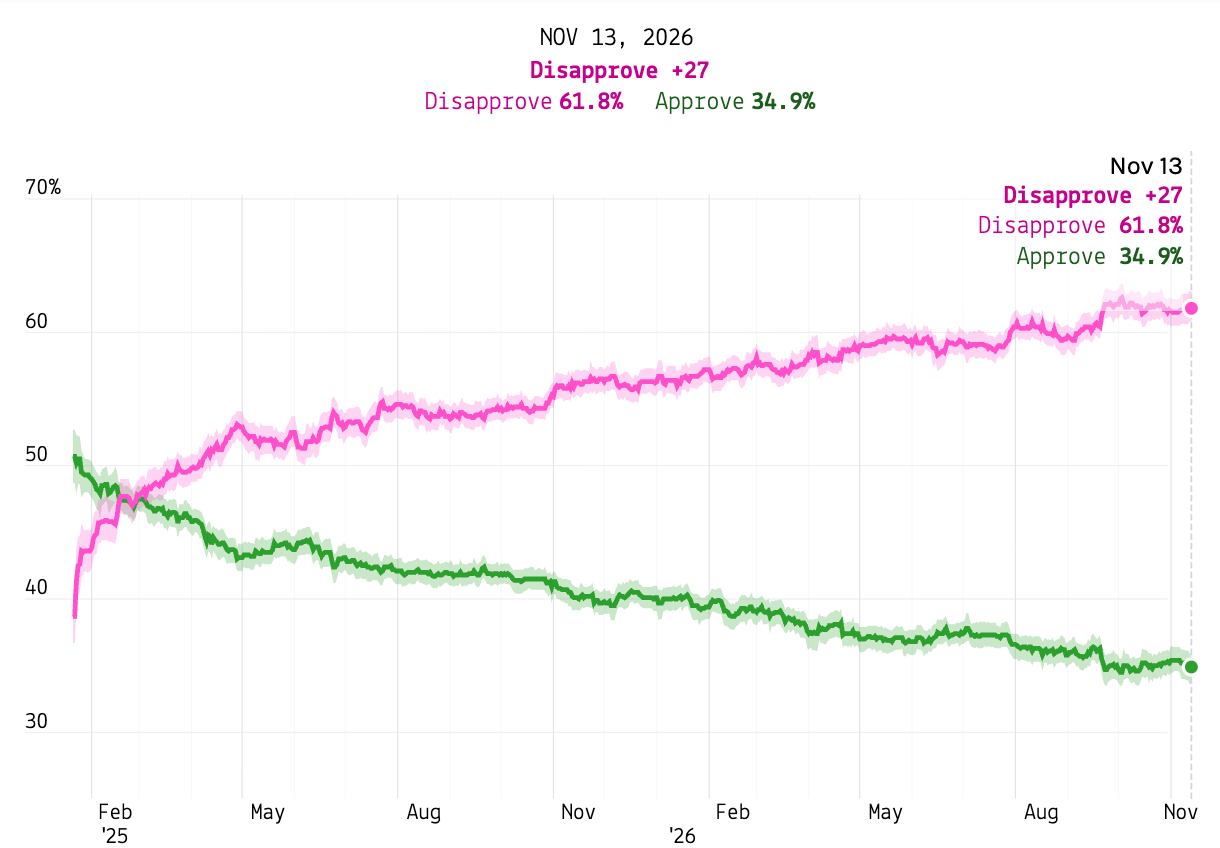
President Trump’s net approval rating among U.S. adults fell slightly this week, now standing at -27 percentage points compared to -26 most of last week. Overall, 61.8 percent of Americans disapprove of the president’s job performance, while 34.9 percent approve.
Paid subscribers to 50+1 get access to premium analysis, plus sortable tables and complete data access on our polling website. If you want to follow the 2026 cycle with the best data at your fingertips, become a paid subscriber.