



Last week, FiftyPlusOne launched our brand new congressional election forecast for the 2026 midterms. As of this morning, the forecast gives Democrats an 89 out of 100 chance of winning the majority of seats in the House and a 55 out of 100 chance of controlling the Senate after November. The model powering these estimates updates four times a day, taking in various data that have historically been predictive of election outcomes.
One of those inputs is, of course, the polls — specifically, averages of polls. We have one set of computer programs that takes in the polls for every statewide and federal election in the country, adjusts them, and calculates an average estimate of support for each candidate over time, and then another program that reads in those estimates and feeds them through the forecast model.
Earlier this summer, I squirreled these polling averages away on a cloud computer server somewhere in the U.S. (probably in Ashburn, Virginia), where I left them to tick away each day while the team worked on getting our forecast model up. Now that it is, we had some time last week to put together a set of new graphs of these averages and publish them for everyone to use.
These averages are now up online at the FiftyPlusOne website. Below, I quickly run through our new estimates in each competitive U.S. Senate race.
Georgia
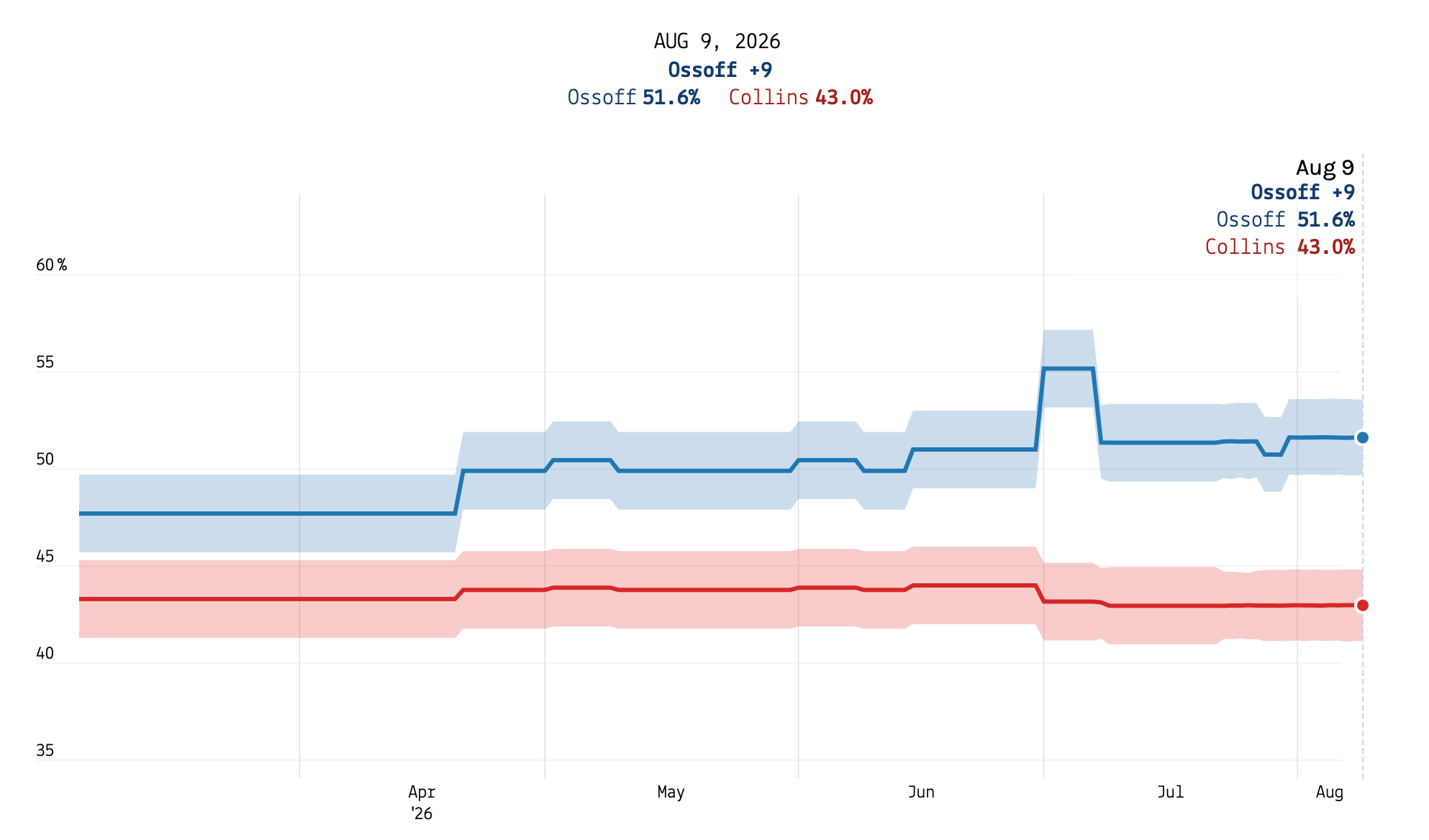
Jon Ossoff is in the strongest position of any Democrat in the country, currently leading Republican opponent Mike Collins by 8.6 points. The incumbent has gained steadily since March, when the average opened at D+4.4. It peaked at D+12 on July 1 before settling back.
The caveat in Georgia (and most Senate contests so far) is that the polling is thin. Georgia has produced only five head-to-head polls this year, and they disagree sharply. A poll for Fox News by Beacon Research/Shaw & Co. had Ossoff ahead by 13 points in late June (which caused the July 1 spike in his support); three days later, Wick had him ahead by just 3.8. The most recent, Fabrizio Lee/Impact Research/AARP on July 16, split the difference at D+9 — and nothing has been published since.
Judging by current polls, this is unlikely to be a must-watch, uber-competitive race.
North Carolina
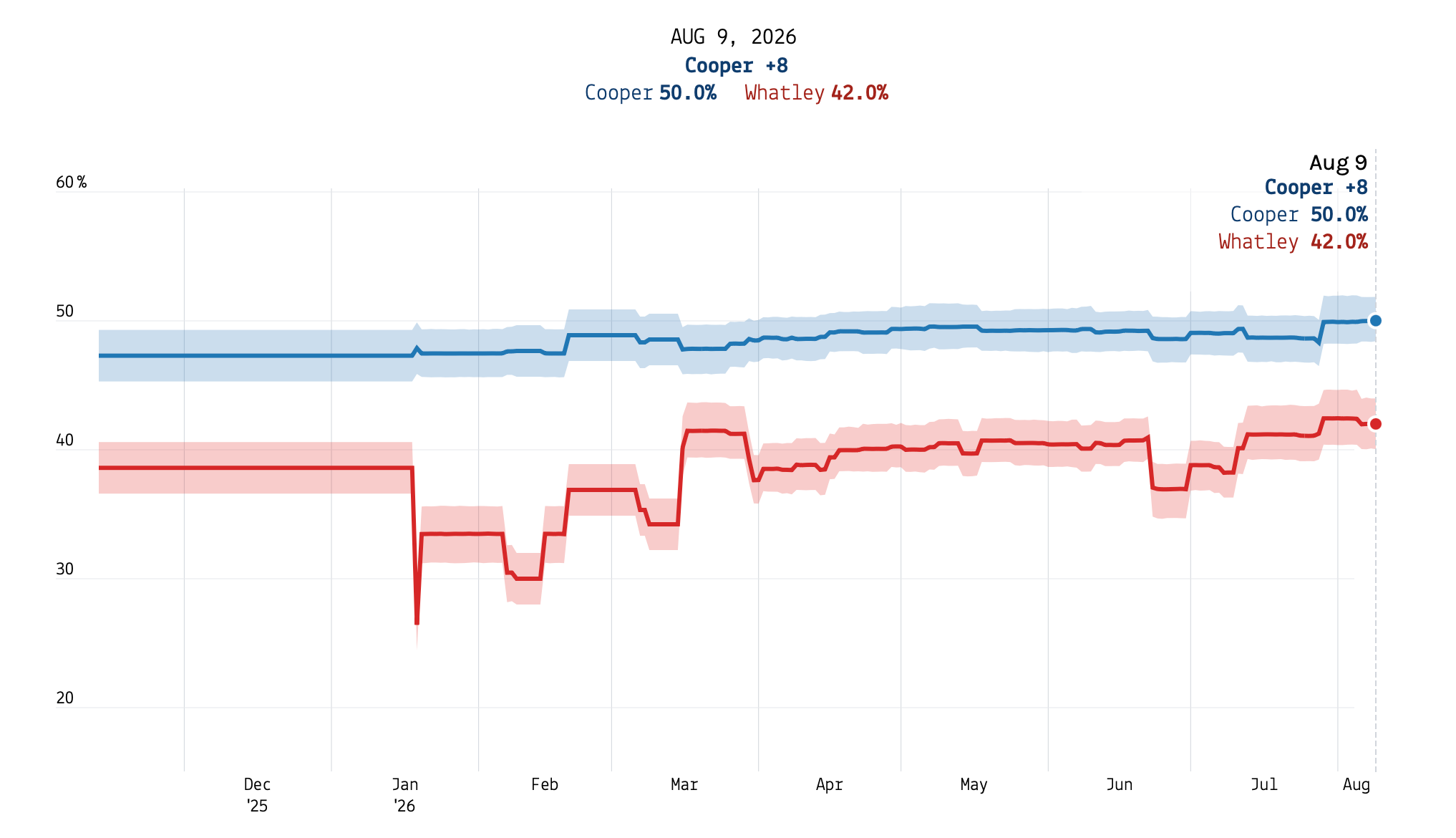
Another state with a big Democratic lead is North Carolina. Former governor Roy Cooper leads Michael Whatley, the current head of the Republican National Committee, by 8.0 points. A month ago, the race sat at D+8.7. Among the competitive races, this has been the most stable one (once we set aside a thin-polling artifact in January that briefly pushed the average above D+21, before correcting within a day)
The recent high-quality polling tells a consistent story. A New York Times/Siena University survey had Cooper at D+7 in late June, and Beacon/Shaw/Fox News had him at D+9 in July. More recently, Change Research had him at D+9 on August 1.
That is a strong position for a popular former governor in a state Republicans once expected to hold comfortably.
Maine
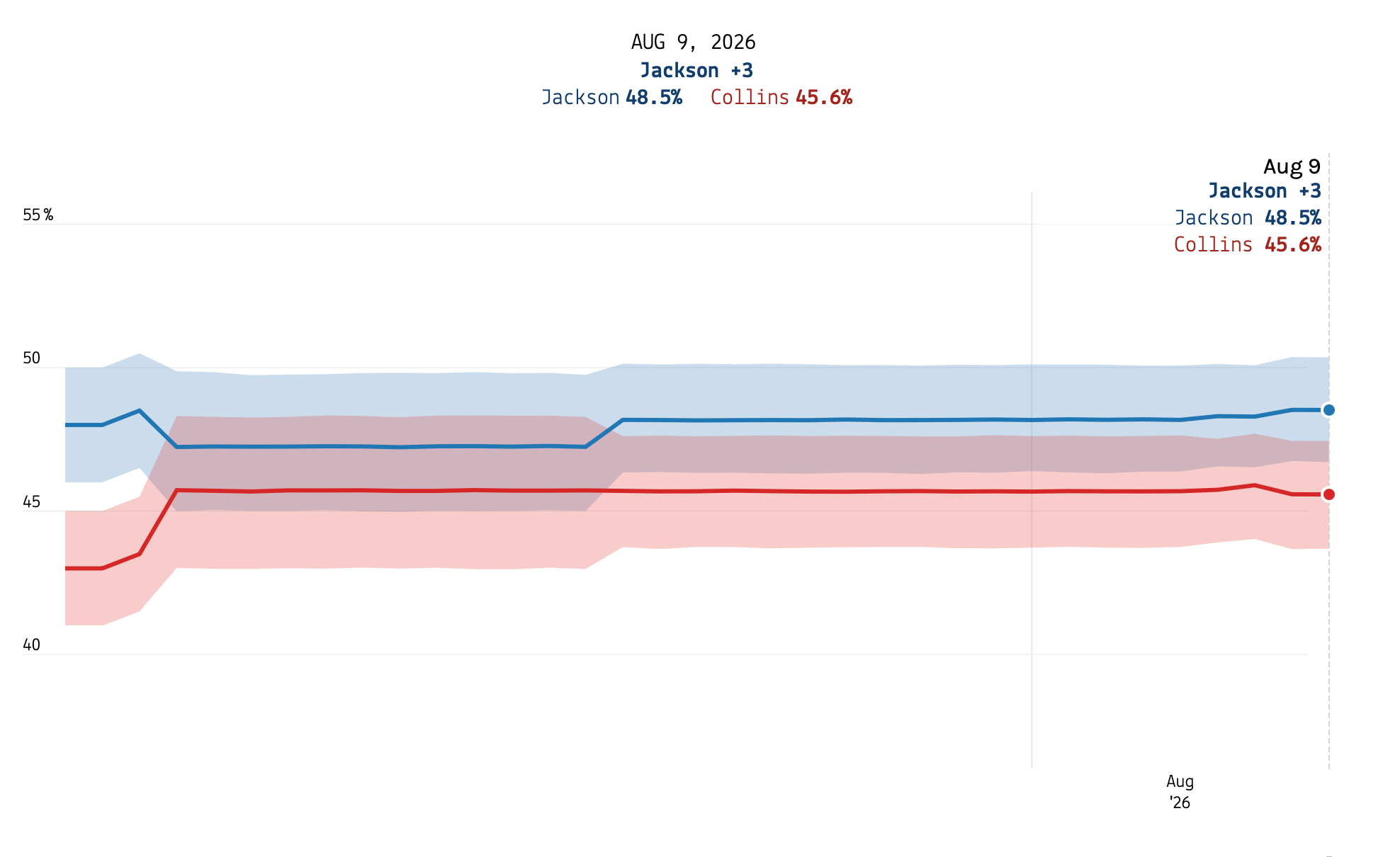
Incumbent Republican Senator Susan Collins currently trails former President of the Maine Senate Troy Jackson by 2.9 points — but this is the newest race with a small sample size. Our average begins just on July 6, and includes only five head-to-head polls conducted since.
The polling to date is all over the place. Public Policy Polling gives Jackson a 5-point margin. Z to A Research has come out on the low end, at R+2 the following day. Both of these polls, however, were conducted during the contest to replace Graham Platner on the ballot, and were sponsored by candidates or organizations supporting particular candidates in that convention. More recently, the University of New Hampshire has pegged Jackson at D+3, and Hart Research has the race at D+4. The average has drifted down from its D+5 opening as the Republican-leaning results have been incorporated.
But poll watchers, be warned: Collins has survived big deficits in the past, including in 2020 when challenger Sara Gideon led her by 8 points on Election Eve. Treat the polls as but a rough guide in the Pine Tree state.
Texas
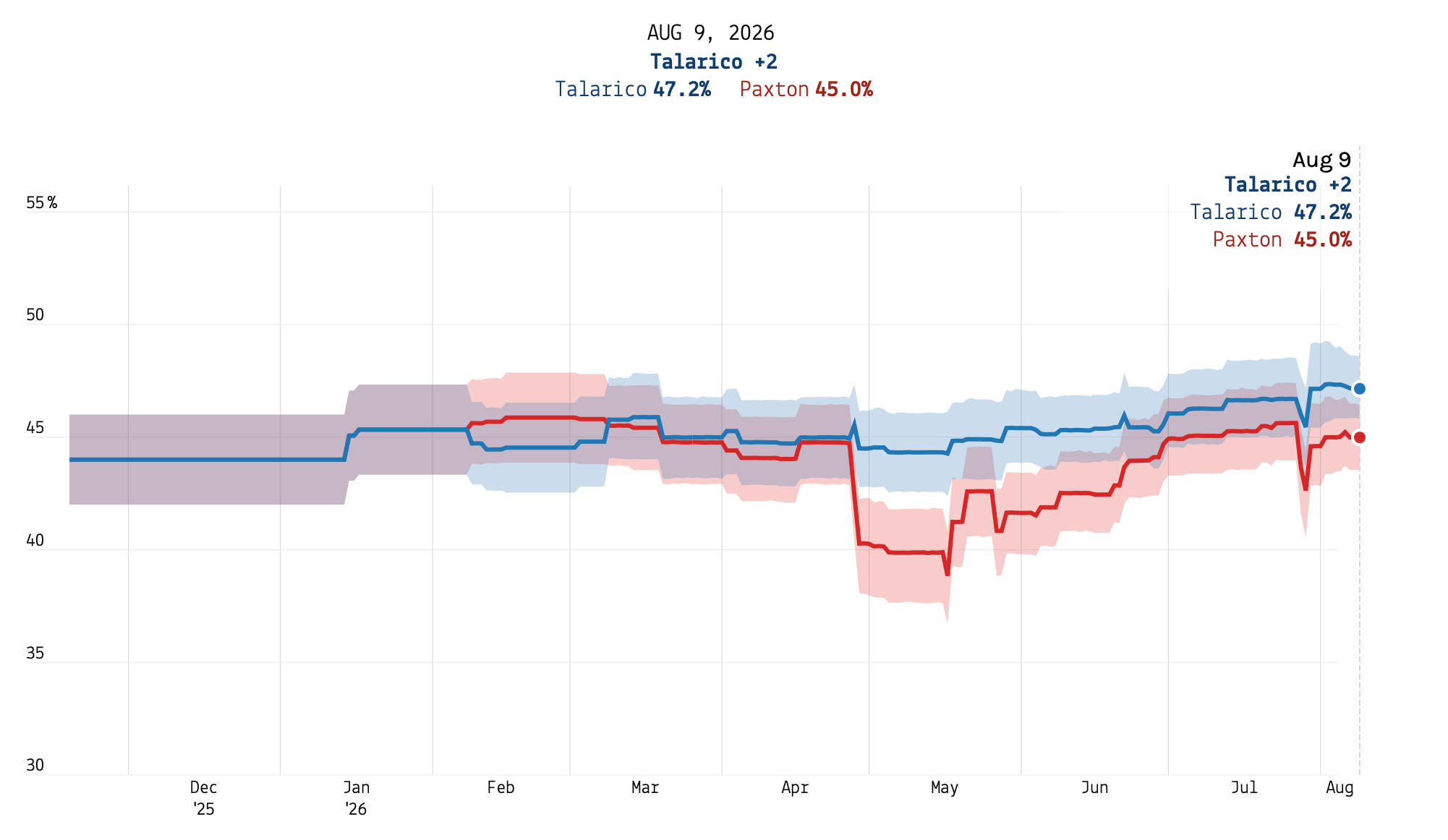
State House Rep. James Talarico leads State Attorney General Ken Paxton by 2.2 points in what has become a genuine race, despite the state’s typical lean hard to the right. The average began dead even in November, slipped to R+1.3 in February, then climbed to D+5.4 by mid-May before easing back.
Texas is the most heavily polled race on the board, with 24 head-to-head surveys. The late-July results cluster tightly, and all show a narrow Democratic lead: Texas Southern University at D+2, ReconMR/Siena University/Texas A&M University at D+4, Wedgewood (an upstart firm) at D+2, and YouGov Blue at D+3.
Ohio
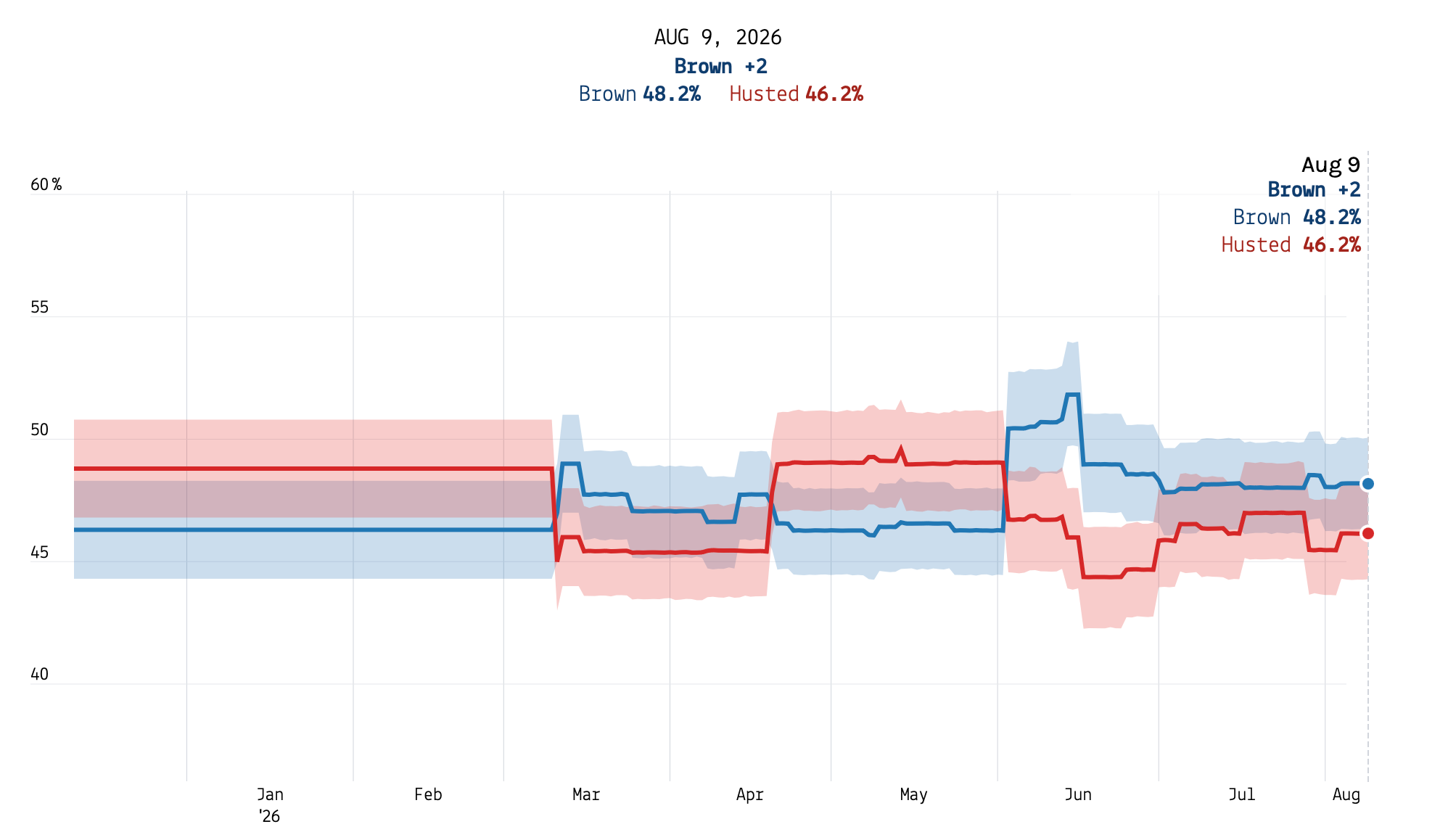
In Ohio, former Senator Sherrod Brown trailed Jon Husted by 2.5 points in December, but he now leads by 2.0 — a swing of 4.5 points.
Since June, the Democrat has seen a flurry of good polls, including one from Beacon/Shaw/Fox News at D+8 and another from Fabrizio, Lee & Associates/Impact Research/AARP at D+3. But Siena University/New York Times then had Husted ahead by 3 in late June, and Ohio has since gone quiet. There has not been a head-to-head poll in six weeks.
The current number therefore rests on polling that is now well over a month old, and should be treated with some caution.
Iowa
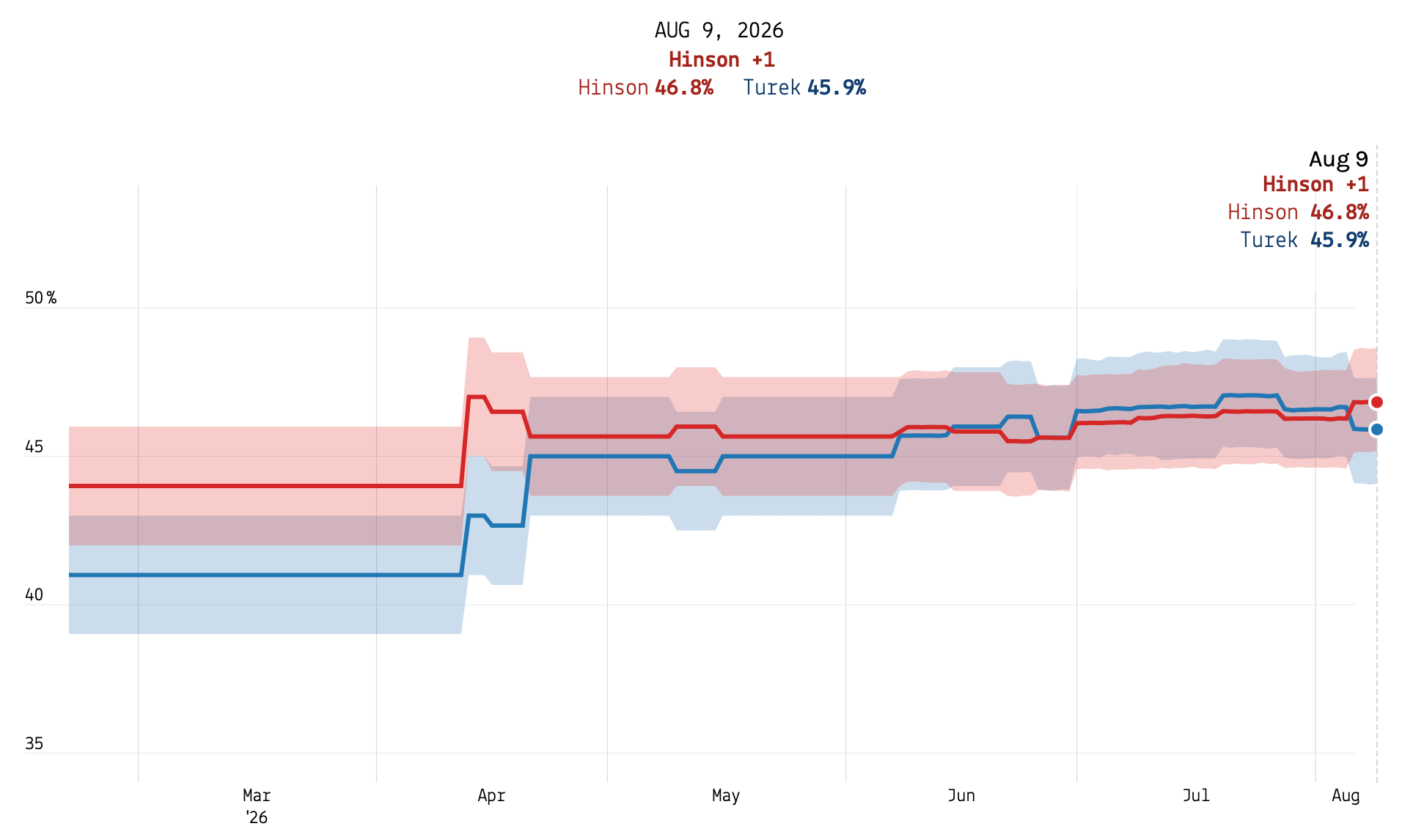
Ashley Hinson leads Josh Turek by 0.9 points in a race that has tightened considerably since the spring — and marks a big shift left since 2024. Turek trailed by 3 points in February and by as many as 4 in April. He briefly took a narrow lead in late June before slipping back. The race remains a tossup. The only poll released in the last 6 weeks in this contest, from Emerson College/Nexstar, shows Hinson ahead by 3 points.
Michigan
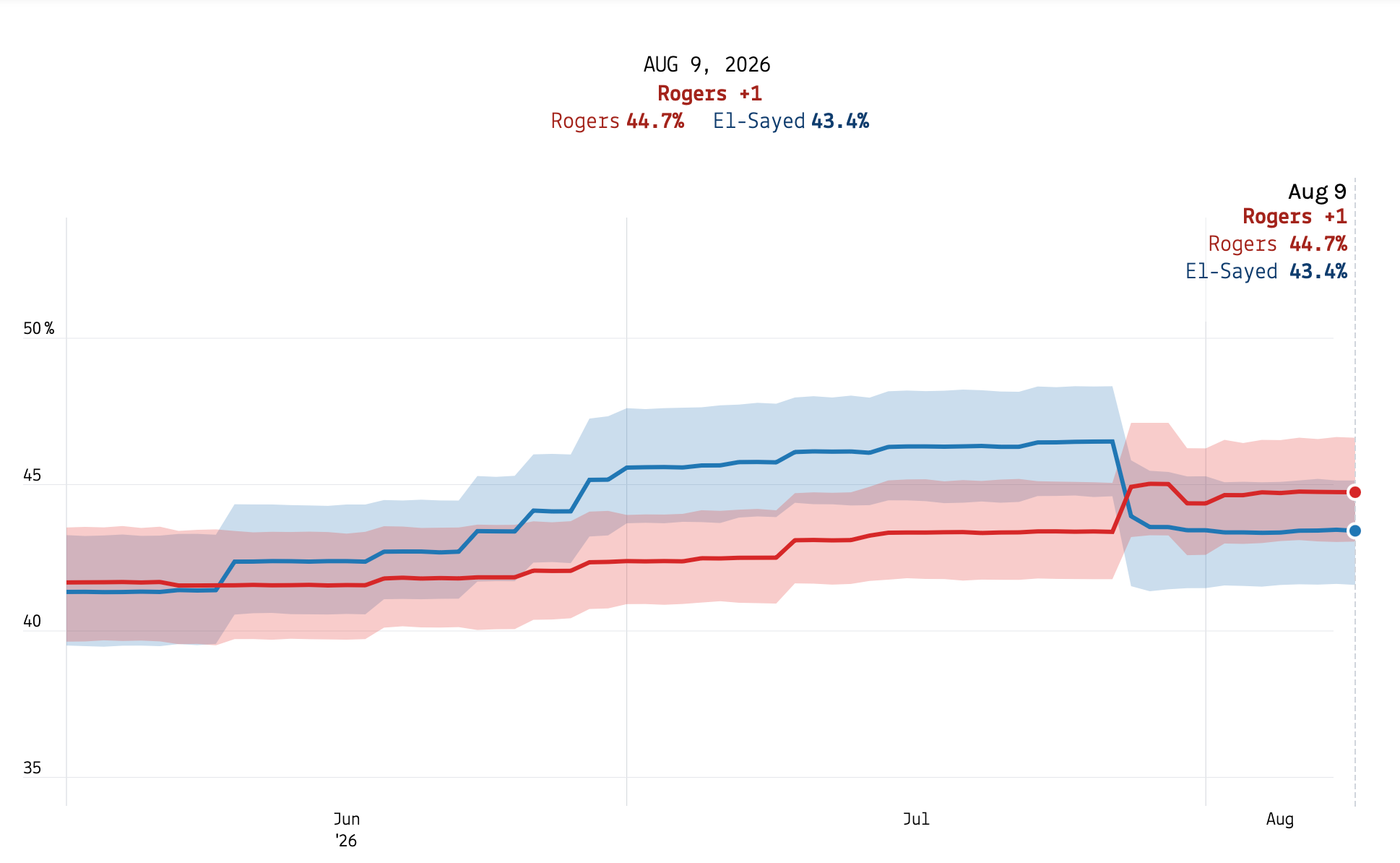
This is the closest race on the map. Failed 2024 Republican nominee Mike Rogers leads Abdul El-Sayed by 1.3 points after reversing a Democratic advantage that stood at D+3.3 as recently as July 8.
But the shift came largely from a single poll. The Glengariff Group’s July 24 survey had El-Sayed at 38.7 percent and Rogers at 49.0 percent — a roughly 10-point Republican margin, far outside anything other surveys in the race. But because of a dearth of recent data, when the poll entered the average on July 28, the line moved just over four points in a single day.
Subsequent polls were much closer: Mitchell had the race tied, SoCal had it at R+1, and EPIC-MRA had it at R+3. The average has since stabilized around R+1.
Whether the Glengariff result captured a real shift or merely reflected the firm’s house effect is the central question in Michigan. This is the fourth poll Glengariff has released in the race, and all four have shown Rogers ahead of El-Sayed by more than the average did at the time — by 6.1, 6.4, 4.9, and now 10.3 points.
Alaska
We don’t have an average for Alaska up yet because the primary has not happened. Our forecast model does use these pre-primary polls, but as a policy we do not publish general-election averages for races that aren’t set yet.
The overall picture
There are eight potentially competitive U.S. Senate races this year. Democrats need to win in six of them to gain control of the Senate — two in the seats they currently control, plus four flips for a total of 51 seats.
Doing some unofficial averaging in Alaska, Democrats currently lead in six of these eight races. The two in which they trail — Michigan and Iowa — are both essentially tied, and Michigan has no new data since Abdul El-Sayed and Mike Rogers won the Democratic and Republican primaries, respectively, last Tuesday. Their strongest positions, in Georgia and North Carolina, look like near locks for November.
Check out our new polling averages at FiftyPlusOne.news/averages.
Paid subscribers to 50+1 get access to premium analysis, plus sortable tables and complete data access on our polling website. If you want to follow the 2026 cycle with the best data at your fingertips, become a paid subscriber.
This is awesome!
Thanks for this very readable state of the in play Senate races this coming November.