



Welcome to The Trendline, the FiftyPlusOne.news weekly polling roundup. Subscribe to get it delivered straight to your inbox and get bundled access to our polling website.
Flock cameras seem to be everywhere these days, both in the news and around the country. Communities all over America are debating whether to continue use of the automated license plate readers, with some terminating their contracts and others standing firm on their use of the cameras. Amid mounting privacy concerns and repeated instances of police officers misusing the technology to track private citizens, Flock Safety has reportedly been considering selling itself. But even amid all this controversy, supporters of these types of cameras say they continue to be useful tools for law enforcement to find and prosecute criminals. So, where do Americans stand? This week on The Trendline, we find out.
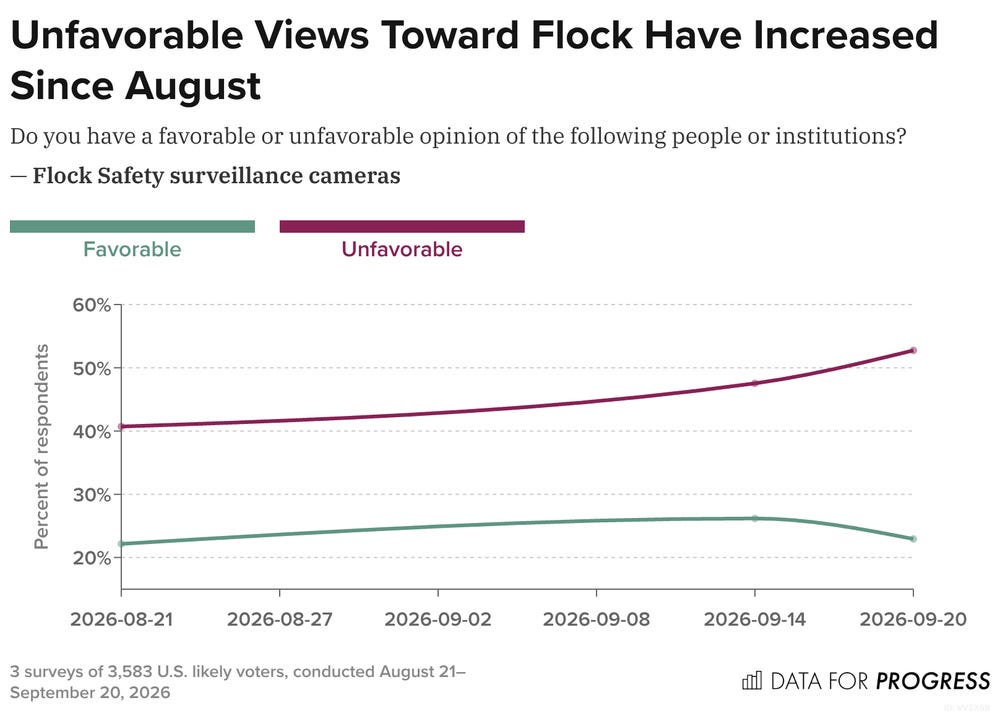
Beginning in August, Data for Progress has been tracking whether people have a favorable or unfavorable view of Flock cameras. While favorable views have been mired in the low 20s throughout their tracking, unfavorable views have risen from 41 percent in mid-August to 52 percent in the most recent survey (Sept. 18 - 20, 2026).
In a more general question, Cygnal explains to voters what automatic license plate readers (ALPRs) are as follows:
Automatic license plate readers are cameras placed along roads that photograph the license plate of passing cars and alert law enforcement if the vehicle has been involved in a crime or is being driven by a missing person.
Even given this somewhat generous definition, their most recent survey on the issue (Sept. 1 - 2, 2026) found support for the use of these cameras 3 points underwater, 46 to 49, a drop of 21 points in net support since they first asked the question in July.
Asked about what might be appropriate uses of the technology, a significant majority of respondents told Cygnal that locating missing persons, finding stolen vehicles, and solving crimes were all acceptable. However, just 43 percent said it was appropriate to use ALPRs to catch people with outstanding warrants, and only 28 percent said it was acceptable to use the cameras to help immigration agents find and deport people. Fifteen percent of respondents said that none of the circumstances presented were appropriate uses of ALPRs.
In a Navigator Research survey (Sept. 10 - 14, 2026), 62 percent of respondents said they were concerned about the use of Flock cameras, while 26 percent were not. However, the specific details of voters’ concerns vary widely. Given a list of possible concerns and the ability to choose more than one, no individual issue had more than 33 percent of respondents saying it was concerning, and no issue had fewer than 23 percent. Topping the list of concerns were the collection of information about people without their consent (33 percent) or who have not committed or been suspected of a crime (33 percent), allowing the government to track where people go every day (32 percent), and the risk of hackers gaining access to the cameras or data (31 percent).
When it comes to privacy, however, voters seem pretty clearly against the use of Flock cameras. In a Marquette Law School poll (Sept. 2 - 9, 2026), respondents were told “Flock Safety has a network of 120,000 cameras which allow the company and law enforcement to track the movement of vehicles.” Given that information, 39 percent said that these cameras were an important tool for police investigations, while 61 percent said they were an unacceptable violation of privacy rights. While Republicans were slightly less likely than independents or Democrats to say the cameras were a violation of privacy, majorities across the political spectrum agreed with that position.
Interestingly, though, Black voters were split on the issue, with 51 percent saying Flock cameras were an important tool for law enforcement while 49 percent said they were a violation of privacy. The sample size on this subgroup is fairly small, so we should read this finding with caution, as it doesn’t really jibe with some previous polling. For example, according to YouGov (July 27 - Aug. 6, 2026), on almost every issue tested, Black voters had a more negative view of law enforcement than other racial groups, and were more supportive of policies to rein in police power than other racial groups. On the other hand, in Data for Progress’s tracking, Black voters had the most favorable views of Flock cameras of any racial group presented in crosstabs in every survey.
When it comes to the effectiveness of these cameras, Americans are split. A YouGov survey (Aug. 18 - 21, 2026) found that 30 percent of Americans said ALPRs reduce crime, while 38 percent said they didn’t and the rest were unsure. Respondents also said police were using these cameras in inappropriate ways: 44 percent said police often or sometimes use ALPRs to stalk or harass private citizens, while 37 percent said they rarely or never do. And 48 percent said police use ALPR data to build criminal cases against innocent people, while 29 percent said they don’t. There was also overwhelming support for requiring police to get a warrant before accessing the data: 66 percent said they should need a warrant, while just 20 percent said they should not.
Of course, it wouldn’t be American public opinion without some contradictory findings. The August YouGov poll found that when asked whether it was more important to give law enforcement tools to address crime or protect people’s privacy, 52 percent said privacy was more important, while 34 percent chose law enforcement. But in the very next question, asked if they would give up more personal privacy if it reduced crime, respondents were split almost evenly, with 36 percent saying they would give up privacy to reduce crime and 35 percent saying they wouldn’t. Perhaps this is due to some overly rosy perceptions of people’s own susceptibility to be charged with crimes: Just 12 percent of respondents told the pollster they often drive faster than the speed limit, while another 29 percent said they sometimes do. Forty-three percent said they rarely or never drive above the speed limit. Sure, Jan.
Other polling nuggets
In a new CNN/SSRS poll (Sept. 16 - 17, 2026), voters are even more down on Trump’s handling of the economy than they were on former President Joe Biden’s. Sixty-six percent of adults said Trump had worsened economic conditions in the country, while 21 percent said he had improved the economy, and 13 percent said he had had no effect. When CNN posed the same question to Americans about Biden the month before the 2022 midterms, just 50 percent said Biden had made the economy worse, while 26 percent said it was better, and 24 said he had made no effect. That’s despite Americans back then feeling worse about the overall economy than they do today — 28 percent of Americans in the newer poll rate the economy as good today, compared to 22 percent of Americans in CNN’s October 2022 poll.
As the United Nations General Assembly convenes in New York City, 58 percent of Americans say that the U.S. should remain a member of the organization it helped found, according to the latest YouGov/The Economist poll (Sept. 18 - 21, 2026). Eighteen percent said the U.S. should withdraw its membership, while 24 percent weren’t sure. Those numbers mirror a separate question in the poll asking whether the United States should take an active part in world affairs — 51 percent said yes, while 29 percent said we should stay out of world affairs, and 21 percent said they weren’t sure. Democrats and independents were solidly in favor of remaining in the UN, while Republicans were more split; 31 percent of GOP respondents favored withdrawing, while 37 percent said they wanted to remain.
As his approval hits record lows, Republicans seem to be drifting away from Trump in other ways, too. In the latest Echelon Insights poll (Sept. 17 - 21, 2026), just 34 percent of Republicans say they consider themselves primarily to be a supporter of Trump, compared to 56 percent who said they’re primarily supporters of the Republican Party. That’s a reversal from immediately following Trump’s inauguration in January 2025, when Echelon found 59 percent of Republicans said they were primarily supporters of Trump, while 36 percent said the Republican Party. Back then, 73 percent of Republicans said they strongly approved of the job Trump was doing as president; that number has fallen to 42 percent in the latest survey.
Seventeen percent of Americans say they lie at least a few times a week, according to a poll from YouGov (Sept. 15 - 19, 2026). Another 17 percent say they lie a few times a month, while 15 percent of respondents say they never lie. But most Americans agree that lying is okay at least sometimes, usually in the interest of being polite — for instance, when telling a new parent that their baby is cute even if you don’t think so, or saying you love a gift even if you don’t. Other lies were more taboo according to respondents, like telling a doctor you drink less alcohol than you really do, or saying you’re on the way when you haven’t actually left yet. Overall, 63 percent of Americans said they lie less often than most other people, which statistically doesn’t really make sense. Somebody’s gotta be lying.
Polling averages update
All numbers are as of 12:00 PM Eastern on Sept. 25, 2026.
2026 U.S. House generic ballot
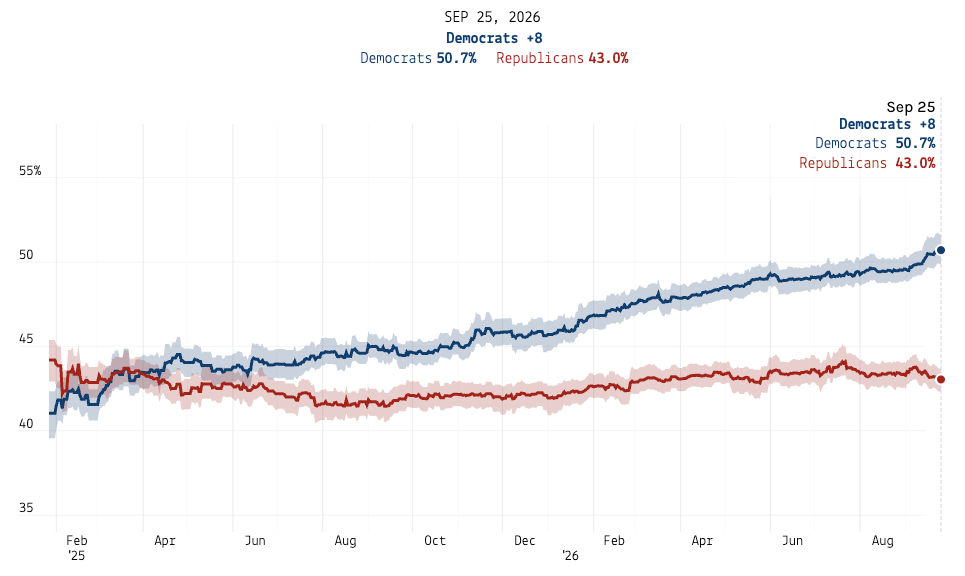
The Democratic margin in the 2026 U.S. House generic ballot ticked up another point this week, with Democrats now ahead of Republicans by 8 percentage points. Currently, 50.7 percent of likely voters indicate that they plan to vote for a Democrat in November, while 43 percent plan to vote for a Republican.
Trump’s job approval
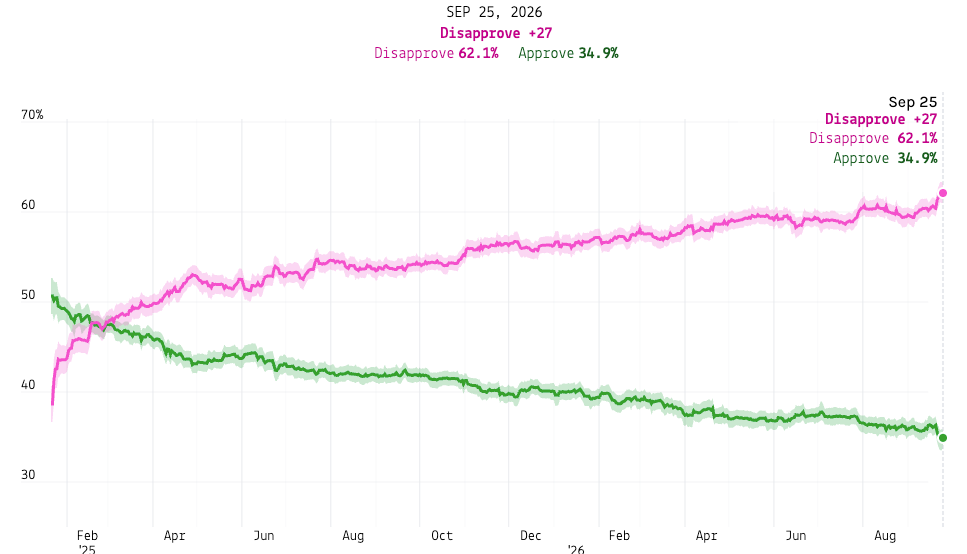
President Trump’s net approval rating among U.S. adults dropped two points this week, for a new low of -27 percentage points. Overall, 62.1 percent of Americans disapprove of the president’s job performance, while just 34.9 percent approve, his lowest ever rating.
Paid subscribers to 50+1 get access to premium analysis, plus sortable tables and complete data access on our polling website. If you want to follow the 2026 cycle with the best data at your fingertips, become a paid subscriber.