



We’re hard at work here at 50+1 putting the finishing touches on our fully fledged election forecast for the 2026 midterms. Barring unforeseen coding challenges (which do happen with these things), readers can expect that to come out in the next week or so.
In the meantime, here’s a fresh look at what the polls are saying about the battle for Congress today, according to our seat-level “nowcast” model. You can read more about how that model works here.
Paid subscribers to 50+1 get access to premium analysis, plus sortable tables and complete data access on our polling website. If you want to follow the 2026 cycle with the best data at your fingertips, become a paid subscriber.
And if you’re in the market for either the raw polling data used in this analysis, pre-calculated polling averages, or the data behind our upcoming election forecast for each House and Senate seat, check out our API subscription and get in touch about enterprise-level data access.
A polling averages update
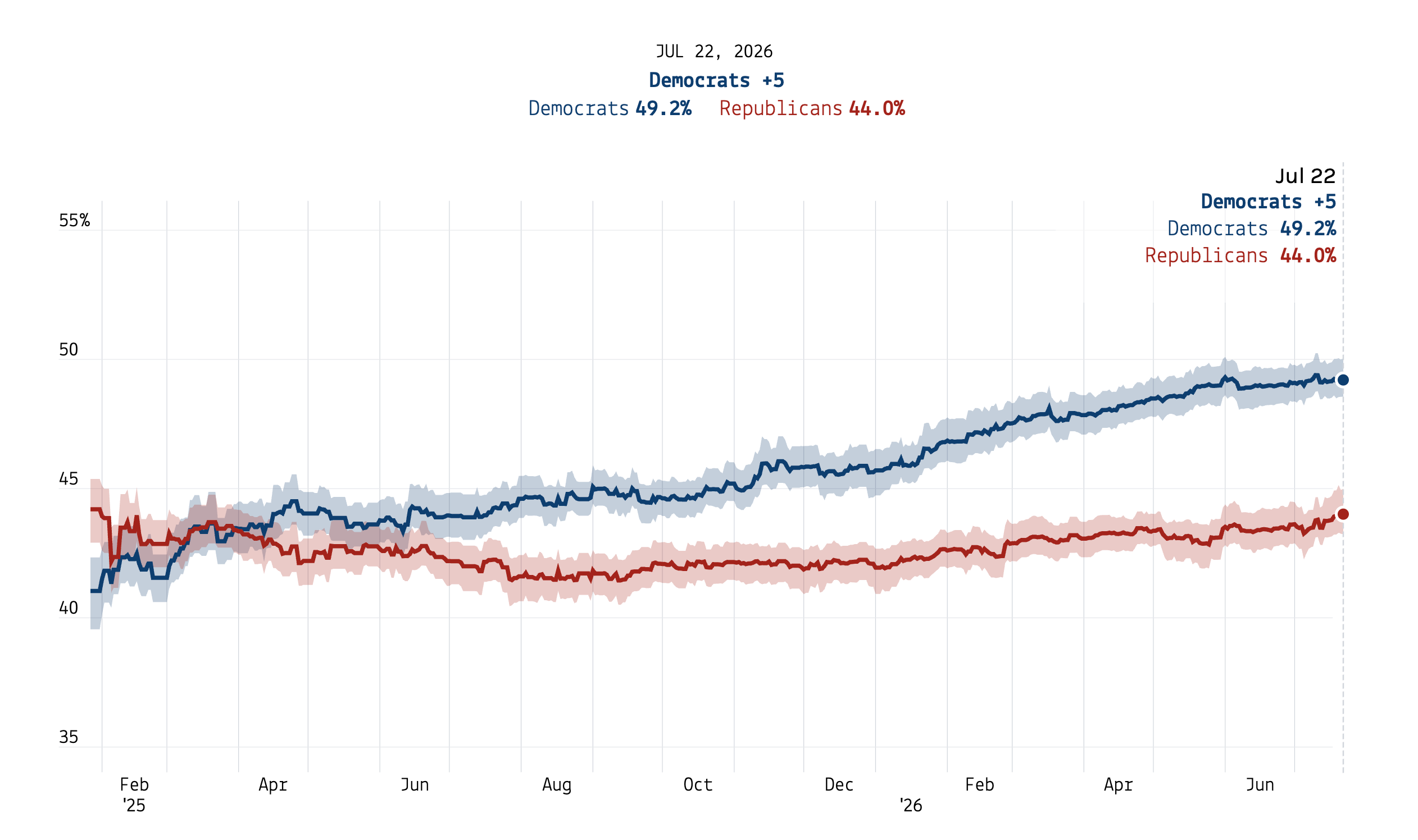
Let’s start with the national picture. According to our published average, Democrats currently lead the generic ballot 49.2% to 44.0% — a 5.2-point edge, down from roughly six points at our last nowcast update. The movement is almost entirely on the Republican side of the ballot, with undecided voters gravitating into the GOP voter pool while the Democrats’ vote share has sat roughly flat since mid-May.
When we consider polling alone, the race-level picture still tilts blue. Democrats currently lead in four Republican-held Senate seats: North Carolina (D+5.5), Maine (D+1.9), Ohio (D+0.6), and Texas (D+0.6). Make that five if you include Nebraska, where independent candidate Dan Osborn — who says he would caucus with neither party, but whose seat we count toward Democratic control — leads by five. (Be careful with this one; only one survey has been released in this race since February, so there are wide error bars around Osborn’s lead.)
Additionally, Democrats are polling within a point in two more Senate races: Iowa (R+0.9) and Alaska (R+0.9).
On the Democratic side of the map, New Hampshire (D+7.3), Georgia (D+7.1), Minnesota (D+5.8), and Michigan (D+0.6) round out the competitive seats; Florida (R+7.9) remains the GOP’s most comfortable lead in races for which we have polls.
Maine deserves a quick note. It now looks almost certain that Troy Jackson, former President of the Maine Senate, will be the new Democratic nominee to take on Susan Collins in November. We have gathered four polls testing support for his campaign: Wedgewood Polls (July 4–6) had him up 48–43, PPP (July 7, conducted for Platner’s campaign before he dropped out) up 49–44, Z to A Research (July 7–8, sponsored by 314 Action, who was supporting Nirav Shah to replace Platner) down 47–49, and the first high-quality nonpartisan survey from the University of New Hampshire (July 15–20) has Jackson up 49–46. Our adjusted average puts the race at Jackson +1.9 — tighter than the raw toplines because of house-effect and sponsor adjustments, but a good place for a challenger to sit against the incumbent Collins, who has made a career of beating expectations.
In the House, ten districts have enough polling for an average. Arizona’s 6th (D+0.1) and Michigan’s 4th (R+0.1) are dead heats; Pennsylvania’s 8th (R+0.7), Wisconsin’s 3rd (D+1.4), Maine’s 2nd (R+2.3), and Michigan’s 7th (R+2.6) are all inside the margin of error.
State of the nowcast
If the election were held today, our nowcast model gives Democrats a median of 50 seats in the Senate (counting Osborn’s) and a 46% chance of controlling the chamber, down a few points from two weeks ago. The Democratic hold on the House has also slipped slightly, now at a median of 227 Democratic seats and a 79% chance of the majority (82% at our last update) with district polls generating an implied national House vote of about D+6.7 (rosier than the current generic ballot average).
According to the joint simulations from our model (which, unlike others, simulates House and Senate elections simultaneously), Democrats sweep both chambers about 44% of the time, Republicans hold both about 19%, and in roughly 38% of simulations the parties split control.
The big movers in the Senate are: North Carolina, where Democratic candidate Roy Cooper has slipped from D+9 to D+5.5 and New Hampshire, which has sunk from D+9.7 to D+7.3. And our model now has more uncertainty about what will happen in Maine, given the lack of polling in the new matchup between Jackson and Collins.
If the election were held today, we are fairly confident the Democrats would pick up the House and have an outside chance at taking the Senate, too. Yet there is a long way to November. A full forecasting model for the House and Senate is coming out soon here at 50+1. It will be accessible here on our Substack and website.
FiftyPlusOne publishes daily updating polling averages for every competitive House and Senate race, plus the raw data behind them, at FiftyPlusOne.news. Enterprise subscribers can get all of that data and more via our data API.