



Welcome to The Trendline, the FiftyPlusOne.news weekly polling roundup. Subscribe to get it delivered straight to your inbox and get bundled access to our polling website.
Last week, trade negotiations between the United States and Canada abruptly fell apart, with both sides pointing fingers at the other. A 50 percent tariff on a long list of Canadian goods is now in effect, and the Trump administration has threatened an expansion of tariffs to additional products, including auto parts, to take effect in January 2027.
In response, the Canadian government announced retaliatory tariffs of 50 percent on key U.S. imports to Canada, which will take effect in September. Prime Minister Mark Carney told Canadians in a press conference Saturday that “You’re at war when you’re attacked. We got attacked,” and that his government was going to “hit back.”
So, what do Americans think of all this back-and-forth? What do Canadians think? Today on the Trendline, we’re checking in on both, to get a feel for how the American and Canadian public view the trade war, their leaders, and each other.
For many, President Donald Trump’s decision to escalate a trade war with Canada this close to the midterms seems baffling. Canadian tariffs are expected to have a disproportionate impact on several states with key Senate races, potentially increasing economic hardship just before voting begins. Right now, Trump’s net approval rating on trade (-22.7 percentage points) more or less matches his overall net approval rating (-23.5 percentage points), but if increases in tariffs cause higher prices, he’s got plenty of room to fall; his net approval rating on inflation is more than 20 percentage points lower than on trade.
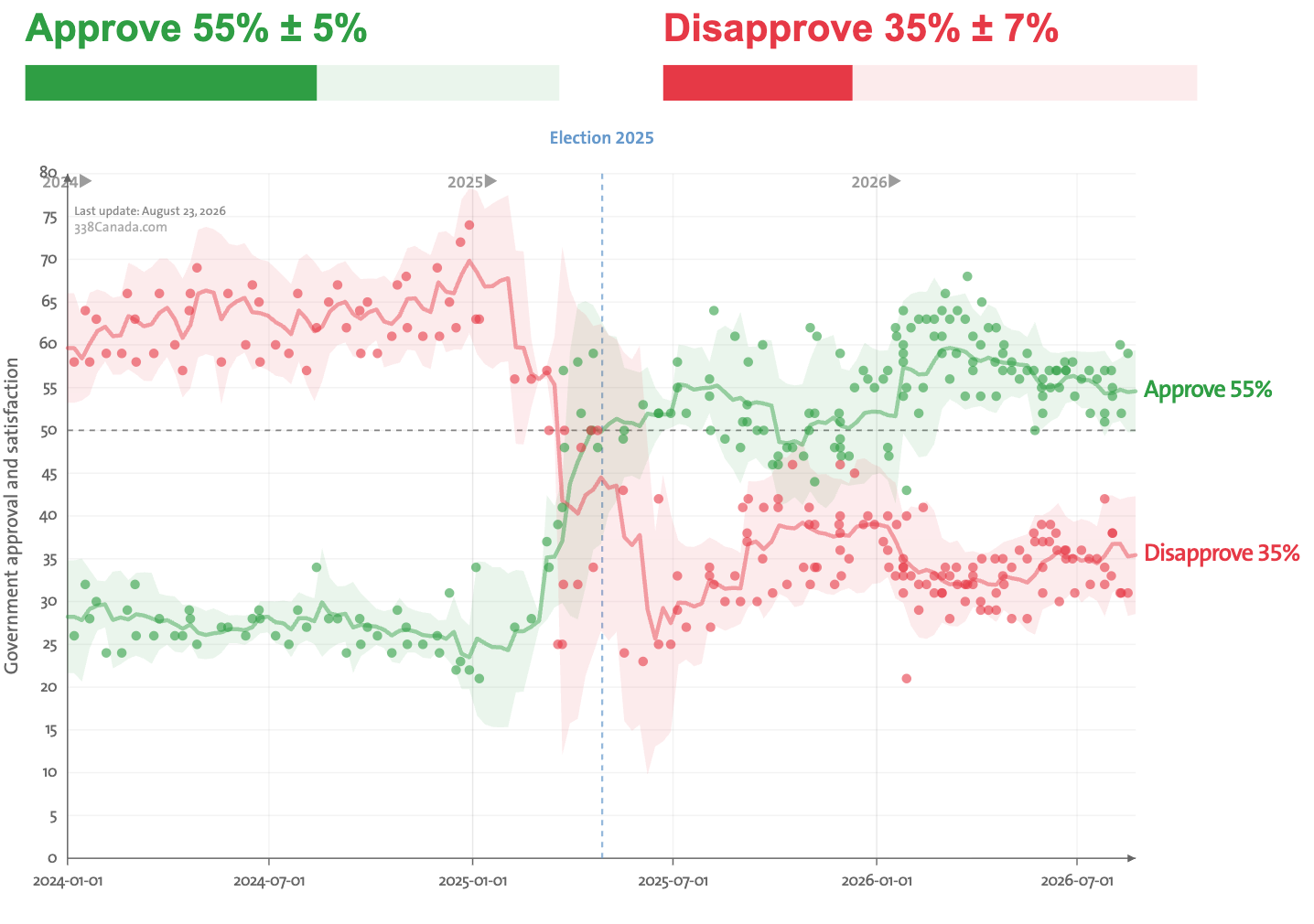
With elections coming up and his approval already quite negative, Trump doesn’t have a lot of wiggle room with the American public. Carney, on the other hand, seems to be basking in goodwill from Canadians. According to Canadian poll aggregator 338Canada, approval of Carney/the Carney government has been positive since the 2025 election. (Because of Canada’s parliamentary system, 338Canada includes polls that ask about Carney directly as well as those that ask about the Carney government.) Carney currently has a +20 net approval rating among Canadians.
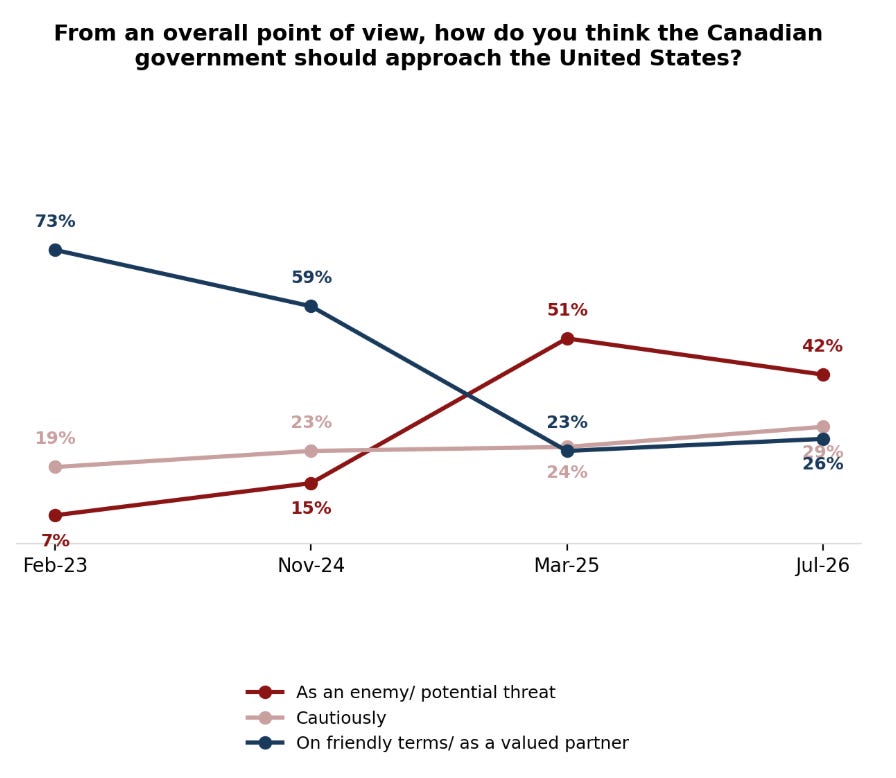
In the wake of the ongoing trade war, we’ve also seen sharp changes in how Canadians view Americans, though not really vice versa. For example, in February 2023, the Angus Reid Institute found that 73 percent of Canadians thought Canada should approach the U.S. “on friendly terms / as a valued partner.” By July of this year, that number had crashed to 26 percent. At the same time, the share who said the U.S. should be treated as an enemy or potential threat rose from just 7 percent in 2023 to 42 percent in July.
American’s views of the relationship between our two governments have also dimmed in the last few years, but to nowhere near the same degree. In a YouGov/The Economist poll conducted in May 2023, 83 percent of registered voters said they viewed Canada as an ally, while just 10 percent viewed it as an enemy. By February of this year, the most recent data from YouGov/The Economist on this question, voters were only slightly less likely to view Canada as a friend: 76 percent said the nation was an ally, while 14 percent said it was an enemy.
Even as the trade war has escalated, that view doesn’t seem to have changed much among Americans. In Angus Reid polling (Jul. 31 - Aug. 5, 2026 among Americans; Jul. 10 - 14, 2026 among Canadians), 78 percent of Americans said that we should treat Canada as a friend or ally, while just 4 percent said we should treat the nation as an enemy or threat to American interests.
This increasing sourness of Canadians toward the American government is also spilling over to the American people, and of course Donald Trump. In the Angus Reid poll, Trump’s favorability is underwater among Canadians by 64 percentage points, 79 to 15, and their favorability of the American people is underwater by 4 percentage points, 48 to 44. In a survey from the Pew Research Center released in June and conducted earlier this year, 74 percent of Americans said they had a favorable opinion of Canada; just 34 percent of Canadians returned the sentiment.
But while Canadians appear to be fuming mad at our nation, our leader, and us, Americans barely know who Mark Carney even is. Of the 15 foreign politicians with the highest name recognition in YouGov’s ongoing tracking, Carney ranked dead last, with only 45 percent of Americans saying they recognized his name.
But while not many people know who Carney is, those that do have a pretty good impression of him. He has the second-highest net favorability of these 15 leaders, with only President Volodymyr Zelenskyy of Ukraine better liked.
And despite our diverging opinions of each other, Americans and Canadians actually agree about the new round of tariffs levied by the U.S. against Canada: They don’t like them. According to the Angus Reid poll, just 24 percent of Americans support the new tariffs, while 59 percent are opposed. And in a Marquette Law School poll (Jul. 22 - 29, 2026), 56 percent of Americans said that tariffs hurt the U.S. economy, while 26 percent said they help and 17 percent said they don’t make much difference.
When it comes to the Canadian response to tariffs, Carney likely has the Canadian people on his side. In a Leger poll (Aug. 15 - 17, 2026) conducted before the talks collapsed, 56 percent of Canadians said they wanted the government to “take a hard line and make no more concessions,” compared to 31 percent who said they preferred the government “be flexible and, if need be, make concessions.” Asked about a variety of retaliatory measures that Canada could take against the U.S., every possible measure was above water with Canadians, with the most preferred option being to “add a special tax on electricity sold to the United States.”
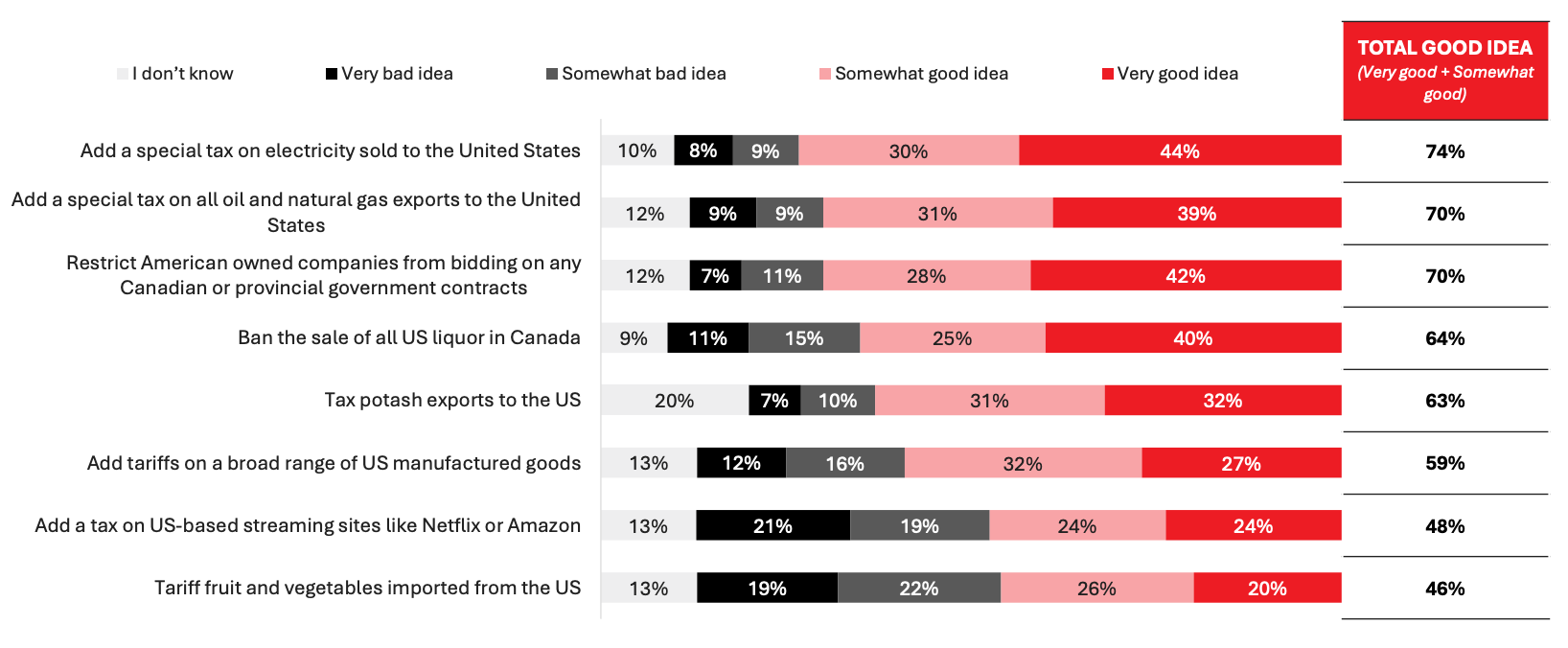
While the Canadian government has not yet introduced taxes or tariffs on electricity, the measure they are currently pursuing — tariffs on a broad range of U.S. goods — was supported by 59 percent of Canadians, with 28 percent opposed and 13 percent unsure.
Given how unpopular tariffs are in the States, it’s perhaps surprising that even Americans are somewhat supportive of Canada’s response. In a YouGov poll (Aug. 26, 2026), 43 percent of Americans said they approved of Canada’s retaliatory measures, while 40 percent were opposed. And the response doesn’t break sharply along partisan lines: The retaliatory tariffs were approved of by 53 percent of Democrats, 43 percent of independents, and 33 percent of Republicans, a more bipartisan mix than we typically see.
All in all, the Canadian government appears well positioned. Carney has broad support for his actions and a high approval rating. Americans don’t support their own government in this fight, strongly disapprove of Trump’s handling of trade, and by a slim margin even support Canada’s imposition of tariffs against our own nation. Those retaliatory tariffs aren’t set to take effect until Sept. 8, and against this backdrop, it’s still possible the two nations come to an agreement before that ever happens. But regardless of whether a deal is made, it’ll be a tall order to rebuild the old era of good feelings that seems to have all but vanished, at least on the Canadian side.
Other polling nuggets
Most Americans still think that UFOs are a result of human activity or natural phenomena rather than alien spacecraft, according to new polling from Gallup (Jul. 1 - 19, 2026). Forty-nine percent attributed UFO sightings to boring old human activity (down from 60 percent in 2019), while 37 percent said that at least some sightings were evidence of aliens visiting from outer space, up slightly from the 33 percent who said the same in 2019. Overall, almost a fifth of Americans (17 percent) say they’ve seen a UFO before. Men are more likely than women to say they’ve seen a UFO, while the Midwest seems to be a rather UFO-sparse area — just 12 percent of those in the Midwest said they’d seen a UFO, the least of any region, while 20 percent of those who lived in the East and West of the country and 16 percent of those in the South reported having witnessed a UFO. And in the great American tradition of distrusting the government, 78 percent of adults believe the government knows more about UFOs than it’s letting on. That’s despite Trump ordering the Pentagon to release any files it had on UFOs and “alien and extraterrestrial life” in February.
After Trump ordered the U.S. Postal Service not to deliver any mail ballots to states that haven’t provided a list of eligible voters, the Supreme Court granted him an interim win Monday, though another court Thursday reimposed a nationwide injunction blocking the rule. In a Navigator Research survey (Aug. 21 - 24, 2026), 60 percent of respondents said they were confident that voting by mail was safe and secure, including 78 percent of Democrats, 50 percent of independents, and 43 of Republicans. And in a new poll from SurveyMonkey and the Partnership for Large Election Jurisdictions (Aug. 18 - 20, 2026), 74 percent of likely voters said they were confident mail ballots would be counted accurately. One big criticism of voting by mail has been the time it takes some states to count votes, which can cause significant shifts in candidates’ vote shares as more ballots get counted. Sixty-five percent of likely voters, including majorities across the political spectrum, said they support allowing election officials to preprocess mail-in ballots, a method of speeding up vote-tallying that’s currently allowed in some states like Florida, but prohibited in others like Michigan. Overall, 34 percent of likely voters in the survey said they planned to vote by mail.
News broke this week of a major settlement between Meta and attorneys general from 52 states and territories, where Meta agreed to pay approximately $18 billion in penalties and make significant changes to its platforms in an attempt to reduce the risk of harm to children and teenagers. Recent polling from Pew Research Center (May 26 - Jun. 1, 2026) shows that a majority of Americans would go a step further and support banning children under 16 from using social media entirely. That included solid majorities of both Democrats and Republicans. Interestingly, Americans 65 and older were the least likely to support such a ban, below even adults aged 18-29 (though a plurality of 49 percent of older voters were still in favor). When asked how they felt about certain restrictions — similar to those Meta agreed to in its settlement — like limiting how much time minors can spend on social media apps and requiring more stringent age-verification methods, almost 80 percent of adults said they were supportive of each measure. Seventy-seven percent of adults also said they supported banning the use of phones in classrooms, up from 68 percent in 2024. And in the first time since Pew began asking the question two years ago, a plurality (48 percent) of Americans favor banning the use of phones during the entire school day (43 percent were opposed).
We lost a legend this week: Dolly Parton’s family announced Tuesday that the country music superstar had passed away after a brief battle with cancer. Almost universally loved, Dolly had a 70 percent favorability rating in an April survey by the University of Massachusetts/YouGov, with only 5 percent of adults saying they had an unfavorable opinion of her. Known not only for her smash hits, Dolly also made headlines with her philanthropy, flashy outfits, and unmatched charisma. A YouGov poll this week (Aug. 27, 2026) asked Americans what they thought Dolly would be most remembered for; 39 percent said her music, while 26 percent said her charitable work, and 20 percent said her personality. Rest in peace to a beloved national icon.
Polling averages update
All numbers are as of 9:30 AM Eastern on Aug. 28, 2026.
2026 U.S. House generic ballot
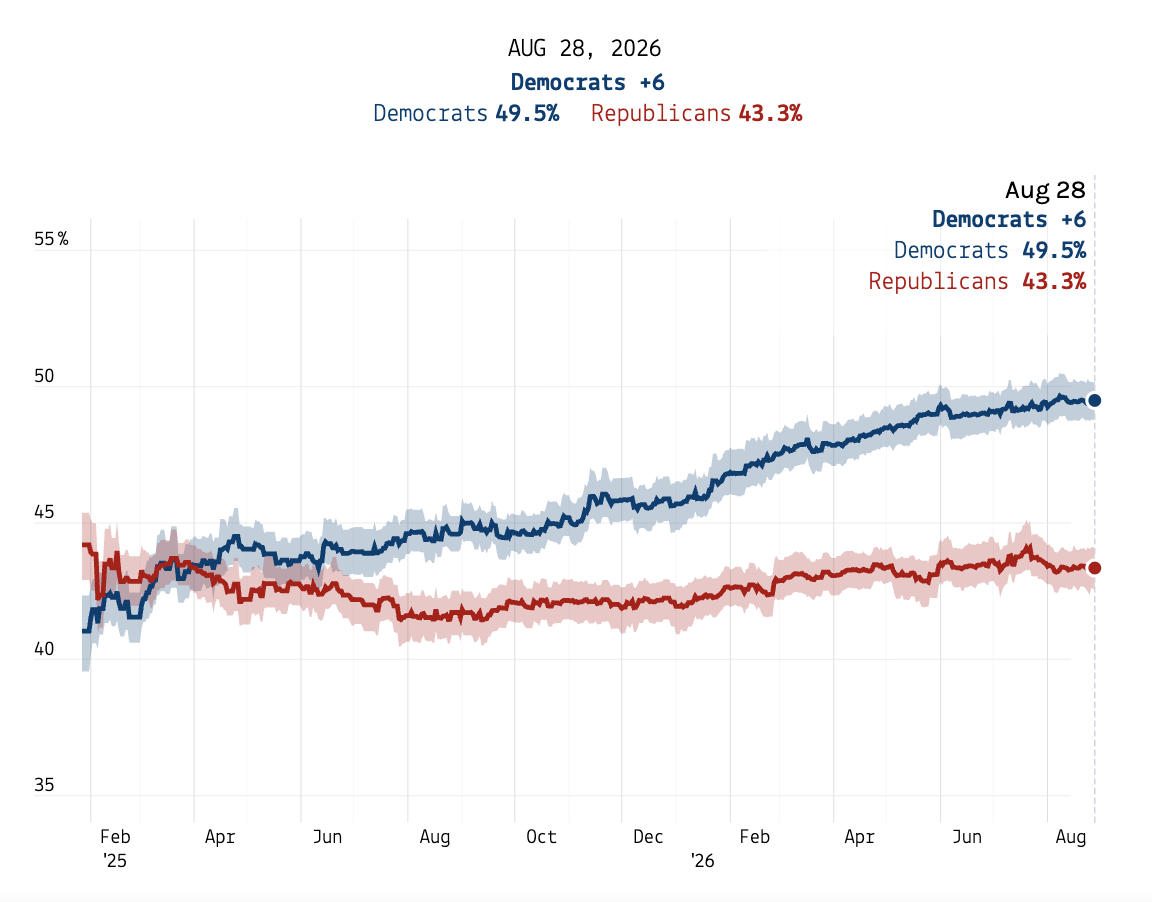
The Democratic margin in the 2026 U.S. House generic ballot remained stable this week, with Democrats ahead of Republicans by 6 percentage points. Currently, 49.5 percent of likely voters indicate that they plan to vote for a Democrat in November, while 43.4 percent plan to vote for a Republican.
Trump’s job approval
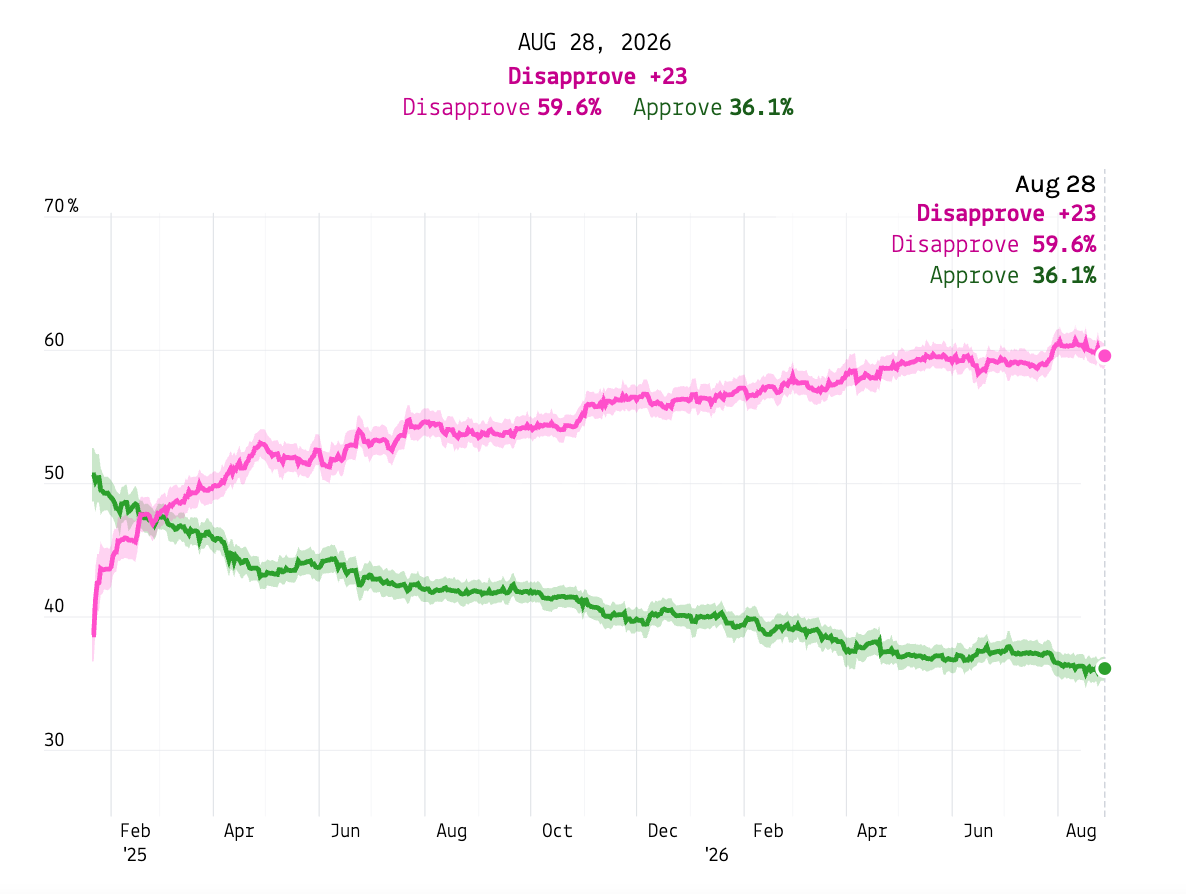
President Trump’s approval rating among U.S. adults barely budged this week, with 36.1 percent of Americans approving of his job performance, identical to last week. His disapproval rating nudged down from 59.9 percent last week to 59.6 percent this week.
Paid subscribers to 50+1 get access to premium analysis, plus sortable tables and complete data access on our polling website. If you want to follow the 2026 cycle with the best data at your fingertips, become a paid subscriber.