



Welcome to The Trendline, FiftyPlusOne’s weekly polling roundup. Subscribe to get it delivered straight to your inbox and get bundled access to our polling website.
Pentagon officials told lawmakers this week that the first week of the ongoing U.S. campaign in Iran has cost over $11 billion, and some estimates show that the war will cost taxpayers nearly $1 billion every day. Americans tell pollsters that the cost of living is the country’s most important problem and they don’t see Trump as focusing on the right issues, so this week on The Trendline we’re checking in on how Americans think about the cost of the war and federal spending more generally.
Across the political spectrum, Americans do express concern about the cost of the new war against Iran. A majority of Republican, Democratic, and Independent adults said they were very or somewhat concerned about the financial costs of U.S. military action in Iran in a Reuters/Ipsos survey published this week (conducted Mar. 6 - 9, 2026). But notably, Republicans are far less concerned than any other group, and the number of Republicans who said they were “very concerned” is 50 percentage points smaller than the number of Democrats who said the same.
Contrast that with, for example, the number of respondents who told the same pollster that they were very or somewhat concerned about “risk to the lives of American military personnel,” where we see agreement across the political spectrum, with at least 85 percent of every group expressing concern, and it appears that funding stands out as a point on which the parties disagree.
And this disagreement may not come as a big surprise. For years, polls have shown differences in how the two parties prioritize federal spending, particularly when it comes to spending on the military and national defense. While Americans across the political spectrum support increased spending on universal social safety net programs, like Social Security and Medicare, they differ sharply on spending on the environment, education, national defense, foreign aid, and ICE, according to new YouGov/The Economist data (Mar. 6 - 9, 2026).
When it comes to national defense in particular, YouGov showed 58 percent of Republicans supported increasing spending, while 6 percent supported decreasing spending. On the other hand, only 20 percent of Democrats supported increased spending on defense, while 38 percent said it should be decreased.
And the parties also differ in terms of what spending they would cut to reduce the federal debt. In a poll conducted by Gallup last year (Sept. 2 - 16, 2025), Democrats’ most favored option for reducing federal debt (other than raising taxes) was cutting defense spending, with 63 percent saying they would support the move. But among Republicans, only 13 percent said they would support cuts to defense spending. In contrast, GOP voters favored cutting Medicaid and food assistance programs (75 percent) and increasing tariffs (89 percent) to decrease the deficit.
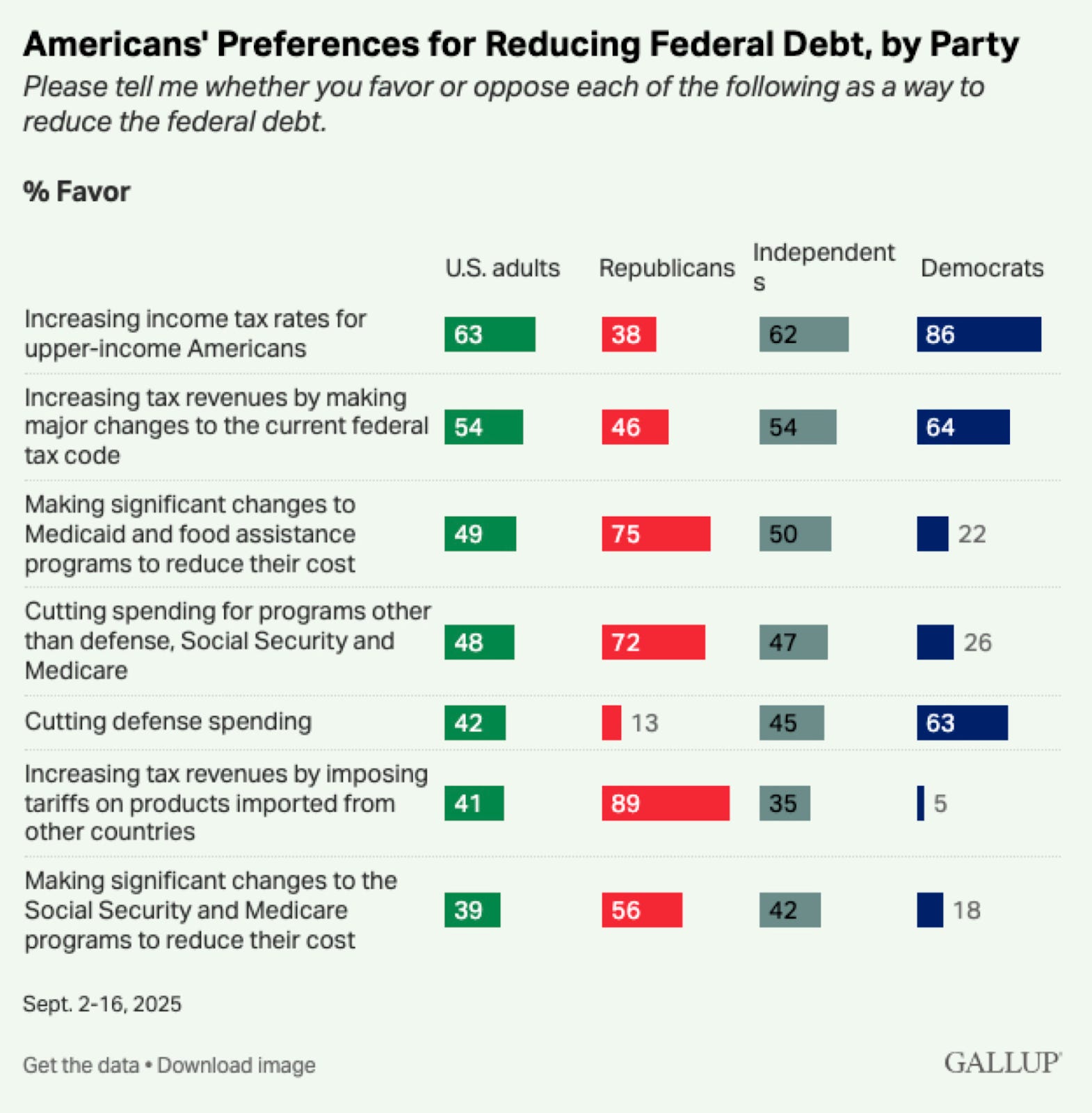
It’s expected that in the coming weeks, Congress will consider a supplemental spending bill to fund continued military action in the Middle East. And despite the fact that voters across the political spectrum have been concerned about the rising national debt for years, Republicans appear ready to support it. Democrats, for their part, have not committed to attempting to block the package, so regardless of American’s feelings about defense spending, it may be inevitable that the money gets approved.
New polling average for Illinois Senate primary
This week, 50+1 launched a polling average for the upcoming Democratic primary for U.S. Senator from Illinois (the seat currently held by retiring Sen. Dick Durbin). According to the polls, the race is most likely to be won by Raja Krishnamoorthi, the current U.S. Rep. from Illinois’ Eight Congressional District; Juliana Stratton, the state’s current Lieutenant Governor; or Robin Kelly, the Rep. from IL-02.
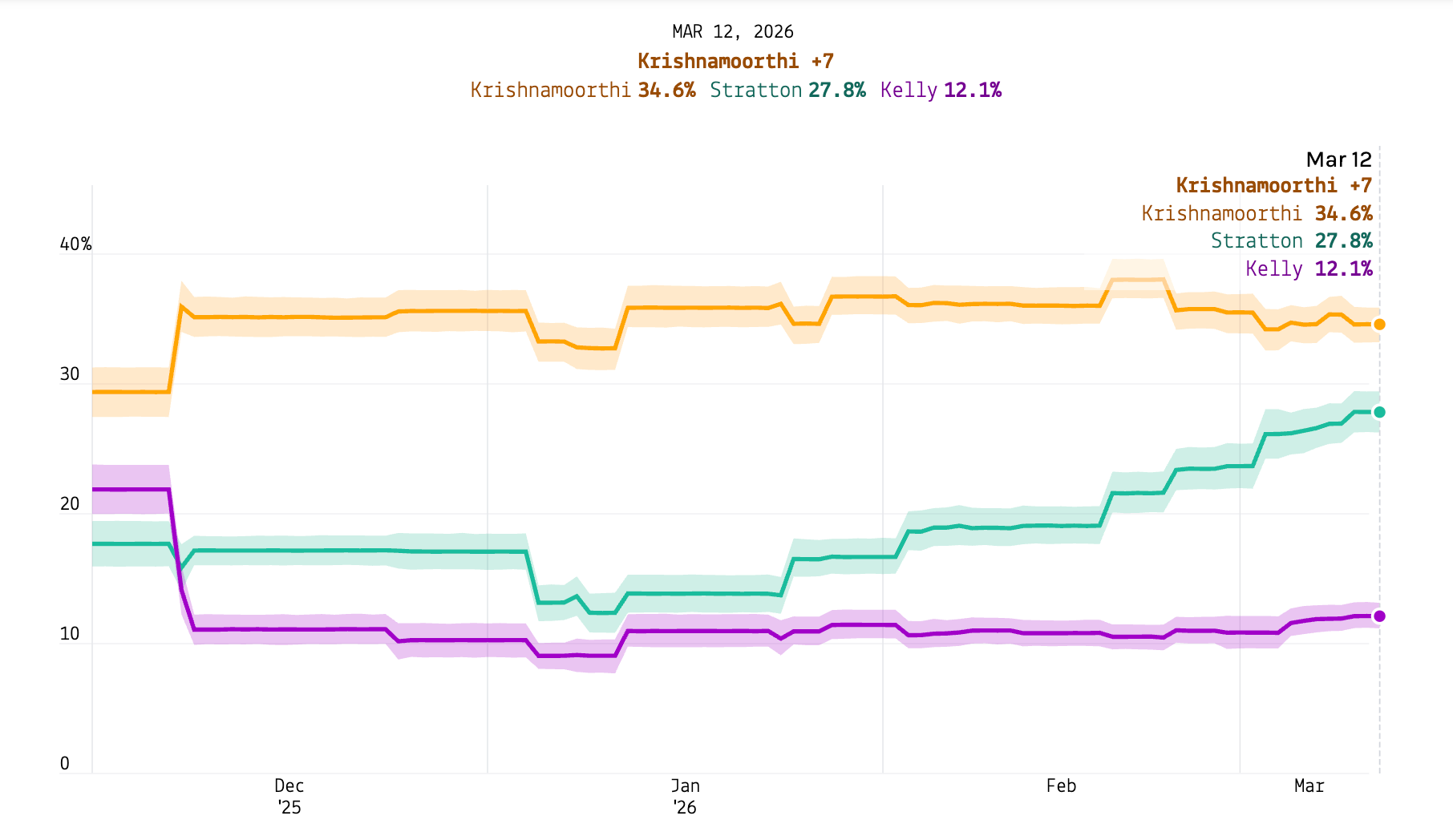
We know it’s a little close to the contest to be launching a polling average (voters cast their ballots next week), but we here at 50+1 are still testing out our infrastructure for more primary averages. We expect Illinois will be our final test, and other averages can come along sooner!
As with the Texas elections last week, primary polling averages should be considered noisy and treated with uncertainty. The average poll for the Republican primary for Texas Senator, for example, was off by 7 points in terms of the final vote margin between John Cornyn and Ken Paxton.
Other polling nuggets
YouGov conducted an interesting survey experiment testing out the public’s approval of Donald Trump firing Secretary of Homeland Security Kristi Noem last week. The experiment asks roughly 550 voters each one of two questions: either (A) “ Do you approve or disapprove of President Trump’s decision to fire Kristi Noem as Secretary of the Department of Homeland Security?“ or (B) “Do you approve or disapprove of the decision to fire Kristi Noem as Secretary of the Department of Homeland Security?”. YouGov found the question wording mentioning Trump received more support, 60% in favor of versus 11% opposed to the firing, compared to the neutral framing, 53% in favor to 11% opposed. The effect is driven mostly by Republicans, who approve more of Noem’s firing when Trump is mentioned.
A new national survey by the right-leaning pollster Cygnal finds a majority of Americans (55%) believe AI will have a net negative impact on society, but 67% say it’s still important that the U.S. leads in AI development. Young people (ages 18-29) are the most likely to be pessimistic about AI.
A new Marist University poll reveals voters are anxious about the security of the 2026 election. Just 66% of voters say they are confident that their state or local government “will run a fair and accurate election this November.” Confidence in election administration has fallen particularly with Democrats, Marist notes: In October of 2024, 88% of Democrats told the pollster they were confident in the upcoming election, compared to 72% now. The poll finds 58% of Americans think voters will be turned away at the polls for being ineligible to vote (the poll did not specify whether this turning away would be correct or incorrect; some Americans are, after all, ineligible to vote).
The 2026 Academy Awards (Oscars) will be held Sunday, March 15, 2026. YouGov asked voters if they’ll be watching, and who their pick for best picture is. Sinners is a crowd favorite with 19% saying it deserves the award. But the popular choice often loses; the same poll found just 2% of adults think last year’s winner, Anora, should have won.
A new Data for Progress survey finds a slim majority of likely voters — 52% — believe Trump was “at least partly motivated” to take military action against Iran to distract from the Epstein scandal, compared to 40% who say he was not motivated by it at all.
The headline for this survey, sponsored by the digital news publications Zeteo and Drop Site News, was “Majority of Americans Believe Trump Launched Iran War to Cover Up Epstein Scandal.” We think the headline overstates the finding; the question sets a very low bar for agreement, asking voters whether Trump was “at least partly motivated to take military action against Iran in order to distract from the Jeffrey Epstein scandal” or “not motivated at all” by that goal. “At least partly motivated” means even a respondent who attributes minimal weight to the Epstein angle counts as agreeing with the premise.
We think the more electorally significant finding from this poll comes from a separate question altogether. Voters said they would be less likely to support candidates in 2026 and 2028 who support the war in Iran — by a net of around 20 points across three different electoral scenarios, including congressional races, a 2028 presidential candidate, and members who vote for Trump’s Iran supplemental funding request.
Polling averages update
All numbers are as of 11:00 AM Eastern on March 6, 2026..
2026 U.S. House generic ballot
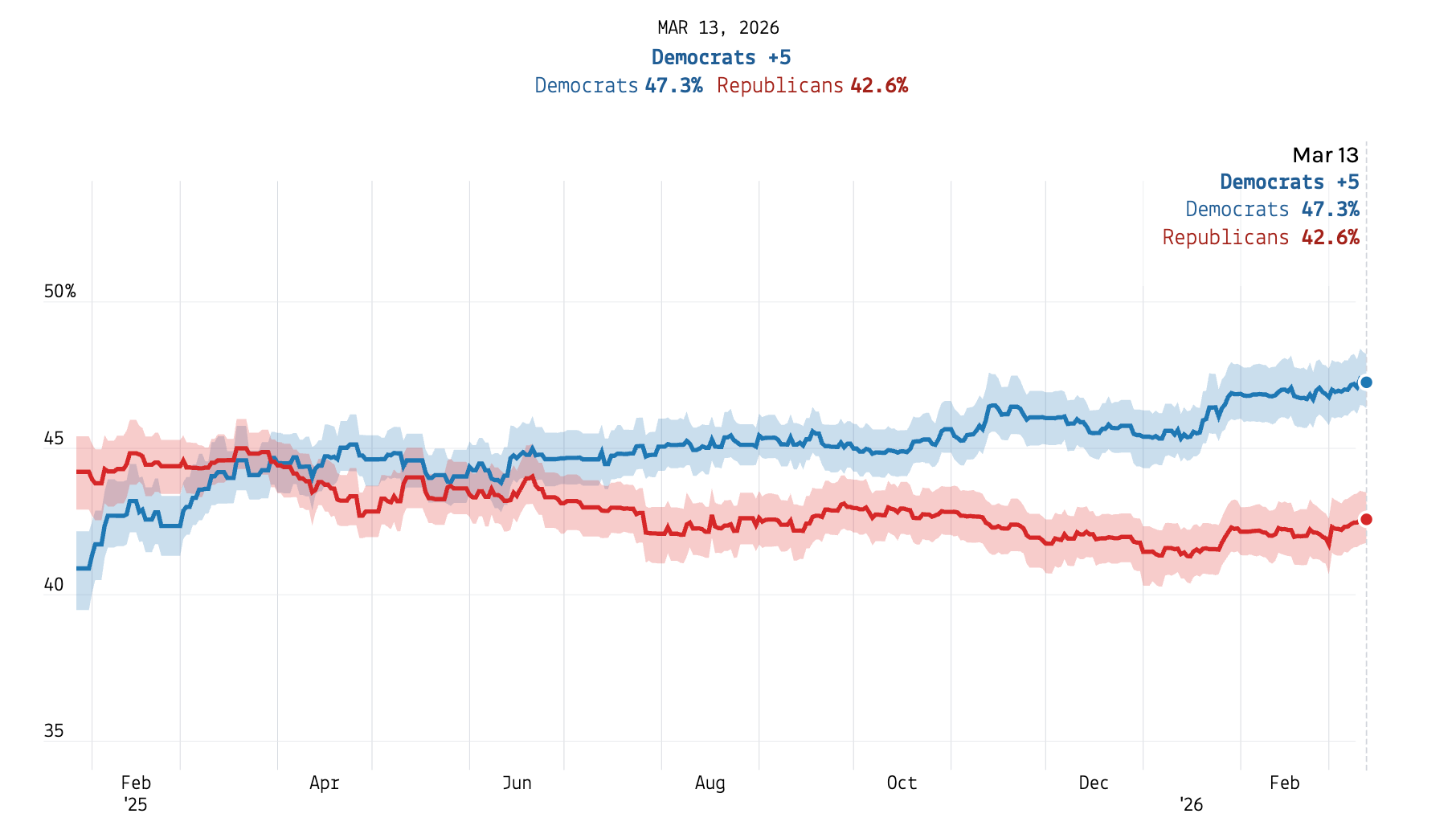
Democrats have held their lead on the 2026 U.S. House generic ballot at +4.7 over the last week, rounding to 47% of the vote for Democrats versus 42% for the Republicans.
Trump’s job approval
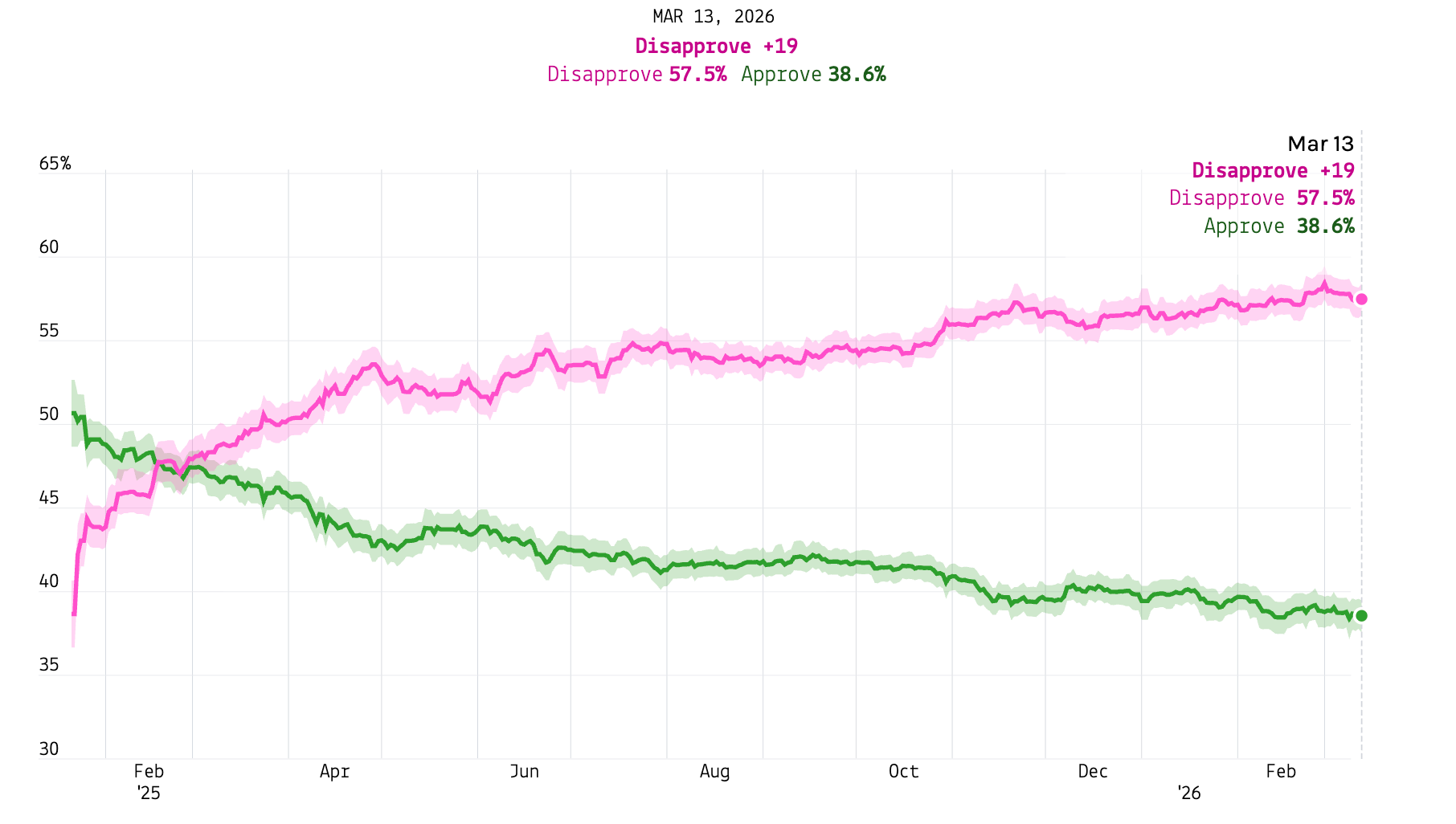
President Trump’s approval rating (38.6%) declined within the margin of error from 38.7% in the week ending March 13, 2026. His disapproval rating also “fell” from 57.8% to 57.5, taking him just off an all-time-high net disapproval rating (now -19).
Paid subscribers to 50+1 get access to premium analysis, plus sortable tables and complete data access on our polling website. If you want to follow the 2026 cycle with the best data at your fingertips, become a paid subscriber.