



Welcome to The Trendline, FiftyPlusOne’s weekly polling roundup. Subscribe to get it delivered straight to your inbox and get bundled access to our polling website.
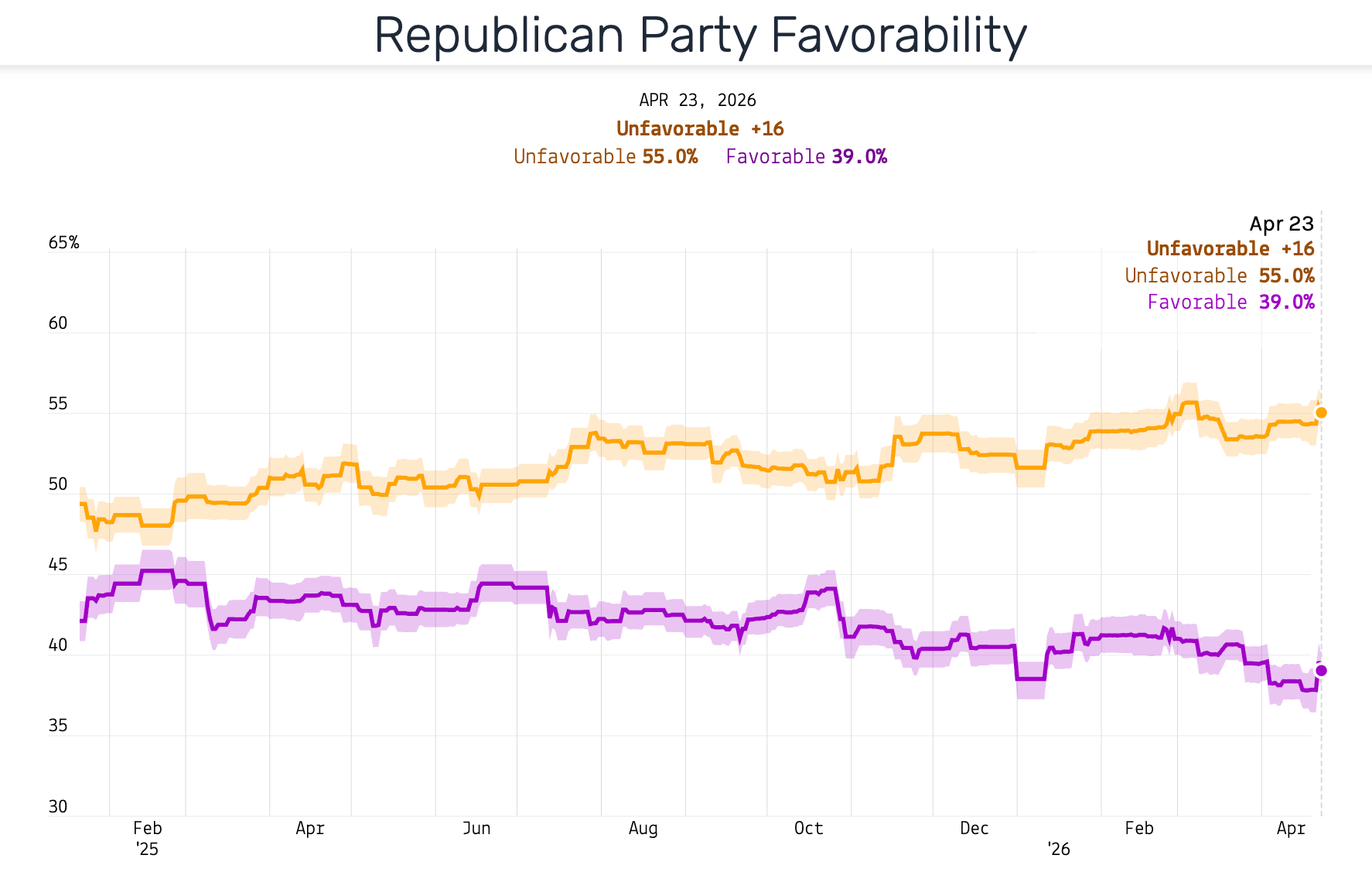
This week, we rolled out new averages at FiftyPlusOne of favorability polling for the Democratic and Republican parties, calculated back to January 2025. These averages show ratings of the Democratic Party holding steady (and negative) since the beginning of Donald Trump’s second term as president, and views of the Republicans turning sharply south.
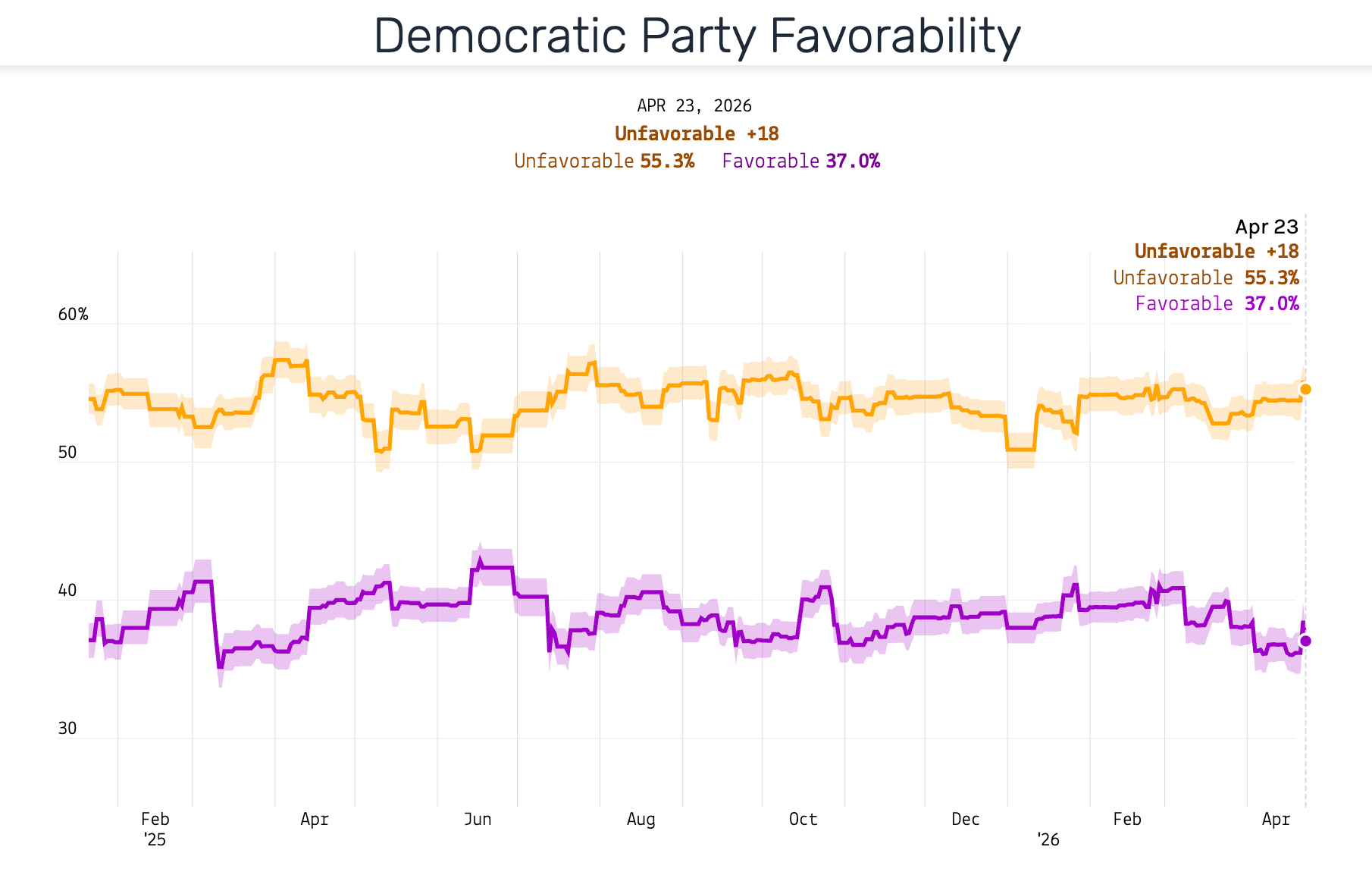
Democrats started Trump’s second term with a net rating of -17, 54.6 percent unfavorable to 37.1 percent favorable, and today are rated at -18, 55.3 to 37.0. Republicans, meanwhile, started at -7 (49.4 percent to 42.1 percent) and today score a -16 (55 to 39).
We can use these polls to calculate a “net favorability advantage” for both parties, measured as the difference between the two parties’ net ratings. Numbers above zero mean Democrats have a better net rating than Republicans; numbers below zero mean Republicans have the edge. Here’s what that statistics looks like since Bill Clinton’s presidency:
Party favorability has been a subject of considerable conversation in the media over the last year. Back in July, we wrote about a much-discussed Wall Street Journal poll that put the Democratic Party at a net favorability of -30 and a 19-point deficit against Republicans. That piece made three arguments worth updating here: that the WSJ number was an outlier against the average of polls (Democrats looked more like -10 compared to Republicans); that much of the Democratic favorability deficit comes from in-party disaffection by “very liberal” Democrats who don’t plan to defect at the ballot box; and that party favorability this far from an election has “almost no predictive power” for midterm results.
Out-parties tend to gain ground on favorability
Armed with our new averages, we want to follow up on that last point. One reason favorability is a poor predictor of election results is that it is not the same as vote choice; you can view a party (or candidate) unfavorably and still vote for it (them). Another reason is that favorability numbers move a lot between inauguration and Election Day, in ways that look fairly similar across cycles. Exhibit A of this might be the 2026 election: Democrats had a nearly -10 net favorability disadvantage versus the Republicans in January of 2025, but the difference between the parties’ ratings now is just -1.4.
Since 1992, six cycles have started with a new party taking the White House: Clinton in 1993, George W. Bush in 2001, Obama in 2009, Trump in 2017, Biden in 2021, and Trump again in 2025. (For our purposes here, we will set aside the 2001 cycle because the September 11 terror attacks disrupted first-term favorability dynamics, and basically all other political polling, in ways that don’t generalize.) In the four completed cycles we can compare to, the out-party’s favorability advantage either grew or stayed roughly flat between inauguration and the first midterm. In none of those cycles did it get meaningfully worse.
The magnitudes vary a lot. Republicans entering the Obama administration started at about -36, one of the deepest favorability deficits in the series — and gained nearly 33 points by the 2010 midterm, finishing close to parity. Republicans in 2021 started 21 points down and gained about 17 points by November 2022. Republicans in 1993, barely underwater at -2, gained 7 points by 1994. And the 2017 Democrats — the only out-party in this window to come in with an advantage, at +12 — moved essentially sideways, ending the cycle one point below where they started. That’s within the margin of error.
This pattern is consistent with a simple theory of mean reversion: the more underwater the out-party begins, the bigger the recovery as the in-party absorbs the normal wear and tear of governing.
One methodological note: Our new polling average was a little too jumpy on old, noisy historical data, so for this article we are using a slightly smoother version for modern polling for the sake of comparison. This smoother version tends to soften bounces and reversions from running an average over sparse data, but also dampens spikes after elections and other big events.
According to our smoother average, Democrats have gained about four points of favorability advantage since Trump’s inauguration in January. That’s broadly in line with historical expectations: the predominant pattern in the data is mean reversion, and because Democrats started this cycle only 6 points down on our average, we shouldn’t expect as large a movement as if they were down 21 points like the GOP in 2021, or their -36 in 2009.
Democrats in 2026: Not as bad as it seems?
There are two reasons this matters. First, it reinforces our point last summer that the “worst-ever” framing of the WSJ poll was never really supported by the average of polls: an average of polls never showed a -19 hole. Second, it’s evidence of our other point that the out-party should gain ground in favorability before the midterms, as the party in power accumulates policy shocks and thermostatic public opinion kicks in.
We argued in July that the Democratic brand wasn’t as broken as a single bad poll implied. The historical pattern in our new average adds a complementary point: that party brands are to an extent “self-healing” over the long term and relative to the other party. This presents a fundamental challenge for both parties: even if you’re strictly enacting policies voters support, how can you hope to build a durable long-term coalition?
Other polling nuggets
In a new Reuters/Ipsos poll (Apr. 15 - 20), Americans, especially Republicans, expressed concerns about the upcoming midterm election. Forty-six percent of respondents said that there are large numbers of fraudulent ballots cast by non-citizens in U.S. elections (in reality, this is not a widespread problem), including 82 percent of Republicans. Moreover, 83 percent of Republicans said they worried about fraudulent mail-in ballots, compared with 33 percent of Democrats and 53 percent of Americans overall. And while just 28 percent of Americans supported National Guard presence at the polls, 45 percent of Republicans said they did.
There are some points of agreement between the parties, though. Seventy-nine percent of Democrats and 71 percent of Republicans agreed that their own ballots will be counted properly. And 77 percent of Americans, including 95 percent of Republicans and 63 percent of Democrats, support a requirement that voters show some form of ID at the polls.For the first time in over 15 years, Democrats have taken the lead over Republicans on who voters trust more to handle the economy in Fox News polling. According to a new Fox/Beacon Research/Shaw and Company Research poll (Apr. 17 - 20, 2026), voters said that Democrats would do a better job on the economy than Republicans by a margin of 4 points. Democrats hold a lead on some other key midterm issues, including healthcare (21 point lead), inflation and prices (8 point lead), and foreign policy (6 point lead). On the other hand, Republicans continue to dominate Democrats on border security (16 point lead), and hold a lead on other important midterm issues, including immigration (8 point lead) and national security (6 point lead).
Asked about a variety of quality of life issues, voters are overwhelmingly pessimistic in a new Echelon Insights poll (Apr. 17 - 20, 2023). Topping the list: “trust in government and institutions,” which 73 percent said was getting worse and 12 percent said was getting better, a margin of 61 points. Next was “cost of living,” which voters said was getting worse rather than better by a margin of 60 points, “mental health and emotional well-being,” (49 points), and the quality of education and job security, tied at a margin of 40 points. The only issue tested that wasn’t underwater was “workplace safety,” where 31 percent of voters said it was getting better over time, and 31 percent said it was getting worse.
Who will be the first to reach Mars? According to a new RMG Research/Napolitan News Service poll (Apr. 14 - 15, 2026), it’s nearly a tied race between SpaceX and the U.S. government, with 35 percent of voters saying the government will be first to land a human on the red planet, and 31 percent saying Elon Musk’s company will lead the way. Another seven percent say China will get to Mars first, and 4 percent say some other private company will.
Polling averages update
All numbers are as of 10:00 AM Eastern on April 24, 2026.
2026 U.S. House generic ballot
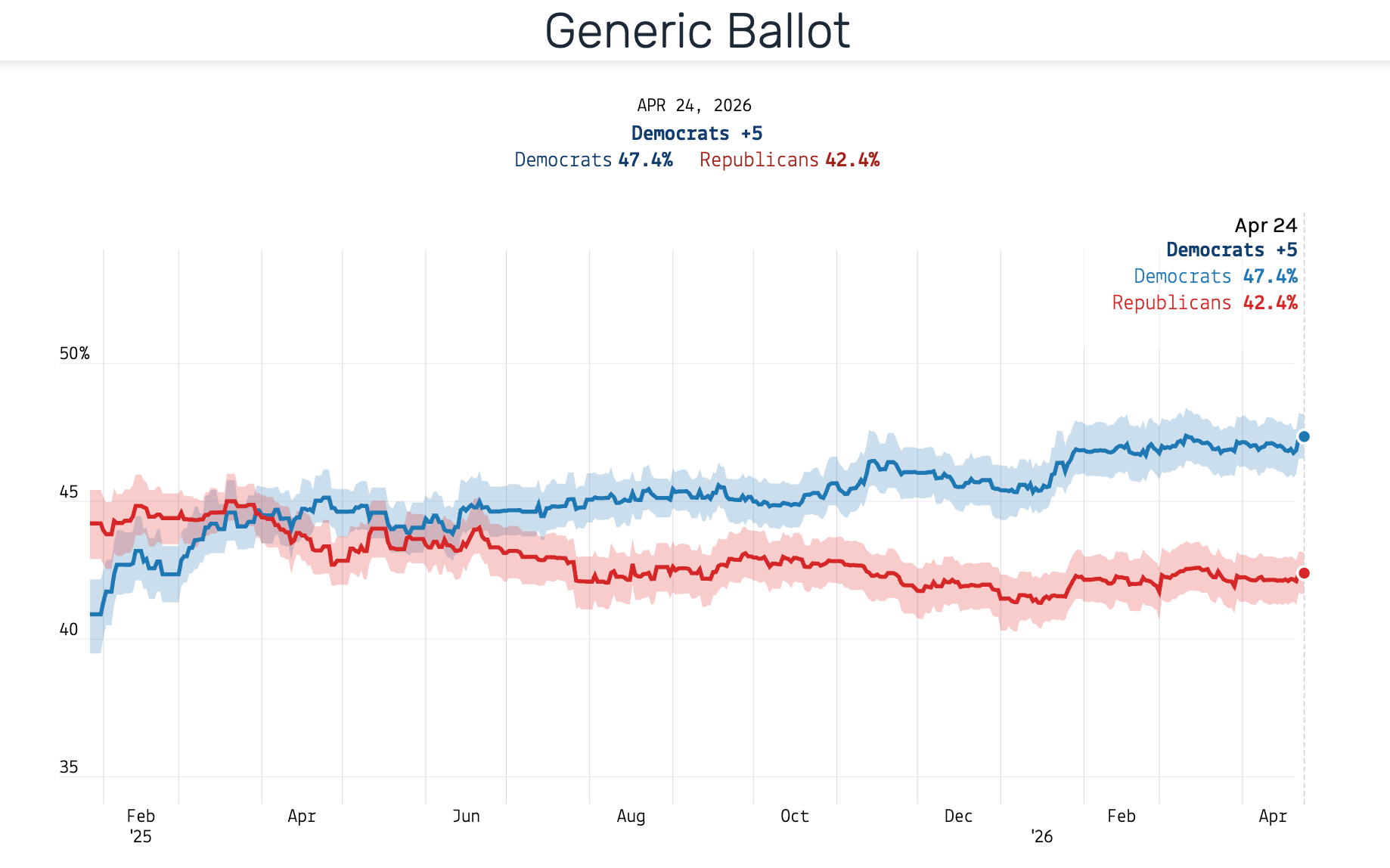
Democrats have held their lead on the 2026 U.S. House generic ballot at +5 (after rounding) over the last week, with 47.4 percent of registered voters saying they’ll cast their ballot for Democrats this fall versus 42.4 percent for the Republicans.
Trump’s job approval
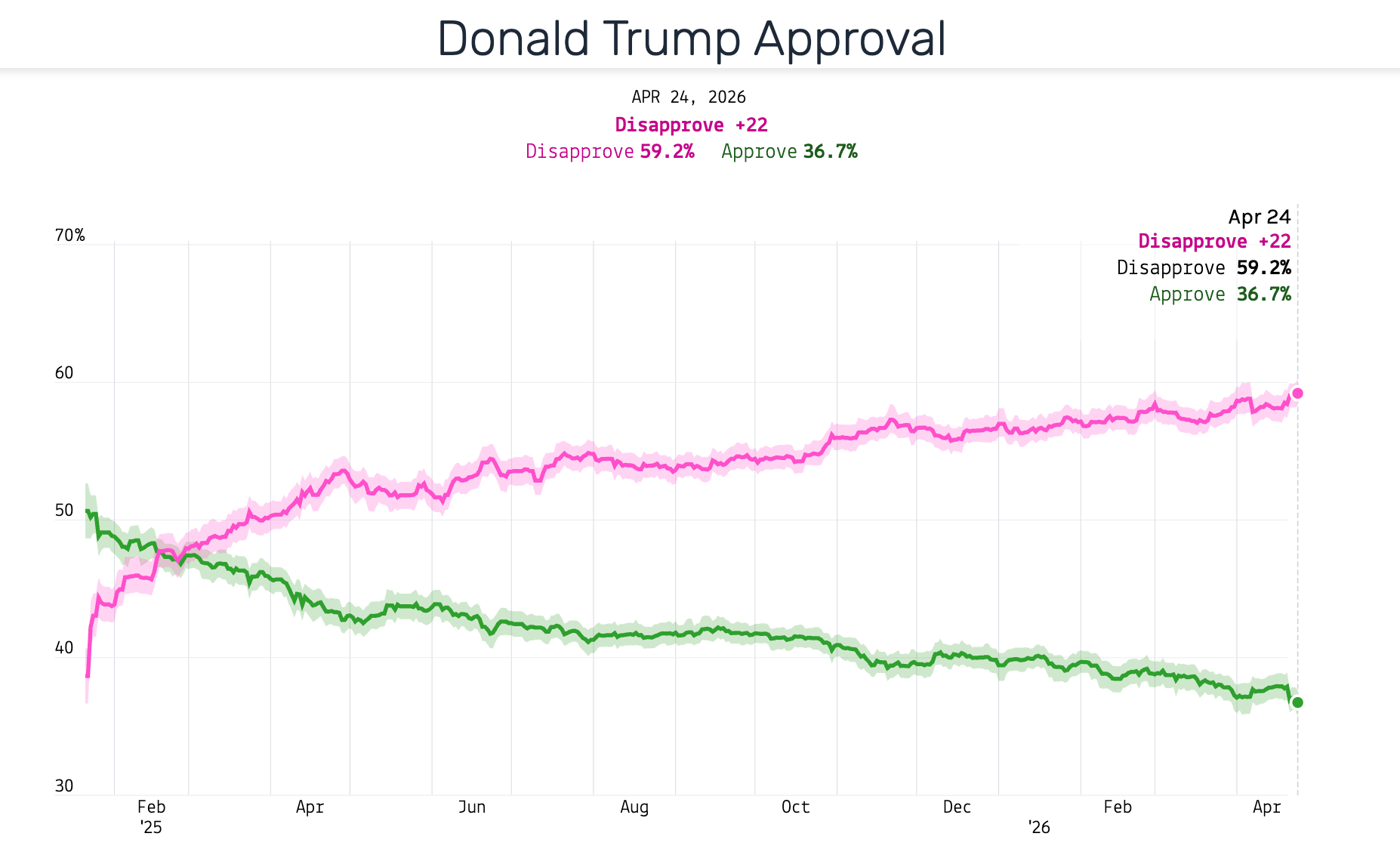
President Trump’s approval rating fell to a new all-time low of 36.7 percent this week, while the percent of Americans who disapprove of the job he is doing rose to 59.2 percent. This is the first time his disapproval has risen above 59. Trump’s -22 rating matches his first-term low, which came after the January 6, 2021 attack on the U.S. Capitol.
These averages update fresh on the 50+1 website with every new poll we add to our database.
Paid subscribers to 50+1 get access to premium analysis, plus sortable tables and complete data access on our polling website. If you want to follow the 2026 cycle with the best data at your fingertips, become a paid subscriber.