



Welcome to The Trendline, FiftyPlusOne’s weekly polling roundup. Subscribe to get it delivered straight to your inbox and get bundled access to our polling website.
It’s budget season again on Capitol Hill, and members of congress have been spending the last few weeks debating a variety of proposals, including ending the DHS shutdown and funding ICE (Trump signed a bill to end the shutdown and fund DHS on April 30, 2026), significant increases to the Pentagon’s budget, and big cuts to the EPA, among other things. So this week on The Trendline, we’re checking in on what Americans prioritize for their tax dollars, and how they feel about federal spending overall.
When it comes to some of the proposed spending cuts being considered, it appears that the GOP may be on the wrong side of public opinion. In an RMG Research/Napolitan News Service poll (Apr. 27 - 28, 2026), voters opposed cuts to the Department of Education budget by 30 percentage points (62 percent to 32 percent), and also opposed cuts to the TSA by 36 percentage points (63 percent to 27 percent). As to the Democratic position that funding for ICE should be cut, voters agree by a much smaller margin; 51 percent favor cutting ICE funding, while 44 percent oppose.
And on increases in funding for the Pentagon, Congress may also be out on a limb. Asked in a Verasight/The Argument poll (Apr. 20 - 23, 2026) about several categories of spending, the military was by far the category voters were most likely to say the government spends too much on.
Moreover, in order to pay for the increased spending on the Pentagon, the GOP has been mulling additional cuts to health care, which was already significantly cut in last year’s budget reconciliation bill (officially titled the “One Big Beautiful Bill Act”). Republican leaders say that these cuts are actually intended to target wasteful spending and fraud, while opponents say such fraud is not common, and cuts will hurt Americans, especially Medicaid recipients.
As to what Americans think, it’s a bit more complicated. In the RMG Research/Napolitan News survey, 21 percent of voters said that most federal spending is waste and fraud, and another 44 percent said a lot of it is. Twenty-four percent said that some federal spending is waste and fraud, and only 5 percent said not very much spending is fraudulent. Against that backdrop, it’s possible that Republicans will be able to sell their idea that cuts are really just eliminating fraudulent uses of taxpayer dollars.
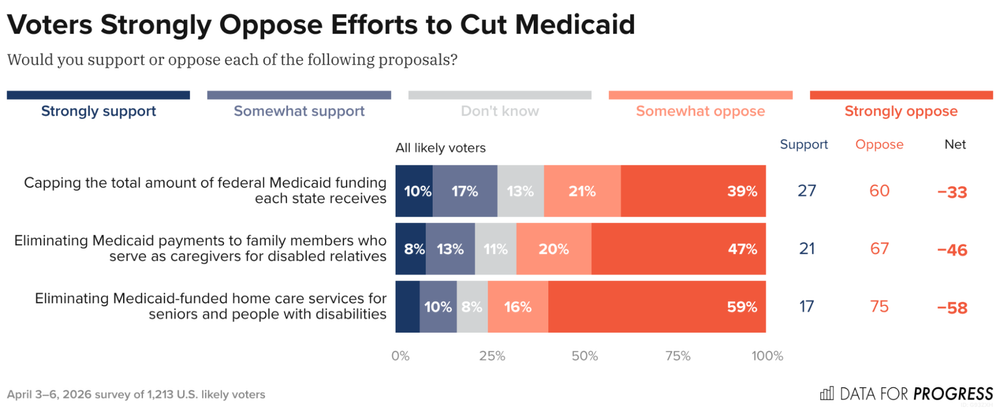
On the other hand, as we see in the Verasight/The Argument poll, 67 percent of voters said that the government spends too little on health care, so it may be tough to get the public on board with additional cuts. And possibly more troubling for the GOP: even when you get more specific, their position remains unpopular. In a Data for Progress survey (Apr. 3 - 6, 2026), voters were asked about a variety of specific policies that have been proposed as means to reduce Medicaid spending; all of these were underwater by over 30 percentage points.
In general, the public seems to prioritize programs that directly benefit Americans. Asked in a YouGov/The Economist poll (Apr. 24 - 27, 2026) whether the federal government should increase, decrease, or not change spending levels on a variety of broad priorities, the most favored increases include direct benefit programs like Social Security, Medicare, and Medicaid, as well as general social welfare programs like veterans’ spending and education.
Of course, this spending debate doesn’t happen in a vacuum. For the first time since World War II, the U.S. federal debt exceeds 100 percent of GDP, according to the Wall Street Journal. And on the face of it, Americans are concerned about the debt and deficit. In a new survey from Global Strategy Group/North Star Opinion Research for the Peter G. Peterson Foundation, 88 percent of voters said they were concerned about the national debt’s impact on interest rates, and 92 percent said they were concerned about the national debt’s impact on inflation. Moreover, 83 percent said that a candidate “having a plan to address the national debt” would be a factor in determining their 2026 support. Sixty-six percent said that they thought the national debt would get worse over the next few years, while just 28 percent said they thought it would get better.
These numbers, of course, sound like a dire warning for politicians as they prepare to advance what may well be another deficit increase. But under the hood, it’s not quite so clear that this is as big of a political problem as the toplines suggest. For starters, the questions about concerns related to inflation and interest rates were preceded in the poll by the following:
As you may know, economists from across the ideological spectrum agree that the rising national debt can increase inflation and interest rates, which makes things like goods, services and transportation more expensive for consumers.
Primed to already believe high debt levels impact inflation and interest rates, respondents gave the expected answers.
As to the federal debt being a factor in voter’s choices in 2026, there’s no doubt that it probably does matter to some voters. Asked in a vacuum whether having a plan to tackle the debt might make a difference, it’s quite easy for respondents to say yes. But in truth, government spending generally doesn’t top the list of priorities for most Americans. In YouGov/The Economist polls over the last few years, when asked which is the most important issue, the issues of “taxes and government spending” has never exceeded 10 percent of respondents, about the same number as say that national security and foreign policy is their top issue. Dominating voters’ concerns in that time period: inflation and prices (though “civil rights and civil liberties” also had a bit of a moment in the summer and fall of 2025).
Finally, on the poll result showing 66 percent said that they thought the national debt would get worse over the next few years: this is more or less the same as the percentage of respondents who have saying this for over a decade. The Peter G. Peterson Foundation, a nonprofit organization that advocates for federal debt reduction, has been conducting monthly surveys stretching back to late 2012, including this most recent April poll. In those surveys, an average of 29 percent of respondents have said they expect the debt to get better over the next few years, while 61 percent said they expect it to get worse. That’s not too different from the 28-66 spread in the latest survey. In fact, only one thing seems to have moved opinion on this in the decade-plus of data: Donald Trump being elected.
To be clear, such optimism was short-lived on both occasions. After both the 2016 and 2024 elections, the survey briefly showed voters moving to near-parity on the question of whether the debt will get better or worse over the next few years, but voters quickly returned to their general ambient grumpiness about the debt situation. Still, voters may harbor some hope that the right politician might be able to improve the situation sometime in the future. But after two terms of failing to get the budget deficit down — in fact, the president has increased the deficit dramatically in both stints as president — perhaps Americans have learned he’s not the man for this particular job.
Other polling nuggets
A new ABC News/Washington Post/Ipsos poll (Apr. 24 - 28, 2026) finds that the public is opposed to President Donald Trump’s planned White House ballroom: 56 percent of Americans oppose tearing down the East Wing to make room for it, while just 28 percent support the project. Strong opposition outweighs strong support by about 3-to-1, and the numbers are essentially unchanged from a poll conducted in October. Voters also oppose Trump’s proposed 250-foot arch near Arlington National Cemetery with 52 percent opposed and just 21 percent in favor, and his idea to add his signature to paper currency was opposed by more than 5-to-1.
A new KFF Health Tracking poll (Apr. 14 - 19, 2026) finds that the cost of health care continues to top Americans’ list of economic concerns, even as worries about gas prices have climbed since the war in Iran began. Sixty-four percent of adults said they’re worried about being able to afford health care costs, and the same share said they were worried about gas and other transportation costs, up from 52 percent in January. Health care affordability is also poised to play a real political role this fall: 55 percent of voters said it will have a “major impact” on their decision to vote, and 61 percent said it will affect which party’s candidate they support. Voters trust Democrats over Republicans to address health care costs (37 to 26 percent) and prescription drug costs (33 to 26 percent).
Most Americans don’t want politicians drawing their own districts. In a new Economist/YouGov poll (Apr. 24 - 27, 2026), 71 percent of Americans said that states should not be allowed to draw congressional districts in a way that intentionally favors one party, while just 7 percent said it should be allowed — with bipartisan opposition from 74 percent of Democrats, 70 percent of independents, and 69 percent of Republicans. The same poll also asked about mail voting, where Americans are unsympathetic to Donald Trump’s proposed restrictions: a 58 percent majority said mail voting should either be made easier or kept the same, while just 33 percent said it should be made harder or eliminated entirely.
For young adults today, moving back in with mom and dad is increasingly the norm. According to a new Ipsos poll conducted for Thrivent Financial (Mar. 24 - Apr. 3, 2026), 29 percent of Americans aged 18-35 have moved back in with their parents at least once as an adult, and another 32 percent never left in the first place. Among those who came back, 55 percent said it was financially necessary. Twenty percent of those aged 18-35 who haven’t bought a home say they don’t expect to ever purchase one. The good news for young adults: most parents say they are willing to cut down on personal expenses or savings goals to help support their adult children at home. (Your poll columnist would welcome a home cooked meal at his mother’s table.)
And to end on an optimistic note: a new Gallup survey (Mar. 2 - 18, 2026) finds Americans think kindness is alive and well. Sixty percent of U.S. adults said they see people treating others with kindness and respect “often” or “very often,” while 65 percent reported personally experiencing an act of kindness from someone in their community at least once in the past seven days, and nearly three-quarters (73 percent) said most Americans are very or somewhat kind.
Polling averages update
All numbers are as of 10:00 AM Eastern on May 1, 2026.
2026 U.S. House generic ballot
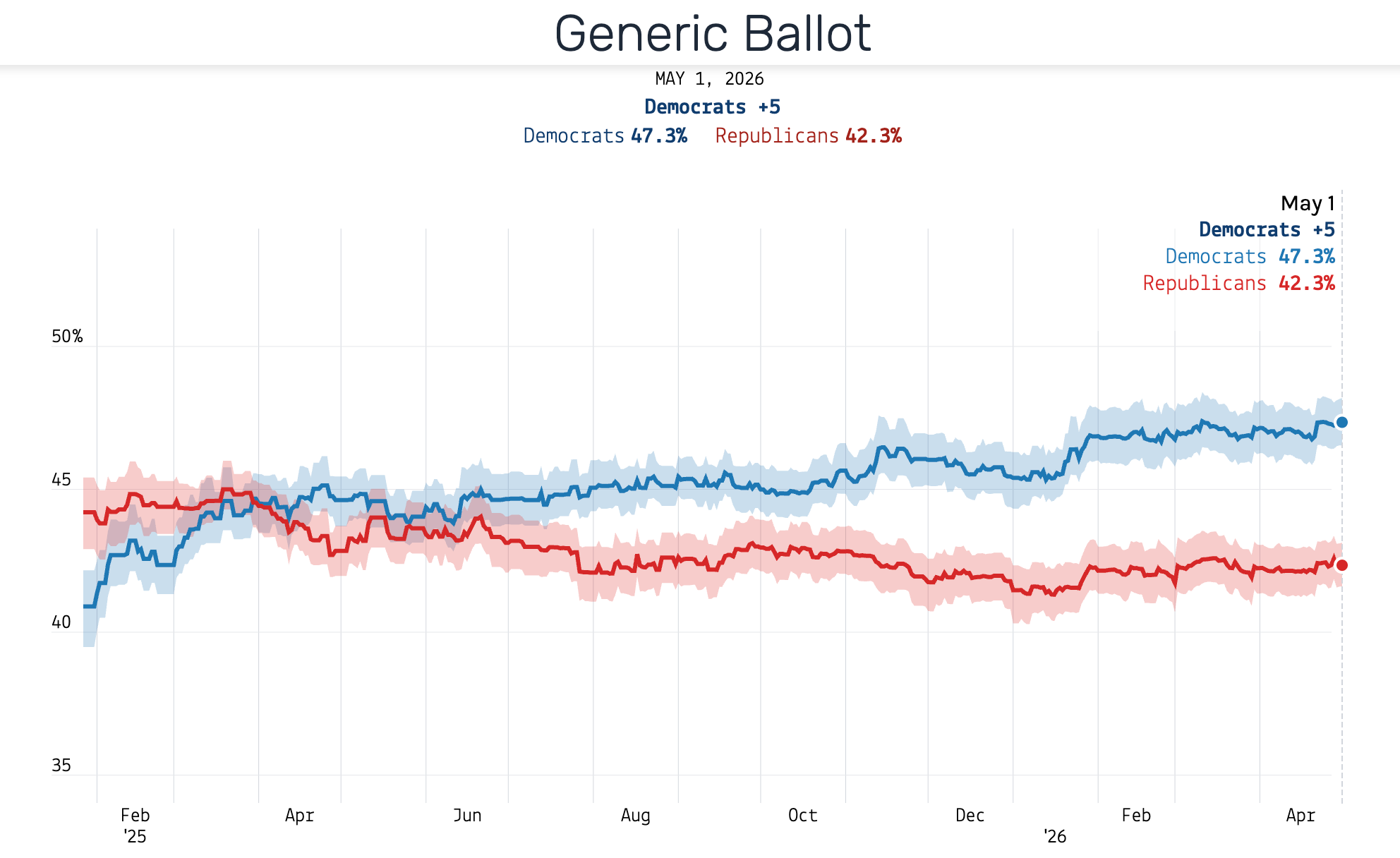
Democrats have held their lead on the 2026 U.S. House generic ballot at +5 (after rounding) over the last week, with 47.3 percent of registered voters saying they’ll cast their ballot for Democrats this fall versus 42.3 percent for the Republicans.
Trump’s job approval
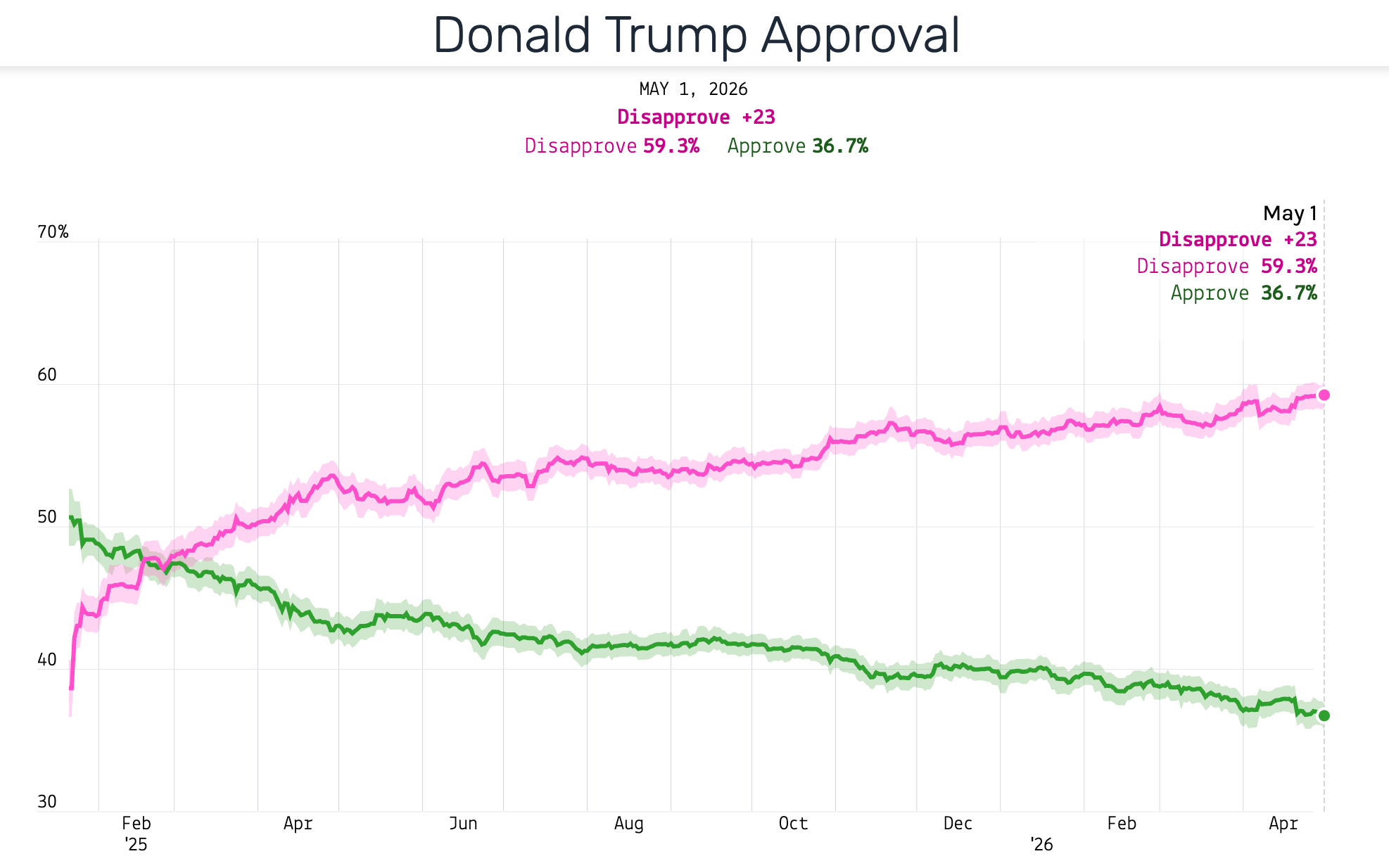
President Trump’s approval rating among U.S. adults held steady at an all-time low of 36.7 percent this week, while the percent of Americans who disapprove of the job he is doing rose to 59.3 percent. As of May 1 at 10:00 AM, this is the first time Trump’s rating has rounded to -23.
These averages update fresh on the 50+1 website with every new poll we add to our database.
Paid subscribers to 50+1 get access to premium analysis, plus sortable tables and complete data access on our polling website. If you want to follow the 2026 cycle with the best data at your fingertips, become a paid subscriber.
A big part of people's confidence of Trump cutting the deficit was that DOGE eventually was going to save $2T/yr. That would have been about 30% of the federal budget, which would have allowed maintaining the current level of services and also make the tax cuts permanent, and still balance the budget.
Once people decided that DOGE was not going to be able to do that, the numbers went back to historical norms.