



Welcome to The Trendline, FiftyPlusOne’s weekly polling roundup. Subscribe to get it delivered straight to your inbox and get bundled access to our polling website.
In the last few days, the Trump administration has released intelligence that could serve as a justification for some form of military intervention in Cuba. Axios reported that the Cuban government was considering preemptive drone strikes against the United States. The Department of Justice has issued an indictment for former Cuban president Raúl Castro related to events that happened 30 years ago, which could serve as a pretext for a military operation similar to the one that removed Nicolás Maduro in Venezuela. Secretary of State Marco Rubio called the island a national security threat.
So, what do Americans actually think about Cuba, and military interventions more generally? This week on The Trendline, we dig into the polls to find out how the public is feeling about America’s relationship with the world, and in particular, our island neighbor.
Polls are mixed on how Americans think about our actions on the world stage. According to a Siena University/The New York Times poll (May 11 - 15, 2026), 54 percent of registered voters said they agreed more that we “should pay less attention to problems overseas and concentrate more on problems here at home,” while 41 percent said they agreed more that it’s “best for the future of our country to be active in world affairs in order to maintain American security and prosperity.”
Democrats and independents were more likely to say America should focus more attention here at home: 56 percent of Democrats and 59 percent of independents said they agreed more with the first statement. But 52 percent of Republicans said they agreed more with the second statement (probably because their party is currently in charge of foreign policy).
This question, however, might overstate support for American isolationism. The wording provides a lot of information to respondents: phrases like “concentrate on problems here at home” and “American security and prosperity” can serve as nudges to poll takers, particularly in a charged partisan environment. A simpler version of the question, asked by YouGov/The Economist (May 15 - 18, 2026) gets very different responses.
Asked if the U.S. should “take an active part in world affairs or stay out of world affairs,” 47 percent of Americans preferred the U.S. taking an active part, while 31 percent said the U.S. should stay out. And in this version of the question, majorities of both Democrats and Republicans agreed with the active role (52 and 57 percent, respectively). Only independents preferred the U.S. staying out of world affairs, with 37 percent taking the isolationist position and 35 percent saying the U.S. should be active.
When it comes to foreign military interventions specifically, polling generally shows opposition. In a different YouGov survey (May 15 - 18, 2026), 43 percent of Americans said that U.S. foreign military interventions more often worsen situations in the countries where they occur, while just 19 percent said they improve the situation on the ground, consistent with previous polling on the topic. And in a YouGov/The Economist poll from late March, 54 percent of Americans said the U.S. should use military force less often than we do now, while just 5 percent said we should use military force more often (another 28 percent said that we should use force as often as we do now, and 13 percent were unsure).
Against that backdrop, it’s perhaps unsurprising that pursuit of regime change in Cuba isn’t particularly popular. According to a poll from Change Research, among those that are following the news about Cuba (about 66 percent of respondents), just 39 percent said they supported regime change in Cuba, while 51 percent were opposed. This is notable, as those that are following the news are perhaps more likely to have strong feelings about Cuba and the Cuban government.
When poll questions directly mention military involvement, the numbers get much worse for the pro-regime change side. In the March YouGov/The Economist poll, just 22 percent of Americans said they supported using military force to overthrow the government in Cuba, while 55 percent were opposed (23 percent said they weren’t sure).
In a January survey from Ipsos/The Chicago Council on Global Affairs, Americans were generally unsupportive of the use of military force to make political change in other countries, including Cuba, though were more supportive of using force to protect our allies.
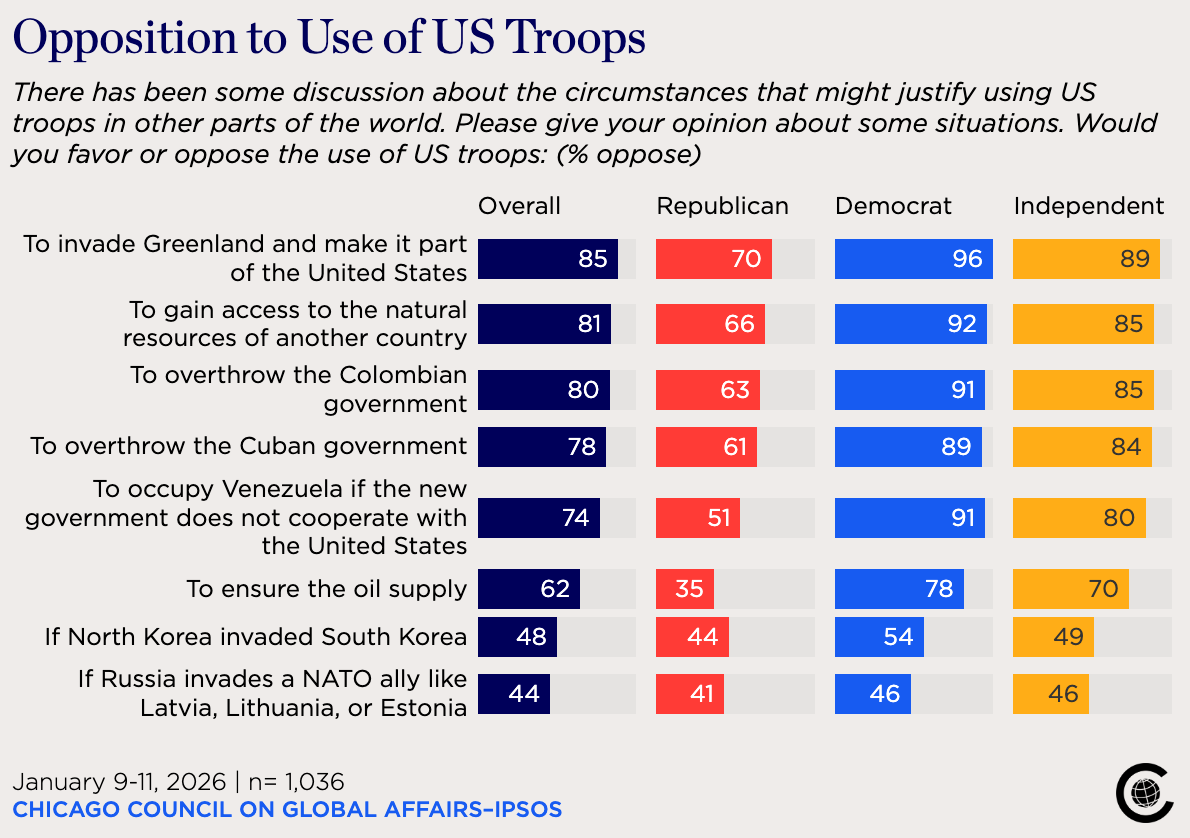
Seventy-eight percent of Americans said they opposed the use of U.S. troops to overthrow the Cuban government in particular. And 70 percent said it is generally unacceptable to use military force to change the political leadership of another country.
Outside of military intervention, though, views on Cuba are a bit more muddled. In the YouGov poll, just 9 percent of respondents said they had a favorable opinion of the Cuban government, while 60 percent had an unfavorable opinion. But even given this distaste for the government of Cuba, 65 percent said they had a favorable opinion of the Cuban people, while 9 percent viewed the population unfavorably.
As to the potential justifications of military intervention based on Cuba’s potentially being a national security threat, only 5 percent said they thought Cuba was “an immediate and serious threat to the U.S.,” so that probably won’t hold water with the public. And many Americans think we should be a bit nicer to Cuba: 41 percent said the U.S. treats Cuba too harshly, compared to 11 percent who said the U.S. is too lenient (another 22 percent said our treatment of Cuba is about right, and 26 percent were undecided). In addition, 57 percent said they would approve of the U.S. having diplomatic relations with the nation, while just 11 percent would disapprove.
In the March YouGov/The Economist poll, voters didn’t seem quite sure of what to make of our current actions in Cuba. Asked if they supported the oil blockade on the island, 24 percent said they did, 38 percent said they didn’t, and 38 percent said they weren’t sure. In a March poll from Harris/Harvard CAPS, voters were asked about a variety of policy approaches related to Cuba; the most popular approaches were to pursue diplomatic negotiations (27 percent support) and provide humanitarian aid to the Cuban people (26 percent support). Only 16 percent said the U.S. should consider military options if the situation worsens.
Still, the Trump administration may have some important backing for action against Cuba: Cuban Americans. In an April poll of South Florida Cuban Americans from The Tarrance Group/Bendixen & Amandi International/The Miami Herald, 79 percent said that they supported some form of military intervention in Cuba. And in a March poll of Latino voters by Florida International University/The Latino Public Opinion Forum, Latinos of Cuban origin stood out as particularly supportive of Trump and the Republican party: 53 percent of Cubans approved of Trump, compared to a 31 percent approval rating among Latinos overall. And of all national origins in the poll, Cubans were the only group who showed a Republican advantage on the generic ballot
Taken all together, polling suggests that the public overall probably prefers a Cuba approach closer to that of former President Barack Obama: normalizing diplomatic relations and increasing cooperation with the nation, rather than the approach taken by both Trump and former President Joe Biden of hostility and sanctions. It appears, for now, they will not get their wish.
Other polling nuggets
According to Gallup (May 1 - 17, 2026), Americans across the political spectrum are souring on the economy. The Gallup economic confidence index has dropped to -45, the lowest level since the inflation crisis in Summer 2022. Just 16 percent of Americans rate economic conditions as excellent or good, while 49 percent rate them as poor and 34 percent as “only fair.” Worsening opinions about the economy cross political lines: Republicans’ economic confidence has dropped from a second Trump term high of +68 in August 2025 to +22 now. In the same time frame, independents’ confidence dropped from -35 to -58, and Democrats’ confidence dropped from -70 to -80. As further evidence of increasing bipartisan pessimism about the economy, in an AP-NORC poll (May 14 - 18, 2026), Trump’s approval rating on the economy has fallen to 63 percent among Republicans, down from a high of 79 percent in February, just prior to the Iran war.
According to a survey from Siena University/The New York Times (May 11 - 15, 2026), Democrats are frustrated with their own party. Among potential Democratic voters, 45 percent said they were satisfied with the Democratic Party, while 53 percent were dissatisfied. Seventy-five percent said the Democratic Party should reposition, with 47 percent saying it should move to the center and 28 percent saying it should move to the left; just 19 percent said they thought it should not move in either direction. Still, these frustrations don’t seem to be bleeding into voters’ plans for November. Despite their dissatisfaction with the party writ large, 95 percent of these voters said they plan to vote for the Democratic candidate in November, and less than 1 percent said they would support the Republican. And though the Republican Party has advantages in terms of satisfaction among its own voters (68 percent of Republican voters are satisfied with the Republican Party), Democrats seem a bit more enthusiastic about November: 47 percent said they are “almost certain” to vote, compared with 41 percent among Republicans.
According to Quinnipiac University (May 14 - 18, 2026), 36 percent of Americans believe that the Pentagon’s newly released UFO files show evidence of intelligent life on other planets. Forty-two percent don’t believe the files are evidence of aliens, and 22 percent aren’t sure. The most skeptical group is Republicans, 50 percent of whom say that the files do not show evidence of alien intelligence, while 31 percent believe they do. Independents are most likely to express belief, with 38 percent believing there’s evidence of alien life, and 38 percent disbelieving.
Polling averages update
All numbers are as of 11:00 AM Eastern on May 22, 2026.
2026 U.S. House generic ballot
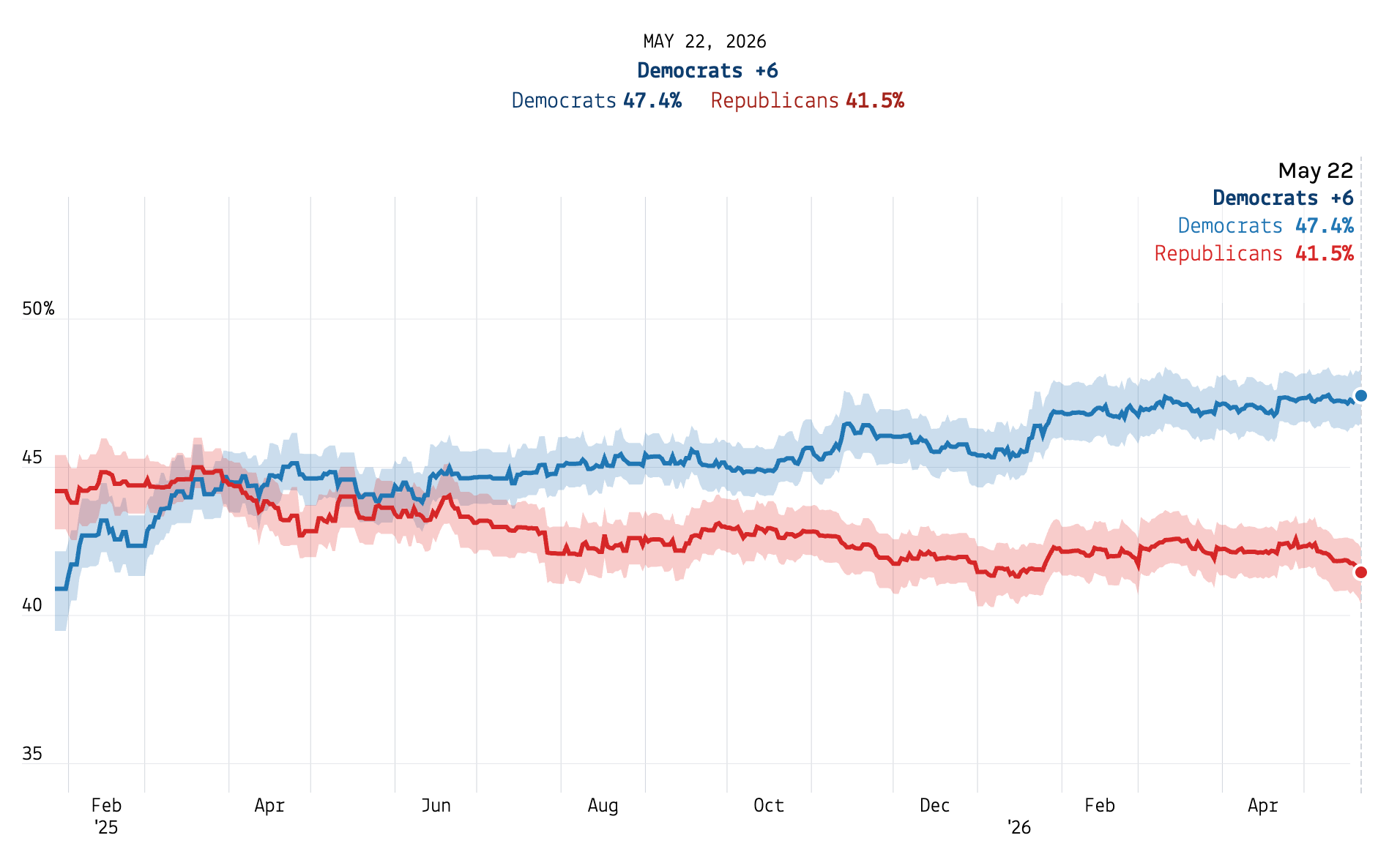
After months of hovering around a 5-point lead, the Democrats have grown their margin on the 2026 U.S. House generic ballot to +6 this week. At writing, 47.4 percent of registered voters saying they’ll cast their ballot for Democrats this fall — similar to the 47.2 percent we reported in our last newsletter — versus 41.5 percent for the Republicans.
Trump’s job approval
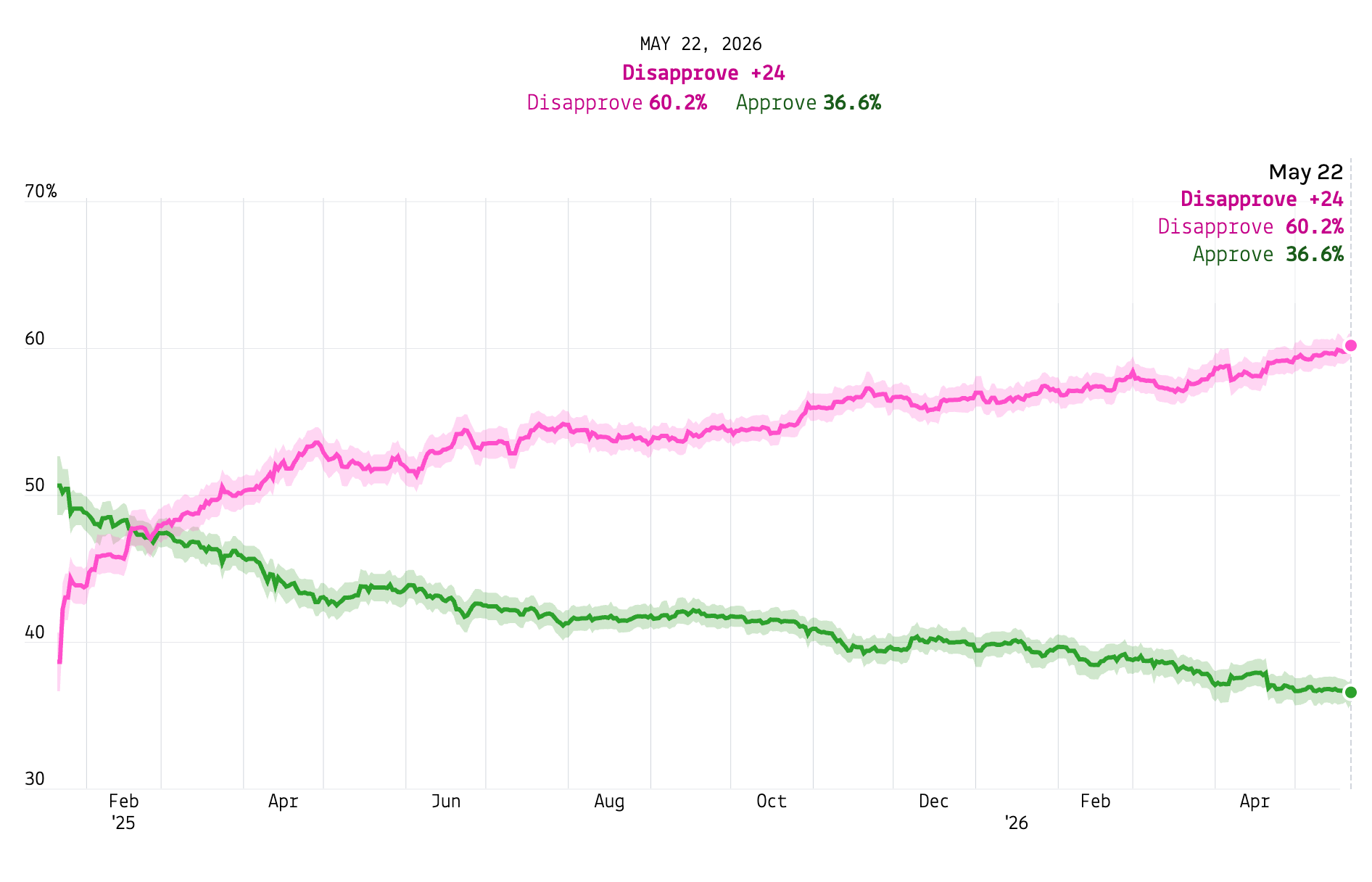
President Trump’s approval rating among U.S. adults hit a new all-time low of 36.5 percent in our average this week, while the percent saying they disapprove rose to 60.2 percent for the first time. The net rating – rounding down on our site for the first time to -24 – is also a new low.
Paid subscribers to 50+1 get access to premium analysis, plus sortable tables and complete data access on our polling website. If you want to follow the 2026 cycle with the best data at your fingertips, become a paid subscriber.