

Welcome to The Trendline, FiftyPlusOne’s weekly polling roundup. Subscribe to get it delivered straight to your inbox.
The explosion of investment into artificial intelligence has driven a surge in construction of new data centers all over America. This construction boom has contributed to some hesitance on the part of local governments and communities, and may have a political impact. In key states for the midterms, like Ohio, Texas, Pennsylvania, Wisconsin, and Michigan, political fights over data center development have erupted, often with scrambled party lines. In many states, leaders are openly welcoming new construction, while local communities are more skeptical. In Michigan, for example, Governor Gretchen Whitmer has been outwardly supportive of data center construction, even as more than a dozen municipalities and counties have passed moratoria on the projects.
As a result of recent artificial intelligence-related news, we’ve seen a new rash of polls looking into how Americans feel about the technology, and how they’re thinking about data centers in their communities. As it turns out, most Americans don’t really have a deep familiarity with AI, which could contribute to their data center hesitancy. For example, in a YouGov/Economist survey conducted this week, just 23 percent of Americans said they regularly use AI. Another 40 percent said that they have used it before, but don’t regularly use it. Nearly a third, 31 percent, said that they have never used it themselves (19 percent said they had seen it used, and 12 percent said they had never seen anyone else use it). And when it comes to trust in the technology, Americans appear to have a dimmer view. Just 7 percent said they have a great deal of trust in AI, 28 percent said they have a fair amount of trust in AI, but 58 percent said they had either not much trust or no trust in the technology.
Notably, these positions cut across party lines. Twenty-six percent of both Democrats and Republicans said they regularly use AI, and 30 percent of Democrats and 34 percent of Republicans said they had never used it. As to trust, 8 percent of Democrats said they had a great deal of trust in AI, a position shared by 9 percent of Republicans.
However, voters do see some value in AI. In an early February survey published by Echelon Insights this week, respondents were asked whether AI would have a positive impact on various aspects of American life. When it comes to areas like business, work, and shopping, Americans expect AI to have a more positive than negative impact. But respondents were much more negative about AI’s impact on education and cost of living. And overall, people are uneasy about the technology: a survey from Verasight, conducted in Dec 2025, found 56% of adults said they were anxious about AI tools.
And when it comes to jobs, people are especially pessimistic. In a survey from Cygnal conducted in early February, 9 percent of likely voters said that AI would create more jobs than it eliminates, compared to 62 percent who said it would eliminate more jobs than it creates (another 19 percent said that the number of jobs created and eliminated by AI would be roughly equal). Concern over job loss has led to a dramatic increase in the number of Americans who think the government should step in. In an Ipsos survey conducted in late January, 72 percent agree that “the government should take action to prevent the potential loss of jobs due to AI,” while 18 percent disagree. The last time Ipsos asked this question in April 2023, Americans were split, with 43 percent supporting government action and 42 percent against.
Now, the issue of data centers is a much more local one than that of artificial intelligence. In some communities where data center construction has been challenged or even halted, activists cite concerns about energy and water usage, tax revenue, and long-term viability of economic benefits, as well as general AI skepticism. And this local concern shows up in support for data center construction in polling, more generally: the further away a data center sounds, the more likely respondents are to support it. For example, consider three question wordings from three different pollsters. One asks about whether respondents would support a data center “in their area,” one asks if they would support one “in their community,” and the third asks if they would support one “within 10 miles of your home.” As the data centers get closer, support gets lower.
In addition, data center opposition based on energy costs does seem to be resonating with the American people. In a late January survey from Public First/Politico, among respondents who said they would generally support a plan to build a data center in their local area, support drops when costs increase. Asked if they would support or oppose a plan to build a data center in their local area, 37 percent of respondents indicated support, while 28 percent indicated opposition. However, among those that indicated support, that support drops significantly if the data center increases costs to local households. At a monthly costs to households of just $5, nearly a third of those who previously indicated they would support data center construction in their local area change their minds. At a cost of $50 per month, only a third are still on board.
Overall, people think artificial intelligence is moving too quickly. In a Fox News poll conducted in late January, 59 percent of voters said that AI was moving too quickly, while 6 percent said it was moving too slowly and 33 percent said it was about the right pace. Perhaps because of the speed of change, people slightly favor government regulation: in the Ipsos poll, 50 percent of respondents said that government should have a major role in the oversight of AI, while 41 percent said a minor role and just 9 percent said no role at all.
But even so, voters may not trust the government when it comes to technology regulation. In the Fox News poll, just 8 percent said they have a great deal of confidence in the federal government’s ability to properly regulate artificial intelligence technology, while 28 percent had some confidence, and a majority, 63 percent, had not much or no confidence at all. And to make matters worse, confidence in the federal government’s ability to regulate the tech has been decreasing over time. In April 2023, 39 percent of voters told Fox News that they had a great deal or some confidence, which has fallen to 36 percent in the latest survey. At the same time, the percentage who say they have not much or no confidence at all has risen from 59 percent to 63 percent.
Subscribe to FiftyPlusOne to unlock the full polling experience on our website and get premium analysis that goes beyond the toplines. FPO subscribers get new analysis weekly and help keep the infrastructure for our website running.
Other polling nuggets
Do people want government insurance for prescription drugs? YouGov did a survey experiment this week (Feb. 9 - 11, 2026) that tested support for the policy using two different question wordings. Half of respondents received a question asking if they approved of the government launching “a new website called TrumpRx.gov that offers discounts on some prescription drugs for people who pay without using insurance,” whereas the other half were asked about “a new website that offers discounts on some prescription drugs for people who pay without using insurance.” YouGov found that 41% of adults approved of the policy when they were given the TrumpRx condition, while support rose to 57% of adults on the generic policy description.
Do you answer phone calls from strangers? YouGov also asked, in a poll conducted on Feb. 16, 2026, whether Americans answer phone calls from numbers they don’t recognize. Just 5 percent of adults said they always do, whereas 42% of the public responded that they never answer calls from unknown numbers. This is bad news for pollsters, who, just 30 years ago, could reliably get 30-40% of people to complete an interview when they called.
A survey from RMG Research, conducted Feb. 17 - 18, 2026, found that a majority of U.S. adults favor banning “Wall Street Investors” from buying single-family homes, a policy some in Washington believe would help reduce housing prices across America. (The actual research on the subject finds less than 0.5% of single-family houses in the U.S. are owned by Wall Street, suggesting more limited effects of an investment-firm ban on house prices.)
A new poll from Navigator Research (Jan. 29 - Feb. 1, 2026) probes the many reasons Americans hate congress. According to the survey, eight out of every 10 adults believe elected officials’ focus on enriching themselves and their donors stops them from getting things done, while 76% say members of Congress “[work] for big corporations instead of the people.”
Speaking of corporations, SpaceX CEO Elon Musk recently announced the company would shift its strategic focus to establishing a colony on the moon over the next few decades. YouGov finds that 7% of Americans say they “would definitely” live on a lunar colony, while 48 percent “definitely would not.” Maybe response rates will be higher up there.
Polling average updates
Texas Senate primary polls
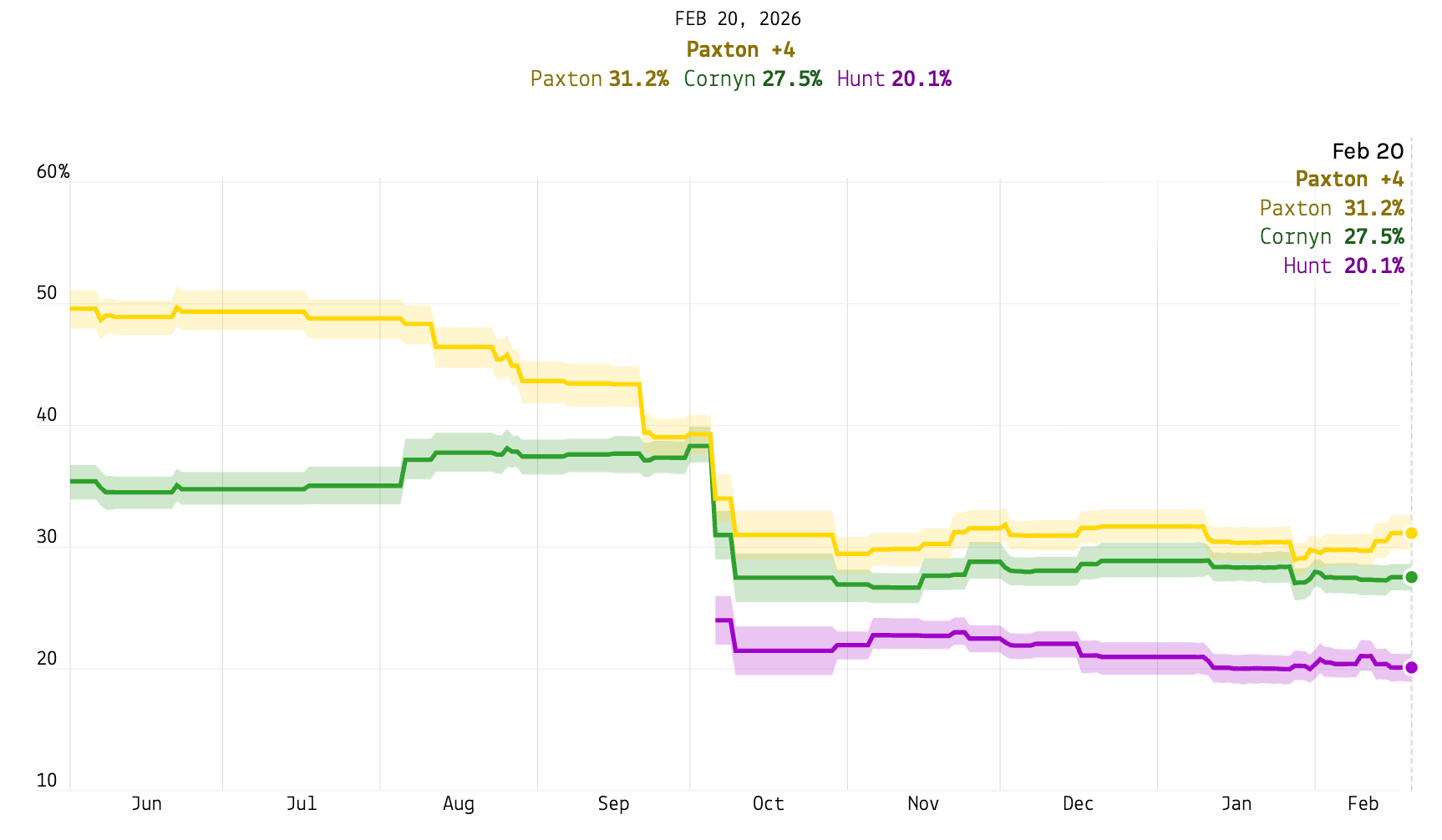
This week, FiftyPlusOne released new polling averages of the primary elections for Texas’s U.S. Senate election this fall. On the Republican side, Texas Attorney General (31.2%) currently leads Incumbent Senator John Cornyn (27.5%) in a 3-person race with U.S. Rep. Wesley Hunt trailing in third (20.1%).
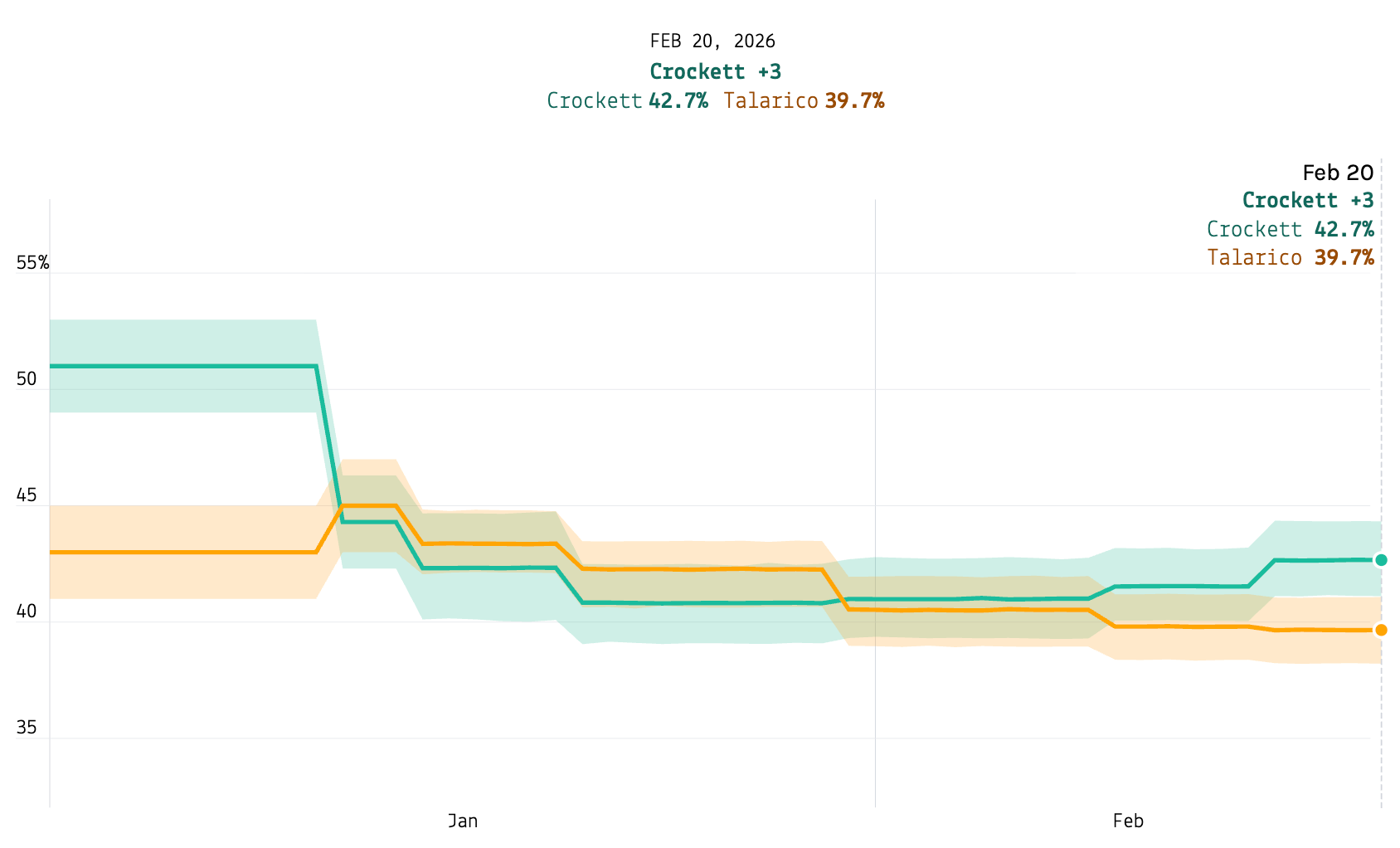
On the Democratic side of the lone-star primary, U.S. Rep Jasmine Crockett currently leads state house Rep. James Talarico 42.7% to 39.7%. That three-point lead is inside the margin of error of our average.
Trump approval
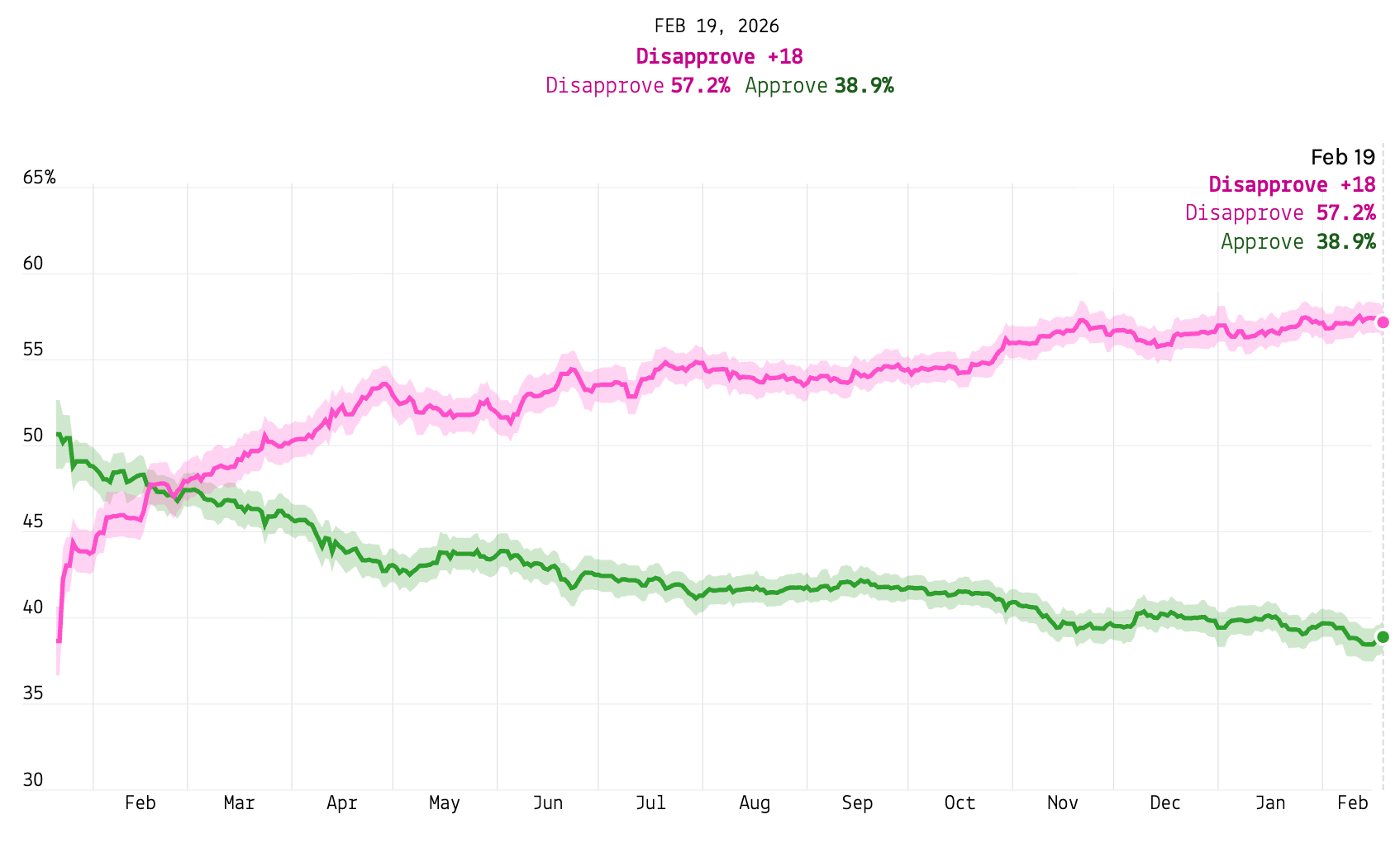
According to the FiftyPlusOne.news average, 38.9% of U.S. adults approve of the way Donald Trump is handling his job as president today, while 57.2% disapprove. This time last month, his numbers were 39.6% and 56.8%.
Generic ballot
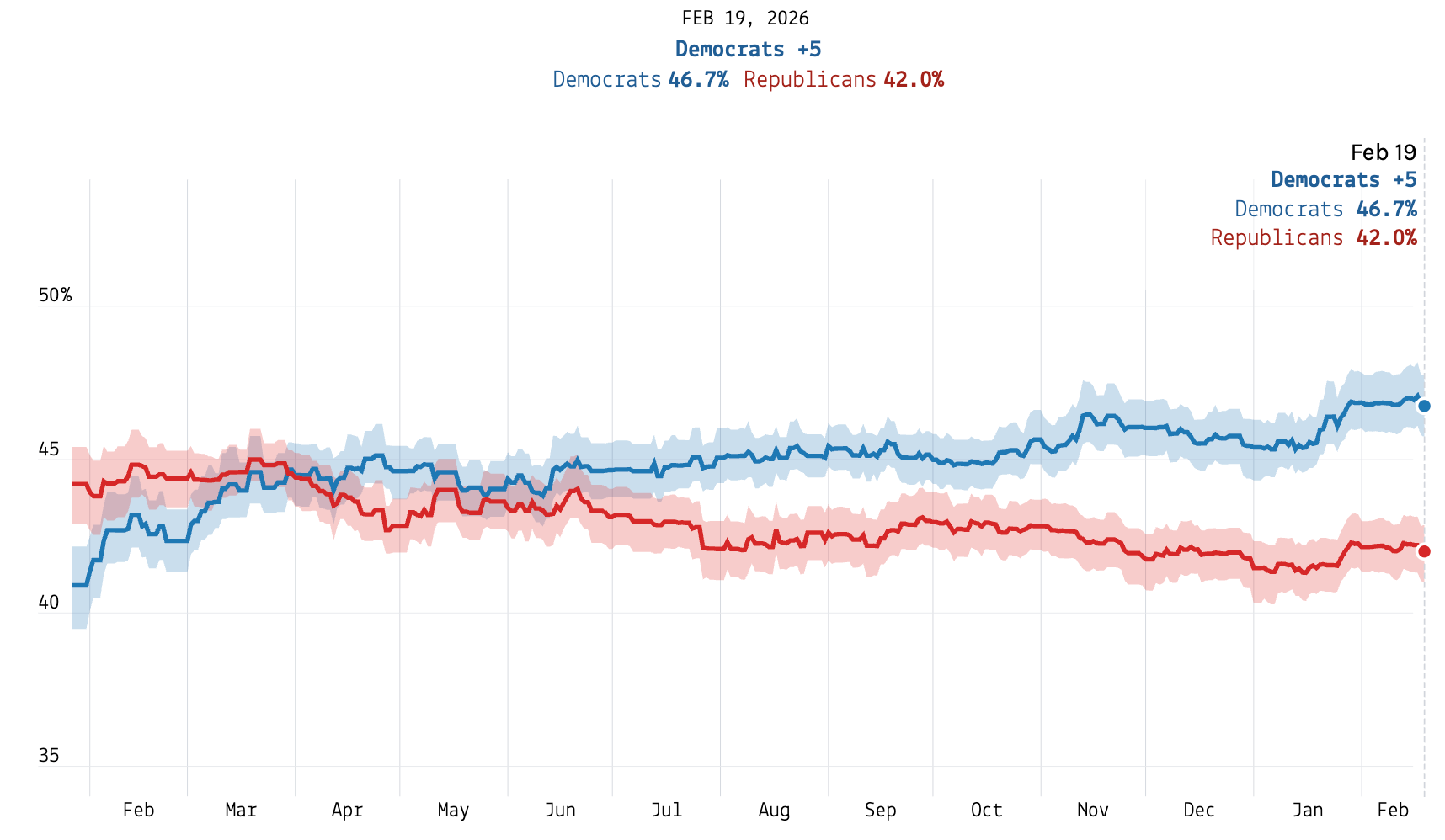
Democrats currently lead in our average of U.S. House generic ballot polls by 4.7 points, 46.7% for Democrats to 42.0% for Republicans. This time last month, Democrats were up 4.4 points, 46.0% to 41.6%.