



Welcome to The Trendline, the FiftyPlusOne.news weekly polling roundup. Subscribe to get it delivered straight to your inbox and get bundled access to our polling website.
On Thursday, July 16, 2026, President Donald Trump gave a primetime address in which he discussed American election integrity, a topic he has focused on since his election loss in 2020. In the speech, Trump said that U.S. elections are vulnerable to foreign interference, particularly from China, and repeated unproven allegations of widespread voter fraud, particularly in the 2020 election. One of the president’s claims is that the Chinese Communist Party “hacked” U.S. elections by collecting person-level records of registered voters called “voter files” which are free to download in many states (for example, here is North Carolina’s).
To be clear, despite years of trying, the Department of Justice has not found evidence of widespread systemic voter fraud in the 2020 election. Trump and his supporters have lost dozens of lawsuits alleging misconduct in the election, and independent analyses have repeatedly shown no evidence of systemic fraud.
But Trump’s repeated insistence that American elections are vulnerable may be impacting how voters think about our democracy, and whether or not it is secure.
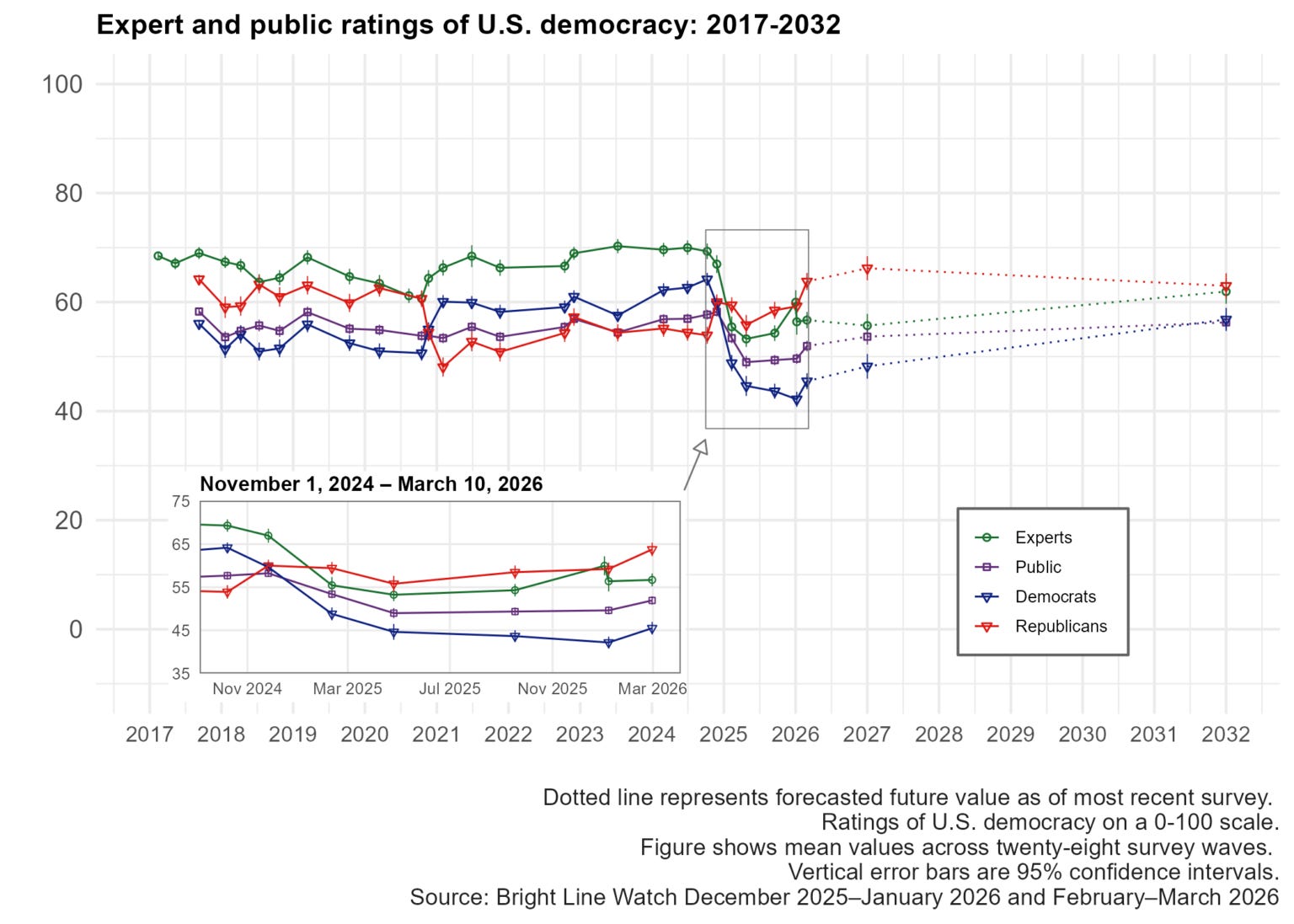
Since 2017, researchers at Bright Line Watch have been asking both the public and political science experts to rate U.S. democracy on a scale from 0 to 100. Until the 2020 election, ratings of democracy were fairly stable among the public. Republicans typically rated our democracy around 60, and Democrats around 50. But in the wake of the 2020 election, those ratings flipped: Republicans’ evaluation of democracy fell below 50, and Democrats’ evaluations rose to above 60 for the first time in the survey’s history.
Notably, though, expert ratings of democracy didn’t budge in that time period (though they were higher before 2017 in other datasets). From 2017 through November 2024, experts consistently rated U.S. democracy between 60 and 70 on the 100-point scale. But through Trump’s second term, that rating has plummeted. Experts now rate U.S. democracy at close to 55 on the 100-point scale, and ratings among the public have also dropped from the mid-50s to the high 40s/low 50s. This has been driven by a collapse among Democrats, whose ratings of democracy plummeted from the mid 60s prior to the 2024 election to the mid 40s today.
Other surveys also reveal a lack of confidence in U.S. democracy. In a recent YouGov poll, majorities or near-majorities of Americans said they believed the 2026 elections would be tampered with in a variety of ways, including tampering with vote counts, voter fraud, and failure to properly count ballots.
Despite believing that various malfeasance will occur, however, Americans don’t think it will change the results of the elections. And when you drill down, there’s broad differences between the sorts of issues Democrats and Republicans are concerned about. For example, 71 percent of Republicans think there will probably be voter fraud in the 2026 elections, while just 34 percent of Democrats do. On the other hand, 66 percent of Democrats say that some people who are eligible to vote will be prevented from doing so; just 33 percent of Republicans agree. The one issue on which everyone seems to agree? That false information will be spread about the elections: 76 percent of Americans overall say that will probably occur, including 79 percent of Democrats and 76 percent of Republicans.
Trust in election administration is also low. In a June Marquette Law School poll, just 38 percent of Americans said they had a great deal or quite a lot of confidence in “the people who administer elections in your state;” another 34 percent said they had some confidence, and 28 percent said they had very little or no confidence at all in local elections officials. This lack of trust is especially partisan: 29 percent of Republicans and 22 percent of independents said they had a great deal or quite a lot of confidence in local elections officials, but 53 percent of Democrats had confidence in election administrators.
On the other hand, in the same poll, Democrats were far more pessimistic about our democracy than Republicans. While 52 percent of Americans overall said they were very or somewhat optimistic about our country’s future as a democracy, just 41 percent of Democrats said so, compared with 66 percent of Republicans.
The lack of confidence in local elections administrators is particularly concerning, especially as Trump has attempted to federalize some elections administration work. According to the latest Bright Line Watch survey, 93 percent of political science experts said that calls to nationalize voting were a threat to democracy, including 85 percent who rated it as a serious or extraordinary threat. Eighty-eight percent said that the DOJ suing states for access to their voter lists was a threat to democracy.
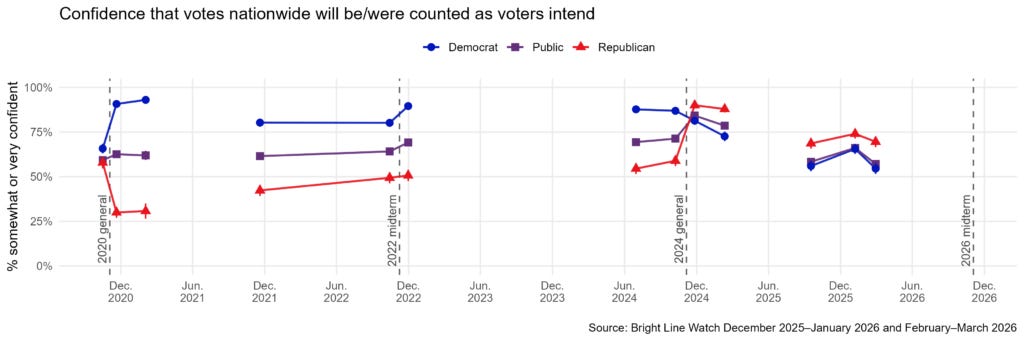
However, it doesn’t appear that Trump is the only factor influencing how Americans feel about election integrity. Before the 2020 election, Bright Line Watch found that across the political spectrum, confidence that votes would be counted as voters intended was less than 70 percent. And in the years since then, confidence in votes being counted as voters intend has been highly polarized, and often tied to whether or not voters’ own party did well in the elections. Confidence in votes being counted accurately has been falling among Democrats since the 2024 election, for example, while Republican confidence spiked in December 2024.
Trump’s continued insistence that American elections are insecure has made election integrity a partisan issue, where it may not have been one in the past. However, while the issue makes political science experts and close poll watchers nervous, it may not be as big of a deal to the American public. In a June 2026 survey from Morning Consult and the Cato Institute, voters were asked which issues are the “greatest threat to the United States remaining a free republic.” Given a list of options and asked to choose up to three, “people refusing to accept election results” was the second least often chosen, with 10 percent selecting it (the least concerning was “falling birth rates” at six percent). The options chosen most frequently as threats to our free republic were corruption at 30 percent and “politicians ignoring the Constitution” at 26 percent. And perhaps that should be more concerning for Trump: in February, over half of Americans said the president is corrupt.
Other polling nuggets
A majority (55 percent) of Americans think the U.S. should reduce or end military support to Israel, according to a Washington Post/Ipsos poll (Jul. 8 - 13, 2026). Twenty-nine percent said the U.S. should end its military support of Israel, and 26 percent said it should reduce support. Just eight percent of respondents said the U.S. should increase military support for Israel, and a plurality, 32 percent, said that support should be kept at current levels. Democrats are especially likely to say support should be reduced or ended: 72 percent of Democrats said so, while 59 percent of Republicans said it should be increased or kept at current levels. Republicans that identify as MAGA were the most likely to support continued funding of Israel’s military, with 69 percent saying support should be increased or kept steady.
Patriotism looks different around the world, according to a recent Politico/Public First survey (Jun. 14 - 17, 2026). While all six countries polled (the U.S., U.K., France, Canada, Spain, and Germany) rated voting in elections as the most patriotic act, things diverge from there. In the U.S., voters rated serving in the military and displaying a national flag as the next two most patriotic acts. In France, Spain, and Canada, buying products made in respondents’ home countries were rated highly, and both Spain and France rated paying taxes as an act of patriotism. In the U.K. and Germany, singing the national anthem was rated highly as an act of patriotism, and respondents in the U.K. said that supporting their country in international events like the World Cup was an act of patriotism.
After Senator Lindsey Graham’s death and Senator Mitch McConnell’s recent hospitalization, voters support more transparency about politicians’ health. In a Tavern Research survey (Jul. 13, 2026), given some information about these circumstances, 62 percent of voters said they would support new Senate rules requiring Senators to update the public about their health status, while just 20 percent were opposed. Support was bipartisan, with 51 percent of Trump voters and 78 percent of Harris voters in support of new rules requiring health disclosures.
The World Cup final matchup between Argentina and Spain is set for this Sunday, July 19, 2026. In a YouGov poll (Jul. 16, 2026), 36 percent of Americans said they plan to watch the match, while 56 percent said they won’t. And America doesn’t seem to prefer one team or the other: 20 percent said they wanted Argentina to win, while 23 percent said they wanted Spain to win. Forty-four percent said they didn’t know who they wanted to win, and 14 percent said they wanted neither team to win (this group will, ultimately, be disappointed).
Polling averages update
All numbers are as of 12:00 PM Eastern on July 17, 2026.
2026 U.S. House generic ballot
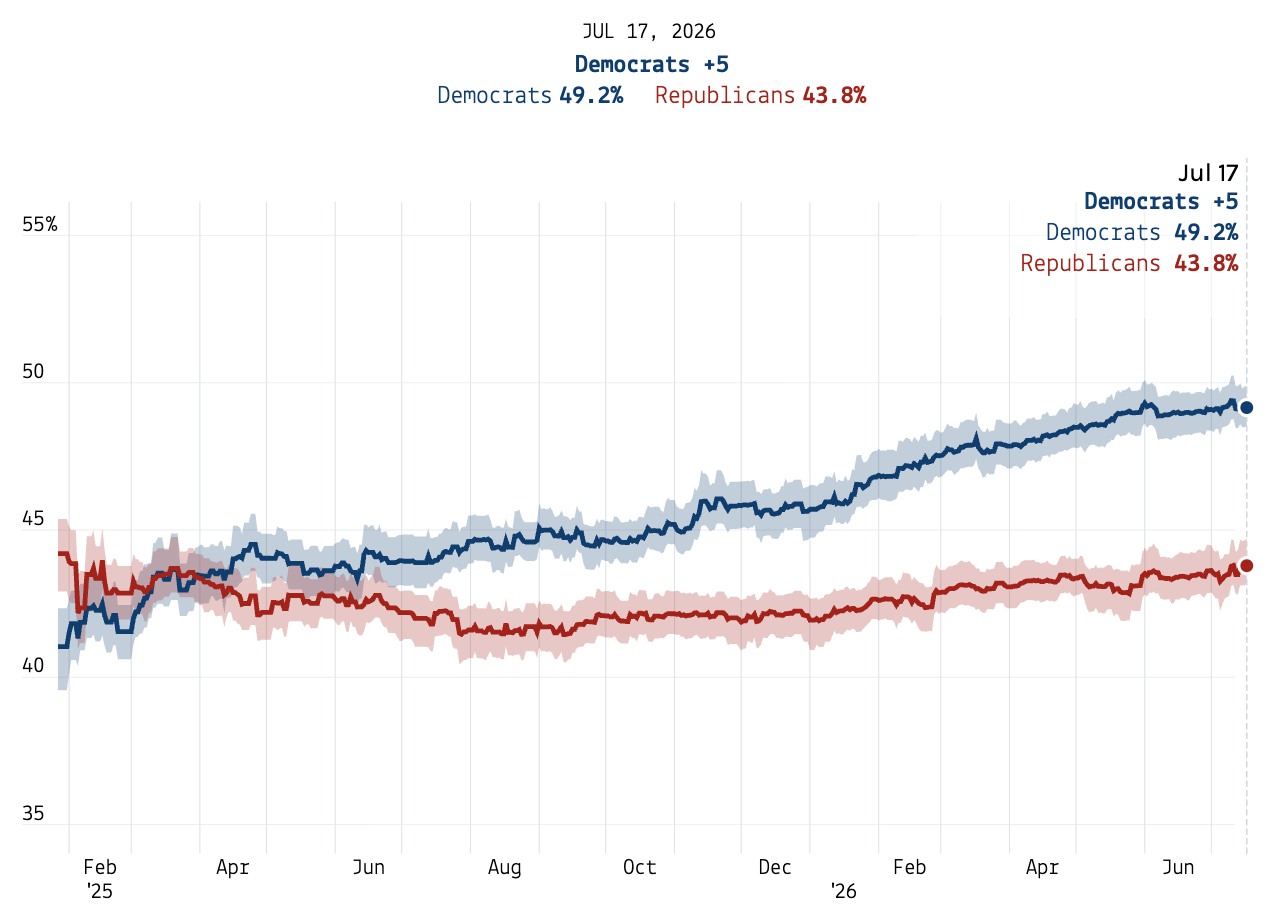
The Democratic margin in the 2026 U.S. House generic ballot rounded up to 5 points this week, down from 6 points last week. The percent of likely voters indicating they will vote for a Democrat stayed mostly the same, going from 49.3 to 49.2 percent this week, but the percent saying they will vote for a Republican slightly increased from 43.5 percent last week to 43.8 percent this week.
Trump’s job approval
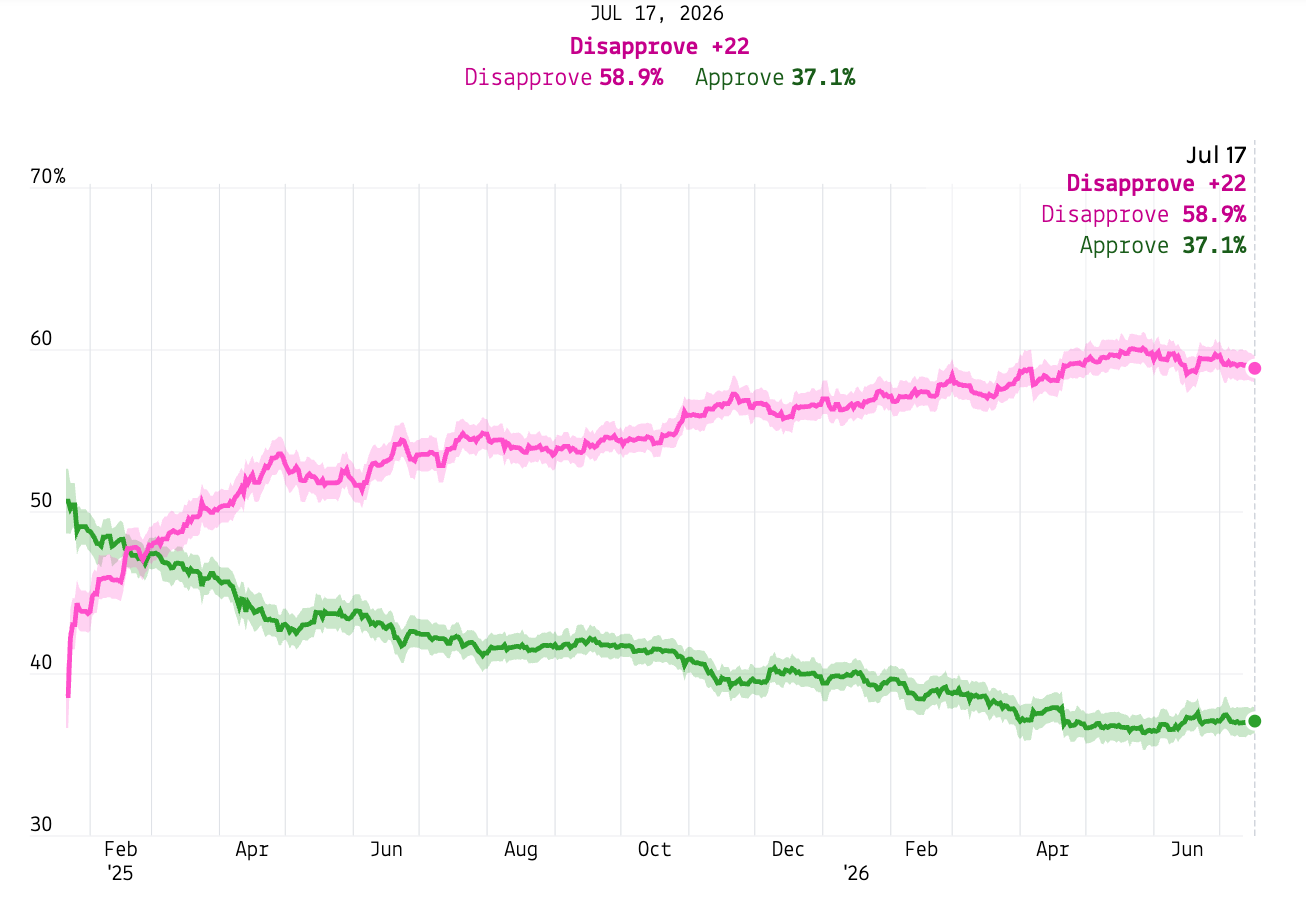
President Trump’s approval rating among U.S. adults remains underwater by 22 points this week, with very little movement compared to last week — the percent of adults who approve of the president remains the same at 37.1 percent, while disapproval has fallen only a tenth of a percentage point.
Paid subscribers to 50+1 get access to premium analysis, plus sortable tables and complete data access on our polling website. If you want to follow the 2026 cycle with the best data at your fingertips, become a paid subscriber.