



Welcome to The Trendline, FiftyPlusOne’s weekly polling roundup. Subscribe to get it delivered straight to your inbox and get bundled access to our polling website.
As the nation gears up to celebrate its 250th birthday, feelings about American identity vary across the country. This week on The Trendline, we check in on how Americans feel about the nation, our shared values, and the upcoming celebrations.
In a Beacon Research/Shaw and Company Research/Fox News poll (May 15 - 18, 2026), Americans were split about America 250. Fifty-one percent of registered voters said they were excited for the 250th anniversary, while 49 percent said they weren’t. Among Republicans, 74 percent said they were excited, but just 35 percent of Democrats and 37 percent of independents agreed.
Partisan divisions go even further than excitement. Asked in an open-ended question to give one word that describes America today, just 27 percent gave a word with positive connotation, like “freedom” or “great,” while 65 percent gave a word with a negative connotation, like “declining” or “divided.” These responses fell along party lines; 85 percent of Democrats chose a word with a negative connotation, while Republicans were slightly more likely to choose a word with a positive connotation (46 percent to 43 percent).
These partisan divisions persist in other polling, too. In a survey from University of Massachusetts/YouGov (Mar. 20 - 25, 2026), Americans were asked to choose one option that best captured what the 250th birthday of our nation means to them. Thirty-seven percent said that the option that best describes the anniversary is “a proud national milestone,” 24 percent said it’s “not something I think much about,” 18 percent said it’s “mostly symbolic and ceremonial,” and 14 percent said it’s a “chance to reflect on our unfinished work.
But underneath these toplines are large partisan differences: a majority, 62 percent, of Republicans said the birthday is a proud national milestone, an opinion shared by just 20 percent of Democrats and 30 percent of independents. Democrats were most likely to say that the birthday is “not something I think much about” (29 percent) or a “chance to reflect on our unfinished work” (25 percent).
When it comes to our founding ideals, Americans are pessimistic about how we’re doing. In a University of Maryland Program for Public Consultation survey (Mar. 11 - 19, 2026), 63 percent of Americans say that the Founders would say our government was doing a poor job fulfilling their vision, an opinion shared by 73 percent of Democrats, 73 percent of independents, and 50 percent of Republicans. Americans don’t believe John Adams’ vision of an American government for “the common good” is being upheld: only 22 percent of respondents said that the government is run for “the benefit of all the people,” while 78 percent thought it was for the benefit of “a few big interests looking out for themselves.”
But the data about America isn’t all doom and gloom. Despite pessimism, particularly among Democrats and independents, about the country today, there’s a lot that unites Americans as well. In the University of Massachusetts/YouGov survey, majorities across the political spectrum said that the “founding ideals of the Declaration of Independence still guide the country in meaningful ways,” including 59 percent overall, 75 percent of Republicans, 52 percent of independents, and 51 percent of Democrats. And in an Ipsos survey (Feb. 25 - Mar. 4, 2026), 76 percent of respondents said that America has succeeded a great deal or a fair amount in “achieving the ideals for which this country was founded,” while just 21 percent said we had succeeded not very much or not at all.
Also in the Ipsos survey, there was broad agreement on many of the foundations of American identity. Asked how important various ideals were to being an American, the top answers were “treating people of all backgrounds equally” (84 percent), “believing in freedom, justice, and equality” (83 percent), voting (70 percent), understanding our founding documents (70 percent) and trying to “get ahead through one’s own efforts” (63 percent). Also notable are the ideals that people don’t think are important to being an American, such as having been born in the country (36 percent), flying the American flag (36 percent) or holding Christian beliefs (38 percent).
While the White House prepares for its America 250 events, including rallies and UFC matches, most Americans disapprove of the White House’s plans. In a YouGov survey (June 5, 2026), just 27 percent approved of holding a UFC fight at the White House as part of its celebrations, while 51 percent disapproved. There’s significant partisan division on the UFC fight: just 10 percent of Democrats and 19 percent of independents approve of the event, while 53 percent of Republicans approve.
Regardless of approval, though, most Americans probably won’t be attending. In an Elon University/YouGov poll (Apr. 30 - May 4, 2026), 41 percent said they would be likely to participate in events related to the 250th anniversary, while 50 percent said they wouldn’t. And Americans prefer to keep things closer to home: 71 percent said smaller, local events would feel more authentic, rather than larger, national events.
Despite feeling that times today are more unstable than average (70 percent said so in the Elon University poll), there’s still some love for America. Sixty-eight percent told the pollster they were proud to be an American, versus 26 percent who weren’t, and 65 percent said there’s no other country on Earth they’d rather live in than the United States today.
Asked who best exemplified American democracy’s highest ideals, more people (20 percent) chose Abraham Lincoln than anybody else. So we’ll let Lincoln himself close out today’s piece: “The struggle of today is not altogether for today; it is for a vast future also. With a reliance on Providence all the more firm and earnest, let us proceed in the great task which events have devolved upon us.”
Other polling nuggets
Opposition to data centers is growing, according to a new survey from Embold Research (May 5 - 10, 2026). Seventy percent of respondents say they oppose data centers being built in their local areas, with 58 percent saying they strongly oppose the developments. In December last year, the pollster found 52 percent opposition, including 36 percent strong opposition. Fifty-nine percent of respondents told the pollster that a new data center in their local area would increase electricity prices a lot, and another 14 percent said it would increase prices some. Just 2 percent thought new data centers would decrease their electricity prices.
Fewer than one in three Americans think that Congress is doing its job, according to a new poll from the McCourtney Institute for Democracy/YouGov (May 19 - 26, 2026). Seventy-one percent said that Congress is doing a not very good or poor job, while 29 percent said it was doing a good or great job. As to the other two branches of government, 37 percent said that President Donald Trump is doing a good or great job, and a slight majority, 51 percent, said the same of the Supreme Court. Opinions on Trump are much stronger than the other branches: more Americans said he was doing a “great” job than either of the other two branches, and likewise more Americans said he was doing a “poor” job than either of the other two branches.
Americans are pessimistic about prices in the near future, according to the latest Marquette Law School poll (May 20 - 26, 2026). Just 13 percent expect inflation to decrease over the next year, while a whopping 71 percent expect it to increase (16 percent say it will stay about the same). This expectation is on top of what the respondents said about how things have been going in the past 6 months already: 85 percent said their grocery bills had gone up in the last 6 months, and 95 percent said the price of gas had increased, including 80 percent who said it had increased “a lot.” Trump’s approval rating in the poll on handling inflation and cost of living is underwater by 56 percentage points, with 22 percent approving and 78 percent disapproving.
In an RMG Research/Napolitan News survey (Jun. 1 - 2, 2026), most Americans favor keeping the clocks the same all year round. Sixty-two percent said they support making Daylight Savings Time permanent, while 22 percent opposed the change. Even after being informed about negative consequences of changing the clocks, such as health risks and increased numbers of car crashes, absolutely nothing changed: 63 percent said they supported permanent DST, while 23 percent opposed it.
Polling averages update
All numbers are as of 11:00 AM Eastern on June 5, 2026.
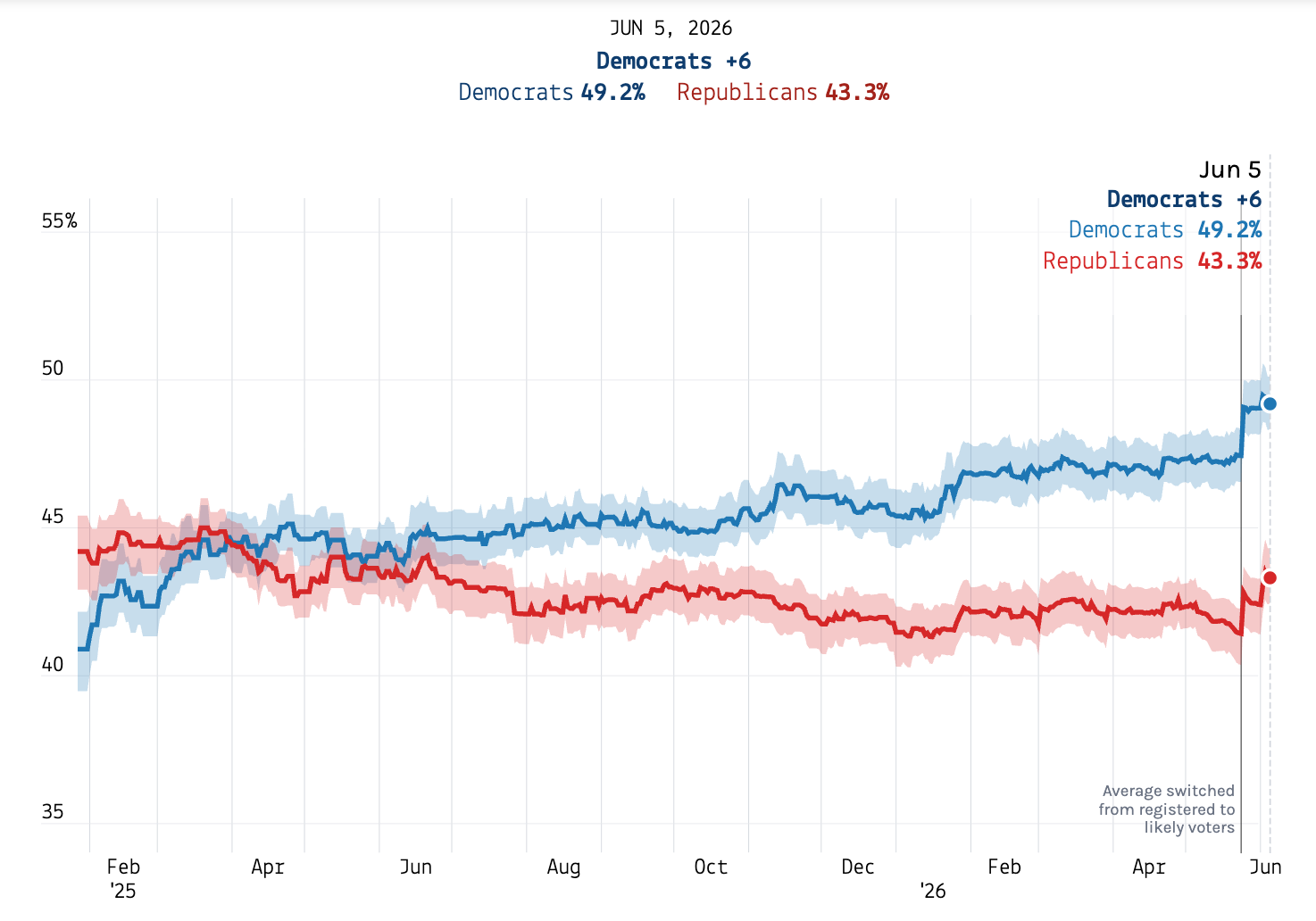
2026 U.S. House generic ballot
The Democratic margin in the 2026 U.S. House generic ballot rounded to 6 points this week, after briefly reaching 7 points last week. At writing, 49.2 percent of likely voters say they’ll cast their ballot for Democrats this fall versus 43.3 percent for the Republicans. The Democratic vote share is more or less the same as last week, while Republicans have increased by nearly a full percentage point.
Trump’s job approval
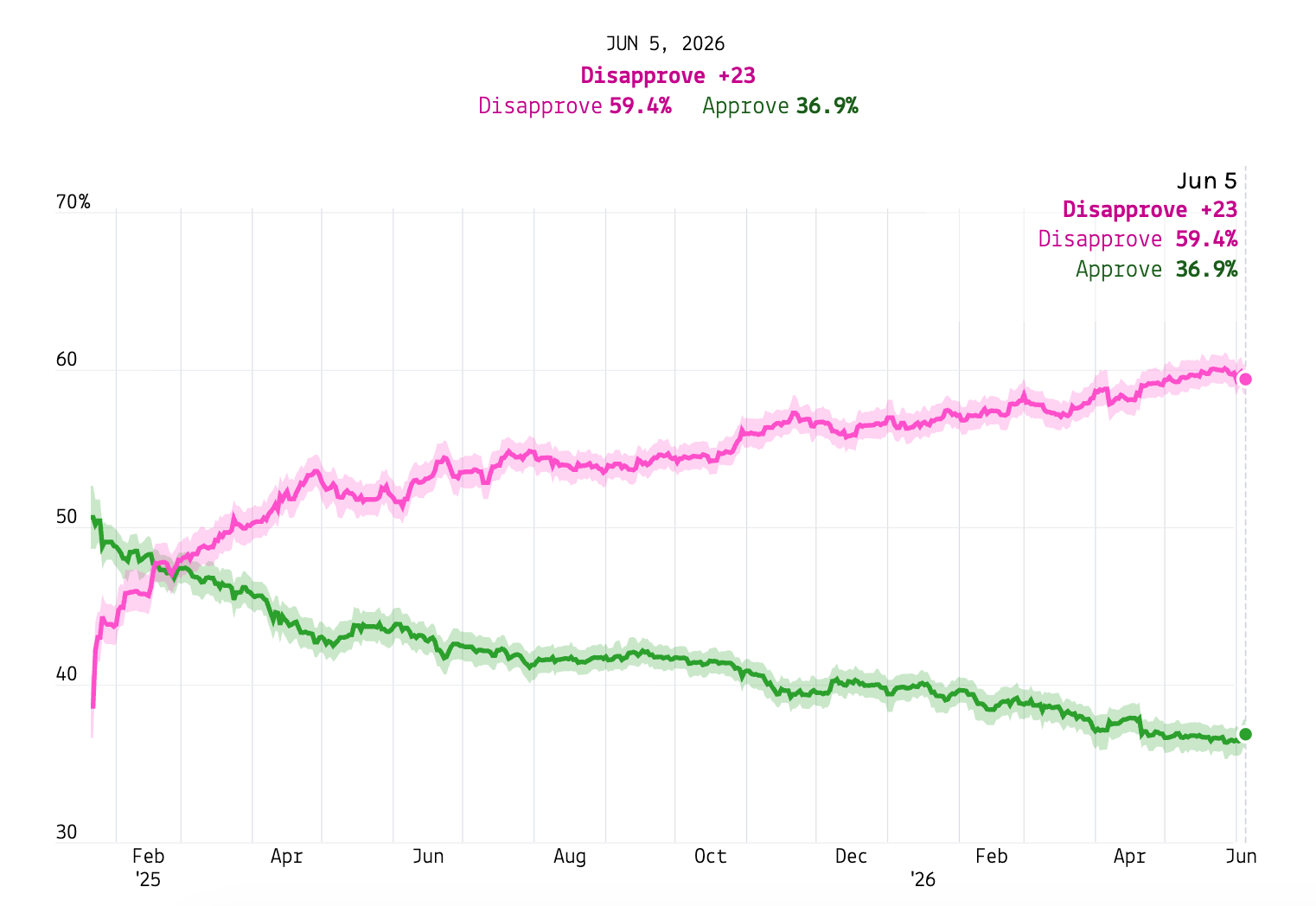
President Trump’s approval rating among U.S. adults has improved slightly from his all-time low last week. An average of 36.9 percent approve of the president this week, while 59.4 percent say they disapprove.
—
Paid subscribers to 50+1 get access to premium analysis, plus sortable tables and complete data access on our polling website. If you want to follow the 2026 cycle with the best data at your fingertips, become a paid subscriber.