



Welcome to The Trendline, the FiftyPlusOne.news weekly polling roundup. Subscribe to get it delivered straight to your inbox and get bundled access to our polling website.
This week, airline traffic in the U.S. was halted for about five hours nationwide, and longer in some locations, due to widespread outages in the air traffic control communications systems. The cause of the problem has been traced back to issues installing a new router, and the Federal Aviation Administration (FAA) will now be shelving that model. Secretary of Transportation Sean Duffy has requested an additional $50 billion in funding to improve air travel infrastructure, though Congress appears skeptical about some details of his request.
Of course, it wouldn’t be America without conspiracy theories floating around that the outage was linked to a hack or other cybersecurity incident. To add to the drama, in what appear to be unrelated incidents, several high-profile companies also experienced technical problems this week, including Microsoft, JPMorgan Chase and other banks, United Airlines, and Apple. To add to the speculation, Secretary of Defense Markwayne Mullin appeared on Fox News on Nov. 16, 2026, and said “one guy that’s very smart with tech… said ‘I believe that it’s the SI.’ … That kind of makes sense to me.” (The Trump administration recently has been referring to artificial intelligence as “SI,” short for “superintelligence.”)
Today on The Trendline, we dig into where Americans stand on all these issues, from cybersecurity, to air travel, to federal spending and everything in between.
(Programming note: we’ll be off next week to enjoy the holiday and spend time with our loved ones. Hopefully you’ll be doing the same!)
When it comes to air travel generally, delays aren’t really passengers’ biggest concerns. According to an Ipsos/Reuters poll (May 8 - 10, 2026) that asked how concerned people were about a variety of air travel-related issues, 56 percent said they were extremely or very concerned about airlines increasing costs, which rose to 62 percent among those who had ever traveled by plane in the past. Fifty percent also said they were concerned about airlines increasing baggage fees. Travel delays came in third place, with 44 percent saying they were extremely or very concerned about the issue.
That’s not to say that people aren’t worried about issues related to air traffic control and delays, of course. Coincidentally, just prior to the FAA outages this week, YouGov ran a survey (Nov. 8 - 10, 2026) about Americans’ experiences with air travel. In that poll, when asked whether a variety of issues were a major problem, minor problem, or not a problem at all, high prices again topped the list of major problems, with 63 percent saying so, but air traffic control staffing shortages was the next highest issue at 47 percent.
And if you consider the total number of respondents who named each issue as either a major or minor problem, costs still top the list at 79 percent, but flight delays and cancellations come in second place at 74 percent (air traffic control staffing issues fall to fifth, at 65 percent).
At a personal level, both before and after the incident this week, Duffy remains relatively unknown. The YouGov survey conducted before the outage found his approval rating underwater by 6 percentage points, 24 to 30, but 46 percent of respondents weren’t sure. In a separate YouGov poll conducted just after the outages (Nov. 16, 2026), those numbers hadn’t shifted all that much; Duffy was still underwater by 8 points, 26 to 34, but 41 percent of respondents still weren’t sure about the secretary. And when it comes to his proposal for increased funding, he likely has the public on his side.
In an Ipsos/Chicago Council on Global Affairs survey (July 10 - 21, 2026), when asked whether various programs should be expanded, cut back, or kept the same, spending on public infrastructure had the third highest support for expansion, at 65 percent, below only healthcare (72 percent) and education (71 percent). The question wording explicitly named airports as among the sort of public infrastructure included.
When it comes to the FAA specifically, Americans also believe the agency likely needs to be expanded. In a survey from Echelon Insights (Apr. 24 -28, 2026), 40 percent said the FAA had too few employees, compared to 31 percent who said it had too many or about the right number (the rest either hadn’t heard of the agency or were unsure). A similar 41 percent said the TSA had too few employees, while 37 percent it had too many or about the right number. Both of these agencies had far more respondents saying there were too few employees than the other national security-related agencies the pollster asked about.
As to Duffy’s specific request for $50 billion, Americans seem to be in favor. In the YouGov poll conducted after the outages this week, 54 percent of respondents said they supported the spending, while just 21 percent were opposed. Support was strongest among Republicans, with 68 percent in favor and just 10 percent opposed, but it was favored by Democrats (45 to 30) and independents (48 to 25) as well.
On the other hand, as a general rule, Americans believe increased spending should come with pay-fors; for example, in a Bullfinch Group/Independent Center poll (Oct. 1 - 6, 2026), 62 percent said that they supported a policy that “any new government program be paid for, either by raising the money or cutting elsewhere,” compared to 17 percent opposed. It’s not clear in Duffy’s request to Congress where the funds would come from.
When it comes to the technology upgrades involved in this incident, Americans are skeptical. Asked about the use of artificial intelligence in the air traffic control space, just 16 percent of the respondents to the Nov. 16 YouGov poll said that using AI to help with air traffic control would make flight delays less common. Twenty-nine percent actually thought the use of the technology would make flight delays more common, while 16 percent said it would make no difference and 39 percent were unsure.
As to the whole cybersecurity of it all, it appears Americans are a bit confused about what exactly happened. In another YouGov poll conducted this week after the outage (Nov. 18, 2026), 18 percent of Americans said that the outages impacting the nation were mainly caused by technical problems, almost the same as the 16 percent who said they were caused by cyberattacks. Another 36 percent said they were caused by a mix of both factors. And it may be outside of the government’s power to control the narrative: 62 percent told the pollster that if there was a major cyberattack in the U.S., the government would likely keep it secret, while just 15 percent believed the government would share the information with the public.
In general, Americans are very worried about cybersecurity. Eighty-four percent of respondents to a Change Research poll (Apr. 3 - 7, 2026) said they were very or somewhat concerned about cyberattacks on the United States from foreign adversaries, with just 14 percent not too concerned or not concerned at all. But voters don’t think this is all on the federal government: 60 percent said that both the government and private companies have primary responsibility for protecting Americans from large-scale cyberattacks, while just 22 percent thought the responsibility lay with the government alone. And that may be at the heart of the anxiety among the public right now. In the Nov. 18 YouGov poll, just 29 percent of Americans were confident in the ability of major companies to prevent cyberattacks, while 62 percent were not.
Paid subscribers to 50+1 get access to premium analysis, plus sortable tables and complete data access on our polling website. If you want to follow the 2028 cycle with the best data at your fingertips, become a paid subscriber.
Other Polling Nuggets
On Thursday, the Senate passed the Bipartisan American Affordability and Jobs Act of 2026, also known as BAAJA, which would streamline the environmental permitting and energy transmission line construction process. Senate Democrats were divided between those who touted the potential for the vast increases in clean energy capacity the bill could bring and those who framed it as a gift to the AI and fossil fuel industries. The American public seems largely out of touch with the bill, despite its potential to dramatically reshape everything from energy production, to transportation, to housing. In a recent Data for Progress poll (Nov. 13 - 15, 2026), just 30 percent of likely voters had heard anything at all about BAAJA. And among those respondents, 37 percent thought the primary impact of the bill would be to expand job training and apprenticeship programs, while another 21 percent thought the primary purpose was to cut taxes. Just 18 percent of those who had heard about the bill correctly said it would make it easier to approve energy and infrastructure projects. While the bill itself is quite technical, voters do seem to support the core concept, at least in the abstract. In a poll by the Rainey Center (Nov. 8 - 12, 2026), 67 percent of likely voters said they would support legislation that would “streamline the process for permitting new energy development,” though specifics about BAAJA were not given.
With new Democratic trifectas in multiple states next year, many will be watching to see whether the National Popular Vote Interstate Compact finally passes in enough states to go into effect. The compact would, if ratified by states comprising at least 270 electoral votes, award all participating states’ electoral votes to the winner of the national popular vote (though there would certainly be legal challenges to the compact). Americans have long been solidly in favor of electing the president via popular vote rather than through the Electoral College. But voters appear a bit more skeptical about the specific mechanics of the NPVIC. In an RMG Research poll for the Napolitan News Service (Nov. 16, 2026), 53 percent of registered voters said that the candidate who received the most votes in their state should also receive that states’ electoral votes, even if a different candidate won the national popular vote. And when the poll asked respondents straight up whether they favored or opposed their state signing an agreement to “give all of their electoral votes to the presidential candidate who wins the overall popular vote nationwide, regardless of whether that candidate won in that state,” just 36 percent were in favor, while 44 percent were opposed and 20 percent weren’t sure.
Senate Democrats are in the midst of a leadership battle, with Maryland Sen. Chris Van Hollen announcing last week that he would challenge Minority Leader Chuck Schumer for the top spot in the chamber in January. While the election is entirely among Democratic senators, Ipsos and the University of Maryland recently asked voters (Nov. 13 - 15, 2026) whom they preferred to become Senate Majority Leader. A large plurality of voters overall and of Democrats said they didn’t know, but among those who had an opinion, Van Hollen led Schumer by a comfortable margin. Thirty-two percent of Democrats preferred the Maryland senator, while only 13 percent supported Schumer. Schumer has said he has enough votes to remain the Democratic leader, but the election isn’t until December and it’s a secret ballot, so the race isn’t over quite yet.
After this year’s midterm sweep, views of the Democratic Party across the country appear to be improving. While still underwater, an average of 43 percent of Americans now have a favorable view of the party, compared to 41 percent on Election Day and just 37 percent at the start of Trump’s second term. Fifty-one percent view the party unfavorably, 2 points lower than on Election Day. Favorable views of the Republican Party have declined during Trump’s term, falling from a net favorability rating of -7 when Trump took office to -18 today.
Happy Thanksgiving to those who celebrate it! Despite its reputation as a source of fiery family disagreements, 83 percent of Americans who celebrate the holiday said they don’t expect their Thanksgiving dinner to feature arguments about politics, according to new polling from YouGov (Nov. 8 - 10, 2026). That’s despite 37 percent saying they do expect to at least discuss politics at the dinner table. When asked which foods Americans plan to eat for the holiday, turkey and mashed potatoes predictably came in first and second, while Brussels sprouts finished last, with just 13 percent of adults expecting it to be part of their Thanksgiving meal. Surprisingly (at least to Cooper), only 37 percent of Americans expected to eat macaroni and cheese for Thanksgiving, but that result varies widely by demographic group. For example, 73 percent of Black Americans said they planned to eat mac and cheese at Thanksgiving, while only 31 percent of white respondents and 39 percent of Hispanic Americans said the same. And the younger a respondent was, the more likely they were to expect mac and cheese for the holiday: 52 percent of those aged 18-29 said they did, but just 18 percent of those aged 65+ said they expect to have mac and cheese on their Thanksgiving table. Seven-year-old Cooper (who had a mac and cheese-themed birthday party) would be appalled.
Polling averages update
All numbers are as of 12:00 PM Eastern on Nov. 20, 2026.
Trump’s job approval
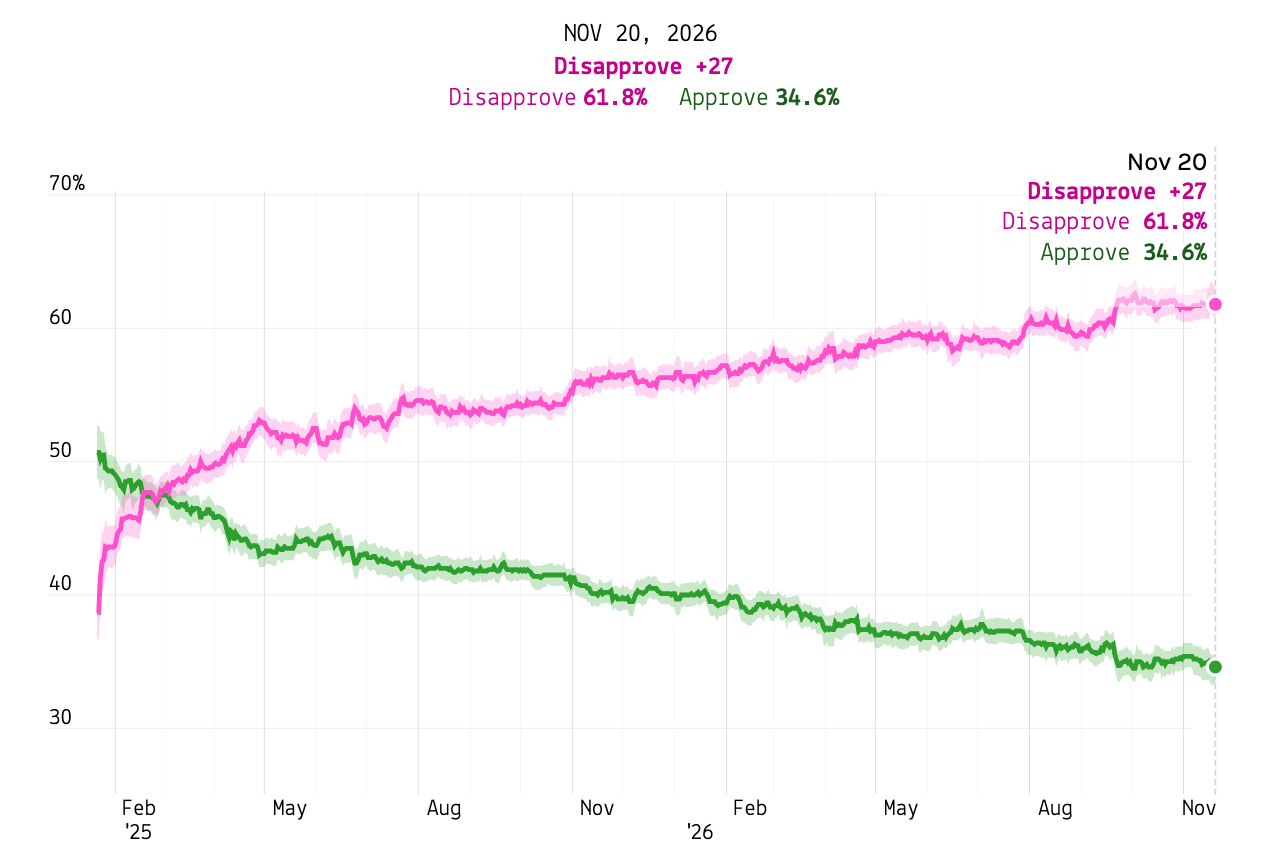
President Trump’s net approval rating among U.S. adults didn’t change much this week. The president’s approval rating is currently underwater by 27 percentage points, with 61.8 percent of Americans disapproving and 34.6 percent approving.
Paid subscribers to 50+1 get access to premium analysis, plus sortable tables and complete data access on our polling website. If you want to follow the 2028 cycle with the best data at your fingertips, become a paid subscriber.